Conveyors Play Key Role in Assembly of Batteries for Electric Vehicles
Modular conveyors provide the flexibility to create a variety of layouts when assembling prismatic multicell battery modules.
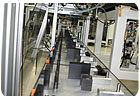
In battery manufacturing, the only constant is change: new designs, new production techniques, new automation approaches, and radical fluctuations in demand.
The challenge for assembly system designers is to create specialized approaches for varying methods of stacking cells, connecting tabs and packaging modules, while also keeping in mind that the needs of today will not necessarily be the needs of tomorrow.
A key element for meeting this challenge are precision conveyors built from structural aluminum framing. These modular conveyors make it easier to both create and alter assembly lines, allowing manufacturers to expand production, add automation, balance workflow, and blend manual and automated assembly techniques. These conveyors provide the flexibility to create a variety of layouts, particularly for assembling prismatic multicell battery modules.
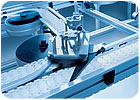
To handle the diversity of assembly processes, Edgewater often turns to modular, pallet-based assembly conveyors, such as TSplus conveyors from Bosch Rexroth Corp. These conveyors are the backbone of many of Edgewater’s battery assembly systems, because they increase line productivity while reducing the potential for damage to the product. Fixturing the product to the pallet makes it easier to control the assembly processes and to add components in a controlled manner.
These conveyors provide a range of options for routing, handling and positioning battery components. For example, cushioned stops are ideal for handling sensitive components.
Pallet-based conveyors also support a variety of automatic identification technologies for process control and tracking. For example, radio-frequency identification tags can be placed on each pallet to exchange information with scanners at each workstation. This makes it easy for operators and floor managers to track the flow of parts, subassemblies and finished products, even if parts are diverted to multiple or redundant workstations. Workers have real-time information about where each pallet is at any time.
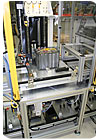
With a wide range of options for routing, handling and stopping parts, modular conveyors let us design an overall system that maximizes throughput and flexibility. Typically, a central conveyor is used to circulate the battery as it’s assembled. From this main line, the battery can be routed onto “cycle-independent” spur lines on which automated or manual processes can occur (or both).
The use of multiple, redundant workstations for some of the slower or more intricate processes helps balance production across the entire system. For example, multiple tabs can be welded quickly at multiple workstations via cycle-independent conveyor loops that move subassemblies through the workstations, and then transfer them back onto the main line. Doing this prevents a slow process from interfering with the overall production cycle time requirements.
Cycle-independent loops can accommodate a variety of different assembly approaches or handle multiple steps simultaneously. By using a “building block” approach to create an assembly area, it’s easy for battery manufacturers to step up production without overtaxing any of the workstations or risking damage to product.
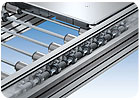
SCARA or six-axis robots perform most assembly tasks. The conveyor and the robotic assembly processes are both controlled by dedicated hardware and software. VarioFlow conveyors are compatible with most standard motion control software systems, as well as Rexroth’s own proprietary electric drive and control and human-machine interface products.
Like pallet-transfer conveyors, modular chain conveyors provide a wide range of modules and components, so automated parts feeding and material handling technologies can be added easily to a large battery assembly system. This allows Edgewater to create reconfigurable systems that are optimized to the needs of each customer, and it helps customers keep pace with changes in demand and assembly techniques.
Chain conveyors are typically used for light-duty processes in battery assembly, such as transporting lithium-ion cell components a few inches square, but they are capable of handling considerable weight and product sizes. Chains are available with tensile strengths of 1,250 newtons.
These durable systems are also fast. The belts can travel 60 feet per minute in some applications. In addition, they can handle sharp curves in both the horizontal and vertical planes to conserve valuable floor space. High-performance, variable-speed drives allow for maximum efficiency in operation and can save thousands of dollars in energy costs.
In the world of hybrid and electric vehicles, for example, lack of manufacturing agility could make it difficult to remain competitive if new and better battery technologies emerge. Modular assembly systems make it easy to adapt to these changes, even if the pace of change is dramatic. Because of their built-in flexibility, these conveyors inspire innovation rather than limit it. Battery manufacturers using modular technologies know they can reconfigure, add to or expand their system to handle whatever advances they can dream up-without having to scrap the entire system and start over from scratch.
The modular approach helps manufacturers respond to change with nimbler, leaner processes. That reduces the cost of ownership by minimizing the cost of change, and provides a solid foundation for growth. Experience has shown that modular assembly systems can be rapidly expanded, even where space is limited, because designers have the flexibility to add conveyors and workstations in a variety of physical orientations and configurations.
In battery manufacturing, the only constant is change: new designs, new production techniques, new automation approaches, and radical fluctuations in demand.
The challenge for assembly system designers is to create specialized approaches for varying methods of stacking cells, connecting tabs and packaging modules, while also keeping in mind that the needs of today will not necessarily be the needs of tomorrow.
A key element for meeting this challenge are precision conveyors built from structural aluminum framing. These modular conveyors make it easier to both create and alter assembly lines, allowing manufacturers to expand production, add automation, balance workflow, and blend manual and automated assembly techniques. These conveyors provide the flexibility to create a variety of layouts, particularly for assembling prismatic multicell battery modules.
Pallet-Based Conveyors
The emergence of hybrid and plug-in electric vehicles may well be the most dramatic shift in the transportation equipment industry since the Model T. This new generation of cars, trucks and buses require large, heavy batteries that are assembled step-by-step from a wide range of components, some of which are sensitive and require gentle handling. Process steps include cell stacking, tab joining, functional testing, framing and casing, and charging.To handle the diversity of assembly processes, Edgewater often turns to modular, pallet-based assembly conveyors, such as TSplus conveyors from Bosch Rexroth Corp. These conveyors are the backbone of many of Edgewater’s battery assembly systems, because they increase line productivity while reducing the potential for damage to the product. Fixturing the product to the pallet makes it easier to control the assembly processes and to add components in a controlled manner.
These conveyors provide a range of options for routing, handling and positioning battery components. For example, cushioned stops are ideal for handling sensitive components.
Pallet-based conveyors also support a variety of automatic identification technologies for process control and tracking. For example, radio-frequency identification tags can be placed on each pallet to exchange information with scanners at each workstation. This makes it easy for operators and floor managers to track the flow of parts, subassemblies and finished products, even if parts are diverted to multiple or redundant workstations. Workers have real-time information about where each pallet is at any time.
Automated and Manual Operations
One of the biggest challenges in building battery assembly systems is the need to combine manual and automated processes on a single line. A line for building battery packs can incorporate fully automatic workstations for welding tabs, as well as manual workstations where two parts are mounted using a screwdriver.With a wide range of options for routing, handling and stopping parts, modular conveyors let us design an overall system that maximizes throughput and flexibility. Typically, a central conveyor is used to circulate the battery as it’s assembled. From this main line, the battery can be routed onto “cycle-independent” spur lines on which automated or manual processes can occur (or both).
The use of multiple, redundant workstations for some of the slower or more intricate processes helps balance production across the entire system. For example, multiple tabs can be welded quickly at multiple workstations via cycle-independent conveyor loops that move subassemblies through the workstations, and then transfer them back onto the main line. Doing this prevents a slow process from interfering with the overall production cycle time requirements.
Cycle-independent loops can accommodate a variety of different assembly approaches or handle multiple steps simultaneously. By using a “building block” approach to create an assembly area, it’s easy for battery manufacturers to step up production without overtaxing any of the workstations or risking damage to product.
Flexible Chain Conveyors
In some assembly areas, delicate components, such as lithium-ion wafers, may benefit from automated parts supply. In these circumstances, Edgewater often uses a modular chain conveyor, such as Rexroth’s VarioFlow, to transfer components smoothly and consistently into automated assembly equipment.SCARA or six-axis robots perform most assembly tasks. The conveyor and the robotic assembly processes are both controlled by dedicated hardware and software. VarioFlow conveyors are compatible with most standard motion control software systems, as well as Rexroth’s own proprietary electric drive and control and human-machine interface products.
Like pallet-transfer conveyors, modular chain conveyors provide a wide range of modules and components, so automated parts feeding and material handling technologies can be added easily to a large battery assembly system. This allows Edgewater to create reconfigurable systems that are optimized to the needs of each customer, and it helps customers keep pace with changes in demand and assembly techniques.
Chain conveyors are typically used for light-duty processes in battery assembly, such as transporting lithium-ion cell components a few inches square, but they are capable of handling considerable weight and product sizes. Chains are available with tensile strengths of 1,250 newtons.
These durable systems are also fast. The belts can travel 60 feet per minute in some applications. In addition, they can handle sharp curves in both the horizontal and vertical planes to conserve valuable floor space. High-performance, variable-speed drives allow for maximum efficiency in operation and can save thousands of dollars in energy costs.
Keeping Up With the Future
The biggest advantage of the modular assembly line approach to battery production lies not just in keeping up with what is happening today, but in the ability to anticipate the needs of tomorrow. Changes in environmental regulations, consumer demand, fabrication techniques and battery technology call for technology that goes beyond traditional assembly processes.In the world of hybrid and electric vehicles, for example, lack of manufacturing agility could make it difficult to remain competitive if new and better battery technologies emerge. Modular assembly systems make it easy to adapt to these changes, even if the pace of change is dramatic. Because of their built-in flexibility, these conveyors inspire innovation rather than limit it. Battery manufacturers using modular technologies know they can reconfigure, add to or expand their system to handle whatever advances they can dream up-without having to scrap the entire system and start over from scratch.
The modular approach helps manufacturers respond to change with nimbler, leaner processes. That reduces the cost of ownership by minimizing the cost of change, and provides a solid foundation for growth. Experience has shown that modular assembly systems can be rapidly expanded, even where space is limited, because designers have the flexibility to add conveyors and workstations in a variety of physical orientations and configurations.
ASSEMBLY ONLINE
For more information on conveyors and automated assembly, visit www.assemblymag.com to read these articles:
Looking for a reprint of this article?
From high-res PDFs to custom plaques, order your copy today!


