Assembly Magazine logo
search
Ask ASSEMBLY AI
cart
facebook twitter linkedin youtube
  • Sign In
  • Create Account
  • Sign Out
  • My Account
Assembly Magazine logo
  • TRENDS
    • Ask ASSEMBLY AI
    • Trends
    • News
    • New Products
  • INDUSTRIES
    • Aerospace
    • Appliance
    • DFMA Assembly
    • Medical Devices
    • Green Manufacturing
    • Lean Manufacturing
    • Machinery Assembly
    • Electronics Assembly
    • Automotive
  • TECHNOLOGIES
    • Adhesives & Dispensing
    • Assembly Presses
    • Automated Assembly Systems
    • Manufacturing Management
    • Manufacturing Software
    • Motion Control
    • Screwdriving & Riveting
    • Robotics
    • Test & Inspection
    • Plastics & Metal Welding
    • Wire Processing
    • Workstations
  • AUTONOMOUS & ELECTRIC MOBILITY
    • AEM Magazine Archives
    • Autonomy
    • Electrification
    • Mobility Services
    • Assembly & Testing
    • AV/EM News
  • MEDIA
    • Ask ASSEMBLY AI
    • Podcasts
    • Assembly News Now
    • Assembly TV
    • Webinars
    • eBooks
  • EVENTS
    • Calendar
    • The ASSEMBLY Show
  • MORE
    • Exclusives >
      • Plant of the Year
      • Capital Spending
    • Buyers Guide >
      • Supplier Insights
    • Classifieds
    • Featured Products
    • Newsletters
    • Store
    • White Papers
    • Columns
    • Sponsor Insights
  • INFOCENTER
    • Assembly & Test Solutions
  • EMAGAZINE
    • eMagazine
    • Archive Issues
    • Advertise
    • Contact Us
    • Sign Up
Columns

Fastening Threads: Even If It Ain't Broke, Make It Cheaper

By David Archer
December 22, 2010
Reducing cost requires action with potential risk, whose objective is often viewed as compromise. However, the need for constantly improving product value is not going to go away. Here are three ways to address cost reduction.


There’s always some peril in making recommendations about how to reduce cost. The maxim, “Even if it ain’t broke, make it cheaper,” is more difficult to implement than its more famous cousin.

Reducing cost requires action with potential risk, whose objective is often viewed as compromise. However, the need for constantly improving product value is not going to go away, nor should it.

Based on our testing experience, here are three ways to address cost reduction, in decreasing order of expected benefit.

Question the Most Fundamental Assumptions. The best way to cut assembly costs is to eliminate a joint. If a joint does not require its components to move relative to one another, or exists because components of fundamentally different material properties are required, the joint is a candidate for elimination.

While further investigation might reveal the presence of that joint can lower total product cost, improve performance or ease maintenance, the need for the added complexity and failure potential inherent in any joint should always be questioned.

When the need for a joint has been established, too often, that joint is designed as a bolted joint without consideration of other methods. Threaded fasteners do two things well, and when a joint requires both those characteristics, a bolted joint is hard to beat.

First is the ability to generate tremendous clamp load in a small and inexpensive package. Second, this high-strength joint can be separated and reassembled without loss of capability or the need for rework. When only one of these needs is required of an application, there are often other fastening methods that will be competitive. When neither is present, a bolted joint is rarely the most cost-effective choice.

Rethink Tool Selection. The cost of fastening tools is the sum of the initial investment, maintenance cost and their influence on assembly cost. High-mix, low-volume assembly applications, or assemblies where the tool location varies, often utilize hand tools, because power tools are viewed as too cumbersome, too complex or too expensive.

Recent battery, motor, control and wireless communication developments have left few applications where a hand tool is more cost-effective than a power tool. State-of-the-art fastening tools can get to all but the most restricted locations, drive a fastener more quickly with better torque selection and accuracy, and report the outcome of each rundown. Potential cost savings is greatest for manufacturers that use a separate torque wrench after manual rundown.

Transducerized DC-electric nutrunners capable of multistep tightening strategies are commonly used by high-volume manufacturers. These tools can sense joint yield, cross-threading and thread stripping, and save the data for each rundown. These tools can also increase the flexibility of how a fastener is tightened to increase quality and joint understanding. But, these advantages can only be gained if the tool’s capabilities are utilized.

In our experience, the only feature employed by assemblers is slowing the spindle before the target torque is reached. All error windows are left wide open, so no troublesome red lights get lit and run data is not analyzed.

When this happens, an expensive tool is arguably no more effective or accurate than a traditional clutched air tool. Engineers should select assembly tools based on an honest assessment of how they will be used, not how they could be used.

Maximize Bolt Potential. The capacity of a significant percentage of joints we have tested is limited by the shear strength of the threads or the compressive strength of the joint members, rather than the bolt’s tensile strength. That is, the failure mode is thread-strip or joint-member yielding, and not bolt fracture.

Bolt fracture is a preferred failure mode, because it means the maximum clamp load possible for that design could be utilized. All else being equal, this leads to minimized cost. An additional benefit is the joint is easier to troubleshoot when problems arise, and is less able to be compromised by overtightening.

The goal of maximizing bolt potential would seem to imply that to minimize cost, the highest commercially available grade of fastener should always be used. However, that’s not always the case. When joint materials and geometry (often available thread engagement) prevent failure by bolt fracture, reducing the grade of fastener used may reduce cost without reducing joint capacity.

Products that must move, be carried or be as small as possible will tend to utilize high-strength fasteners, because increasing weight or volume carries a cost penalty. But, in other industries, such as construction, midgrade fasteners are often most cost-effective and are more forgiving of installation and environmental conditions. A

Archetype Joint specializes in joint design, testing and validation. Dave Archer can be contacted at darcher@archetypejoint.com

Share This Story

Looking for a reprint of this article?
From high-res PDFs to custom plaques, order your copy today!

President
Archetype Joint LLC, Orion, MI

Archetype joint specializes in joint design, testing and validation.

Recommended Content

JOIN TODAY
To unlock your recommendations.

Already have an account? Sign In

  • Made in the U.S.A.

    Consumer Products Manufacturing: Made in the USA

    Supply chain lessons learned during the coronavirus...
    Automated Assembly Systems
    By: Austin Weber
  • Best Practices for Press-Fit Assembly

    Best Practices for Press-Fit Assembly

    In manufacturing, ironclad formulas for success are hard...
    Assembly Presses
    By: Jim Camillo
  • aem0523leader-tesla1.jpg

    Tesla Rethinks the Assembly Line

    Engineers at Tesla Inc. have developed a new process that...
    Automotive Assembly
    By: Austin Weber
Manage My Account
  • eMagazine Subscription
  • Assembly Newsletters
  • Online Registration
  • Subscription Customer Service
  • Manage My Preferences

More Videos

Sponsored Content

Sponsored Content is a special paid section where industry companies provide high quality, objective, non-commercial content around topics of interest to the ASSEMBLY audience. All Sponsored Content is supplied by the advertising company and any opinions expressed in this article are those of the author and not necessarily reflect the views of ASSEMBLY or its parent company, BNP Media. Interested in participating in our Sponsored Content section? Contact your local rep!

close
  • ultrasonic welding
    Sponsored bySonobond Ultrasonics

    Engineering Efficiency in High-Performance Assembly: How Ultrasonic Welding Enhances Throughput, Reliability and Quality

  • UV curing system
    Sponsored byDymax

    Why UV Intensity Alone Doesn’t Define Curing Performance

  • wooden pallets
    Sponsored byLEAN Manufacturing Products

    Eliminating Waste on the Shop Floor: Applying Lean Principles to Improve Manufacturing Efficiency

Popular Stories

ASSEMBLY News Now, episode-30: Volvo Redesigns EV Manufacturing

Volvo Redesigns EV Manufacturing

Boeing CEO Kelly Ortberg announces 1 billion investment

Boeing Plans $1 Billion Wichita Investment, Workforce Training Center

GE Appliances Worker on Line

GE Appliances Expands Factory AI With 800 Gemini Enterprise Agents

Watch the latest episode of ANN now!

Events

July 24, 2025

From Shop Floor to CFO: How Manufacturers Are Closing the Loop Between Operations and Finance

On Demand Learn how manufacturers are bridging the gap between the shop floor and ERP systems to gain real-time visibility, streamline operations, and kick-start digital transformation—without waiting years.

Sponsored by:

PicoStratusGreen
July 30, 2025

Buffer Analysis and Design Fundamentals for Manufacturing Excellence

On Demand In this presentation, Dr. Herman Tang shares practical insights from his industry experience and research on buffer management in manufacturing operations.

View All Submit An Event

Poll

Difficult Assembly Processes

Which assembly process gives you the most difficulty?
View Results Poll Archive

Products

Manufacturing Cost Policy Deployment (MCPD) Profitability Scenarios: Systematic and Systemic Improvement of Manufacturing Costs

Manufacturing Cost Policy Deployment (MCPD) Profitability Scenarios: Systematic and Systemic Improvement of Manufacturing Costs

See More Products
Register for webinar - Modernizing Automotive Assembly: Why Upgrading Legacy MES is a Business Imperative

Related Articles

  • Fastening Threads: It all Starts With Joint Design

    See More
  • Fastening Threads: Better, Cheaper, Faster

    See More
  • Fastening Threads: Dissecting the Nut Factor

    See More

Related Products

See More Products
  • history.jpg

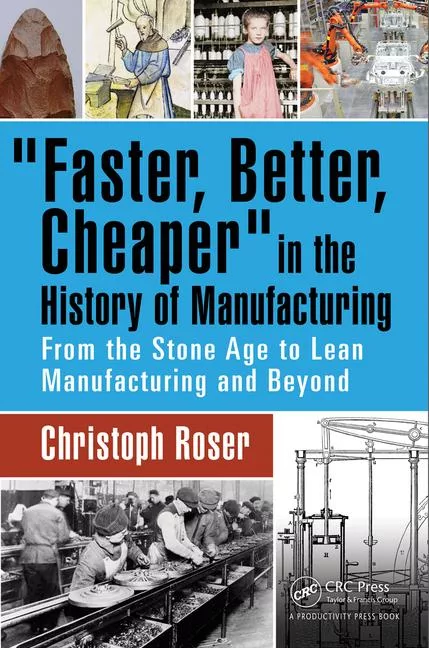
    Faster, Better, Cheaper in the History of Manufacturing: From the Stone Age to Lean Manufacturing and Beyond

  • leaner

    Leaner Manufacturing: How to Make the Lean Production Process Easier, Faster, and More Cost-Effective

See More Products

Events

View AllSubmit An Event
  • August 20, 2025

    K.I.S.S. MES (Keep It Simple, Stupid): Why Modern Manufacturers Are Choosing Modular MES with Real Shop Floor Control

    On Demand If you’re tired of MES that overpromises and underdelivers, it’s time to simplify. Learn how a modular approach gives you control where it counts—without the baggage.Sponsored by:
  • June 12, 2025

    From Manual Data to ISO 9001 in 6 Months: How Lithos Energy Did It

    On Demand How does a fast-growing battery manufacturer move beyond paper travelers to a digital ecosystem that drives better quality, real-time traceability, and faster audits?Sponsored by:
View AllSubmit An Event
×

Never miss the latest news and trends driving the manufacturing industry

Stay in the know on the latest assembly trends.

JOIN TODAY!
  • RESOURCES
    • Advertise
    • Contact Us
    • Directories
    • Manufacturing Division
    • Store
    • Want More?
  • SIGN UP TODAY
    • Create Account
    • eMagazine
    • Newsletters
    • Customer Service
    • Manage Preferences
  • SERVICES
    • Marketing Services
    • Reprints
    • Market Research
    • List Rental
    • Survey/Respondent Access
  • STAY CONNECTED
    • LinkedIn
    • Facebook
    • Instagram
    • YouTube
    • X (Twitter)
  • PRIVACY
    • PRIVACY POLICY
    • TERMS & CONDITIONS
    • DO NOT SELL MY PERSONAL INFORMATION
    • PRIVACY REQUEST
    • ACCESSIBILITY

Copyright ©2026. All Rights Reserved BNP Media, Inc. and BNP Media II, LLC.

Design, CMS, Hosting & Web Development :: ePublishing