Lean Plant Layout
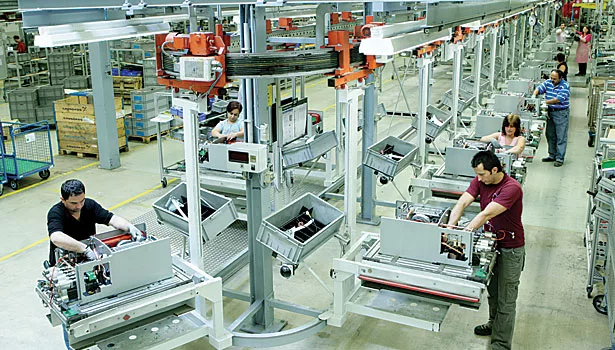
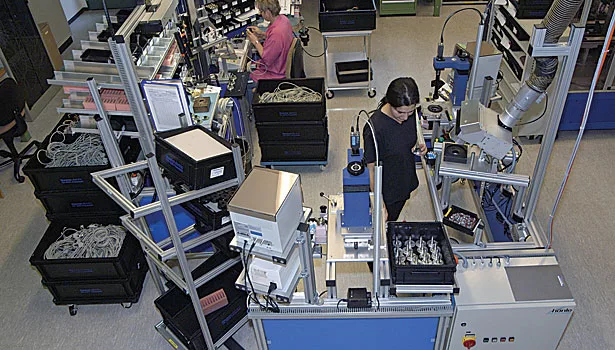
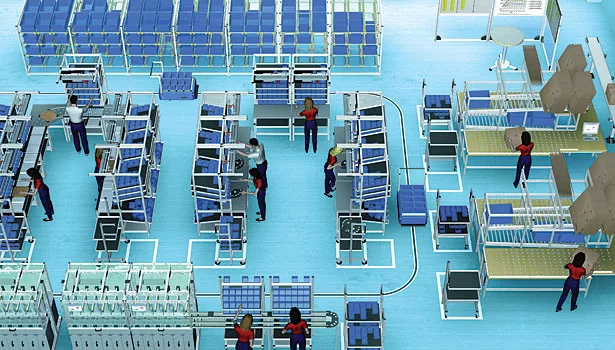
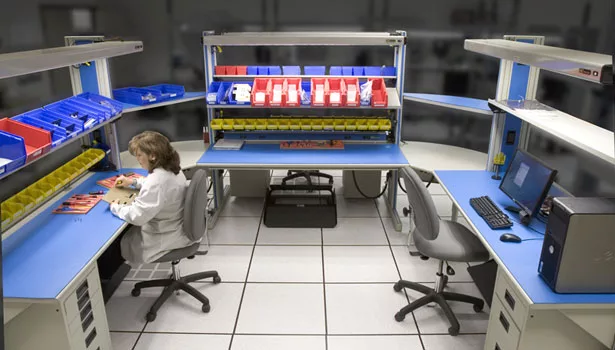
Plant floor design is the key to an efficient production environment. However, when laying out a new plant, changing the layout of an existing facility or adding a new assembly line, many engineers underestimate how many factors to consider.
They only focus on equipment or material flow, instead of designing factories around lean principles, such as jidoka, kaizen and kanban. People, workstations, parts bins and equipment should be arranged to optimize flow, minimize waste and boost productivity.
Assembly lines come in many shapes and sizes. For instance, linear layouts are typically used by automakers, but cellular assembly lines are common at Tier 1 suppliers.
“A line layout in the face of uncertain demand vs. certain demand would have different characteristics,” says Art Smalley, president of the Art of Lean Inc. and a former Toyota Motor Corp. engineer. “A high-volume line vs. a low-volume line will look somewhat different. A line layout in a high wage country will be different than one in a lower wage country.”
Assembly lines have changed dramatically in recent years due to just-in-time delivery, parts sequencing, kitting and other processes that reduce line-side inventories.
Traditionally, plant layout focused more on process-based departments as the core work organization unit. “Work was done in batches to optimize around economic order quantities by department,” says Matt Zayko, an associate at the Lean Transformations Group. “Lean layout starts with the fact that customers order products that cut horizontally across these different vertical silos and departments or value streams.
“Customers want products on-time, with short lead-times and first-time quality, so batch thinking and process-based departments are counterproductive to these goals,” adds Zayko. “Lean layout designs need to support short, simple flows across facilities, from fabrication through final assembly.”
A key difference between traditional and lean plant layout is that in a lean environment, there is very little room for waste and when there is waste, it becomes visible. “For example, space between machines is minimal to prevent inventory from building up, as well as to reduce motion and conveyance,” says Sammy Obara, president of Honsha Associates. “Another characteristic is that the layout allows material to flow consistently with the help of a material handler.”
Traditional plant layouts follow a functional flow. Work centers tend to be grouped into departments, responsible for a certain process, with similar machines. Then, materials are moved between processes in erratic flows, with high levels of work-in-process inventory and long lead times. Such arrangements require 30 percent to 50 percent more physical space than a lean layout to accommodate inventory storage, material handling routes and equipment.
With a lean layout, work centers tend to be grouped by product families or groups of products that share common process routings. This type of layout enables smaller batch and run sizes. It requires less in-process inventory, less material handling due to shorter travel distances, and less physical space.
“The traditional layout is effective at manufacturing a wide variety of products with very different process routings and varying demand levels,” says Don Penkala, president of Granite Bay Global. “The downside is huge inventories of raw material, in-process and finished goods, long lead times, substandard quality, slow process improvement and high cost.”
Numerous Challenges
Laying out a plant floor using lean principles can be a daunting task. One of the biggest challenges confronting engineers is deciding which products will fit into the lean layout and which products must be produced using traditional methods.
“A common misconception is that all products can and should be produced according to lean and one-piece flow principles,” warns Penkala. “Typically, the demand profiles of some products will fit into a lean production strategy, while others will not.
“A particularly challenging situation is one in which there are many hundreds of products with little commonality in process routings,” Penkala points out. “Lean principles can still apply, but it takes some planning to figure out how to segment products into the appropriate families. [Engineers must] decide which families can be flowed, which must use a combination of batch and flow, and which must be run traditionally. In such situations, cells may have to be created that allow for customized, variable demand products and multidirectional flow.”
“In some cases, sorting out a large number of products and variations into compatible families for workcells can be a challenge,” adds Quarterman Lee, president of Strategos Inc. “Sometimes the family groups are quite obvious and easy to identify. But, the psychological challenge of breaking up functional departments and redeploying them as product-focused areas is always [an issue].
“In some cases, the necessity to empower workers and change supervision styles is a major challenge,” says Lee. “Providing equipment to individual workcells may also be a challenge when large-scale equipment has previously been the norm.”
Any lean layout should remain flexible. As continuous improvement occurs, it may be necessary to rearrange the equipment, even slightly, to achieve the new standard. To facilitate this, most experts recommended putting equipment on casters for easy movement.
“Another challenge is how to communicate and define the lean layout to the organization,” says Kurt Greissinger, industry manager for assembly and handling at Bosch Rexroth Corp. “Visual systems help reinforce the behaviors that you are trying to instill in the employees, but they must also be flexible to move with changes in the layout. By using adhesive floor markings instead of paint, it is significantly easier and cheaper to accommodate and communicate change.”
Sometimes, manufacturers rely heavily on large assets that are efficient on a per-unit basis, but inhibit material flow through the plant. These “monuments” are often too large to be easily moved.
The lean philosophy has methods for dealing with this situation, such as sourcing modular equipment or starting the flow process at a downstream work center. “But, these added challenges cause some to [shy] away from lean,” says Penkala. “The best equipment for a lean layout can be easily disconnected from utilities and transferred as production needs dictate changes in cell design.”
Monuments tend to be large pieces of equipment that are shared among various product lines. Paint lines are a good example.
“Often, companies will invest a lot of money into a single paint system that must service many different product lines,” notes Drew Locher, managing director of Change Management Associates. “In such cases, flow will often stop as parts converge from different areas on the shared resource. Such systems are often designed for the continuous flow of parts through washing, painting and curing stations that are all integrated into a single system.”
Other monuments are more batch-oriented, such as heat treating equipment. Typically, parts are loaded into an oven and the heat treating cycle is started. The parts are then removed en masse at the end of the cycle. Those processes are counterproductive to continuous flow.
“These challenges can sometimes be overcome by the purchase of smaller equipment dedicated to each product line, or the purchase of more flow-friendly technology,” explains Locher. “However, sometimes it is not possible, or it’s cost prohibitive. In such cases, engineers must work around these impediments to continuous flow. In a lean operation, that means the application of pull systems to control the flow of materials before and after these monuments.”
Sometimes, engineers must confront an imbalance of different processes. For instance, one process may go faster than another.
“It is not enough to just have the physical layout of operations in such a way to promote flow,” warns Locher. “The processes must be balanced to each other, and ultimately to the demand rate or takt time. This is not as difficult to overcome. Typically, it is possible to slow down a process by some means to achieve the desired balance.
“However, this may seem odd to the traditional production manager or associate who has always tried to go as fast as possible,” Locher points out. “Balance is often overlooked when developing a layout. The result is a layout that looks like it has been designed for flow, but is not performing as such when in operation.”
People vs. Products
When changing a layout, engineers should expect to encounter plenty of problems, resistance and a transition phase as assemblers adapt to new ways.
“A vital step to prepare for layout changes is to train all involved in core lean skills, such as standardized work, kaizen and PDCA (Plan-Do-Check-Act),” says Obara, who spent three years studying lean manufacturing principles in Toyota City, Japan, and another 10 years applying it at Toyota plants in Brazil, Venezuela and the United States. “Without these skills, operators will complain instead of solving problems, procedures will not be sustained, and continuous improvement will not take place.”
When laying out a new assembly line, engineers can start with people, workstations or equipment. But, there’s no one-size-fits-all answer. Many factors must be carefully considered.
“All the planning in the world with respect to workstation layout and equipment can go wasted if assemblers don’t have the necessary tools to do their jobs productively,” argues David Verrill, applications support manager at IAC Industries Inc. “The guy putting things together can always tell you what can make it easier for him to do his job. That needs to be considered as part of the [overall] plan.
“Every manufacturer has different needs,” Verrill points out. “In the workstation industry, we’re seeing an increased focus on accessories that aid [assemblers]. Presentation of parts and tools are particularly important in saving wasted steps.”
According to Kevin Duggan, president of Duggan Associates, there’s no better place to start than with the customer. He suggests asking questions such as: What does your customer value? How does your customer order? “Understand what the output of the operation has to be before laying out an assembly line,” says Duggan.
“It’s important to distinguish between static design, which is associated with traditional layout, and dynamic design,” adds Duggan. “Lean layouts should focus on optimizing the dynamic design using value stream flow.”
Because lean is customer-focused, some experts believe the best place to start a layout conversion is with the plant’s products. “In lean, everything is driven by customer demand, so it is crucial to look at the products you’re offering and their demand profiles,” claims Penkala. “By looking at commonalities in process routings, you’ll be able to identify the best candidates for starting a lean initiative and determining how to lay out equipment and arrange workstations to achieve optimum flow.”
Web Exclusives
You Can't Beat a Good Old Mockup
9 Line Layout Mistakes to Avoid
Are Cellular Layouts Always Best?
Looking for quick answers on assembly and manufacturing topics? Try Ask ASM, our new smart AI search tool. Ask ASM
Looking for a reprint of this article?
From high-res PDFs to custom plaques, order your copy today!