Implementing 5S in Assembly Plants
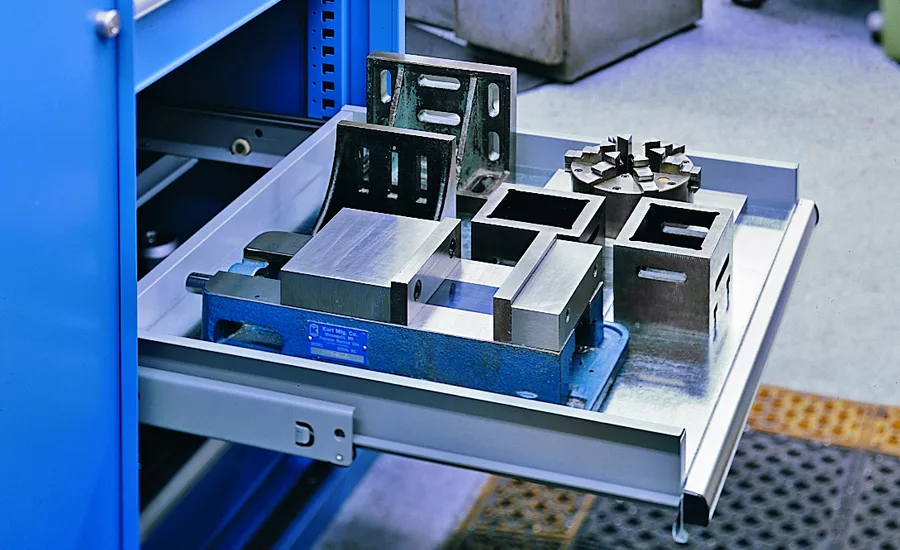
Photo courtesy Lista
5S is a system to reduce waste and optimize productivity by maintaining an orderly workplace and providing visual cues to assemblers. The term refers to five steps—sort, set in order, shine, standardize and sustain—which are also known as the five pillars of a visual workplace.
“A place for everything, and everything in its place” is the mantra of 5S. Well-designed storage and workspace systems improve organization and maximize use of space. Benefits include raising quality, lowering costs, promoting safety, building customer confidence, increasing uptime, and lowering repair costs.
The concept is especially attractive for older assembly plants, where parts and equipment tend to pile up over the years and getting organized is often a lower priority than getting product out the door.
Implementing 5S typically results in significant reductions in the space needed for existing operations. Tools and materials are organized into labeled and color-coded storage locations, as well as kits that contain just what is needed to perform a task.
5S also supports other manufacturing improvements, such as just-in-time production, cellular manufacturing, total quality management and Six Sigma. It’s also a great way to make the plant floor a better a better work environment.
The Five Pillars
Implementing 5S means cleaning up and organizing the workplace. It is typically the first lean method that organizations implement. The methodology encourages assemblers to improve their working conditions and helps them to reduce waste, downtime and in-process inventory.
The first S—sort—requires assemblers to remove all items not needed for current production operations. Only the bare essentials should be left. When in doubt, throw it out.
An assembly station that’s crowded with unnecessary stuff is hard to work in. Assemblers waste time searching for parts and tools. Unneeded inventory and machinery are costly to maintain and hide production problems. They also make it harder to improve flow.
The next S—set in order—means to arrange items so they are easy to use. Items should be labeled so anyone can easily find them or put them away. This saves time and energy spent looking for things.
The third S—shine—involves keeping everything neat and clean every day. The workplace should be turned into a clean, bright place where everyone will enjoy working. Tools and equipment should be kept in working order so they’re ready to be used when needed.
A sloppy workplace is inefficient and unsafe. Morale is poor, and defects are less obvious. Machines that do not receive sufficient maintenance tend to break down and cause defects.
The remaining steps—standardize and sustain—are aimed at maintaining the benefits provided by the first three. 5S should be the plant’s standard operating procedure. It is not a one-and-done methodology. To be effective, 5S must become part of the daily routine of an assembly plant.
5S is implemented in a three-step process. The first step is to assess the current state of the plant. Management should establish a cross-functional implementation team, including employees who work in the areas targeted for improvement. The team should tour those areas and brainstorm on ways to improve organization and reduce waste. A wide range of ideas should be considered. Although every idea won’t be viable, all are worthy of investigation.
Time wasted searching for things is a prime target for improvement. It’s not unusual for a three-hour changeover routine to include 30 minutes of searching. To radically reduce changeover time, there is clearly no room for 30 minutes of searching waste.
Value-stream mapping can be used in the 5S process to analyze material, process and information flows. This map is critical for identifying opportunities for workplace organization and housekeeping improvements. The goal is to eliminate processes that don’t add value and support processes that do.
Based on their observations, the team can envision a future state and begin implementing it. The process is iterative. The future state becomes the current state, and assemblers should be encouraged to continuously identify new ways to reduce waste.
Waste is broadly defined and includes excess movement of material, excess inventory, defects and rework, searching, waiting, and unnecessary motion. Waste could be time spent needlessly searching for a part, a tool or the key to a cabinet. Waste could be accidently including a defective part in a shipment of good parts because a workstation is disorganized. Waste could even be a box of supplies innocently left in a walkway, causing someone to trip and get injured.
The 5S team might observe workers walking long distances to obtain parts or spending time reaching into bins on shelves to find parts. Or the team might discover that hardware, such as fasteners, needed to assemble a particular product is stored in a central location, far away from the point of use. The value-stream map helps to identify what operators really need vs. what they receive.
The Role of Storage
The overarching goal of 5S is to eliminate waste, including time wasted searching for items, waste due to difficulty in using items, and waste due to difficulty in returning items. Storage equipment plays an important part in eliminating this waste through space reduction, organization improvement and inventory management. Storage cabinets and workbenches that allow dense storage, a smaller footprint, and visual organization near where the tool is needed are a key factor in implementing 5S.
Systems should be set up so everything is available when needed. This applies to the assembly line, the packaging area, and the maintenance department. Everything should be labeled and identified. Local storage minimizes travel time. Adjustable storage and workbenches make it easier to adapt to the differing needs of individual employees.
Storage walls organized with bar-coded handles can reduce wasted time due to lost inventory and searching. Such systems also facilitate quick tool changes for different product lines. Storing tools next to their machines, rather than in multiple locations around the facility can save hours each day.
Modular drawer storage cabinets maximize use of cubic space for the highest density storage. These units are ideal for high-density storage of parts, tools and items of virtually any size and type. Scalable to adapt to future requirements, these cabinets can carry a lot of weight. The best ones provide ergonomic access to the contents and enable engineers to organize drawers to their specific needs.
Don’t know where to start? Lista International assists companies in implementing 5S as part of a lean manufacturing program. Our products can help your company eliminate waste through space reduction, organization improvement and inventory management.
Looking for quick answers on assembly and manufacturing topics? Try Ask ASM, our new smart AI search tool. Ask ASM
Looking for a reprint of this article?
From high-res PDFs to custom plaques, order your copy today!