Handheld Crimping Tools
Hand tools are ideal for prototyping, repair and small production runs.
A fully automatic stripping and crimping system might be the “glamour” technology of wire harness assembly shops. However, there’s still plenty of work for handheld electric, pneumatic and manually powered crimping tools.
Hand tools are typically used for prototyping, repair and small production runs. They’re used on workbenches for high-mix, low-volume applications, such as military aerospace electronics. But, hand crimping tools are also widely used for field-service applications in the telecommunications industry, such as repairing telephone cables in a junction box.
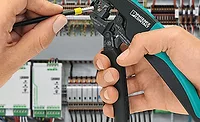
Panel builders tend to use a mix of handheld and automated crimping equipment. They usually prepare leads in a wire harness shop with automated equipment, but make the actual connection within the panel using handheld tools, due to space constraints.
“There’s still a big need for this type of product,” says Abby Robey, vice president of sales and marketing at Xuron Corp. “Handheld crimp tools are often used to secure components to a PCB before soldering. The tools cut the lead wire and then flatten it so that it does not fall back through the hole.”
“Handheld, pliers-style crimping tools are typically used when fewer than 20 connections each day are needed,” adds Chad Smith, director of product management at Thomas & Betts Corp. “For more, we recommend ratchet-style, hand-crimping tools.”
Hand tools are ideal when the working space is tight, and also where there are only a few connections to be made. “When there are many crimps required, automated equipment is recommended,” notes Smith. “Handheld crimping tools tend to be used on wire gauge in the 22 to 10 AWG range.
“With larger wire gauges, the force required to make the proper crimp is difficult to achieve,” explains Smith. “There are larger manual crimping tools available for these sizes, but due to their size, they are not considered handheld.”
Looking for quick answers on assembly and manufacturing topics? Try Ask ASM, our new smart AI search tool. Ask ASM
Tool Options
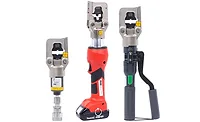
Several different types of handheld crimp tools are available, including manual, battery-powered and pneumatic versions. The most basic option is a pliers-style tool, which often comes in different sizes to accommodate different types of connectors, crimp configurations and shapes.
For example, tools are available for insulated connectors, noninsulated connectors and various size ranges. Some tools include cutters, while others do not. In addition to pliers-style tools, ratchet-type crimpers cover a range of sizes and materials.
Electric and battery-powered tools are usually used when there are many crimps being made or assemblers are working with larger cables and connectors. “When installing smaller wire terminals, battery-powered tools are frequently used, but pliers- or ratchet-style handheld tools are much more common,” says Smith. “With larger connectors, battery-powered tools are more commonly used, since they are able to accommodate a wider range of connectors and wire gauges.
“However, due to the cost, you still tend to see manual and hydraulic hand-operated tools used in the field with these larger connectors,” adds Smith. “Battery-powered tools become more popular when many crimps are being made in a day, as well as in cases when safety is a top priority.”
Pneumatic tools require no operator hand force to terminate and the air tool is generally faster than a hand- or battery-powered crimper. “Terminating wires is virtually effortless with a pneumatic crimp tool,” claims Bob Grenke, application tooling global product manager at Molex Inc. “Replacing manual crimpers with hands-free air-power tools maximizes production and increases production flexibility in manufacturing.
“Production rates can be as high as 600 terminations per hour, depending on the application and operator experience,” claims Grenke. “With an interchangeable crimp-head and die-set design, additional applied cost savings can be achieved.”
No matter what type of tool is used, engineers should ensure that the crimping tool used is matched to the connector and wire size, with optimum tensile strength, mechanical stability and electrical conductivity
“It’s important not to look at the tool alone,” says Smith. “End users need to think of the tool, connector and wire as a system of components working together to make a proper termination. [Ideally, the] tool and connector should be from the same manufacturer to ensure a UL-listed termination.”
“More often than not, the authorized crimping tool and accessories are not called out on the drawing for the wire harness, so the selection of the assembly tooling is often left to the manufacturing engineering staff,” adds Dave Kelly, standards and industry liaison at Daniels Manufacturing Corp. “There is nothing wrong with that [scenario]. But, throughout our industry, many of the engineers who had the experience and the knowledge to manage the complexity of matching the best assembly tooling to the endless combinations of terminals, splices, contacts and connectors are retiring. They’re handing that responsibility to the next generation.
“[We are closely] involved in the teaching process and coaching our customers through the tool selection process,” notes Kelly, who serves as chairman of SAE AE-8C2 Standards Committee and Military Preparing Activity on Terminating Devices and Tooling. “We see an opportunity to help many next-generation engineers through the learning curve.”
Ergonomic Considerations
Ergonomics plays a crucial role in selecting handheld crimping tools. That’s because cumulative trauma disorders or repetitive stress injuries can result from prolonged use of manually powered hand tools.
“Due to the emphasis on ergonomics and employee health issues relating to repetitive stress injuries in recent years, there are lighter and more powerful handheld crimping tools on the market,” Kelly points out. “Some producers of wire harnesses are converting their high production shops to those crimpers, but many are lagging behind in that area.”
Crimping tools are more complex than just wire cutters. “Leverage is important, because you exert force at the head,” says Kellie Coble, manager of applications engineering at Pressmaster Inc. “Linkage design inside the tools is also critical.
“Mechanical advantage and ergonomic design of the crimp tool play a significant role in allowing [operators] to make a consistent and reliable connection,” adds Coble. Key elements include grip size and shape, load distribution and jaw opening.
According to Coble, the optimum guideline is grip span width relative to the hand position in the power grip. “The power grip of the hand combines the fingers formed on one side of the [tool] with the palm on the opposite side of the [tool], and produces the greatest amount of force,” claims Coble.
The mechanical advantage of a hand tool is the ratio of the force applied by the tool at the point of work to the force or effort applied on the handle or grip. “The ratio of force is inversely proportional to the distances from the pivot or fulcrum,” says Coble.
The full crimp cycle ratchet mechanism is another design element that engineers should consider. “For a specific connector and wire combination, it is necessary to achieve a consistent and controlled compression ratio that will provide optimum mechanical and electrical performance,” Coble points out. “[Crimp tools should feature] a full-cycle ratchet mechanism that will not release the connector until the optimum compression is obtained.”
Another important consideration is the jaw opening angle and height of the crimp tool. “Although connectors are universal in size and function, the variety of hand tools proclaiming to be ‘universal’ have wide variations, and may provide variable crimp results,” warns Coble.
“The jaw opening should be wide enough to allow easy access and installation of the connector into the applicable crimp nest,” says Coble. “This is particularly important for those applications on a conveyor assembly line, mounted at arm’s length, or in confined areas where access to the dies is not easily achievable.”
Looking for a reprint of this article?
From high-res PDFs to custom plaques, order your copy today!