New Technology for Welding Aluminum
To meet federally mandated fuel economy standards, automakers must dramatically reduce vehicle weight. As a result, engineers are using more and more aluminum for body panels, engine components and structural parts.
Aluminum use in vehicles is expected to double by 2025, as automakers roll out a wide variety of lighter weight models. In fact, Alcoa and Novelis recently invested $1 billion in their U.S. plants to mass-produce aluminum sheet for the automotive industry. The material offers many advantages over steel. For instance, one kilogram of aluminum can replace two kilograms of steel.
Aluminum is corrosion-resistant and offers an excellent blend of strength and low mass that can help improve fuel economy. Vehicles made with aluminum components can also accelerate faster and brake quicker than their heavier counterparts.
Technology Trickles Down
Traditionally, the auto industry has reserved use of aluminum for high-end vehicles, such as the Audi A8, the Jaguar XJR and the Tesla Model S. But, the technology is starting to trickle down to more conventional vehicles, such as sedans and trucks.
One of the stars of last month’s North American International Auto Show in Detroit was Ford’s new F-150 pickup. It boasts an all-aluminum body, including the doors, hood, side panels, load bed and tailgate, that shaves 700 pounds off the truck.
The F-150 is the first high-volume vehicle to use large amounts of aluminum. Ford assembles as many units of its popular pickup in a month as all other aluminum-bodied vehicles combined sell annually. The aluminum body is joined with structural adhesive and 4,000 rivets vs. 7,000 spot welds on a traditional steel pickup.
While aluminum continues to make inroads into the auto industry, steel is not about to fade away. It will continue to be an important material in Detroit for decades. In fact, Ford engineers increased their use of high-strength steel in the new F-150 frame from 23 percent to 77 percent to improve stiffness and durability, while reducing weight.
Looking for quick answers on assembly and manufacturing topics? Try Ask ASM, our new smart AI search tool. Ask ASM
Traditionally, aluminum vehicles have been assembled with structural adhesives and rivets. Because higher production volumes hinder adhesive use, automakers have relied on self-piercing rivets to join aluminum body parts.
However, rivets add cost, and riveting guns have a limited range of joint configurations. And, while this approach can be used to join lower-strength steels with aluminum, it isn’t suitable for joining aluminum to ultra-high-strength steel.
New Joining Methods
Automakers and part suppliers are focusing on new ways to join aluminum with tools and technology other than traditional resistance spot welding, which is prone to variability. Engineers at Honda Motor Co. recently developed a new, continuous process for joining aluminum and steel using friction stir welding.
The technology generates a stable metallic bond between steel and aluminum sheets by moving a rotating tool on the top of the aluminum, which is lapped over the steel with high pressure. As a result, the welding strength is superior to traditional metal inert gas (MIG) welding.
“This new technology contributes to an improvement in fuel economy by reducing body weight by 25 percent compared to a conventional steel subframe,” claims Ron Lietzke, a Honda spokesman. “In addition, electricity consumption during the welding process is reduced by approximately 50 percent.”
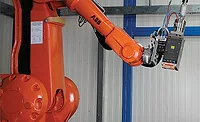
The Honda engineers also developed a new way to apply the welding technology to mass-production vehicles, such as the Accord sedan. Traditionally, friction stir welding requires large equipment, but the new continuous welding system relies on a six-axis robot. In addition, Honda developed a nondestructive inspection system using a highly-sensitive infrared camera and laser beam, which enables inline inspection for every unit.
General Motors engineers have also been experimenting with new ways to weld aluminum. Their resistance spot welding process uses a patented multi-ring domed electrode that does what smooth electrodes are unreliable at doing—welding aluminum to aluminum. By using this process, GM expects to eliminate nearly two pounds of rivets from aluminum body parts, such as hoods, lift gates and doors.
“The ability to weld aluminum body structures and closures in such a robust fashion [gives us] a unique manufacturing advantage,” claims Jon Lauckner, GM chief technology officer and vice president of global R&D.
“This new technology solves the long-standing problem of spot welding aluminum, which is how all manufacturers have welded steel parts together for decades,” adds Lauckner. “It will grow in importance as we increase the use of aluminum in our cars, trucks and crossovers over the next several years.”
Spot welding uses two opposing electrode pincers to compress and fuse pieces of metal together, using an electrical current to create intense heat to form a weld. The process is inexpensive, fast and reliable, but until now, not robust for use on aluminum in today’s manufacturing environment.
According to Lauckner, GM’s new resistance spot welding process works on sheet, extruded and cast aluminum, because the multi-ring domed electrode head disrupts the oxide on aluminum’s surface to enable a stronger weld.
GM already uses the assembly process on the hood of the Cadillac CTS-V, and the lift gate of the Chevrolet Tahoe and GMC Yukon. Aluminum welding also plays a key role in the new Chevrolet Corvette Stingray. In fact, GM invested more than $50 million to upgrade the body shop of its Bowling Green Assembly Plant.
“The new welding process enables us to make the frame lighter and stiffer,” says Dave Tatman, plant manager. “It is 99 pounds lighter and is 57 percent stiffer than the previous-generation frame, resulting in a chassis so strong that the convertible model needs no structural reinforcements.”
It’s also the most complex frame design in the Corvette’s history, featuring main rails composed of five customized aluminum segments, including aluminum extrusions at each end, a center main rail section and hollow-cast nodes at the suspension interface points, all with varied thicknesses.
According to Blair Carlson, GM manufacturing systems research lab group manager, aluminum resistance spot welding is an efficient method for joining aluminum to aluminum where there is two-sided joint access. “It is particularly effective with the thicker materials—up to 4 millimeters—used on the new frame,” he points out.
The process is used in the Corvette’s aluminum structure tunnel subassembly and in mainline attachments of various components. It’s also used for welding aluminum extrusions, die castings and aluminum sheet metal. There are 439 aluminum resistance spot welds on the Corvette Stingray coupe.
Laser welding is used in the frame’s tunnel subassembly to attach sheet aluminum closeout panels to the tunnel structure. “The process enables continuous welding quickly when only single-sided access is available,” says Carlson. There are two robotic laser welding stations in the Bowling Green plant—one with a pair of robots and another with a single robot.
A team of engineers at Brigham Young University recently developed a new way to create an extremely strong bond between aluminum and ultra-high-strength steel. The friction-bit joining process uses a small, consumable bit to create a solid-state joint. It can join lightweight aluminum with cast iron by inserting a thin layer of steel between the two metals, which facilitates bonding.
“Our process can help to combine steels and light metals in the same vehicle frame, which gives engineers more flexibility in designing an optimal structure,” claims Michael Miles, a manufacturing engineering technology professor who developed the process with MegaStir Technologies and Oak Ridge National Laboratory.
Friction-bit joining applications include areas of a vehicle frame where ultra-high-strength steel needs to be joined to a light metal. “For example, an automaker may want to use aluminum for the roof of a car while using ultra-high-strength steel for the A and B pillars of the frame that connect with the roof,” says Miles. “Another example includes the incorporation of lighter-weight metals on the interior parts of the car door.”
Looking for a reprint of this article?
From high-res PDFs to custom plaques, order your copy today!