Heat-Shrink Assembly
Power train manufacturing has become more complex in recent years.
For one, flexibility has become paramount. Often, a diverse range of camshafts or gear shafts of complex geometry must be produced at the same location in varying batch sizes.
Additionally, the physical demands on power train components are increasing. Automakers are increasingly using high-tensile materials. Part geometries are becoming more complex, and components are becoming smaller and more lightweight.
Finally, composite, or multipiece, camshafts are becoming more popular. Compared with one-piece camshafts, which are typically cast or forged, composite camshafts are lighter and offer more flexibility in terms of layout. They also give engineers options for making further structural alterations or using different material combinations. New cam geometries, such as negative radii, can easily be accommodated. Additionally, less manufacturing effort is necessary with regard to machining and plastic deformation.
Composite camshafts also make producing variants easier. Cams, gears and other parts can be made in larger quantities and then joined to the shaft later depending on that day’s production requirements. This reduces manufacturing costs while maintaining a high degree of precision.
The only problem is joining the parts to the shaft. One way to do that is with heat-shrink assembly.
As every high-school student learns in physics class, a metal part expands when heated and contracts to its original size when it cools. Heat-shrink assembly takes advantage of this phenomenon to create a strong interference fit between two mating parts that otherwise could not be accomplished by simply forcing them together with an ordinary press-fit.
Looking for quick answers on assembly and manufacturing topics? Try Ask ASM, our new smart AI search tool. Ask ASM
For example, a gear can be attached to a shaft by heating the gear so that its inner diameter, which begins slightly smaller than the outer diameter of the shaft, expands. When the ID has expanded enough, the hot gear is slid over the shaft. As it cools, it shrinks and sticks in place.
Heat-Shrink Technology
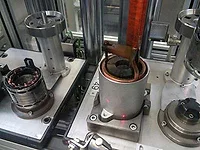
In a heat-shrink assembly machine, the component to be placed on the shaft is precisely brought up to temperature using an inductive or contact heater. The heating unit geometrically fits the part and features an internal temperature control unit.
Temperature control is crucial to the process. If the part is not hot enough, it will not expand enough to fit over the shaft. If the part is overheated, it may warp or temper.
Depending on the material and size, the part is heated to between 302 F and 572 F. Lower temperatures are typically needed for metals such as aluminium, while higher temperatures are used on metals such as low and medium carbon steels.
When the part has reached sufficient temperature, it is joined to the shaft without any application of force. As the part cools and contracts, it clamps firmly onto the shaft.
Thanks to robots, grippers and numerically controlled axes, a heat-shrink assembly machine can join parts with a clearance of less than 15 microns. Precise motion control is important. If the two parts are not properly aligned, the cam or gear will not slide into position. For process reliability, the inner diameter of the part and the outer diameter of the shaft should be produced at tight tolerances, and there should be no burrs on the joining surfaces.
The entire process of placing a cam onto a shaft—from picking up the component to completing the insertion—takes only 7 seconds. While one component is being assembled onto the shaft, the next one is being heated. Thus, a complete camshaft for a four-cylinder engine can be assembled in approximately 40 seconds.
The process gives automakers a large degree of freedom and production flexibility. For instance, heat-shrink assembly can be used with a variety of materials, such as forged or sintered cams that don’t require grinding after attachment to the shaft. Ancillary components, such as bungs or end pieces, can be made from more cost-effective materials, offering a substantial savings potential.
Heat-shrink assembly also has a positive effect on development and functionality. Every shaft assembly can be made to suit individual demands, and functional density can be increased. Where required, gears can be fitted snuggly against shoulders. This ensures that design variants can be implemented in the smallest possible space.
Heat-shrink assembly is becoming particularly important for producing engines for utility vehicles. These engines have composite camshafts with integrated bearing elements. As a consequence, no downstream grinding processes can be carried out on the shafts, since metal chips would damage the bearings.
The heat-shrink assembly process isn’t restricted to the automotive industry. It is also used to assemble electric motors; gearboxes, wheels and transmissions for railcars and engines; gearboxes for lathes, mills and other machine tools; roll bearings and roll neck rings for heavy-duty industrial equipment; and components for power generation equipment, such as gas turbine impellers.
The chief disadvantage of heat-shrink assembly is that it is typically limited to cylindrical components.
Equipment Options
EMAG has designed several machines for heat-shrink assembly.
The VA 700 T was designed specifically for assembling composite camshafts. It can install cams, bearing rings, sensor wheels and other components onto camshafts. Cost efficiency is achieved due to its modular design, short cycle times and quick retooling times.
It can accommodate a workpiece with a maximum length of 1,050 millimeters. Cams and other parts to be placed onto the shaft can be no more than 100 millimeters in diameter and weigh no more than 0.5 kilogram. The total weight of the assembly can be no more than 20 kilograms.
The VA700P is a compact machine for pressing and heat-shrinking parts onto vertically oriented shafts. A rigid design and an absolute path-measuring system ensure positional accuracy. Joining force, path and speed are programmable. Maximum pressing force is 100 kilonewtons. Integrated warming reduces stress on parts during pressing or joining.
The machine can accommodate a workpiece with a maximum length of 700 millimeters. Cams and other parts to be placed onto the shaft can be no more than 200 millimeters in diameter and weigh no more than 5 kilograms. The total weight of the assembly can be no more than 50 kilograms.
The HA700P is a compact machine for pressing and heat-shrinking parts onto large, horizontally oriented workpieces, such as crankshafts and long driveshafts. Additional external or internal warming can be provided for stress-free and power-assisted joining. Numerically controlled modules allow engineers to regulate the insertion process by force and distance. Maximum pressing force is 700 kilonewtons.
Cams and other parts to be placed onto the shaft can be no more than 200 millimeters in diameter and weigh no more than 10 kilograms. The total weight of the assembly can be no more than 100 kilograms.
For more information on the heat-shrink assembly process, including videos, visit www.emag.com/machines/joining-machines.
Looking for a reprint of this article?
From high-res PDFs to custom plaques, order your copy today!