Advances in Silicone Adhesives
Throughout the typical American home, one can find a wide range of products assembled with silicone adhesives. Oven-door handles and refrigerator gaskets, for example, are bonded with silicone because it maintains flexibility when exposed to extreme hot and cold. Glass screens and panes adhere extremely well to durable plastic frames with silicone, making it a wise choice when assembling windows and TVs.
Silicone adhesives are also prevalent throughout the car or truck parked in the garage or on the driveway. For starters, there’s the vehicle’s mirrors and hood ornament. In addition, silicone is used to assemble parts ranging from engine control modules to wire wheels, and it is applied as gaskets that prevent leaks from the vehicle’s oil pan and valve covers.
Loctite Heavy Bodied Ultra Black is one type of silicone adhesive sealant that is applied as a gasket. It was developed in the late 1980s for Pontiac engines by David M. Brassard, founder and CEO of Silicone Solutions.
“Very thick RTV (room temperature vulcanization) compounds were being used [in gaskets] to meet engine assembly test parameters at that time,” recalls Brassard. “Unfortunately, the compounds’ high-molecular-weight polymer had a low crosslink density, making it subject to reversion. Besides oil leaks, reversion caused engine-compartment sealants to depolymerize into a jelly-like substance that plugged oil sump pump inlets and brought about engine failure.”
Brassard began developing a replacement silicone adhesive capable of withstanding acidic environments caused by lubricants that have broken down due to heat exposure. As part of his formulation, Brassard utilized a buffer to help the gasket neutralize acidity and prevent reversion. What’s interesting is the buffer he chose: calcium carbonate, the active ingredient in Tums.
Over the last 25 years or so, Brassard has developed several thousand more adhesives for hundreds of manufacturers in many industries. His competitor suppliers have likewise developed their own proprietary formulations. Together, they have pushed the envelope in silicone adhesive chemistry—resulting in application-specific products that offer faster curing, as well as well-established assembly benefits like flexibility, toughness, low surface energy and chemical resistance.
From Sand to Assembly
Like computer chips and glass, silicone adhesives’ origin can be traced back to silica sand, which is a high-purity quartz derived from naturally produced sand. During World War II, the U.S. military applied silicone sealant (invented by The Dow Corning Co.) to aircraft engines to allow flights at high altitude. Silicone adhesives and sealants for manufacturing first appeared in the early 1960s.
Looking for quick answers on assembly and manufacturing topics? Try Ask ASM, our new smart AI search tool. Ask ASM
“The use of silicone adhesives continues to increase in many industries for two main reasons,” claims Kate Johnson, application engineering specialist—automotive and electronics for Dow Corning. “One is the adhesives’ constantly improving properties. Another is our ability to engineer the adhesive to match a specific application. As a result, manufacturers often consider adhesives a reliable lower-cost assembly alternative to fastening.”
There are three categories of silicone adhesives. Thin, flowable products (1 to 10,000 centipoise) are applied with a spray valve or brush. This group includes gel adhesives; those used as a conformal coating (3 to 8 mils thick) or encapsulant to protect PCBs in harsh environments; and adhesives for dip-coating products. Gels protect delicate components (such as connector pins) from vibration, mechanical shock, water and atmospheric contaminants.
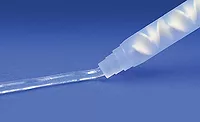
Semiflowable (10,000 to 70,000 centipoise) and thixotropic (100,000 to several million centipoise) adhesives are one- or two-part products that are dispensed with a nozzle in a bead up to 0.25-inch diameter. Thixotropic adhesives, which have a toothpaste-like consistency, are used most often, says Steve Swanson, West Coast sales manager for Novagard Solutions.
Specialty adhesives include those formulated for thermal conductivity or medical devices (FDA Class VI). The former are used with electronic assemblies that feature large semiconductor chips. Examples range from coffee pot warmers to power units in a computer. Class VI adhesives are for medical use and formulated to withstand gamma exposure, moderate humidity, body fluids and ambient chemicals.
Good Chemistry and Performance
Two-part RTVs use a platinum or tin catalyst to initiate polymer cross-linking. Platinum does this through addition cure by adding a hydride-functional cross-linker to the vinyl silicone polymers. Tin, in contrast, condenses the adhesive and relies on moisture to cause cross-linking (condensation cure). Platinum-catalyzed adhesives leave no byproducts, whereas tin-catalyst formulations may leave behind byproducts such as acetic acid, alcohol or acetone.
Most two-part adhesives achieve tack time within 20 minutes and fully cure within several hours at room temperature or as little as 5 minutes with heat (heat gun, oven, infrared or UV light). These adhesives cure at depths greater than 0.25 to 0.375 inch (common with one-part adhesives) and in closed environments.
Hot-melt and UV-curing formulations are also available. The latter type are one- or two-part adhesives that cure in less than 2 minutes, but can only be used where one material in the bond is UV-transparent. These adhesives should be dispensed without light reaching the material before it is applied. Many UV-curing silicones feature a secondary moisture mechanism to ensure that any silicone not irradiated with UV light will still cure.
Craig Strachen, East Coast sales manager for Novagard, says several Tier 1 suppliers use the company’s RTV 800-260 conformal coating for potting
conductors on the back of halogen headlight bulbs. The UV-cure adhesive is placed to a depth of 0.125 inch and length of 0.8 inch, and cures in 3 seconds.
Clear in color, this adhesive has a viscosity of 2,000 to 5,000 centipoise. When cured, it offers 100-psi tensile strength and 100-percent elongation. To facilitate inspection, the adhesive fluoresces when exposed to UV light.
Recently, Dow Corning introduced its EA-7100 adhesive that cures through a process called ‘thermal-radical’ chemistry. According to Geoff Gardner, electronics marketing director for Dow Corning, the adhesive took more than 5 years to develop. It is initially recommended for the assembly of plastic and metal electronics housings, and for attaching connectors, electronic control units or sensors onto substrates for automotive electronics.
A one-part thixotropic (360,000 centipoise) adhesive, EA-7100 requires little to no pretreatment or cleaning for activation. Curing with adhesion begins before skin-over takes place and is complete after only 15 minutes at 100 C.
Besides glass and aluminum, silicone adhesives bond all metal types, ceramic and various plastics. They are usually solvent free and can be formulated with a low or high modulus of elasticity. Other standard benefits include very little shrinkage, long durability (20 to 30 years), and resistance to ozone and polar solvents (liquids with molecules that have a slight electrical charge).
According to John Freedman, marketing and sales director for general healthcare at NuSil Technology LLC, silicone adhesives withstand temperatures ranging from -40 to 600 F. They also have excellent elongation, fire-resistance and gap-filling capabilities.
Freedman says that NuSil’s R32-2186 adhesive is designed for rapid production applications because of its fast cure (several minutes) through the application of heat. A two-part thixotropic adhesive, the product is translucent, has a viscosity of 170,000 centipoise and bonds with other silicones as well as various metals and plastics. Once cured, the adhesive offers high tear strength (125 pounds per inch) and tensile strength (975 psi). Working time is typically 15 hours or more.
Silicone adhesives are often used to seal two parts as well as bond them. This is common with auto parts that hold water, oil and other fluids and must be leakproof. Silicone also seals various appliance assemblies, such as the water tanks in steam irons.
For the past several months, radiator and CAG (charged air cooler) manufacturers have been sealing their products with SS-1801, a two-part RTV silicone adhesive from Silicone Solutions. Besides being able to bond through the radiator’s zinc coating (which protects the aluminum magnesium alloy), the product cures very quickly. After curing, it allows handling of the bonded assembly within minutes. Brassard says the adhesive seals microcracks and also resists weathering, ozone, moisture, UV and high temperatures.
Adhesive flowability, production volume and accuracy requirements always determine which dispensing equipment setup is best: manual application using handheld syringes (time-pressure dispensing), benchtop systems or fully automated machines. High-pressure dispensers are recommended for high-viscosity adhesives, as are dispensers with metering systems for two-part adhesives.
“The LED lighting industry is growing quickly and using lots of silicone adhesives,” notes Bob Umland, marketing and sales director for electronics and engineering at NuSil. “For those manufacturers, silicone provides good thermal management by shielding electronics from moisture and environmental stress.”
Limited Interaction
Silicone’s main limitation is it grips surfaces but doesn’t chemically interact with them. Because its typical tensile strength is only 500 to 1,000 psi, this type of adhesive is not effective for applications requiring a strong chemical bond or rigidity. Applications involving substrates made of Teflon, polyethylene or polypropylene or with durable powder coatings, for example, usually require a primer.
There are other limitations. Silicone adhesives have a short tooling time because of skin formation. Once cured, they offer low tear resistance and cohesive strength, and are prone to picking up dirt due to surface tension.
Dispensing high-viscosity thixotropic adhesives also presents challenges. Steve Kohnle, vice president and general manager of Fisnar Inc., says the adhesives’ abrasive nature makes it harder to keep equipment clean and quickly wears out components.
A couple years ago, a Tier 1 manufacturer of electric-vehicle power supplies asked Fisnar to develop a more durable dispensing valve for a high-volume application. The company was dispensing a very viscous silicone adhesive in a bead 10 inches long by 0.125 inch wide. Cycle time was 4 seconds.
“Initially, their equipment featured a standard spool valve, but the adhesive chewed that up very fast,” explains Kohnle. “Fixing the problem required us to develop a custom ball valve with a special coating.”
Fisnar recently expanded its F7400N series of dispensing robots by introducing the F7405N. This model features a rotational dispense head and five-axis simultaneous positioning, enabling manufacturers to apply adhesives and sealants to flat, curved, vertical or hard-to-reach surfaces (ledges, lips, channels) in products requiring a formed-in-place gasket.
Kohnle says the robot moves in a continuous path or point-to-point within a large X-Y-Z work area (400 by 400 by 100 millimeters). It dispenses directly from a 300-milliliter cartridge with resolution accuracy of 1 micron. Operators can quickly purge leftover fluid by pressing a button on the control panel.
Another industry that increasingly assembles its products with silicone adhesives is solar. Several panel manufacturers rely on the single- or double-acting 9450 meter-mix system from Exact Dispensing Systems to encapsulate junction boxes and photovoltaic circuitry. According to Doug Jaeger, general manager of Exact, the adhesives protect these crucial components from moisture, heat and other environmental factors.
This summer the company also began offering the BeadMaster servo-driven positive-displacement piston meter-mix system. Jaeger says the system provides precise bead placement and profile control in automated applications. It also enhances corner control.
Looking for a reprint of this article?
From high-res PDFs to custom plaques, order your copy today!