Additive Manufacturing Takes Off in Aerospace Industry
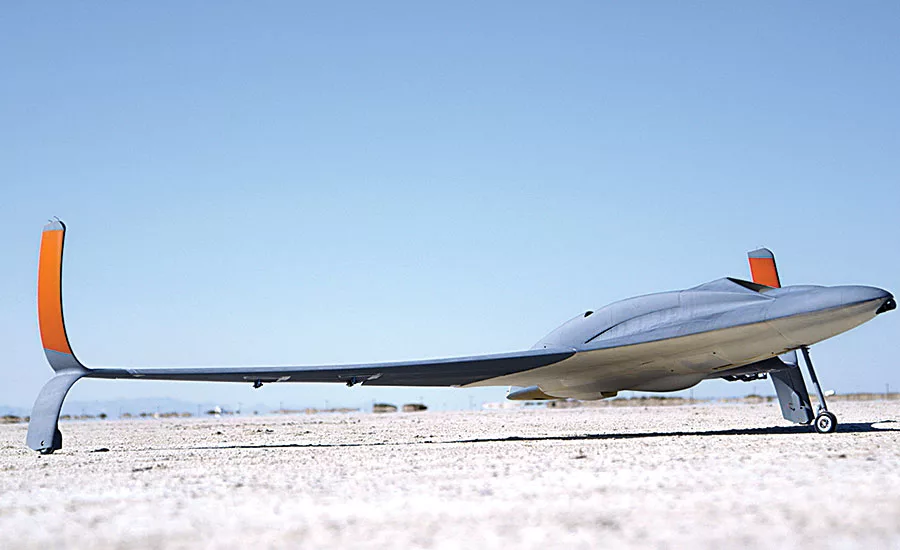
The majority of this jet-powered unmanned aerial vehicle uses 3D-printed parts. Photo courtesy Stratasys Ltd.
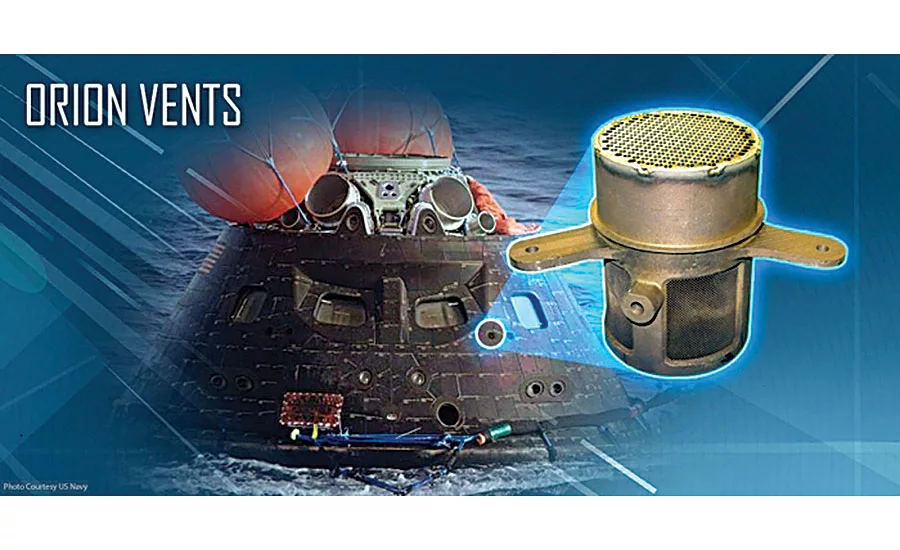
The Orion crew module uses four vents that were printed from nickel alloy. Photo courtesy Lockheed Martin Corp.
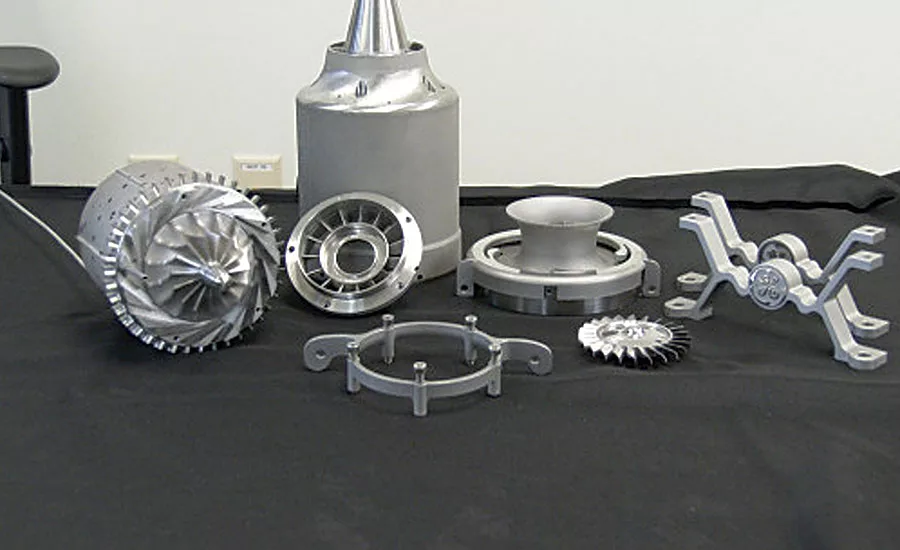
These functional miniature jet engine parts were built with additive manufacturing technology. Photo courtesy GE Aviation
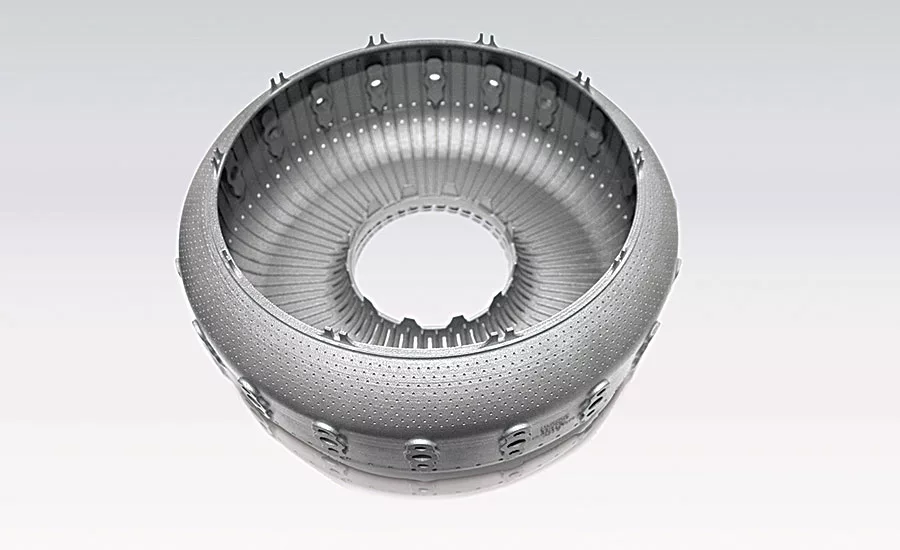
This nickel alloy jet engine combustor was made with direct metal laser sintering. Photo courtesy EOS of North America Inc.
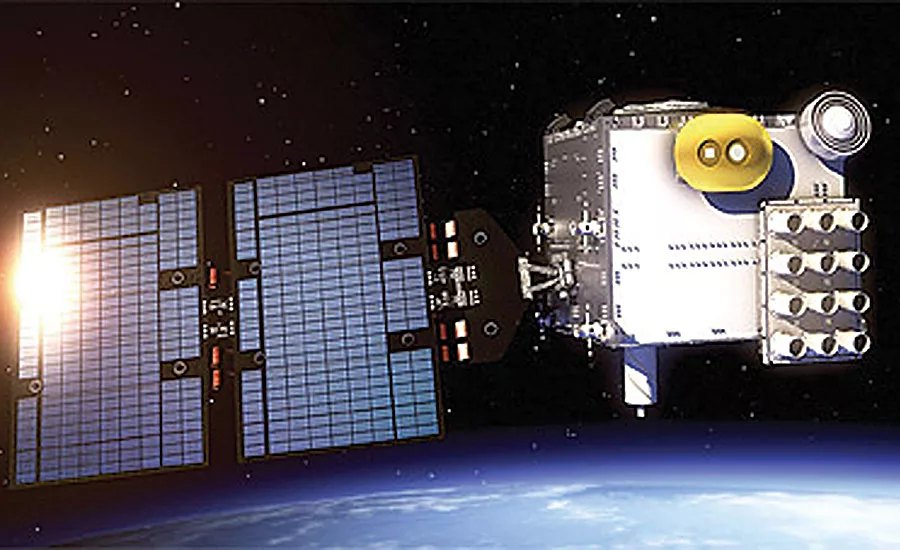
When the COSMIC-2 satellite launches later this year, it will mark the first time that 3D-printed parts will function externally in outer space. NASA engineers used fused deposition modeling technology to produce 30 plastic antenna array supports. Illustration courtesy Stratasys Ltd.
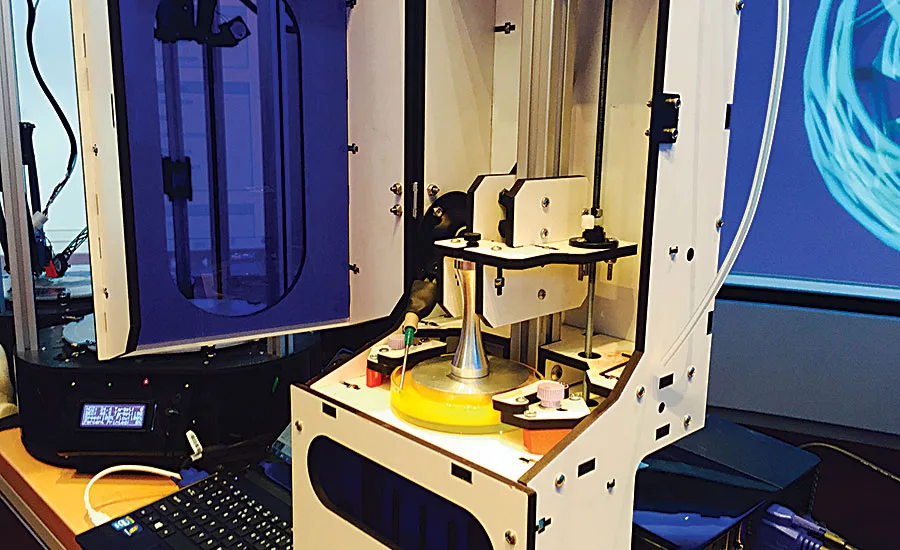
Additive manufacturing allows aerospace companies to build complex shapes and dramatically reduce production time. Photo courtesy Metropolitan State University
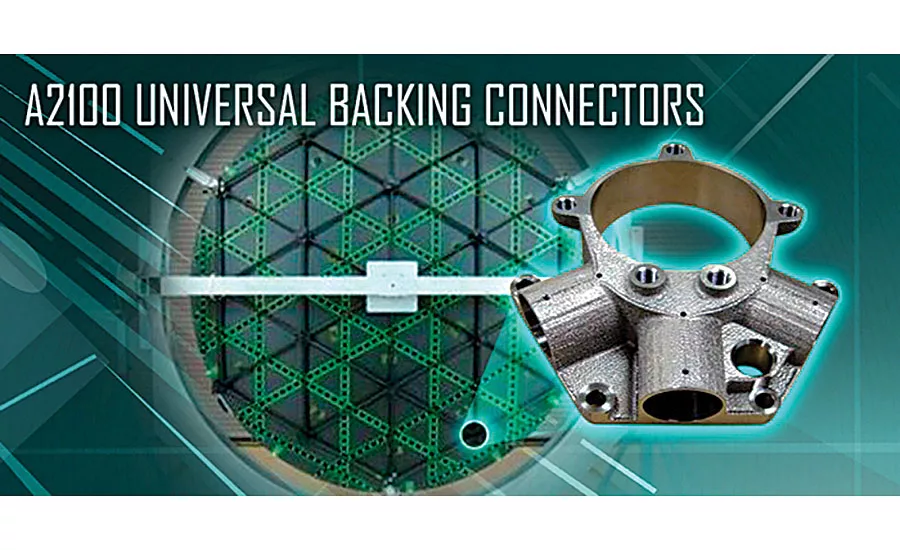
Juncture points for this satellite antenna reflector are connected by sheer tie fittings that were printed out of titanium powder. Photo courtesy Lockheed Martin Corp.
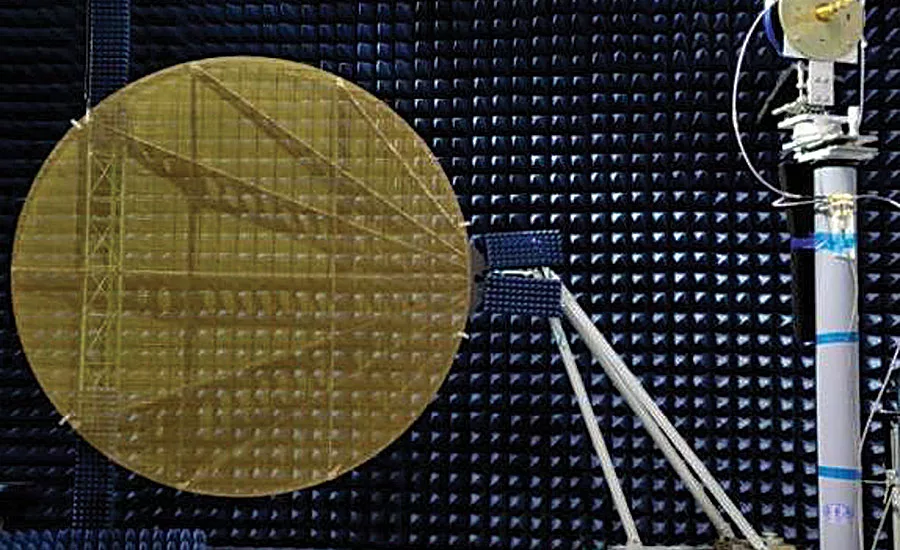
Engineers produced this ultra-lightweight satellite antenna by printing the titanium parts. Photo courtesy Harris Corp.
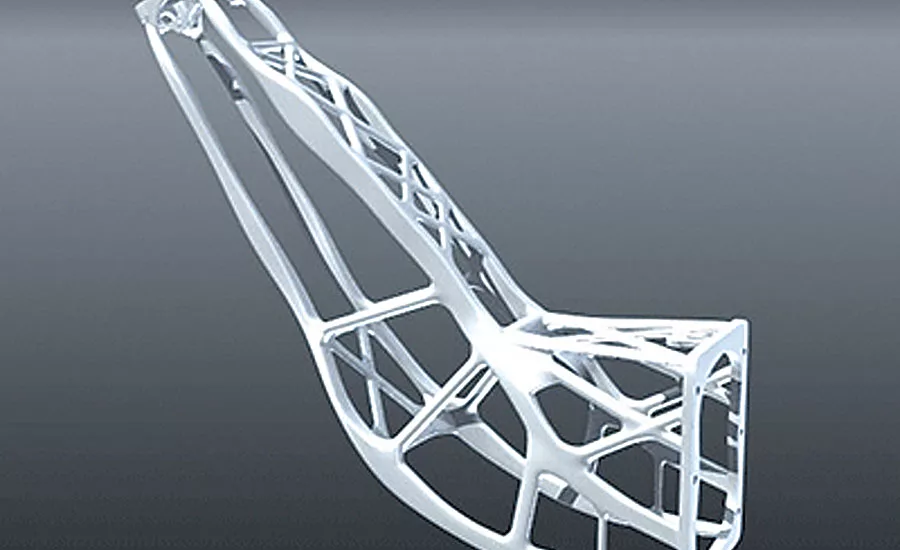
This antenna support arm was printed to reduce weight and production costs. Photo courtesy Altair Engineering Inc .
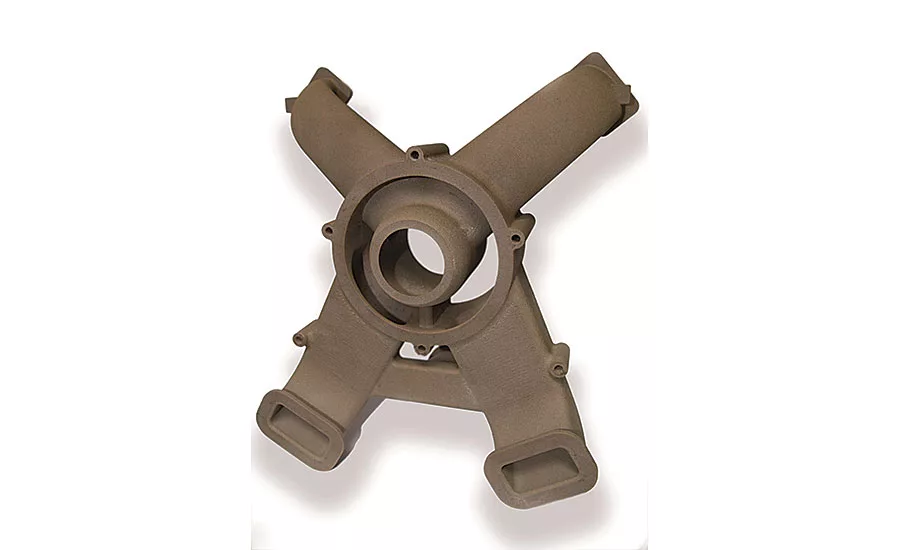
Air ducts are a popular application for additive manufacturing. Photo courtesy EOS of North America Inc.
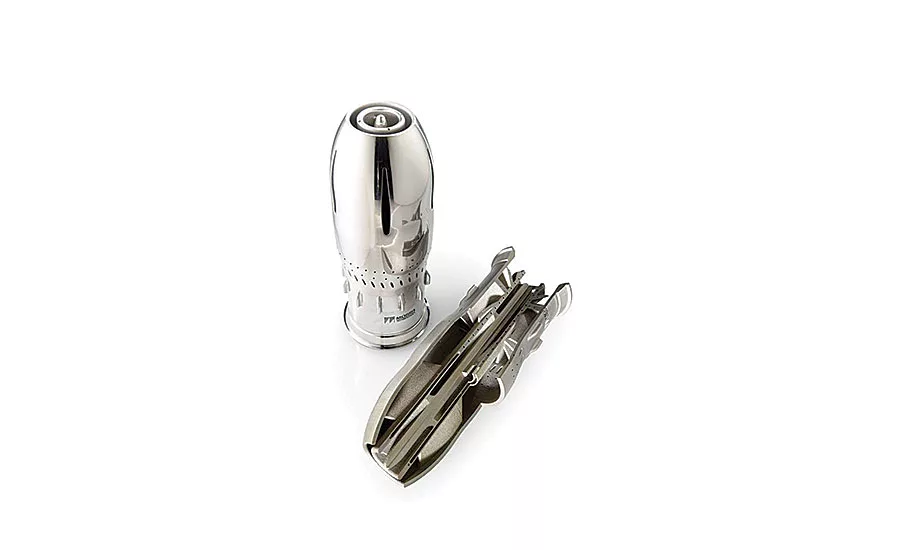
This cobalt chrome gas turbine swirler was produced with direct metal laser sintering. Photo courtesy EOS of North America Inc.
Additive manufacturing is the biggest thing to hit the aerospace industry since composites. It’s transforming the way engineers build and design engines, fuselages, landing gear and thousands of other components.
In the near future, everything from jetliners to satellites will be assembled differently because of 3D-printed parts. That’s why companies from Airbus to Zodiac Aerospace are scrambling to find innovative ways to apply the technology.
Additive manufacturing “prints” solid objects from a digital file by depositing one layer of material on top of another, rather than starting with a piece of metal and cutting or milling it away. It allows companies to more easily manufacture complex shapes and structures that have traditionally been difficult to make. There’s also less waste compared to traditional manufacturing techniques, which require longer setup times and higher material costs.
More than one-third (36 percent) of aerospace professionals responding to ASSEMBLY Magazine’s 2015 State of the Profession survey claim they are actively involved in additive manufacturing projects.
Every segment of the aerospace industry is investing in the technology, including manufacturers of commercial jetliners, military helicopters, rockets and satellites. As quality and processing speed improve, 3D printing will become a viable alternative for an increasing number of applications, including flight-ready production parts.
“Historically, aerospace has always strived to go higher, faster, further,” explains Tom Campbell, director of innovation for space and intelligence systems at Harris Corp. “Additive manufacturing unlocks the ability to make parts that could never be made in the past when we used traditional subtractive manufacturing techniques. Metal brackets are an example.
“The other thing driving interest in the technology is simply competition,” adds Campbell. “A lot of things in aerospace traditionally have a high barrier to entry, due to the cost of machines or infrastructure. But, 3D printing is a tool that allows smaller businesses to play with the big boys. It is the democratization of creating parts.”
Looking for quick answers on assembly and manufacturing topics? Try Ask ASM, our new smart AI search tool. Ask ASM
“The use of additive manufacturing technology reduces the cost to produce components, shortens build times and unleashes engineers to design components that were once impossible to build using traditional manufacturing techniques,” notes Julie Van Kleeck, vice president of advanced space and launch programs at Aerojet Rocketdyne Inc., which is using 3D printing to build parts for the Orion spacecraft.
According to Greg Morris, manager of additive manufacturing and business development at GE Aviation, 3D printing will allow aerospace manufacturers to reduce their parts production time-line from a couple of months or weeks to a couple of weeks or days.
Some experts believe that additive manufacturing will reduce the average lead time for aerospace parts by up to 80 percent. The technology also allows manufacturers to scrap less than 10 percent of expensive material, such as titanium, compared to traditional production methods that often waste up to 90 percent of material.
“There are a number of things driving interest [in additive manufacturing today], such as part consolidation,” says Robert Yancey, vice president of aerospace and composites at Altair Engineering Inc. “Companies can save the cost of fastening and welding processes, as well as integrate designs that can have improved performance. The ability to quickly modify a design, especially for nonstructural applications, provide better performance, or reduce assembly time [also appeals to engineers].”
Complex, multicomponent aerospace parts that previously required assembly can now be printed as a single object.
“Additive manufacturing provides an option for applications with complex geometries, long lead times and lower volumes in aerospace-grade metals,” says Scott Killian, aerospace business development manager at EOS of North America Inc. “It can replace machining, forging, casting and composites, without the need for expensive tooling and slower manufacturing speeds.”
Growing Demand
Aerospace manufacturers have been using 3D printing for more than a decade, primarily for prototyping applications. But, as the technology has improved in recent years, they’ve ramped up investments. That trend is expected to continue over the next 10 years.
SmarTech Markets Publishing predicts that revenues from additive manufacturing hardware, software, materials and services for commercial and general aviation will reach $2 billion by 2020, rising to more than $3 billion by 2022.
However, the industry sector with the highest adoption rate is the space industry, which includes manufacturers of missiles, rockets and satellites.
“Space applications [require] lower volumes of parts, and additive manufacturing is an ideal solution for that scenario,” explains Magnus Rene, president and CEO of Arcam AB, a Swedish company that supplies additive manufacturing equipment to companies such as Airbus, GKN, GE Aviation and Pratt & Whitney. “The military and defense market is next, because of lower part volumes, high technical demands and less validation needs.
“When additive manufacturing first emerged, there was hesitation from some aerospace engineers who felt the technology wasn’t yet proven or reliable, or that it might be a passing fad,” notes Rene. “Today, most engineers recognize the importance and potential of the technology.”
According to Rene, many types of aerospace parts can be produced with additive manufacturing. “The ideal candidates are smaller, more complex components, such as general prismatic parts and brackets,” he points out.
“This technology is ideal for noncosmetic interior parts or nonstructural and non-flight-critical parts,” says Ron Clemons, director of vertical business development at Stratasys Direct Manufacturing. “But, new applications are opening up all the time.
“We have recently begun to produce cosmetic parts, such as the plastic covers that go around cabin lights,” Clemons points out. “All those parts have to be finely finished, textured and painted to match traditional molded parts.”
The Federal Aviation Administration (FAA) recently certified the first 3D-printed part for commercial use: a fist-sized piece of silver metal that houses the compressor inlet temperature sensor inside a GE jet engine. Located in the inlet to the high-pressure compressor, the sensor provides pressure and temperature measurements for the engine’s control system. General Electric engineers are now printing other engine components, such as fuel nozzles, that will be flying onboard commercial jetliners within a few years.
“Fuel nozzles are great to redesign, as they are stationary, nonmoving components in an engine,” says Joseph Gabriel, president of Form 3D Solutions & Manufacturing LLC, a 3D printing service provider. “On the other hand, blades rotate and are much harder to receive FAA approval, especially with some of the material integrity bugs [that still need to be worked out with additive manufacturing].
“Small interior parts that are located all over the cabin [are good candidates for 3D printing applications], because they could benefit a great deal by weight-saving redesigns,” adds Gabriel.
“Complex metal parts, such as fuel nozzles and manifolds, are the main focus today,” says Mark Kemper, president and CEO of Engineering & Manufacturing Services Inc., another 3D printing service provider that does work for aerospace manufacturers. “As parts get larger, build speed, cost, accuracy and post-processing issues play a bigger role. Also, volume is a key factor. Low-volume applications are great candidates for additive manufacturing applications.”
“The most ideal [applications] are products where you can take 15 to 20 parts and combine them into one [assembly],” adds Harris Corp.’s Campbell. “[With 3D printing], you can control the quality. Very complex parts, such as designs with impossible-to-machine cavities, are ideal.”
New Tools, New Thinking
No matter what type of aerospace component is to be printed, engineers must redesign parts and rethink critical issues such as joint design.
“Engineers should rethink their designs with additive manufacturing,” warns Altair Engineering’s Yancey. “You are not taking advantage of the technology when you take a machined or cast part and simply replicate it with 3D printing.”
“Traditionally, engineers were taught how to design parts to be easily manufactured,” adds Campbell. “With the new additive manufacturing paradigm, that is a hindrance.
“In the past, good design was thought to be simple and easy to machine,” Campbell points out. “There were multiple parts to bolt together. With additive manufacturing, there is no limit to complexity. But, training is important.
“[To address this issue], we purchased a software suite that can be used to optimize parts using additive manufacturing tools,” explains Campbell. “We’re trying to increase awareness of [this technology’s] capability.
“The biggest detraction of additive manufacturing is being able to control the material properties and the strength of the part,” says Campbell. “The end consistency of parts will vary. That’s the biggest hurdle [to adopting this technology for aerospace applications], where part failure is not an option.”
“The biggest challenge is for engineers to begin to think more openly about geometric design,” claims Jack Beuth, Ph.D., a professor of mechanical engineering at Carnegie Mellon University and director of the NextManufacturing Center. “With additive manufacturing, added geometric complexity does not incur added cost and you do not have to have material where it is not needed (where it does not carry significant stress).
“Optimized component designs can tend to take on organic shapes, can be hollow or can consist of an outer shell with a 3D cellular mesh in the center regions of the part,” Beuth points out. “That mesh can have high strength and stiffness, yet be much lighter than a solid part.
“I have seen a similar situation in teaching our undergraduate additive manufacturing course, which includes a product design project,” says Beuth. “Even young, open-minded [engineers] tend to design products that look bulky, with straight sides and simple shapes. That is all they have ever seen. They have to be trained to allow for and exploit geometric complexity.”
Additive Processes
Aerospace engineers are using several different additive manufacturing processes to turn their ideas into reality. Options include direct metal laser sintering (DMLS), electron beam additive manufacturing (EBM), fused deposition modeling (FDM), selective laser melting (SLM) and selective laser sintering (SLS).
DMLS fuses powdered metal and alloy materials with a high-wattage laser to produce robust metal parts. It can produce end-use parts that are comparable to machined or cast parts.
EBM is favored by many aerospace manufacturers. It is ideal for producing large-scale, near-net shape parts made of Inconel, tantalum, titanium and other high-value metals.
FDM employs engineering thermoplastics. It makes it possible for components of almost any size to be produced, because there are no predetermined space requirements to pose any restrictions.
With SLM, step-by-step laser radiation is scanned across a bed of powdered metal. The laser traces out the form of the component along the surface of the powder. Wherever the laser touches the powder, the metal powder instantly melts and then solidifies to form a solid mass as the component is built-up layer by layer.
SLS uses a diode-pumped fiber optic laser that allows engineers to process higher melt-point alloys, as well as reactive alloys, such as aluminum and titanium. It is ideal for producing parts with complex geometries, such as ducting and air-handling components, that cannot be made by traditional manufacturing methods.
On the material side, engineers have several options for direct-metal printing, including aluminum alloys; cobalt chrome alloys; nickel super alloys, such as IN 718 and IN625; and titanium alloys, such as Ti6Al4V. And, new materials are coming soon, such as tungsten.
According to IDTechEx, metals are the fastest-growing segment of 3D printing, with printer sales growing 48 percent annually and material sales growing at 32 percent.
Demand for high-temperature polymers, such as polyetheretherketone, will continue to grow in the future. But, but for aerospace applications, it will be a smaller market compared to metal. Polyetherimide is a popular material used for FDM applications, because engineers can produce parts that meet the flame, smoke and toxicity requirements set by the FAA.
Sky-High Applications
The holy grail of additive manufacturing applications in the aerospace industry is a human-piloted aircraft made entirely of 3D-printed parts. That isn’t likely to happen any time soon. However, it’s a different story for unmanned aircraft and spacecraft.
At the recent Dubai Air Show, Aurora Flight Sciences Corp. unveiled a jet-powered unmanned aerial vehicle (UAV) that uses 3D-printed parts for 80 percent of its design and manufacture. The functional UAV weighs 33 pounds, features a 9-foot-wide wingspan and can fly more than 150 mph.
“A primary goal for us was to show the aerospace industry just how quickly you can go from designing to building to flying a 3D-printed aircraft,” says Dan Campbell, aerospace research engineer at Aurora Flight Sciences. “To the best of our knowledge, this is the largest, fastest and most complex 3D-printed UAV ever produced.
“Additive manufacturing provided the design-optimization to produce a stiff, lightweight structure without the common restrictions of traditional manufacturing methods,” explains Campbell. “This also enabled the cost-effective development of a customized, mission-specific vehicle without the cost constraints of low-volume production.”
“This is a perfect demonstration of the unique capabilities that additive manufacturing can bring to aerospace,” adds Scott Sevcik, aerospace and defense senior business development manager at Stratasys Ltd. “This meant using different 3D-printing materials and technologies together on one aircraft to maximize the benefits of additive manufacturing and print both lightweight and capable structural components.”
Two widely publicized aerospace applications involve jet engines that will be used in next-generation single-aisle jetliners. Pratt & Whitney features 3D-printed parts in its PurePower PW1500G engines, which will power the new Airbus A320neo. Engineers used additive manufacturing technology to produce air-worthy parts such as compressor stators and synch-ring brackets.
Not to be undone, archrival GE Aviation recently started flight tests with its LEAP engine, which contains 19 printed fuel nozzles. The fuel-efficient engine will power Boeing’s new 737MAX.
Engineers at NASA’s Marshall Space Flight Center are also using additive manufacturing technology to build injector fuel nozzles that will be used in its Space Launch Systems program. Thanks to 3D printing, they were able to build rocket injectors 15 times faster than with traditional manufacturing processes.
The engineers were also able to consolidate the complex part from 163 individual components into two-piece units. The parts were printed in 10 days; they typically take six to nine months to construct via traditional manufacturing methods.
The dramatic part consolidation effort also eliminated the need to weld, machine, cast or bond the 163 parts together to create the injectors. Built using DMLS, the injectors have already passed hot fire, static and strenuous mechanical property tests.
Aerojet Rocketdyne recently produced 12 additively manufactured production nozzle extensions for use aboard the Orion spacecraft that will one day take humans to Mars. The nozzle extensions are part of the crew module reaction control system that the company is building for Lockheed Martin Corp. and NASA.
The reaction control system provides the Orion crew module with the ability to control its course after it has separated from the service module. Additionally, during Orion’s re-entry into the Earth’s atmosphere, it ensures that the heat shield is properly oriented, the crew module is stable under the parachutes and that the vehicle is in the correct orientation for splashdown.
“The 12 nozzles were produced on a single additive manufacturing machine in just three weeks, which represents a roughly 40 percent reduction in production time when compared with conventional manufacturing techniques,” says Jay Littles, director of Advanced Launch Vehicle Propulsion at Aerojet Rocketdyne.
Engineers at Lockheed Martin Space Systems are also harnessing the power of additive manufacturing to streamline the assembly process. “Our goal is to build a satellite in only 18 months instead of the traditional 36- to 48-month timeframe,” explains Dennis Little, vice president of production at Lockheed Martin Space Systems. “We are currently in the process of qualifying the technology to ensure that parts, such as fuel propulsion tanks, can withstand the harsh environment of launch and getting into space.
“We also recently printed an aluminum avionics box that houses radiation-hardened electronics,” Little points out. “This has allowed us to significantly simplify assembly by reducing the number of joints.
“Traditionally, it takes five independent parts bolted and screwed together to make one box, which can be the size of a small refrigerator and contains about 132 fasteners,” adds Little. “By using 3D printing, we can significantly reduce both weight and production time.
“Our long-term goal is to print an entire satellite,” says Little. “Hopefully, that will occur sometime within the next decade.”
To learn more about additive manufacturing, click:
Looking for a reprint of this article?
From high-res PDFs to custom plaques, order your copy today!