Assembly Magazine logo
search
Ask ASSEMBLY AI
cart
facebook twitter linkedin youtube
  • Sign In
  • Create Account
  • Sign Out
  • My Account
Assembly Magazine logo
  • TRENDS
    • Ask ASSEMBLY AI
    • Trends
    • News
    • New Products
  • INDUSTRIES
    • Aerospace
    • Appliance
    • DFMA Assembly
    • Medical Devices
    • Green Manufacturing
    • Lean Manufacturing
    • Machinery Assembly
    • Electronics Assembly
    • Automotive
  • TECHNOLOGIES
    • Adhesives & Dispensing
    • Assembly Presses
    • Automated Assembly Systems
    • Manufacturing Management
    • Manufacturing Software
    • Motion Control
    • Screwdriving & Riveting
    • Robotics
    • Test & Inspection
    • Plastics & Metal Welding
    • Wire Processing
    • Workstations
  • AUTONOMOUS & ELECTRIC MOBILITY
    • AEM Magazine Archives
    • Autonomy
    • Electrification
    • Mobility Services
    • Assembly & Testing
    • AV/EM News
  • MEDIA
    • Ask ASSEMBLY AI
    • Podcasts
    • Assembly News Now
    • Assembly TV
    • Webinars
    • eBooks
  • EVENTS
    • Calendar
    • The ASSEMBLY Show
  • MORE
    • Exclusives >
      • Plant of the Year
      • Capital Spending
    • Buyers Guide >
      • Supplier Insights
    • Classifieds
    • Featured Products
    • Newsletters
    • Store
    • White Papers
    • Columns
    • Sponsor Insights
  • INFOCENTER
    • Assembly & Test Solutions
  • EMAGAZINE
    • eMagazine
    • Archive Issues
    • Advertise
    • Contact Us
    • Sign Up
IndustriesColumnsAutomotive AssemblyOn CampusElectrification

Drexel Cooling System Takes Heat Off EV Batteries
By Austin Weber
asb0922campus1.jpg

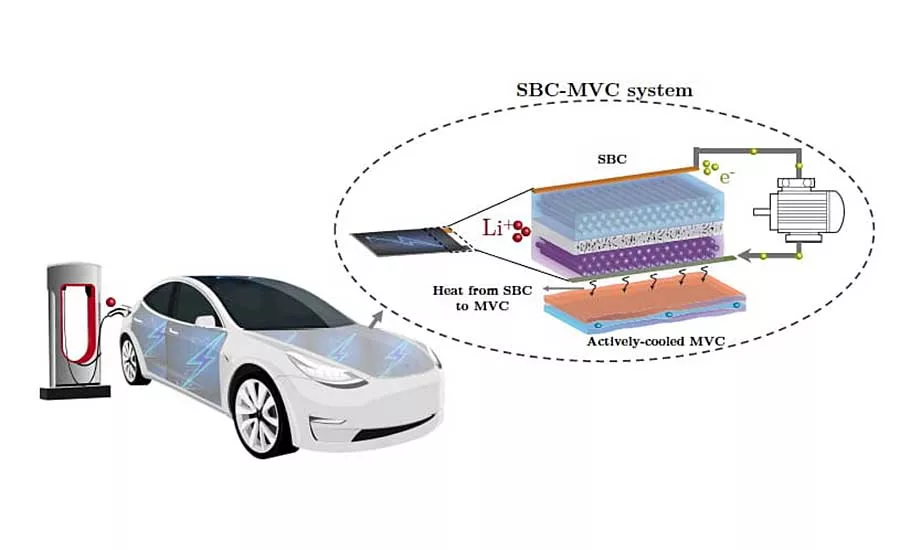
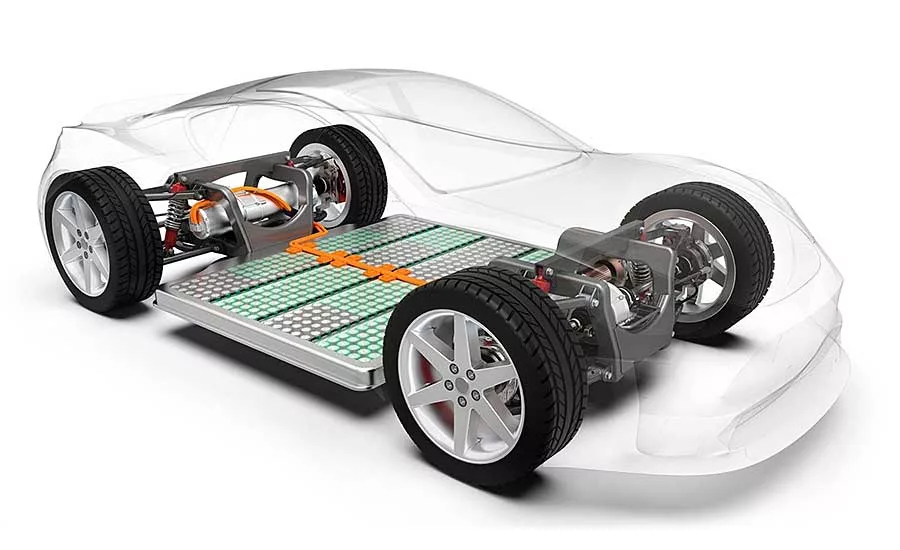
Structural batteries could help reduce the weight of electric vehicles. Illustration courtesy Drexel University

asb0922campus2.jpg

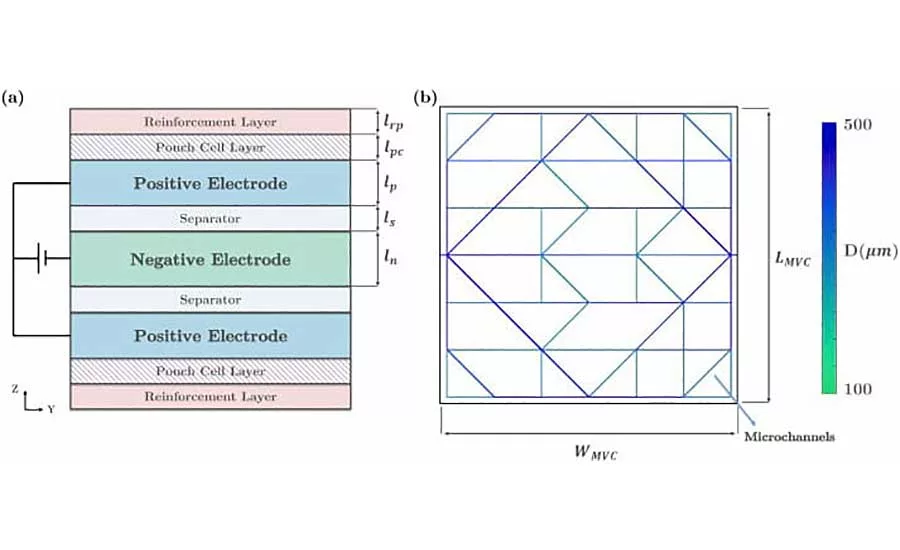
Thermal management plays an important role in structural battery composites and microvascular composites. Illustration courtesy Drexel University
asb0922campus3.jpg

Sandwiching structural batteries between layers of cooling microvascular composites can stabilize their temperature during use. Illustration courtesy Drexel University
asb0922campus1.jpg
asb0922campus2.jpg
asb0922campus3.jpg
September 19, 2022

Overheating is one of the biggest challenges facing engineers developing new types of battery technology. Too much thermal activity can reduce performance, cause malfunctions and increase the risk of fires and other serious problems in electric vehicles.

To address the issue, engineers at Drexel University are focusing on cooling systems. They’ve created a blood vessel-like network in the packaging of a new generation of carbon-fiber composite based batteries. It addresses performance-enhancing factors, like battery capacity and conductivity.

“One of the primary hindering factors in the development of EVs is that the specific energy of batteries is low, which makes vehicles heavy, especially for a long-range design,” says Ahmad Najafi, Ph.D., an assistant professor of mechanical engineer at Drexel University.

According to Najafi, growing demand for EVs has been plagued by a number of high-profile recalls that have called the durability and safety of batteries into question. As a result, more automakers and suppliers are looking at using solid batteries—a thin, carbon fiber-based version of the larger lithium-ion batteries widely used in electric vehicles—because they can be incorporated into the physical structure of the vehicle chassis as a way to cut weight.

Trimming the weight of a car by just 10 percent can boost its mileage efficiency between charges by as much as 6 percent to 8 percent. Najafi believes that replacing portions of a car frame with carbon-fiber composite material that functions both as a structural component and as a battery could reduce overall weight as well as improve energy storage capacity.

However, for these structural batteries to succeed, engineers must first address a challenge that arises from the use of a solid polymer rather than a liquid electrolyte.

“Heat generation will be substantially higher in structural batteries [compared to] standard lithium-ion batteries,” says Najafi. That’s because the conductivity of the polymer electrolyte is much smaller than that of liquid electrolytes.

Looking for quick answers on assembly and manufacturing topics? Try Ask ASM, our new smart AI search tool. Ask ASM →

Electrons face more of a bottleneck as they move through the polymer. They’re forced to move slower and, as a result, generate more heat as the battery discharges its energy.

“While structural battery composites are a promising technology for reducing weight in electric vehicles, their design could certainly benefit from the addition of a thermal-management system,” explains Najafi. “Not only could this improve the range of an EV, but it would also greatly reduce the chances of a thermal runaway reaction.”

Najafi and his colleagues have been developing special composite materials for heat management. They tapped into nature’s own cooling method—the vascular system—to dissipate heat. Modifying a design tool they invented to plot the optimal microvascular network, the engineers were able to design cooling composites that would work as part of the structural battery packaging currently being tested by automakers such as Tesla, Volkswagen and Volvo.

The design system can calculate the best pattern, size and number of microvascular channels to quickly dissipate heat from batteries. It also optimizes the flow efficiency of coolant moving through the channels.

“These composites function something like a radiator in an internal combustion engine vehicle,” Najafi points out. “The coolant draws in the heat and pulls it away from the battery composite as it moves through the network of microchannels.”

Sandwiching structural batteries between layers of cooling microvascular composites can stabilize their temperature during use, and extend the time and power range in which they can function.

Najafi’s structural battery optimization process includes several design parameters, such as thickness and fiber directions in each layer of carbon fiber. Other factors that affect performance include the volume fraction of fibers in the active materials, and the number of microvascular composite panels required for thermal regulation.

To test each combination, Drexel engineers measured the stiffness of each structural battery-cooling composite laminate to ensure they met safety standards. Then, they simulated the energy demand of a vehicle at various speeds over a duration of several minutes, while recording the temperature of the battery and the predicted range of the vehicle.

Computer models of one optimized system showed that it could improve the driving range of a Tesla Model S by as much as 23 percent. However, Najafi believes the real value of the R&D effort is its ability to glean the best combination of battery size and weight for any electric vehicle.

“While we know that every bit of weight savings can help improve the performance of an EV, thermal management can be just as important—perhaps more—when it comes to making people feel comfortable driving them,” says Najafi. “Our system strives to integrate improvements in both of these areas, which could play an important role in the progress of electric vehicles.”

KEYWORDS: battery manufacturing electric vehicles

Share This Story

Looking for a reprint of this article?
From high-res PDFs to custom plaques, order your copy today!

Austinweber headshot
Austin has been senior editor for ASSEMBLY Magazine since September 1999. He has more than 21 years of b-to-b publishing experience and has written about a wide variety of manufacturing and engineering topics. Austin is a graduate of the University of Michigan.

Recommended Content

JOIN TODAY
To unlock your recommendations.

Already have an account? Sign In

  • Made in the U.S.A.

    Consumer Products Manufacturing: Made in the USA

    Supply chain lessons learned during the coronavirus...
    Automated Assembly Systems
    By: Austin Weber
  • Best Practices for Press-Fit Assembly

    Best Practices for Press-Fit Assembly

    In manufacturing, ironclad formulas for success are hard...
    Assembly Presses
    By: Jim Camillo
  • aem0523leader-tesla1.jpg

    Tesla Rethinks the Assembly Line

    Engineers at Tesla Inc. have developed a new process that...
    Assembly and Testing
    By: Austin Weber
Manage My Account
  • eMagazine Subscription
  • Assembly Newsletters
  • Online Registration
  • Subscription Customer Service
  • Manage My Preferences

More Videos

Sponsored Content

Sponsored Content is a special paid section where industry companies provide high quality, objective, non-commercial content around topics of interest to the ASSEMBLY audience. All Sponsored Content is supplied by the advertising company and any opinions expressed in this article are those of the author and not necessarily reflect the views of ASSEMBLY or its parent company, BNP Media. Interested in participating in our Sponsored Content section? Contact your local rep!

close
  • ultrasonic welding
    Sponsored bySonobond Ultrasonics

    Engineering Efficiency in High-Performance Assembly: How Ultrasonic Welding Enhances Throughput, Reliability and Quality

  • UV curing system
    Sponsored byDymax

    Why UV Intensity Alone Doesn’t Define Curing Performance

  • wooden pallets
    Sponsored byLEAN Manufacturing Products

    Eliminating Waste on the Shop Floor: Applying Lean Principles to Improve Manufacturing Efficiency

Popular Stories

Ferrari

Ferrari Unveils Four-Door EV

ASSEMBLY News Now, episode-30: Volvo Redesigns EV Manufacturing

Volvo Redesigns EV Manufacturing

automated consumer goods assembly system

Best Practices for Cycle Time Optimization

Watch the latest episode of ANN now!

Events

July 24, 2025

From Shop Floor to CFO: How Manufacturers Are Closing the Loop Between Operations and Finance

On Demand Learn how manufacturers are bridging the gap between the shop floor and ERP systems to gain real-time visibility, streamline operations, and kick-start digital transformation—without waiting years.

Sponsored by:

PicoStratusGreen
July 30, 2025

Buffer Analysis and Design Fundamentals for Manufacturing Excellence

On Demand In this presentation, Dr. Herman Tang shares practical insights from his industry experience and research on buffer management in manufacturing operations.

View All Submit An Event

Poll

Difficult Assembly Processes

Which assembly process gives you the most difficulty?
View Results Poll Archive

Products

Manufacturing Cost Policy Deployment (MCPD) Profitability Scenarios: Systematic and Systemic Improvement of Manufacturing Costs

Manufacturing Cost Policy Deployment (MCPD) Profitability Scenarios: Systematic and Systemic Improvement of Manufacturing Costs

See More Products
Register for webinar - Modernizing Automotive Assembly: Why Upgrading Legacy MES is a Business Imperative

Related Articles

  • Ultrasound technology enables engineers to peer inside EV batteries.

    New Process Uses Ultrasound Technology to Test EV Batteries

    See More
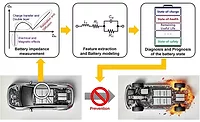
  • Using Electrochemical impedance spectroscopy technology to improve the stability and performance of high-capacity batteries in electric vehicles

    New System Monitors EV Batteries

    See More
  • aem1222tech1.jpg

    New Technology Boosts EV Batteries

    See More

Related Products

See More Products
  • manu.jpg

    Manufacturing System Throughput Excellence: Analysis, Improvement, and Design

  • assembly august 2019

    ASSEMBLY August 2019 Issue

  • Kaizen Assembly: Designing, Constructing, and Managing a Lean Assembly Line

See More Products

Related Directories

  • One-Off Robotics

    One-Off Robotics is an advanced equipment manufacturer designing and building the world's most innovative robotic fabrication systems. We specialize in robotic metal additive manufacturing and robotic milling, offering both stationary and portable, field-deployable systems engineered for demanding production environments. Our technologies enable additive, subtractive, and hybrid fabrication processes, supporting applications across Defense, Aerospace, Research, and Specialized Production sectors.
×

Never miss the latest news and trends driving the manufacturing industry

Stay in the know on the latest assembly trends.

JOIN TODAY!
  • RESOURCES
    • Advertise
    • Contact Us
    • Directories
    • Manufacturing Division
    • Store
    • Want More?
  • SIGN UP TODAY
    • Create Account
    • eMagazine
    • Newsletters
    • Customer Service
    • Manage Preferences
  • SERVICES
    • Marketing Services
    • Reprints
    • Market Research
    • List Rental
    • Survey/Respondent Access
  • STAY CONNECTED
    • LinkedIn
    • Facebook
    • Instagram
    • YouTube
    • X (Twitter)
  • PRIVACY
    • PRIVACY POLICY
    • TERMS & CONDITIONS
    • DO NOT SELL MY PERSONAL INFORMATION
    • PRIVACY REQUEST
    • ACCESSIBILITY

Copyright ©2026. All Rights Reserved BNP Media, Inc. and BNP Media II, LLC.

Design, CMS, Hosting & Web Development :: ePublishing