German Factory Implements "Industry 4.0"
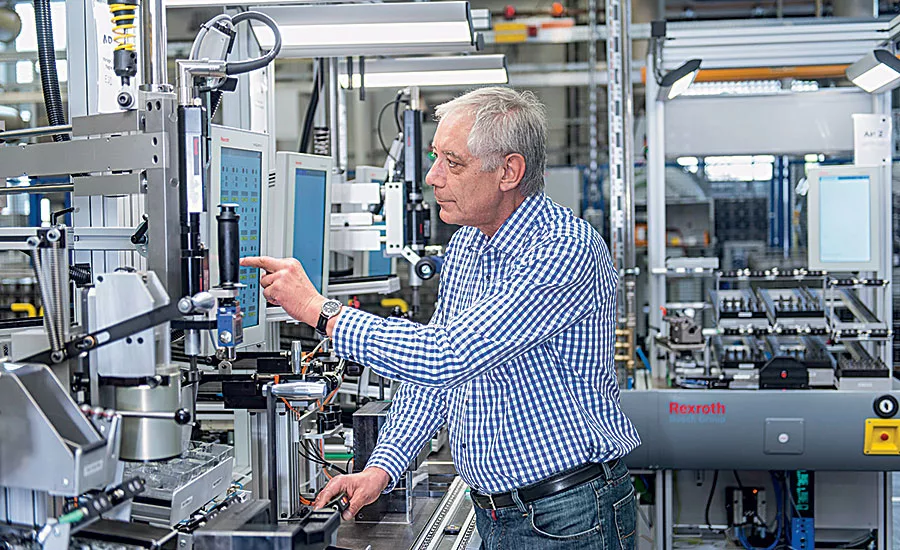
Each worker carries a Bluetooth tag that stores manufacturing-related information about that person and automatically transmits it to the assembly station. The station then automatically adjusts itself based on the worker’s preferences. Photo courtesy Bosch Rexroth Corp.
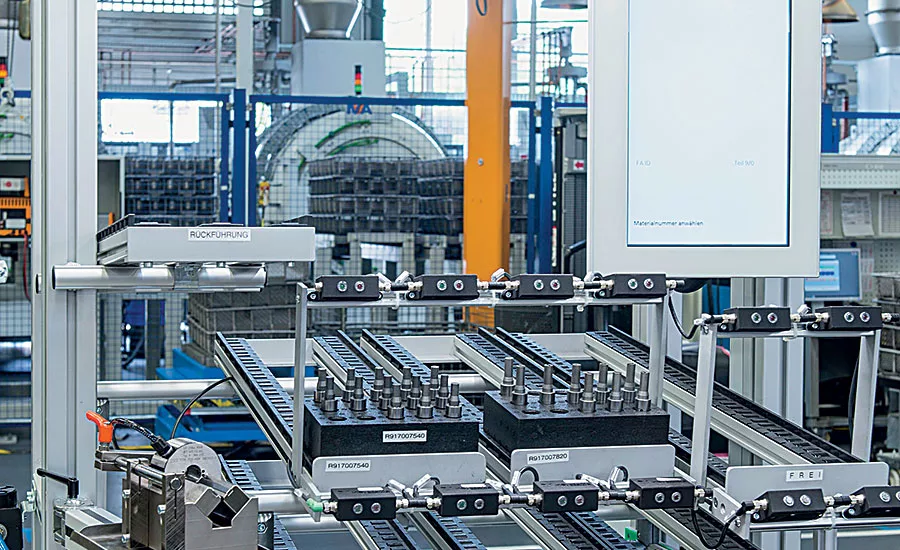
The connected industry line has many features that make assembly tasks easier, such as displaying text on screen in the best font size and language for the worker. Photo courtesy Bosch Rexroth Corp.
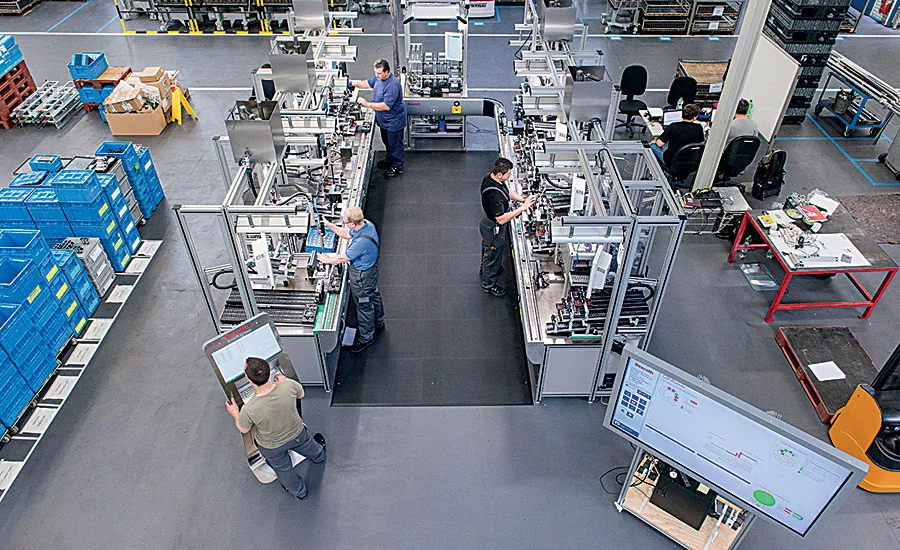
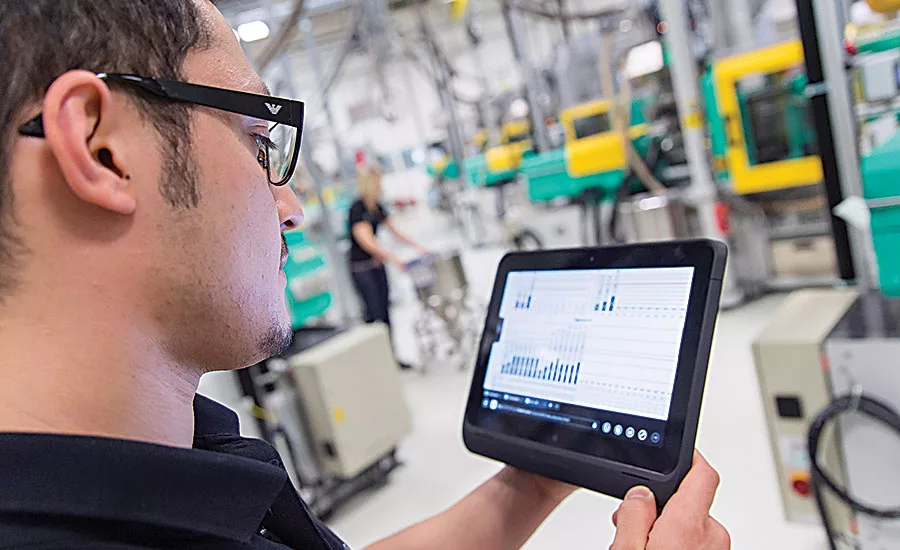
To better manage the assembly process, workers receive key data on a tablet in real time. Photo courtesy Bosch Rexroth Corp.
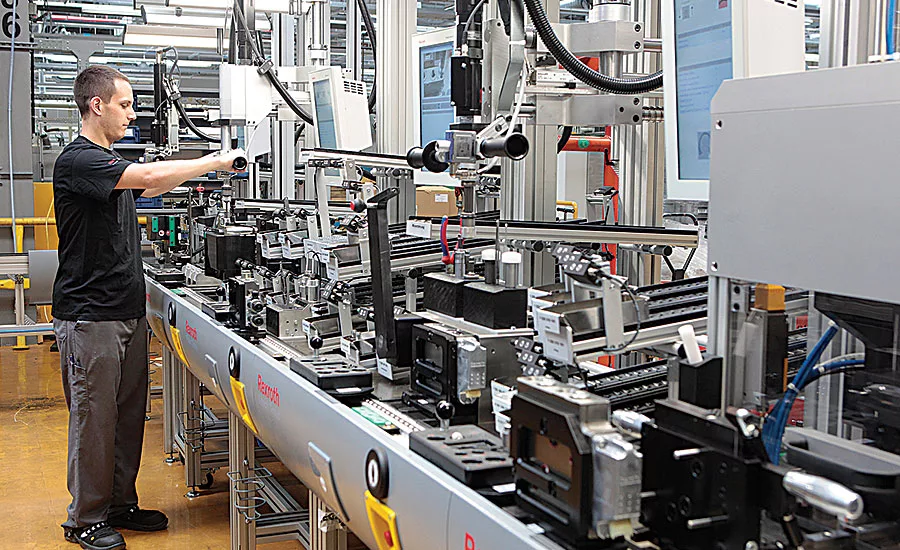
The Rexroth connected industry line allows an extensive product range to be assembled without the need to perform technical or logistical setup tasks. Photo courtesy Bosch Rexroth Corp.
The connected industry line allows products to be assembled economically, even down to batch size one. Photo courtesy Bosch Rexroth Corp.
Bosch Rexroth production planner Nicole Arendt remembers the hottest day of June 2013 very well. That was when she was given the go-ahead for a forward-thinking project at the company’s assembly plant in Homburg, Germany. Not the best of days to be at your most creative, she thought. But that was exactly what was required of the project team as they pondered their options in a meeting room at the invitation of project manager Andreas Jenke.
“We were given the task of building a versatile ‘Industry 4.0’ line,” recalls production planner Berthold Roser. “The subject of this connected industry was nothing new. And it was clear that the new technologies could help us respond to changes in the market with greater speed and flexibility. But at the start, we were certainly asking ourselves what this type of line might actually look like.”
The line would be used to produce electrohydraulic valves for tractors. Together with his colleagues in Homburg, Roser developed the requirements of the project from a plant perspective. Now, these plans have not only become a sophisticated concept, they have turned into an entire assembly line.
No Setup Required
The connected assembly line had its grand unveiling at a production conference in Horb, Germany, in 2014. Its development was characterized by one thing above all else: lots of discussions.
“Working in a cross-divisional team was completely new to me,” explains Arendt. “In particular, the interfaces between logistics and production, production planning and central IT are extremely important for the new line.”
To implement the project, engineers and managers worked together in a constructive way to implement new and innovative ideas. Arendt herself is providing technical support for the assembly line.
“I have been involved from the beginning and have been able to use my product knowledge to contribute to the planning process,” she says.
The new line allows an extensive product range to be assembled without the need to perform technical or logistical setup tasks. Some 2,000 components, 200 valve variants and six product families can currently be produced on the new assembly line.
“As soon as production and logistics became involved in the project, the more beneficial it became,” says Roser. “That’s because those of us in planning didn’t know what improvements in ongoing operations had been integrated into existing lines. We were able to use this knowledge for the new line.”
Individual Workstations
The line is packed with features that make tasks easier for workers. The assembly stations automatically adjust themselves individually to workers based on their preferences. Flat screens display text in the best font size and language for each individual. Information about the assembly steps is displayed in the appropriate level of detail, depending on each worker’s qualifications. Each associate carries a Bluetooth tag that stores his or her information and automatically transmits it to the assembly station.
“Our focus has always been on connecting humans, machines and products to increase agility, accelerate processes, and manage the wide variety of products,” explains Tim Brügge, assistant to the technical plant manager in Homburg.
“By providing context-sensitive information, we have been able to implement a highly intuitive user guidance system that focuses on the people in the value-adding process,” adds Jenke.
The workpiece carrier for each product also carries an RFID chip containing that product’s identification number. The workpiece carrier guides the product along the line and requests all the operations and materials required for assembly from the individual workstations.
Aside from intelligent workstations and products, what differentiates the connected industry line from its predecessors? “Decentralized production planning is the key element,” Arendt explains.
In the future, the line will no longer be controlled from a central enterprise resource planning system. Instead, the machines on the shop floor can plan for themselves. They report when they are available, when they require maintenance, and when any faults occur.
One important element is activeCockpit. This manufacturing coordination and control system, developed by Rexroth, uses apps with flexible enhancement options. “As has always been the case, a real person will still make the final decisions,” says Arendt. “But their planning processes will be supported by the fact that all information will be available immediately.”
From Nucleus to Production Network
Networking and Industry 4.0 help Bosch manage complexity. “There are three important requirements for Rexroth: To increase our ability to absorb rapid changes in the market, to be able to get our products on the market quicker, and to be able to cover the wide range of products with lower costs,” says Frank Hess, technical plant manager. “Overall, we see this as a way to increase our competiveness, including at site level.”
In the future, the networked approach will make this possible. “During implementation, it was important to follow the principles of our Bosch Production System in a consistent way. This system is the basis for the new and forward-looking connected industry solutions,” says Jenke.
“The new line is the nucleus for us,” adds Hess. “Taking this as a starting point, we will add the individual applications and features to the value stream. That is the next step: integration from the supplier right through to the customer.”
After that, the third step will be to harness the intelligence of the products and provide added value and services to the customer. Or in other words, to develop new business models. One vision is of a final product that informs the customer when it needs servicing or must be replaced, and at the same time places an order with the plant and the supplier.
Rexroth’s major objective is not just for production plants around the world to be linked to the connected industry standard, but to be organized on a decentralized basis. “All information and data will be available via the cloud, controlled by a lead plant,” explains Hess.
Increased Transparency and Safety
Arendt and logistics manager Moritz Hoffmann are working to make sure this happens. Together, they consider how provision of materials to the new line might work. This is no easy task.
“A multi-product line does, of course, have a lot more components,” says Hoffman. “This makes it more challenging to make sure we always have everything in the right number and in the right place at the right time.”
In addition, the new line has to be integrated into the logistics of the plant and the other lines. Hoffmann is also working on the long-term objective of extending logistics to include suppliers and customers.
“The borders between companies will become blurred,” he says. “We will work on an increasingly interconnected basis and exchange more information.”
But initially, he hopes that the new line will offer greater security in planning, since the digitization of data allows weaknesses to be identified more quickly—before they become a problem.
“In the future, we will see much sooner if there is a problem looming,” explains Arendt. “We can reduce downtime, because we will receive a signal from individual components at an earlier stage. The spare part order will then be placed before the need for maintenance arises.”
All the project participants are excited about the availability of data. And Hess is pleased that Rexroth has taken a strategic step toward Industry 4.0.
“Rexroth is the lead supplier of automation components and connected industry features,” he says. “But this means we are also actively positioned as the key user. This allows us to demonstrate the possibilities provided by factory automation components to our customers. In this sense, the new line offers us a fantastic testing ground and helps us to make a sustainable increase in our competitiveness.”
For more information about Industry 4.0, click here: http://tinyurl.com/j3ps5vm. For a video about the connected assembly line at Bosch, click here: http://tinyurl.com/zfvroe4.
Looking for a reprint of this article?
From high-res PDFs to custom plaques, order your copy today!


