Assembly Magazine logo
search
Ask ASSEMBLY AI
cart
facebook twitter linkedin youtube
  • Sign In
  • Create Account
  • Sign Out
  • My Account
Assembly Magazine logo
  • TRENDS
    • Ask ASSEMBLY AI
    • Trends
    • News
    • New Products
  • INDUSTRIES
    • Aerospace
    • Appliance
    • DFMA Assembly
    • Medical Devices
    • Green Manufacturing
    • Lean Manufacturing
    • Machinery Assembly
    • Electronics Assembly
    • Automotive
  • TECHNOLOGIES
    • Adhesives & Dispensing
    • Assembly Presses
    • Automated Assembly Systems
    • Manufacturing Management
    • Manufacturing Software
    • Motion Control
    • Screwdriving & Riveting
    • Robotics
    • Test & Inspection
    • Plastics & Metal Welding
    • Wire Processing
    • Workstations
  • AUTONOMOUS & ELECTRIC MOBILITY
    • AEM Magazine Archives
    • Autonomy
    • Electrification
    • Mobility Services
    • Assembly & Testing
    • AV/EM News
  • MEDIA
    • Ask ASSEMBLY AI
    • Podcasts
    • Assembly News Now
    • Assembly TV
    • Webinars
    • eBooks
  • EVENTS
    • Calendar
    • The ASSEMBLY Show
  • MORE
    • Exclusives >
      • Plant of the Year
      • Capital Spending
    • Buyers Guide >
      • Supplier Insights
    • Classifieds
    • Featured Products
    • Newsletters
    • Store
    • White Papers
    • Columns
    • Sponsor Insights
  • INFOCENTER
    • Assembly & Test Solutions
  • EMAGAZINE
    • eMagazine
    • Archive Issues
    • Advertise
    • Contact Us
    • Sign Up
Adhesives & Dispensing Assembly

New Mixer Optimizes Adhesive Performance

An innovative, square-shaped static mixer conserves two-component materials, speeds curing, and enhances bond strength.
By Anthony Martucci
New Mixer Optimizes Adhesive Performance

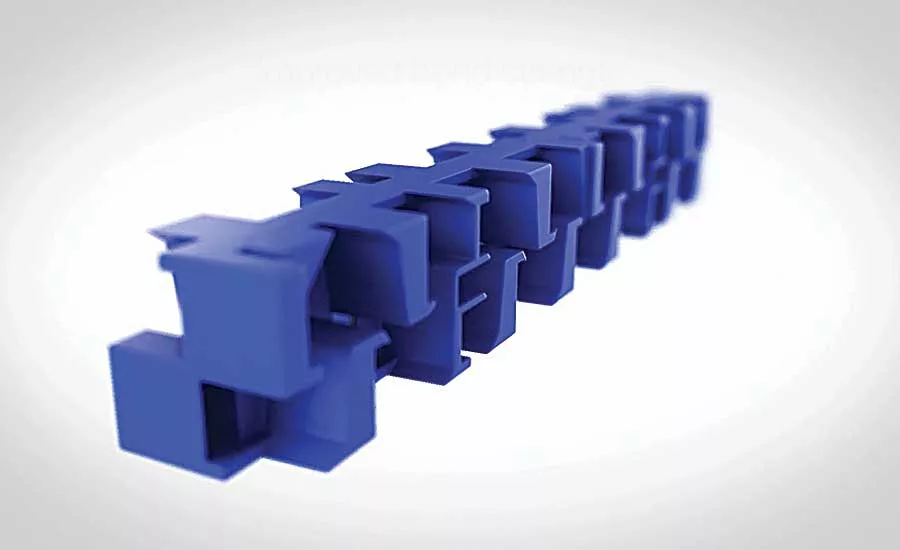
Computer-aided design software and analysis of fluid dynamics played major roles in the development of a novel, square mixing architecture for two-component adhesives. Photo courtesy Nordson EFD
New Mixer Optimizes Adhesive Performance

Although static mixers have long been based in round mixing chambers, mathematical analysis indicated that a square geometry would actually provide more efficient and effective mixing. Photo courtesy Nordson EFD
New Mixer Optimizes Adhesive Performance

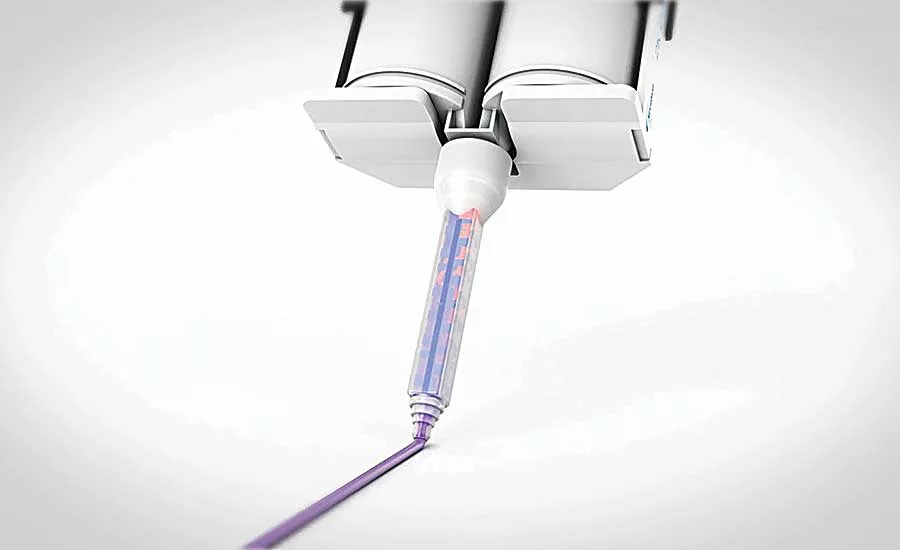
Once specific amounts of resin and hardener are metered out, the two materials pass through a static mixer to thoroughly blend the two fluids. This ensures complete curing and full realization of the adhesive’s properties. Photo courtesy Nordson EFD
New Mixer Optimizes Adhesive Performance

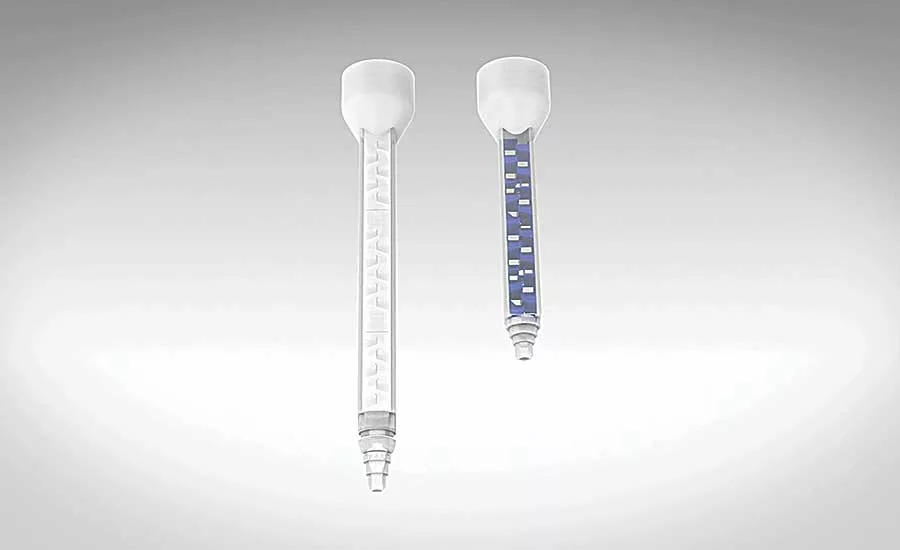
EFD’s new square static mixer is 20 percent shorter than comparable square-geometry mixers. That means 30 percent less adhesive is retained in the mixer when it comes time for disposal. Photo courtesy Nordson EFD

New Mixer Optimizes Adhesive Performance
January 6, 2017

Two-component adhesives are widely used for assembly in numerous industries, including aerospace, automotive and construction. Applied correctly, these adhesives provide strong, durable bonds.

Adequately mixing the two components greatly affects the final bond strength. Once specific amounts of resin and hardener are metered out, the two materials pass through a static mixer to thoroughly blend the two fluids. This ensures complete curing and full realization of the adhesive’s properties.

As part of our ongoing research to improve mixing techniques, we recently developed a new static mixing approach with noteworthy capabilities. Our new square static mixer is approximately 20 percent shorter in length than comparable square-geometry mixers. That means some 30 percent less adhesive is retained in the mixer when it comes time for disposal.

That figure is even better when the new mixer is compared with spiral mixers. The new design retains 50 to 60 percent less fluid than a spiral mixer.

And, compared with conventional mixers, our new design has been shown to improve the bonding quality of widely used adhesives and sealants.

Number Crunching

The new square mixer technology is a result of extensive study of fluid dynamics and understanding how the characteristics of the two fluids, such as their aggregate viscosities, can change during a nonlinear mixing process. Fluids can mix in various ways, for example, by random mixing, chaotic mixing, and laminar mixing. Fluid motions change as a function of time, and the main challenge in developing an improved mixing approach for adhesives was to produce a homogeneous combination of the two fluids in the shortest distance and the shortest time possible.

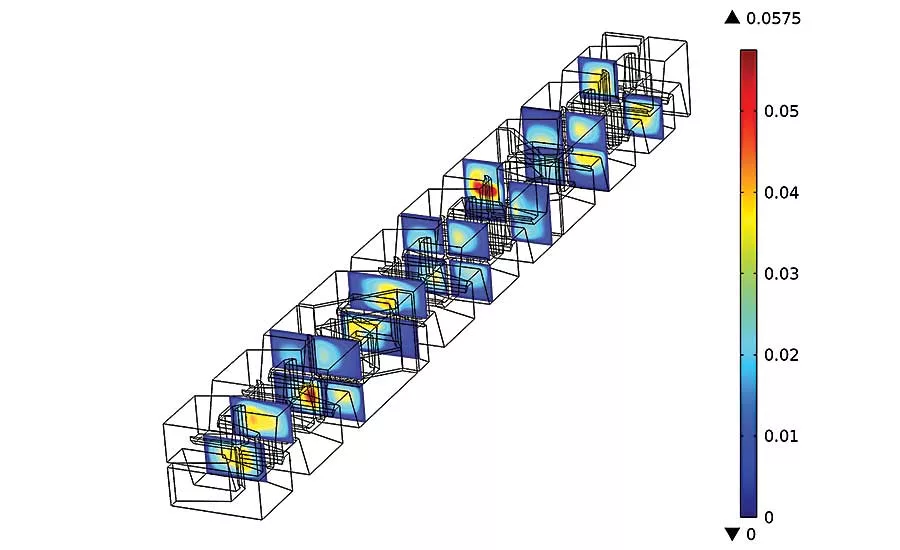
Software was an important tool in developing the new square mixer. We used mathematical analysis of probability density functions to predict mixing rates for various mixer geometries. Although static mixers have long been based in round mixing chambers, our mathematical analysis showed that a square geometry would actually provide more efficient and effective mixing results. The square geometry promotes laminar mixing, which we found to require less energy to achieve a desired mix quality.

Looking for quick answers on assembly and manufacturing topics? Try Ask ASM, our new smart AI search tool. Ask ASM →

In addition to commercial simulation and design software, we used our own proprietary analysis software to develop our new mixer. Two years in the making, our software predicts flow patterns and results from mixing two fluids with different mixing geometries, different inlet shapes, and different fluid paths and angles. The software potentially saved years of trial-and-error study by making it possible to simulate hundreds of different mixing geometries, fluid path angles and nozzle openings before determining likely candidates for prototyping.

The result of our research is a new line of square, disposable mixers, the OptiMixer Series 480 mixers. Depending upon required volume and length, the mixers use different numbers of wedge elements to achieve optimum mixing results.

The mixer elements are 8.7 millimeters wide, and mixers are available with nine, 17, 25, 33 and 41 mixing elements. The number of elements determines the housing length and retained volume. Housing lengths range from 7.4 to 20.6 centimeters. Inlets are either an integral nut or bell. Outlets are barbed or stepped.

Testing Progress

To better understand the capabilities of the new mixers, we put them to the test with various two-part adhesives. We wanted to know if better mixing would equate to better adhesive performance.

Four two-part adhesives were used in the testing: a structural adhesive, a urethane, a silicone gasketing material and a high-strength epoxy. The adhesives were supplied in 400-milliliter side-by-side cartridges. They were dispensed using a Loctite pneumatic gun.

Three different conventional, disposable, static mixers were tested against 25- and 33-element OptiMixers.

Five samples were bonded with each combination of mixer and adhesive. Bonding surfaces were cleaned with isopropyl alcohol prior to application of the adhesives. Each adhesive was applied to a 5-inch-wide lap shear specimen, and a second 5-inch specimen was then mated to the first with a
0.5-inch overlap. The assemblies were then clamped with an 87-pound weight and allowed to cure for seven days at ambient temperature. The shear strength of each bond was then measured according to ASTM D1002-05 requirements.

In all cases, the adhesives dispensed from OptiMixers yielded higher bond strengths than those applied with the conventional mixers. In addition, bond strength variation among the five samples was less for material dispensed through OptiMixers than that for adhesives dispensed through the other mixers.

For example, when the epoxy was dispensed with the OptiMixer, the average shear strength at failure was 1,677 psi. In contrast, the same epoxy blended with a conventional mixer provided an average shear strength of 1,338 psi at failure.

As significant, the OptiMixer maintained repeatable shear strength numbers for all five epoxy samples, from a low of 1,298 psi to a high of 2,282 psi, resulting in a standard deviation of 384 psi. The other mixer used in the testing gave a wide range of shear strength values, with a much greater standard deviation of 807 psi across the five test samples.

Similar results were obtained with the structural adhesive, a two-part methacrylate acrylic formulation. When dispensed through a standard mixer, the adhesive yielded a shear strength ranging from 1,998 to 2,549 psi, for an average of 2,333 psi. When the same adhesive was dispensed through the longer of the two OptiMixers, the shear strength ranged from 2,496 to 2,947 psi, for an average of 2,787 psi.

For more information on mixers and dispensing technology, call 800-556-3484 or visit www.nordsonefd.com.

KEYWORDS: dispensing two-part materials meter-mix-dispense equipment

Share This Story

Looking for a reprint of this article?
From high-res PDFs to custom plaques, order your copy today!

Anthony Martucci, Product Line Manager, Nordson EFD, East Providence, RI

Recommended Content

JOIN TODAY
To unlock your recommendations.

Already have an account? Sign In

  • Made in the U.S.A.

    Consumer Products Manufacturing: Made in the USA

    Supply chain lessons learned during the coronavirus...
    Automated Assembly Systems
    By: Austin Weber
  • Best Practices for Press-Fit Assembly

    Best Practices for Press-Fit Assembly

    In manufacturing, ironclad formulas for success are hard...
    Assembly Presses
    By: Jim Camillo
  • aem0523leader-tesla1.jpg

    Tesla Rethinks the Assembly Line

    Engineers at Tesla Inc. have developed a new process that...
    Electrification
    By: Austin Weber
Manage My Account
  • eMagazine Subscription
  • Assembly Newsletters
  • Online Registration
  • Subscription Customer Service
  • Manage My Preferences

More Videos

Sponsored Content

Sponsored Content is a special paid section where industry companies provide high quality, objective, non-commercial content around topics of interest to the ASSEMBLY audience. All Sponsored Content is supplied by the advertising company and any opinions expressed in this article are those of the author and not necessarily reflect the views of ASSEMBLY or its parent company, BNP Media. Interested in participating in our Sponsored Content section? Contact your local rep!

close
  • ultrasonic welding
    Sponsored bySonobond Ultrasonics

    Engineering Efficiency in High-Performance Assembly: How Ultrasonic Welding Enhances Throughput, Reliability and Quality

  • UV curing system
    Sponsored byDymax

    Why UV Intensity Alone Doesn’t Define Curing Performance

  • wooden pallets
    Sponsored byLEAN Manufacturing Products

    Eliminating Waste on the Shop Floor: Applying Lean Principles to Improve Manufacturing Efficiency

Popular Stories

ASSEMBLY News Now, episode 30: Volvo Redesigns EV Manufacturing

Volvo Redesigns EV Manufacturing

Boeing CEO Kelly Ortberg announces 1 billion investment

Boeing Plans $1 Billion Wichita Investment, Workforce Training Center

GE Appliances Worker on Line

GE Appliances Expands Factory AI With 800 Gemini Enterprise Agents

Watch the latest episode of ANN now!

Events

July 24, 2025

From Shop Floor to CFO: How Manufacturers Are Closing the Loop Between Operations and Finance

On Demand Learn how manufacturers are bridging the gap between the shop floor and ERP systems to gain real-time visibility, streamline operations, and kick-start digital transformation—without waiting years.

Sponsored by:

PicoStratusGreen
July 30, 2025

Buffer Analysis and Design Fundamentals for Manufacturing Excellence

On Demand In this presentation, Dr. Herman Tang shares practical insights from his industry experience and research on buffer management in manufacturing operations.

View All Submit An Event

Poll

Difficult Assembly Processes

Which assembly process gives you the most difficulty?
View Results Poll Archive

Products

Manufacturing Cost Policy Deployment (MCPD) Profitability Scenarios: Systematic and Systemic Improvement of Manufacturing Costs

Manufacturing Cost Policy Deployment (MCPD) Profitability Scenarios: Systematic and Systemic Improvement of Manufacturing Costs

See More Products
Register for webinar - Modernizing Automotive Assembly: Why Upgrading Legacy MES is a Business Imperative

Related Articles

  • Assembly in Action: Surface Treatment Ensures Adhesive Performance

    See More
  • Festo's VTUX valve terminal

    Valve Terminal Optimizes Machine Performance

    See More
  • SCIGRIP® SG2000.jpg

    IPS Adhesives Introduces High-Performance Two-Part Adhesive

    See More

Related Products

See More Products
  • Testing Adhesive Joints: Best Practices

  • 0001349.jpeg

    Adhesion and Adhesives Technology 4e

  • november 2019 assembly

    ASSEMBLY November 2019 Issue

See More Products

Related Directories

  • Re Mixers Inc.

    Re Mixers, Inc. manufactures Xemex Mixing Nozzles, a revolutionary new static mixer technology offering optimal adhesive mixing with 75% less waste. Through vertically integrated manufacturing processes, Re Mixers offers unparalleled supply chain security and order fulfillment capabilities. Contact us directly to learn about all of our dispensing equipment solutions.
  • Avery Dennison Performance Tapes

    Avery Dennison Performance Tapes is a world-class operation focused on developing and manufacturing high-performance pressure-sensitive adhesives and tapes for a broad range of applications in automotive, appliances, electronics, building and construction, specialty industrial and personal care segments. The organization has more than 50 years of experience supplying standard and customized pressure-sensitive materials designed to deliver innovative solutions for customers’ needs across the globe. Worldwide manufacturing facilities ensure a global presence supported by local sales, technical and customer service throughout the regions.
  • Adhesives Research Inc.

    Adhesives Research is a global leader in providing adhesive design flexibility, fast development capabilities, combined with unique turnkey solutions. Adhesives Research has a broad range of commercially available products and specially developed adhesive and coating platform technologies for the bonding, assembly and functional performance of Medical devices, Electronics and Industrial applications.
×

Never miss the latest news and trends driving the manufacturing industry

Stay in the know on the latest assembly trends.

JOIN TODAY!
  • RESOURCES
    • Advertise
    • Contact Us
    • Directories
    • Manufacturing Division
    • Store
    • Want More?
  • SIGN UP TODAY
    • Create Account
    • eMagazine
    • Newsletters
    • Customer Service
    • Manage Preferences
  • SERVICES
    • Marketing Services
    • Reprints
    • Market Research
    • List Rental
    • Survey/Respondent Access
  • STAY CONNECTED
    • LinkedIn
    • Facebook
    • Instagram
    • YouTube
    • X (Twitter)
  • PRIVACY
    • PRIVACY POLICY
    • TERMS & CONDITIONS
    • DO NOT SELL MY PERSONAL INFORMATION
    • PRIVACY REQUEST
    • ACCESSIBILITY

Copyright ©2026. All Rights Reserved BNP Media, Inc. and BNP Media II, LLC.

Design, CMS, Hosting & Web Development :: ePublishing