Low-Profile Conveyors Move Small Parts for Assembly
Low-profile belt conveyors and pallet-transfer conveyors are popular—and precise—methods of moving small parts for assembly.
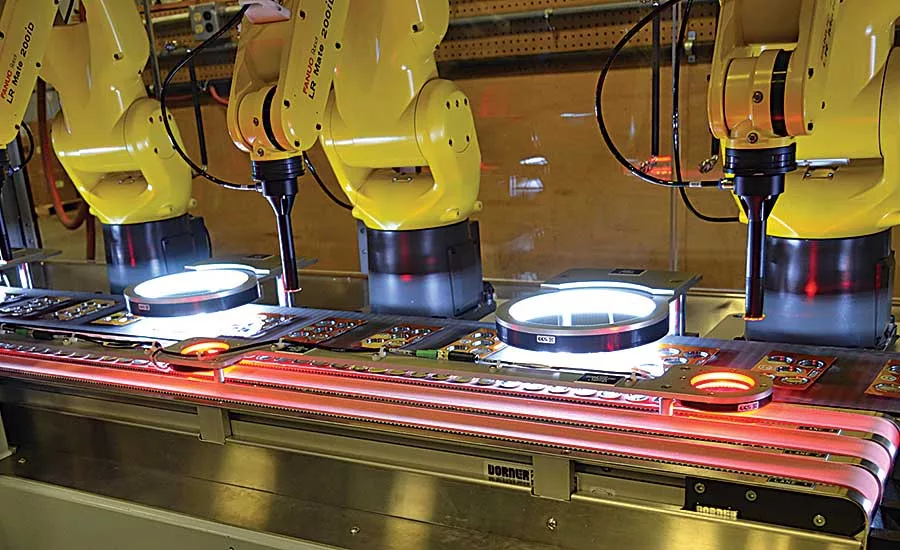
In this automated assembly application, vision guided robots are integrated with Precision Move conveyors to inspect and accurately place coins into presentation cases. Photo courtesy Dorner Co.
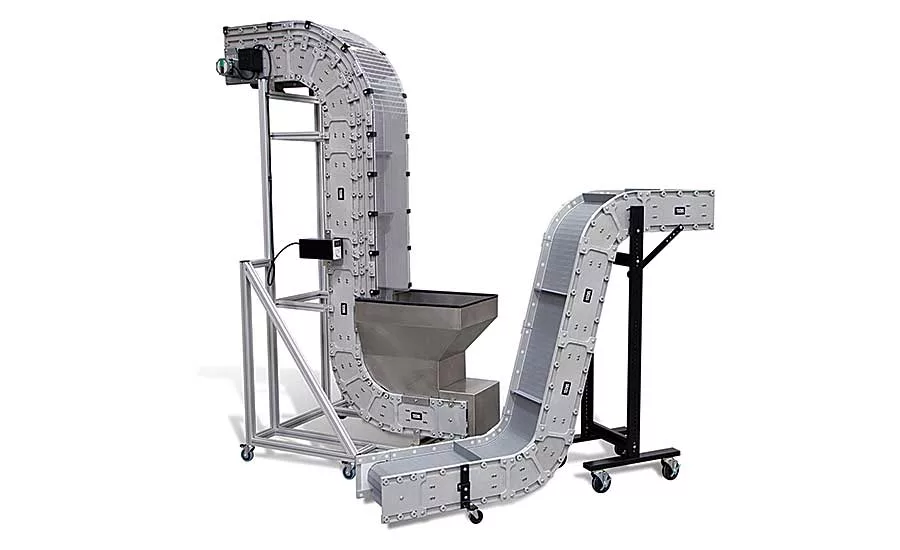
DynaCon vertical lift conveyors are compact and flexible, with a wide array of choices regarding length, width, inclines, declines and belt styles. Photo courtesy Dynamic Conveyor Corp.
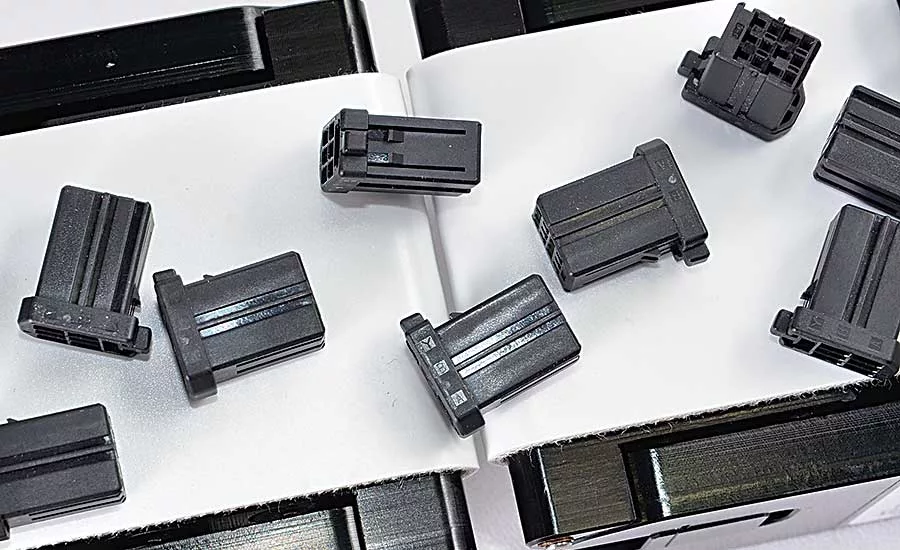
Low-profile modular conveyors ensure error-free transfer of parts from one belt to another. Photo courtesy QC Industries Conveyors
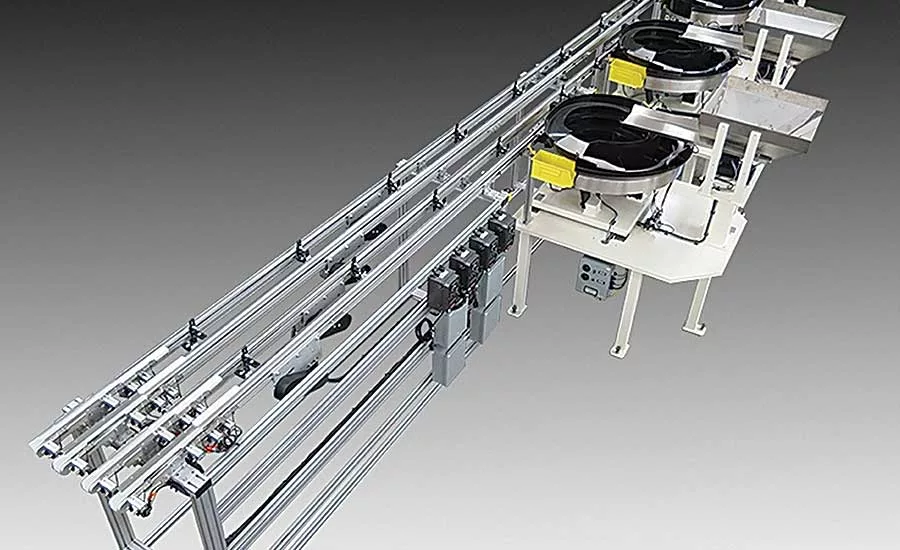
Four Auto-Kinetics Model 55 belt conveyors (shown integrated with four custom vibratory feeders) have a T-slotted, extruded aluminum frame that allows for quick and easy reconfiguration. Photo courtesy Performance Feeders Inc.
Of all the things that conveyors have moved the past 222 years, none is more iconic than the small chocolate candies that overwhelmed Lucille Ball and Vivian Vance working on the assembly line in September 1952. Humor aside, the skit made clear the importance that conveyors, in particular (and automation, in general), played at American factories just a few years after WWII.
Since then, several companies have used conveyors to create memorable ad campaigns. One of the most notable was for M&Ms, which featured its large peanut mascot overseeing an industrial conveyor in a plant.
Other companies’ ads feature a rodent on a short conveyor or treadmill to represent the ‘rat race’ of life, so to speak, where the animal is unable to improve its circumstances until it uses the product being advertised. QC Industries Conveyors is quite familiar with that type of conveyor, having supplied 2-by-12-inch treadmills for lab rats at the University of Cincinnati in the past.
“This type of conveyor definitely falls under the specialty category for us,” notes Brad Marx, engineering manager at QC Industries. “Normally, we provide manufacturers in the pharmaceutical, stamping, automotive, medical, white goods and consumer electronics industries with low-profile conveyors that move small parts into, out of and through workstations or machines.”
Equipment suppliers offer several types of conveyors that move small parts quickly and accurately. The most popular type for several decades has been low-profile belt conveyors, which keep parts properly oriented at all times and can be equipped with many types of belts.
When the application requires moving one or more parts for multiple assembly or inspection processes, many companies find that linear pallet-transfer conveyors are a better option. These stand-alone systems feature a square or rectangular pallet that is carried by single or dual strands of a belt or a roller chain within an extruded aluminum profile.
A Scrappy Start
Several sources cite 1795 as the year the first conveyor was used. It featured a leather belt running over a wooden bed, and was powered with hand cranks and a series of pullies. The conveyor’s main purpose was to transport farm goods onto ships at port. As decades passed, conveyors evolved and became standard equipment in factories in every industry.
Looking for quick answers on assembly and manufacturing topics? Try Ask ASM, our new smart AI search tool. Ask ASM
However, the low-profile belt conveyor so popular today didn’t appear until the early 1970s. At that time, brothers Wolfgang and Horst Dorner (founders of the Dorner Co.) were unable to find a conveyor with a low-enough profile to efficiently remove scrap and parts from under their dies. So they decided to build their own. The brothers developed and patented a small radial thrust bearing, and worked with belting companies to obtain a flexible, durable belt that wrapped around small-diameter rollers. In 1973, the Dorner Co. introduced its low-profile 4100 industrial conveyor to handle both large and small parts.
“The term ‘small part’ is relative, but we consider it to be no more than 0.5 inch wide and 2 inches long,” explains John Kuhnz, vice president of engineered solutions at Dorner. “Low-profile belt conveyors are definitely the best option when it comes to moving large amounts of small parts. Our customers use them to move everything from glass marbles and hand-grenade components, to small food pieces and parts of tiny scissors.”
“It’s essential for the supplier to fully understand what the end-user means by a ‘small part,’” says Paul Kuharevicz, engineering manager at Dynamic Conveyor Corp. “For that specific company, a small part may be something much tinier than a water-bottle cap.”
Some manufacturers start out using low-profile belt conveyors to move small parts, while others are forced to make the switch to optimize productivity. Marx says some companies install belt conveyors to end the time-consuming practice of manually loading parts into bins and then moving them to workstations.
Kuharevicz recalls why one well-known manufacturer of small aluminum parts switched from an air-conveyance system to a belt conveyor a few years ago. As parts were blown through the long tube, a small percentage would often hit an elbow and become damaged or unusable.
Low-profile conveyors feature a steel, stainless steel or extruded aluminum frame and come with a wide range of belts. Sometimes belts contain various chemical additives to enhance their resistance to cleaning agents like alcohol and chlorine.
Dorner offers 10 standard types, including flat and cleated, but can custom-build up to 100 specialty types. Typical belt materials include urethane-polyester, PVC-polyester, nitrile rubber, acetal plastic and various resins, notes Kuhnz. Thicknesses range from one to several ply, and the belts always flex as they move.
Mark Buck, sales manager for conveyors at Performance Feeders Inc., says a vacuum belt is one way to keep parts properly oriented as a conveyor slightly changes in elevation. This belt features perforations that draw air through grooves in the bed of a standard conveyor.
Manufacturers in every industry operate low-profile belt conveyors. Buck says GE Appliances uses his company’s conveyors to orient and feed small parts to a robot that quickly assembles refrigerator doors. Performance Feeders also provides conveyors to manufacturers of medical devices, pharmaceuticals, consumer goods and automotive products. This May, for example, the supplier will provide several conveyors to an automotive Tier 1 company. These conveyors will receive small parts from feeding lines and transfer the parts to workstations for assembly.
The supplier’s Auto-Kinetics Model 55 belt conveyors feature a T-slotted, extruded aluminum frame that is durable and allows quick and easy reconfiguration. Standard features include a 16-gauge stainless steel wear
surface, sealed ball bearings on all pulleys and a center-drive module that can be positioned anywhere along the conveyor. Available belts are hard- or soft-top urethane, lattice- or rough-top friction, and FDA-approved for food and pharmaceutical applications.
Dynamic Conveyor supplies many conveyors to makers of medical devices and companies that injection-mold plastic products for the cosmetic and automotive industries. Among the medical devices its conveyors move along assembly lines are single-use intravenous syringes.
DynaCon vertical lift conveyors from Dynamic Conveyor are compact and flexible, with a wide array of choices regarding length, width, inclines, declines and belt styles. Powered by an energy-efficient electric motor, the conveyor has a lift capacity of 100 pounds. It is available in standard widths from 4 to 60 inches, and features durable yet lightweight plastic side panels. DynaCon can be kept free standing to add to an existing system, or included with a multi-stacked conveyor system. Standard accessories include those for metal detection, clean rooms, water tanks, cooling fans, box filling and split belts.
To move small electronic components, suppliers offer belts with an embedded electrically conductive static inhibitor. Marx says this feature enables many electronics manufacturers to safely move PCBs and related parts throughout their plants. One medical-device customer conveys cervical spatulas. A fastener supplier uses one QC Industries conveyor to move metal pieces to a feeder for a screwmaking machine, and another conveyor to move the finished screws out of the machine.
“Transferring small screws or metal pieces from one conveyor to a feeder or another conveyor can be problematic,” notes Marx. “These small items can get stuck under side rails, which can lead to belt damage. The best way to prevent this is making sure the conveyor has either a seal at each side, or a corrugated rubber sidewall welded to the belt.”
QC Industries’ AS40 end drive belt conveyors feature a Pivot rotatable drive and an optional nosebar tail to aid movement of small parts. This tail has an 11-millimeter outer belt diameter to ensure error-free transfer of parts between belts. It is available for all standard conveyor widths, and pushing and pulling applications.
Also standard are single-piece, rigid aluminum frames (for conveyors up to 12 inches wide), large (35-millimeter) sealed ball bearings, and crowned drive pulleys that ensure proper belt tracking. The conveyors move parts up to 400 fpm. Tension-release tails allow for easy under-belt cleaning and belt changes.
Pharmaceutical and medical-device manufacturers frequently use the Aquagard 7200 series conveyor from Dorner. It features FDA-approved belting that is 1.75 to 18 inches wide and travels up to 264 fpm. The conveyor is 2 to 18 feet long, handles loads up to 60 pounds and is equipped with a 1.25-inch-diameter drive pulley that turns 4.25 inches of belt per revolution. All gearmotors and controls are wash-down rated. The series includes Conformite European models.
Power of the Pallet
Pallet-transfer conveyors are growing in popularity for several reasons. They quickly move parts to a precise spot, provide independent control over individual pallets, and offer design flexibility. The conveyors can be arranged side-by-side; in a rectangular, carousel or serpentine pattern; or stacked one atop the other.
During operation, friction within the belt or chain strands move the pallet, which is only supported on its edges. When the pallet encounters another pallet or a gate, it stops and the strands slide freely beneath it.
Some companies make lift-and-tilt and lift-and-rotate modules to facilitate manual assembly operations. Also available are lift-and-locate units that slightly raise pallets off the conveyor for automated processes.
Belts (made of static-dissipative rubber) are recommended for high-precision applications because they generate more friction than a roller or flat-top chain. However, they are also more difficult to repair or resize.
Roller chain (consisting of steel and plastic rollers linked together in a chain) is better suited for sensitive or heavy products because it accelerates the pallet slowly after stopping. Flat-top chain (roller chain topped with flat caps of low-friction plastic or steel) flexes from side to side, making it ideal for carousel and serpentine layouts.
According to Kuhnz, medical and automotive manufacturers frequently use pallet-transfer conveyors in applications involving small parts that undergo multiple assembly processes. One Tier 1 automotive supplier customer uses the company’s Precision Move 2200 pallet conveyor to move 12 small parts to multiple automated workstations that build a brake caliper subassembly.
System pallets are 160, 240, 320, 400 or 480 millimeters wide, and they move on twin conveyors up to 24 feet, 7 inches long. The system features lifting and corner modules, and a unique pin tracking system that guides pallets through 90-degree turns. It also allows operators to quickly change belts without removing the conveyor, which is clean room Class 100 certified.
Some transfer systems feature cushions that bring pallets to a gentle halt. Others have dowel pins at stop locations that engage holes in the pallet for precise positioning. Guide rails, which are located below the conveyor track and match corresponding slots underneath the pallet, also improve accuracy.
When downward force is exerted on the pallet, such as during a pressing operation, cams can be used to lift the pallets instead of pneumatic cylinders. To prevent pallets from tipping, hold-down rails can be attached to the track sides. These rails are tall enough to slide into the slots and stabilize the pallet, but not so tall that they lift the pallet off the strands.
FlexLink Systems Inc.’s X65 pallet conveyor has a maximum operating speed of 120 meters per minute and a low-friction design that enables it to handle products up to 1 kilogram. Also beneficial are the platform’s quiet operation and easy integration into process control systems, such as track and trace.
Looking for a reprint of this article?
From high-res PDFs to custom plaques, order your copy today!