Ammunition Sealants and Bullet Pull Strength
UV-curing external ammunition sealants can make bullet pull strength more consistent and thereby improve performance and accuracy.
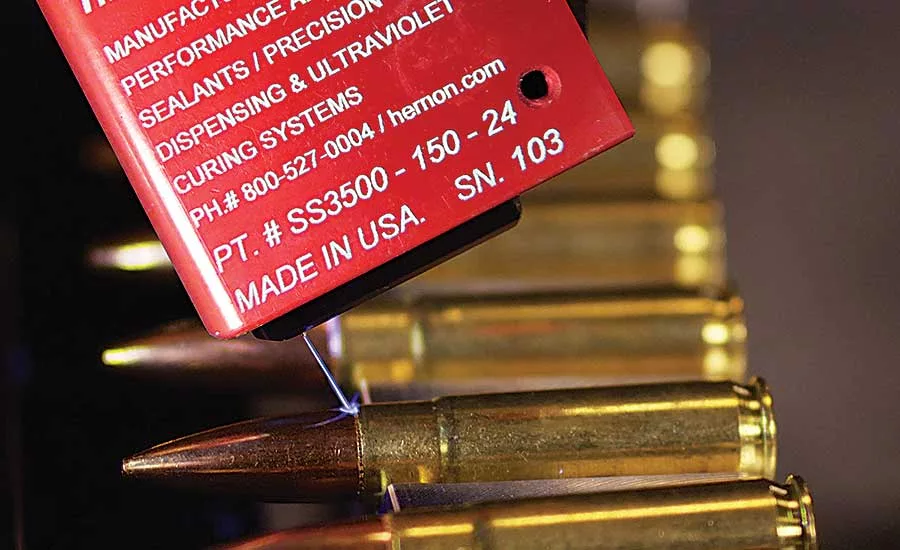
External ammunition sealants are applied with noncontact precision jet valves to the joint line of the cartridge case mouth and bullet. Photo courtesy Hernon Manufacturing Inc.
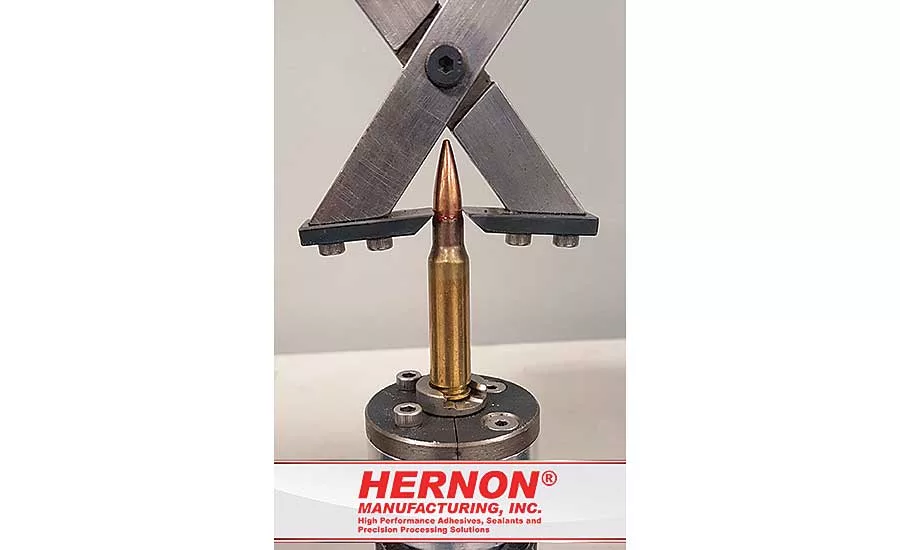
Bullet pull strength is one of the many factors that affect the performance of ammunition. Photo courtesy Hernon Manufacturing Inc.
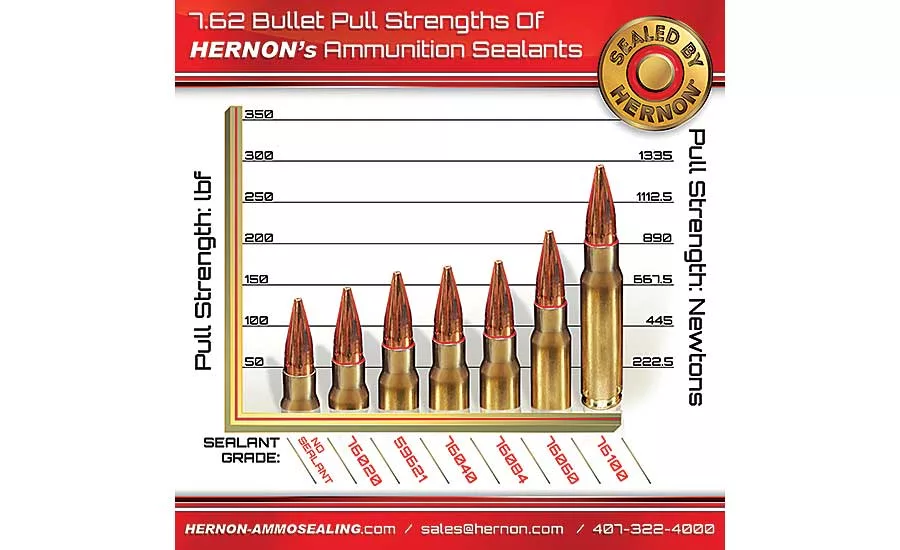
External ammunition sealants are available with a range of tested pull strengths. Which to choose depends on the bullet, the gun, accuracy requirements, and other factors. Source: Hernon Manufacturing Inc.
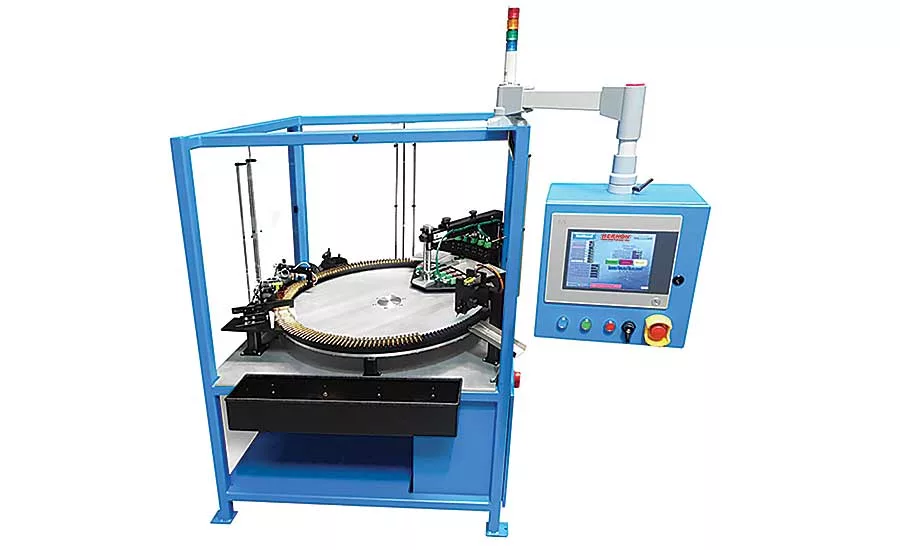
New technology has put automated sealing, curing and inspection systems within reach of any ammunition manufacturer. Photo courtesy Hernon Manufacturing Inc.
Bullet pull strength is the force necessary to separate a bullet from the cartridge casing. This force can vary, depending on the type and size of the ammunition. It can even vary from cartridge to cartridge within the same type and caliber. UV-curing external ammunition sealants can make bullet pull strength more consistent and thereby improve performance and accuracy.
Repeatability is core to a user’s experience with ammunition. The last thing you want when firing a gun is a surprise, and ballistics engineers work tirelessly to produce reliable ammunition that will perform the same way time and time again. The consistency of ammunition is typically measured by analyzing the “tightness” of a shot grouping fired under specified conditions. The pattern is judged by measuring the distance between the most disparate impacts. Anything that can bring the shots into a more concise pattern proves an increase in precision.
Bullet pull strength is one of the many factors that affect ammunition performance in such a test. If the pull strengths vary or are inconsistent around the circumference of the bullet, that variation will often translate into irregular trajectories and impacts for projectiles.
Bullet pull strength is a result of the interaction between the bullet and the case mouth. Several things can affect bullet pull strength, including:
- The relationship between the bullet diameter and the case mouth diameter.
- The hardness of the case or the material finish on the inner walls of the case mouth.
- The bullet material.
- The presence or absence of a metal jacket.
- The sealant used, such as inner-mouth bitumen.
- The mouth crimp.
Traditionally, the primary method to control bullet pull strength has been to physically alter the casing and bullet to adjust the fit. For example, the case mouth can be crimped. Crimping is done to set the minimum force needed to extract the bullet. Crimping also serves to lock the case mouth inside the bullet cannelure. This system works to protect against both crimp jump and bullet setback, which is particularly important for ammunition used in automatic weapons. Without crimping, the bullet might be pushed inside the case during mechanical feeding. This can result in a higher pressure shot, which may be a severe problem during firing.
An Alternative to Crimping
Ammunition sealants were originally developed to protect cartridges against water and other contaminants. Historically, sealants have been asphalt-based (bitumen) and were heavily dosed with solvent to keep the mixture’s viscosity low during application. Once applied, the sealant would need time to become tack-free as the solvent evaporated. This evaporation of solvents resulted in toxic fumes that were potentially harmful to the environment and to process engineers.
Hernon developed UV-curing sealants and ammunition sealing systems to modernize this process. Our external ammunition sealants are 100 percent active with no solvents. This eliminates toxic fumes and allows sealing systems to process ammunition continuously, creating efficiency gains over batch processing methods.
While first developed to protect against water and other contaminants, it was later realized that the sealants could be used to alter bullet pull strength. Using external ammunition sealant, pull strength is set by bonding the projectile to the casing. Because sealants adhere to the casing and projectile with a defined shear strength, ammunition manufacturers can essentially select the pull strength needed to separate the projectile from the casing. If manufacturers would rather just seal the cartridge without otherwise changing the properties of the assembly, they can use a sealant that does not measurably alter bullet pull strength.
Looking for quick answers on assembly and manufacturing topics? Try Ask ASM, our new smart AI search tool. Ask ASM
Using an external sealant to set bullet pull strength can significantly improve ammunition performance compared with crimping. How? Crimping a cartridge adds variables that can make bullet pull strength inconsistent. The consistency and efficacy of the crimp is influenced by tool wear, machine
settings, cannelure depth, cannelure style, and other factors.
Because of these variables, it is common to suppress the mouth crimp for match-grade or sniper-grade ammunition, since those cartridges are usually not fired with automatic weapons. Suppressing the mouth crimp reduces the complexity of the cartridge, avoiding potential issues associated with crimping. The goal is to produce an assembly with more consistent bullet pull strength.
However, unsuppressed crimping is necessary for most ammunition types and uses. External ammunition sealants mask the variables associated with crimping, reducing their consequences and creating more consistent bullet pull strengths.
Because of its low viscosity and wicking properties, the external ammunition sealant is distributed evenly around the cartridge case mouth and base of the projectile. This even distribution results in uniform bullet pull strength and a stable release and flight pattern for the bullet. This claim is evidenced by comparing the standard deviation of bullet pull strength for sealed and unsealed cartridges. Results for sealed rounds have a lower standard deviation. A lower standard deviation of bullet pull strength translates into more consistent bullet velocities, a more reliable trajectory for each bullet, and ultimately a tighter (more precise) grouping on the target.
External ammunition sealants can maximize bullet pull strength at almost 300 pounds. As bullet pull strength increases, so does the pressure inside the ammunition casing prior to the bullet firing. This may be a positive or a negative for ballistics engineers, depending on what they want to achieve. As a result, ammunition sealants are available with a range of tested pull strengths.
Of course, many factors can affect the performance of ammunition, and individual results may vary based upon the manufacturer and cartridge model. How an ammunition sealant is dispensed and cured can also influence results. Changes in how much sealant is applied to the cartridge, the wavelength of ultraviolet (UV) light used to cure the sealant, and the length and intensity of light exposure can all lead to variation in bond strength. Each cartridge type should be tested individually to determine the exact effects.
Dispensing and Curing Sealants
External ammunition sealants are applied with noncontact precision jet valves to the joint line of the cartridge case mouth and bullet. They can also be applied to the primer cap. They are specially formulated to exhibit very low viscosity and to wick around the case mouth and primer, resulting in a smooth, consistent distribution of sealant. The sealants are then cured in place using an array of UV LED curing lights.
When exposed to UV light at the right wavelength and intensity, the sealants only need a few seconds to cure. Further subsurface curing occurs anaerobically. After UV curing is completed, ammunition can be handled, tested, packaged and shipped in minutes without ever leaving the assembly line.
Originally, the cost of automated ammunition sealing systems may have only made business sense for the largest ammunition manufacturers. However, new smaller models have brought automated sealing, curing and inspection equipment within reach of any manufacturer. Improvements in design have reduced machine complexity and even the software and interface has become more intuitive.
For more information, call 407-322-4000 or visit www.hernon-ammosealing.com.
Looking for a reprint of this article?
From high-res PDFs to custom plaques, order your copy today!