Assembly Magazine logo
search
Ask ASSEMBLY AI
cart
facebook twitter linkedin youtube
  • Sign In
  • Create Account
  • Sign Out
  • My Account
Assembly Magazine logo
  • TRENDS
    • Ask ASSEMBLY AI
    • Trends
    • News
    • New Products
  • INDUSTRIES
    • Aerospace
    • Appliance
    • DFMA Assembly
    • Medical Devices
    • Green Manufacturing
    • Lean Manufacturing
    • Machinery Assembly
    • Electronics Assembly
    • Automotive
  • TECHNOLOGIES
    • Adhesives & Dispensing
    • Assembly Presses
    • Automated Assembly Systems
    • Manufacturing Management
    • Manufacturing Software
    • Motion Control
    • Screwdriving & Riveting
    • Robotics
    • Test & Inspection
    • Plastics & Metal Welding
    • Wire Processing
    • Workstations
  • AUTONOMOUS & ELECTRIC MOBILITY
    • AEM Magazine Archives
    • Autonomy
    • Electrification
    • Mobility Services
    • Assembly & Testing
    • AV/EM News
  • MEDIA
    • Ask ASSEMBLY AI
    • Podcasts
    • Assembly News Now
    • Assembly TV
    • Webinars
    • eBooks
  • EVENTS
    • Calendar
    • The ASSEMBLY Show
  • MORE
    • Exclusives >
      • Plant of the Year
      • Capital Spending
    • Buyers Guide >
      • Supplier Insights
    • Classifieds
    • Featured Products
    • Newsletters
    • Store
    • White Papers
    • Columns
    • Sponsor Insights
  • INFOCENTER
    • Assembly & Test Solutions
  • EMAGAZINE
    • eMagazine
    • Archive Issues
    • Advertise
    • Contact Us
    • Sign Up

advertisement

How To Get More Productivity and Quality Control from a Hand Press
schmidt
schmidt
schmidt
schmidt
schmidt
schmidt
schmidt
schmidt
schmidt
schmidt
March 1, 2018

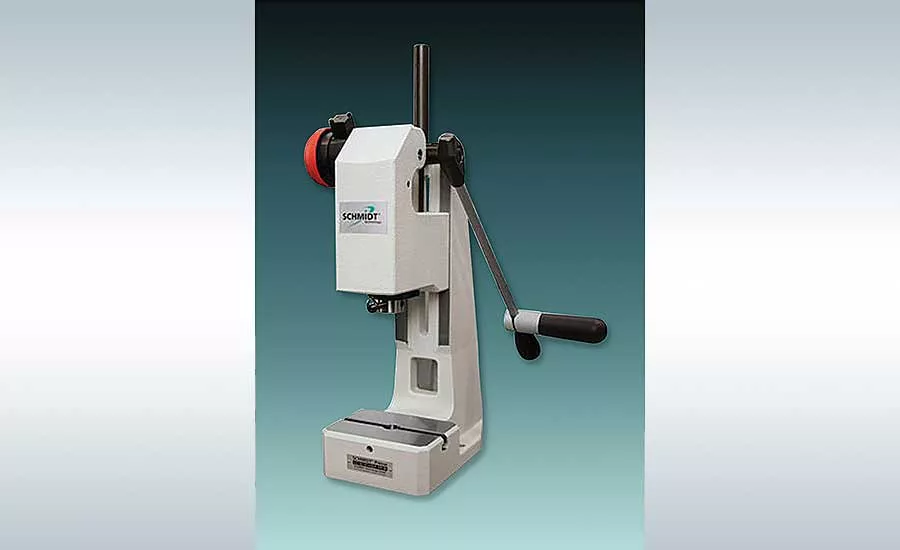
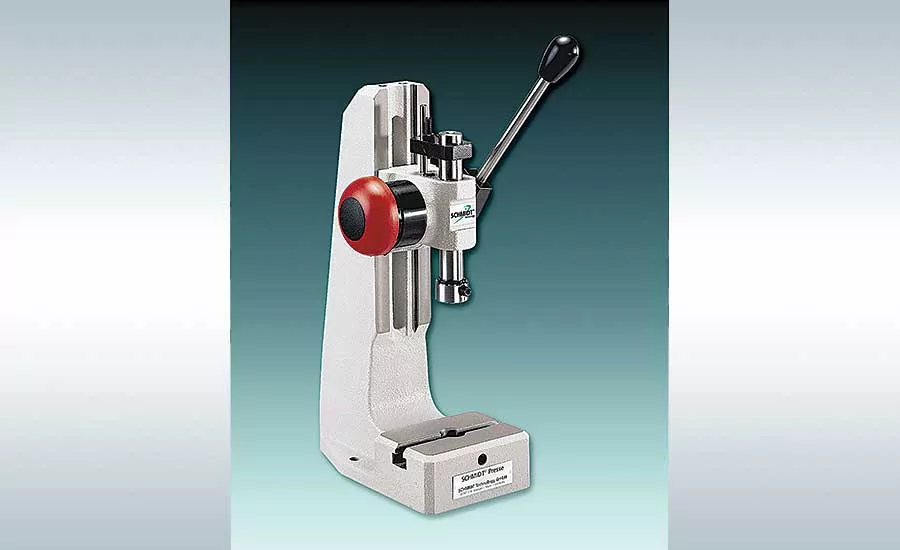
As a leading manufacturer of precision presses, SCHMIDT Technology offers the most complete line of hand-operated presses in the industry. Whether you’re performing a simple assembly or an intricate assembly process with demanding tolerances, we have a standard hand press or a highly sophisticated hand-operated pressing system that will most likely meet your needs. We offer Rack & Pinion and Toggle Presses with forces up to 5,000 lbs.

Standard Hand Presses         

Like all SCHMIDT presses, our standard hand presses offer flexibility through adjustable ram strokes, adjustable working heights and built-in positive stops. Precision is provided by guided non-rotating rams, ram and table bores with tight tolerances that are accurately aligned to each other and micrometer adjustment mechanisms. Yet, in order to have a quality assembly process, the operator must fully complete the stroke. This is where the SCHMIDT® Return Stroke Lock Device comes into play. When added to a SCHMIDT hand press, this device will not let either the spring return press handle or the ram return to its starting positions until the end of a complete ram stroke.

When an operator performs the physical task of manually powering a press, ergonomics is always a concern. Plus a comfortable operator will normally achieve higher production outputs. In response, we developed ergonomic handles that attach to our standard handle and provide a more comfortable grip and a horizontal pulling motion. These ergonomic handles have a non-slip grip and can be rotated around the original handle to a position that best suits the operator. Reverse handled toggle presses where the handle is positioned next to the loading area are also available. Instead of rotating an arm and shoulder upward to pull the handle, operators horizontally pull the handle toward their body. Finally, certain press models can be retrofitted with a gear ratio system that reduces the handle rotation required to perform the operation.       

System Provides Cycle Permissive Process Control 

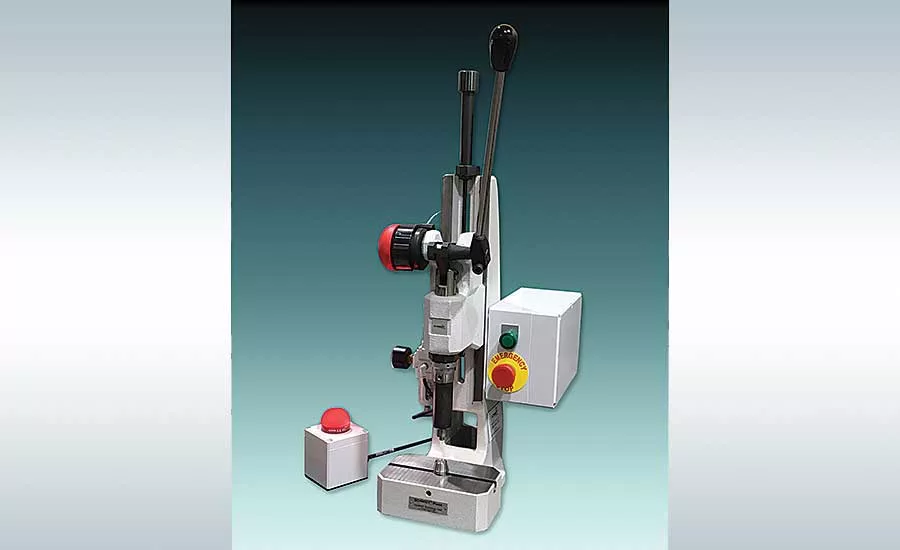
Although our toggle presses can be equipped with a return stroke lock device, what happens if a part is not loaded into the tooling? The operator can pull the handle and complete the stroke, but unfortunately, the end result is a bad part. When small parts are involved in the assembly, missing parts can be a problem. To resolve this issue, our return stroke lock can be modified by adding a pneumatic cylinder, a pneumatic package and a small PLC to the device. Up to five parts presence sensors can then be attached to the tooling. After a part is loaded into the tooling, each sensor sends an input to the PLC. Once all inputs are received, the return stroke lock releases the handle. The operator must then complete the stroke in order for the handle to return to its home position.

As part of a workforce safety plan, this device can include a cycle start button that forces the operator to remove their free hand from the assembly process. Although the operator is not forced to keep their hand out of the pressing area during the full stroke of the press, it does compel the operator to remove their free hand to activate the press.

Looking for quick answers on assembly and manufacturing topics? Try Ask ASM, our new smart AI search tool. Ask ASM →

ManualPress 300 Series Controls & Monitors Assembly Process

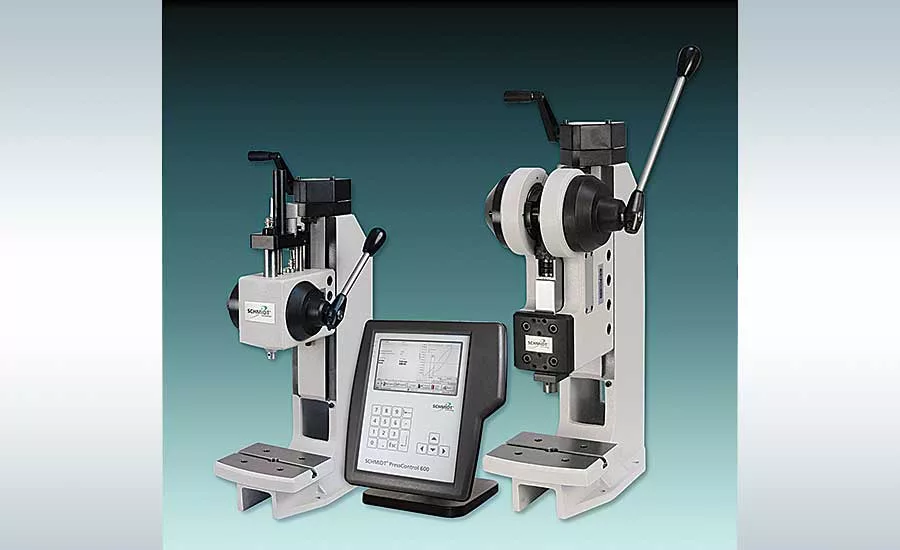
For customers that need the ultimate hand-powered assembly press, our 300 Series Presses are the perfect choice. These cost-effective presses offer the same process monitoring normally associated with servo presses including 100% process verification and complete force and stroke monitoring. They are equipped with an integrated PLC, load cell, electro-magnet, programmable clutch and are operated and controlled by our PressControl 600.

The PressControl can also use tooling sensors to verify parts presence. Preset user criteria for that particular part must be met or the system does not activate the clutch, which attaches the handle to the press ram. Once the handle is pulled, the electro-magnet system serves as the return stroke lock, requiring the operator to complete the ram stroke. Results for each press cycle are automatically captured and compared against user-defined force/distance windows and stroke tolerances providing pass/fail indications to the operator. If a part does not pass, the clutch stays disengaged until the system is reset.

For additional process control, a SCHMIDT Speed Control regulates the speed in which the operator pulls the handle to provide more consistency between operators. The system can also detect and stop the pressing operation if a force is reached too early in the stroke (part too tall) or too late in a stroke (part too short), thereby preventing bad parts. The system can also be programmed to keep the ram in the extended position if a part fails the user-defined process. The operator must then reset the system to remove the part.

Our 300 Series Presses can automatically collect and using our FileXchange Software export press production data to your data storage systems. This data can be employed to satisfy vendor-certification requirements or to demonstrate proof of regulatory compliance.

Contact us today and let us help you select the perfect hand-operated press for your application.


SCHMIDT Technology Corporation

280 Executive Drive

Cranberry Twp., PA 16066                                               

(724) 772-4600

1-800-959-1218

www.schmidtpresses.com

Share This Story

Looking for a reprint of this article?
From high-res PDFs to custom plaques, order your copy today!

Recommended Content

JOIN TODAY
To unlock your recommendations.

Already have an account? Sign In

  • Made in the U.S.A.

    Consumer Products Manufacturing: Made in the USA

    Supply chain lessons learned during the coronavirus...
    Automated Assembly Systems
    By: Austin Weber
  • Best Practices for Press-Fit Assembly

    Best Practices for Press-Fit Assembly

    In manufacturing, ironclad formulas for success are hard...
    Assembly Presses
    By: Jim Camillo
  • aem0523leader-tesla1.jpg

    Tesla Rethinks the Assembly Line

    Engineers at Tesla Inc. have developed a new process that...
    Electrification
    By: Austin Weber
Manage My Account
  • eMagazine Subscription
  • Assembly Newsletters
  • Online Registration
  • Subscription Customer Service
  • Manage My Preferences

More Videos

Sponsored Content

Sponsored Content is a special paid section where industry companies provide high quality, objective, non-commercial content around topics of interest to the ASSEMBLY audience. All Sponsored Content is supplied by the advertising company and any opinions expressed in this article are those of the author and not necessarily reflect the views of ASSEMBLY or its parent company, BNP Media. Interested in participating in our Sponsored Content section? Contact your local rep!

close
  • ultrasonic welding
    Sponsored bySonobond Ultrasonics

    Engineering Efficiency in High-Performance Assembly: How Ultrasonic Welding Enhances Throughput, Reliability and Quality

  • UV curing system
    Sponsored byDymax

    Why UV Intensity Alone Doesn’t Define Curing Performance

  • wooden pallets
    Sponsored byLEAN Manufacturing Products

    Eliminating Waste on the Shop Floor: Applying Lean Principles to Improve Manufacturing Efficiency

Popular Stories

Robots working at Toyota Plant in Japan

Toyota Deploys Geekplus Robots for Factory Material Handling

can of soda pop

The “Diet Coke Problem” as Manufacturers Face Experts Retiring

BMW Group

Humanoids Take on New Role at BMW’s U.S. Assembly Plant

Watch the latest episode of ANN now!

Events

July 24, 2025

From Shop Floor to CFO: How Manufacturers Are Closing the Loop Between Operations and Finance

On Demand Learn how manufacturers are bridging the gap between the shop floor and ERP systems to gain real-time visibility, streamline operations, and kick-start digital transformation—without waiting years.

Sponsored by:

PicoStratusGreen
July 30, 2025

Buffer Analysis and Design Fundamentals for Manufacturing Excellence

On Demand In this presentation, Dr. Herman Tang shares practical insights from his industry experience and research on buffer management in manufacturing operations.

View All Submit An Event

Poll

Difficult Assembly Processes

Which assembly process gives you the most difficulty?
View Results Poll Archive

Products

Manufacturing Cost Policy Deployment (MCPD) Profitability Scenarios: Systematic and Systemic Improvement of Manufacturing Costs

Manufacturing Cost Policy Deployment (MCPD) Profitability Scenarios: Systematic and Systemic Improvement of Manufacturing Costs

See More Products
ebook

Related Articles

  • SCHMIDT

    How To Get More Productivity and Quality Control from a Hydro-Pneumatic Press

    See More
  • Kistler

    How To get to the highest quality of injection molding production

    See More

Related Products

See More Products
  • leaner

    Leaner Manufacturing: How to Make the Lean Production Process Easier, Faster, and More Cost-Effective

  • pocket.jpg

    How To Implement Lean Manufacturing, Second Edition

See More Products

Related Directories

  • HowToRobot

  • Dream to Product

×

Never miss the latest news and trends driving the manufacturing industry

Stay in the know on the latest assembly trends.

JOIN TODAY!
  • RESOURCES
    • Advertise
    • Contact Us
    • Directories
    • Manufacturing Division
    • Store
    • Want More?
  • SIGN UP TODAY
    • Create Account
    • eMagazine
    • Newsletters
    • Customer Service
    • Manage Preferences
  • SERVICES
    • Marketing Services
    • Reprints
    • Market Research
    • List Rental
    • Survey/Respondent Access
  • STAY CONNECTED
    • LinkedIn
    • Facebook
    • Instagram
    • YouTube
    • X (Twitter)
  • PRIVACY
    • PRIVACY POLICY
    • TERMS & CONDITIONS
    • DO NOT SELL MY PERSONAL INFORMATION
    • PRIVACY REQUEST
    • ACCESSIBILITY

Copyright ©2026. All Rights Reserved BNP Media, Inc. and BNP Media II, LLC.

Design, CMS, Hosting & Web Development :: ePublishing