Bubble-Free Potting of Capacitors
Scheugenpflug’s vacuum potting system ensures quality encapsulation of high-voltage capacitors for medical devices.
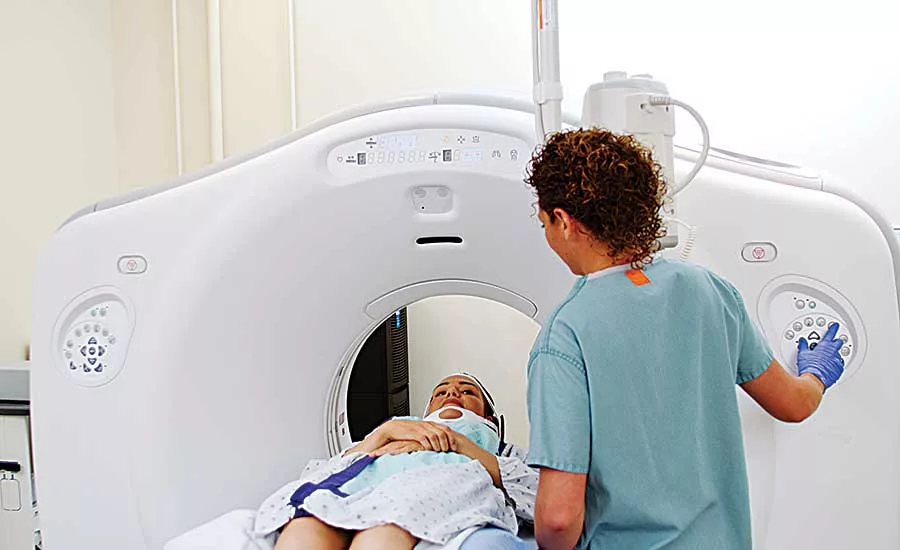
High-voltage capacitors are used in medical technology, such as, CT scanners, X-ray machines or magnetic resonance tomographs. Photo courtesy Scheugenpflug
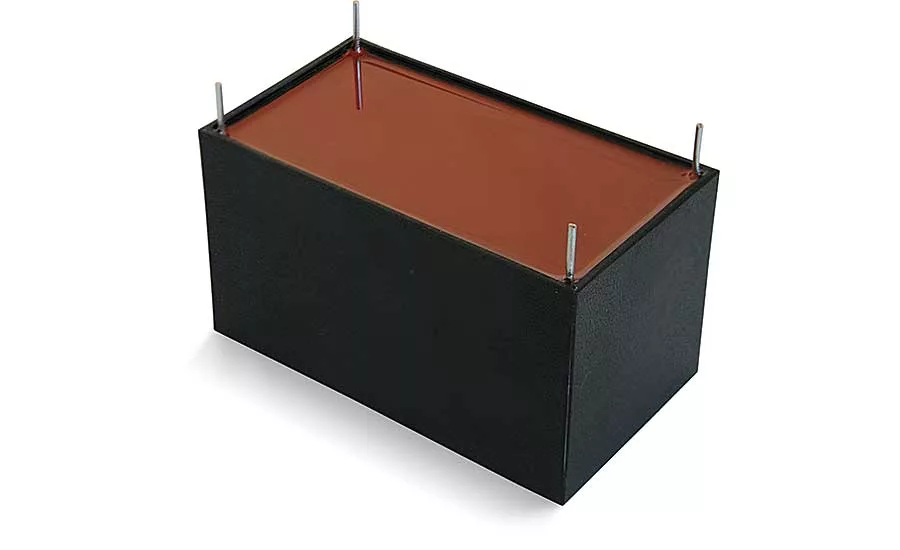
To function reliably over their entire service life, FTCAP’s film capacitors is encapsulated are vacuum with an epoxy. Photo courtesy Scheugenpflug.
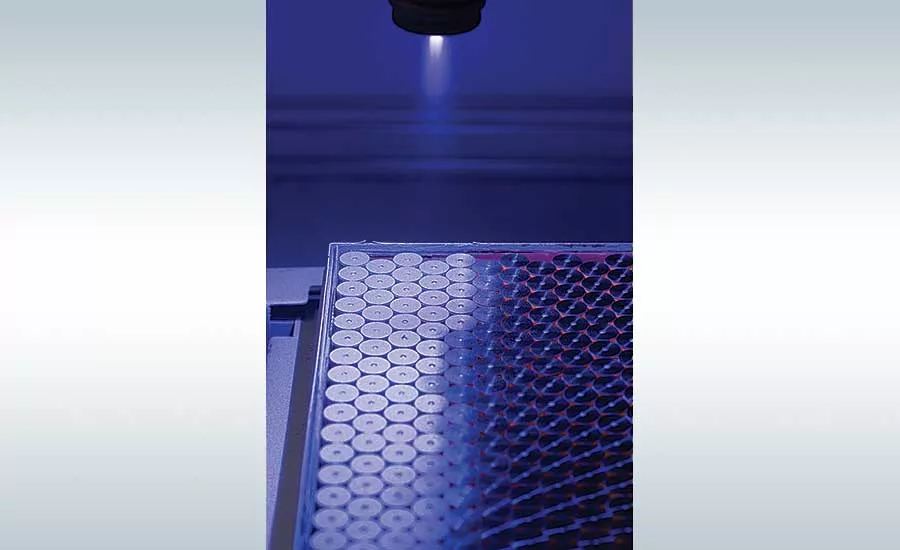
During the “schoopage” process, the film ends of the coil protruding at the sides are electrically contacted by means of spray metallization. Tin, zinc and aluminum are used as contact materials. Photo courtesy Scheugenpflug
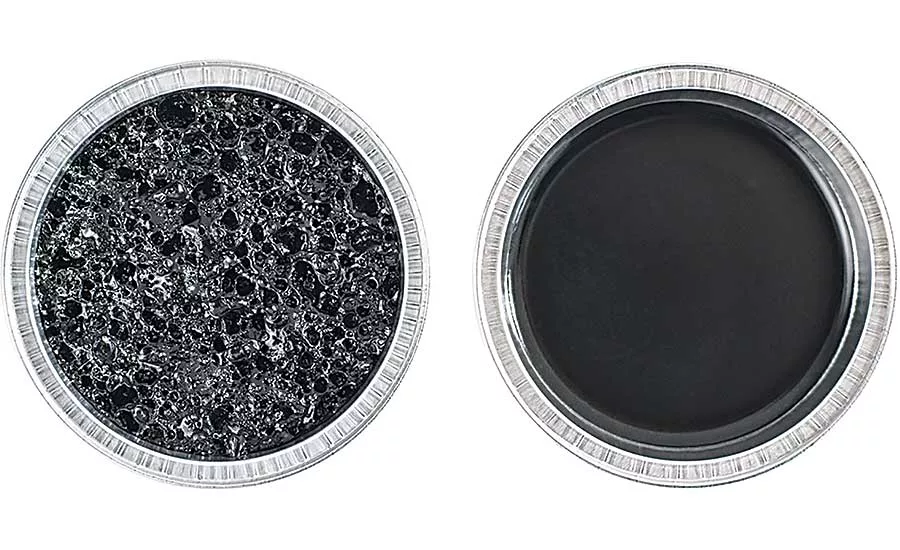
These photos show the difference in texture between a foamed PU that was exposed to moisture, left, and a PU correctly prepared and potted under vacuum, right. Photo courtesy Scheugenpflug.
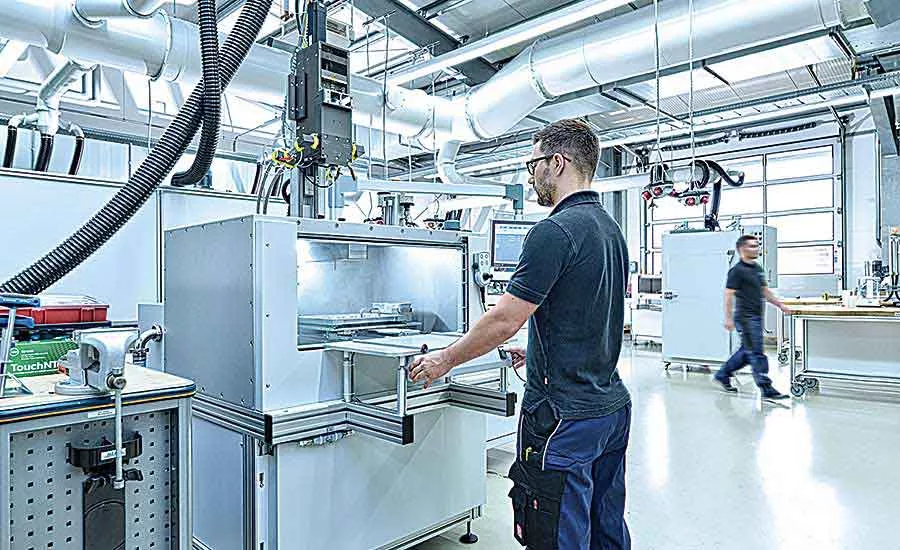
At Scheugenpflug’s Technology and Application Center, an expert technician pots capacitors under a vacuum. Photo courtesy Scheugenpflug.
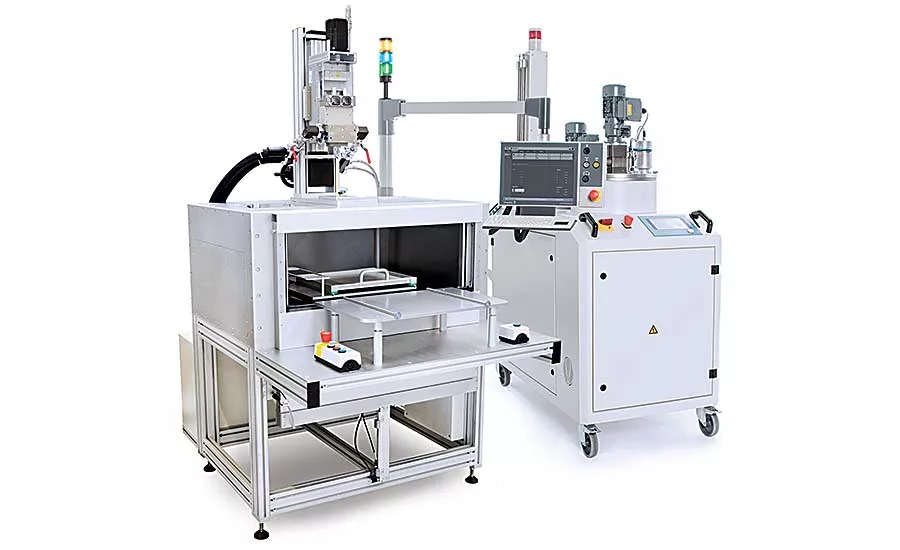
With three traversing axes, the VDS U vacuum dispensing system is suitable for potting several parts in one run. Photo courtesy Scheugenpflug.
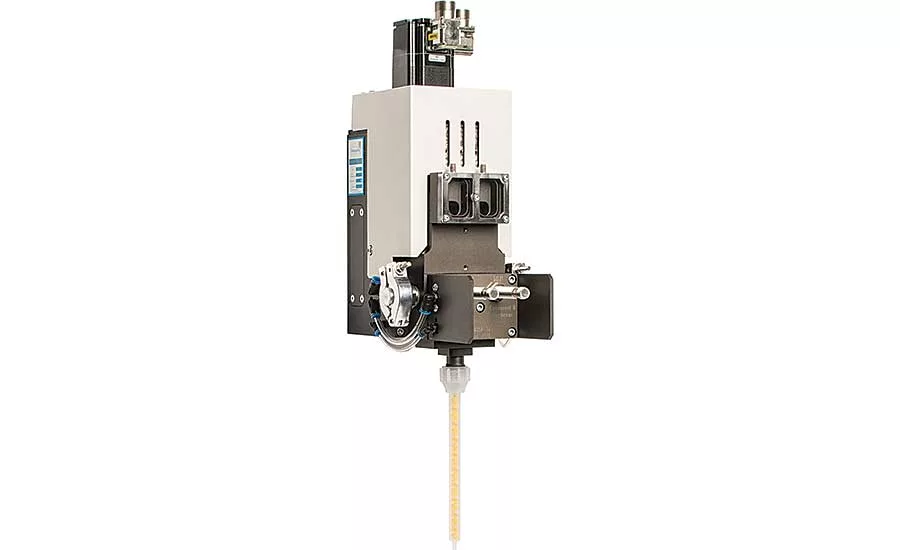
The Dos P016 dispenses two-component materials precisely and repeatably while maintaining a constant mix ratio. Photo courtesy Scheugenpflug.
From cameras to pacemakers, hybrid race cars to solar-powered ships, capacitors are indispensable in both industrial and everyday life. In electrical systems, they ensure that voltage peaks are smoothed out and fault currents are eliminated. Capacitors store electrical energy for flash applications, such as radar guns or professional flash units in photo studios. After charging to a certain voltage, they are able to power appliances with high short-term energy requirements. In airplanes, those passive components supply energy to the brake and onboard systems. Capacitors are also used in electric vehicles where they are used to power electric motors and reduce electromagnetic emissions.
Fischer & Tausche Capacitors (FTCAP), based in Husum, Germany, manufactures capacitors for various applications. Founded in 1948, the company specializes in film and aluminum electrolytic capacitors for special applications in small and medium quantities. In addition to the standard product range, FTCAP also offers special products for more complex requirements, such as durable film capacitors for converters in wind turbines.
To cope with the increasing demand for its products, the capacitor manufacturer recently expanded its production facilities by adding a 600-square-meter production hall. A new potting process has also been established for producing high-voltage capacitors used in medical engineering.
“In medical technology, capacitors with nominal voltages of more than 120 kilovolt are used, for example, in CT scanners or X-ray machines. They smooth the alternating current in high-voltage cascades and thus guarantee good ray quality,” explains André Tausche, Managing Director of FTCAP.
“The capacitors must meet the highest requirements in terms of safety and functionality and service life. However, this could only be achieved with our previous casting systems at great expense.”
To ensure optimum potting quality in film capacitors for high-voltage applications and also a reliable function over the entire service life, potting under vacuum is necessary. This process protects the components from damaging external influences, such as moisture, dust or aggressive chemicals. Vacuum potting also prevents air bubbles from being trapped with the potting medium in the capacitor housing. Air bubbles in the medium can cause partial discharges that damage the surrounding insulation and eventually lead to flashovers, resulting in severe to irreparable damage to the end device.
To achieve an optimal potting process and maximum insulation strength, it is necessary to employ sophisticated dispensing technology adapted to the application. In addition, the potting material must be prepared and fed under vacuum. This is the only way to ensure a consistent absence of bubbles, as well as, effective protection against moisture throughout the entire manufacturing process.
Looking for quick answers on assembly and manufacturing topics? Try Ask ASM, our new smart AI search tool. Ask ASM
Production of Film Capacitors
The basis for the production of film capacitors is a so-called “master roll” of plastic foil. It is treated under vacuum on one or both sides with a vaporized coating of aluminum or zinc that is only a few atomic layers thick. The dielectric strength of the future capacitor depends on the dielectric –— higher voltages require thicker dielectrics. The metallized master roll is then cut into smaller rolls. Depending on the design of the capacitor, the width or height of these smaller rolls defines the dimensions.
In the next step, two metallized foil rolls are wound one on top of the other with an offset so that one edge of the metallization protrudes from each side of the winding. With box capacitors, the coil is then flattened by means of pressure in an additional process step.
This is followed by the so-called “schoopage.” Here, the film ends protruding from the side are electrically contacted by means of spray metallization. During the subsequent healing or burn-in process, a suitable voltage is applied to the schooped roll, which burns out any existing defects in the film. This step is followed by welding or soldering the connecting pins to the schooped side surfaces of the windings. They are then placed in a housing and encapsulated bubble-free in a vacuum. The encapsulation prevents moisture from penetrating the windings and ensures the long-term stability of the capacitor.
In the last step of the process, the final electrical test is carried out. Each capacitor is tested for meeting the specified capacity value, loss factor and impedance. To prevent leakage currents during measurement, FTCAP carries out measurements in fully air-conditioned rooms with low humidity.
Potting for Long-Term Durability
Before deciding on a suitable system technology for the new encapsulation process, FTCAP looked for the right potting material. “For our ‘regular’ capacitors we use potting resins based on polyurethane. However, since the high-voltage capacitors come into contact with liquids such as transformer oil during operation, epoxy resins are more suitable here,” says Tausche.
Polyurethanes (PU) offer a very broad and versatile range of properties. PU compounds are characterized by good machine processibility, low volume shrinkage and moderate flexibility after curing. However, polyurethanes are very sensitive to moisture and must be adequately stored and prepared under vacuum before potting.
In comparison, epoxy resins are characterized by good temperature stability, low flammability and elevated glow-wire ratings. Due to their high hardness, high modulus of elasticity and good mechanical stability when cured, these potting materials are also well-suited for components used in demanding operating environments. The low moisture absorption and the high chemical resistance of epoxy are also key properties for this application.
In the course of various tests, a heat-curing two-component epoxy resin from Wevo-Chemie GmbH produced very good results. Wevopox 8260 FL/Wevodur 1018 is characterized by its high long-term heat resistance and good flow properties. It is also ideally suited for potting high-voltage capacitors because of its high hardness, good degree of cross-linking and low water absorption.
“We modified the material after the tests in order to adapt it even more precisely to the existing application and to optimize its handling,” explains Andreas Arlt, sales engineer at Wevo-Chemie.
To dispense the material, FTCAP chose equipment from Scheugenpflug. “We came back to Scheugenpflug relatively quickly, as we already use a system from the company and we are very satisfied with it,” explains Tausche. “We were also convinced by the fact that Scheugenpflug and Wevo-Chemie successfully realized a project with a very similar material before.”
To determine the optimum system technology for the potting process, Scheugenpflug carried out preparatory dispensing tests together with experts from FTCAP and Wevo-Chemie at its in-house Technology and Application Center.
“Such tests are generally recommended if a new dispensing process is to be established or new materials are to be used,” explains Sebastian Schmitt, sales engineer at Scheugenpflug. “Together with a team of casting experts, fundamental questions can be clarified even before the start of series production — from the best possible equipment to the cycle times that can be achieved.”
VDS U: One for All
In the course of the dispensing tests, Scheugenpflug’s vacuum potting system achieved good results with regard to bubble-free operation and repeatability of the potting process. The universal system is particularly suitable for the series production of medium and large components. Even with difficult part geometries or complex casting programs, the VDS U is the system of choice.
The system is based on standard modules, much like the platform strategies of the automotive industry. This gives users maximum flexibility with short delivery times and attractive pricing. Even in the case of very cramped production environments, the modular components allow for a demand-oriented system design tailored to the respective application.
Since small series and custom-made products make up a significant part of the FTCAP portfolio, the company relies primarily on manual and semi-automatic processes.
“We focus more on niches in the market and on small to medium series. A fully automated production environment would therefore make little sense for us. Instead, we prefer workplaces that can be adapted quickly and easily,” explains Tausche. “Above all, we needed a system that offered us the necessary flexibility in this environment. We certainly made the right decision with the VDS U.” The vacuum potting system is particularly suitable for applications with a wide variety of components because of its 400 by 300 millimeter movable pallet drawer, which allows parts with different sizes and geometries to be potted in one system. The three traversing axes of the VDS U also allow the encapsulation of several components in one run. This ensures short cycle times while maintaining the highest potting quality.
Flexibility is also in demand with regard to the required dispensing quantities: “The capacitors from FTCAP often vary greatly in size and shape,” explains Schmitt. “The quality of the potting process must be consistently high, of course – no matter if 2 grams of material or 100 grams are to be potted. But here, too, the system demonstrates its strengths.”
Scheugenpflug’s Dos P016 piston dispenser ensures the output of exact and reproducible material quantities. Not only does it cover a wide range of requirements, it also allows gentle dispensing of pressure, moisture or shear-sensitive potting media without the risk of material changes. To achieve optimum flow properties with the epoxy resin used, the Dos P016 was additionally equipped with a heating unit for the metering head and each mixing tube. They heat the material shortly before potting, thus reducing its viscosity and ensuring reproducible and bubble-free potting results, even with complex geometries.
The A310 from Scheugenpflug is responsible for the preparation and feeding of the epoxy resin to the potting system. With this system, larger quantities of self-leveling potting materials can be reliably processed and delivered. In addition, this system has an integrated vacuum function to remove air bubbles in the medium during preparation. This is important to ensure that no bubbles are present during subsequent potting processes. The sedimentation of the fillers within the material is prevented through circulation. Hermetically sealed material lines, pumps and valves also prevent the re-introduction of air during the conveying process.
Two-Stage Curing in a Furnace
At FTCAP, the capacitors to be encapsulated are manually inserted in the system. The encapsulation chamber is then evacuated up to a value of 20 millibars. Depending on their size, the housings of the high-voltage capacitors are then filled with epoxy resin in one or more steps.
Large capacitors in particular require multi-stage encapsulation to ensure the absence of bubbles. A defined amount of material is dispensed into the housing under vacuum so that the winding inside is completely covered with potting medium. During the subsequent ventilation of the vacuum chamber, the epoxy is pressed even deeper into existing angles and gaps by the ensuing pressure build-up. After the material has cured for the first time, a final top layer is applied.
The encapsulation process is followed by an optical inspection of the components by the system operator. “It is difficult to check the height of the encapsulation in the housings automatically because we already have tolerances in the film thickness of the winding,” explains Tausche. “The material layer on top of the winding should have a certain minimum thickness. Generally speaking, a slightly fluctuating filling level is no problem for us.”
In the final curing process, the potted epoxy is cured in a furnace at 80 C for two hours and at 110 C for another six hours.
Thanks to the intensive cooperation of Scheugenpflug, Wevo-Chemie and FTCAP, a powerful and precisely adapted potting process could be realized. “The new vacuum process has been worthwhile for us in more than one way,” explains Tausche. “Thanks to the well-engineered system technology, we can now guarantee bubble-free encapsulation and thus the highest quality for our customers. The automated potting process also allows us to handle larger quantities without any problems. That wasn't possible before.”
In the course of the project, the experts from Scheugenpflug and Wevo-Chemie were also able to provide the capacitor manufacturer with extensive experience in materials processing and process technology, thus providing FTCAP with effective support during process start-up.
“We are very satisfied with the result, the cooperation has worked really well,” says Tauche. “When more projects come up, we know who to turn to.”
Looking for a reprint of this article?
From high-res PDFs to custom plaques, order your copy today!