Assembly Magazine logo
search
Ask ASSEMBLY AI
cart
facebook twitter linkedin youtube
  • Sign In
  • Create Account
  • Sign Out
  • My Account
Assembly Magazine logo
  • TRENDS
    • Ask ASSEMBLY AI
    • Trends
    • News
    • New Products
  • INDUSTRIES
    • Aerospace
    • Appliance
    • DFMA Assembly
    • Medical Devices
    • Green Manufacturing
    • Lean Manufacturing
    • Machinery Assembly
    • Electronics Assembly
    • Automotive
  • TECHNOLOGIES
    • Adhesives & Dispensing
    • Assembly Presses
    • Automated Assembly Systems
    • Manufacturing Management
    • Manufacturing Software
    • Motion Control
    • Screwdriving & Riveting
    • Robotics
    • Test & Inspection
    • Plastics & Metal Welding
    • Wire Processing
    • Workstations
  • AUTONOMOUS & ELECTRIC MOBILITY
    • AEM Magazine Archives
    • Autonomy
    • Electrification
    • Mobility Services
    • Assembly & Testing
    • AV/EM News
  • MEDIA
    • Ask ASSEMBLY AI
    • Podcasts
    • Assembly News Now
    • Assembly TV
    • Webinars
    • eBooks
  • EVENTS
    • Calendar
    • The ASSEMBLY Show
  • MORE
    • Exclusives >
      • Plant of the Year
      • Capital Spending
    • Buyers Guide >
      • Supplier Insights
    • Classifieds
    • Featured Products
    • Newsletters
    • Store
    • White Papers
    • Columns
    • Sponsor Insights
  • INFOCENTER
    • Assembly & Test Solutions
  • EMAGAZINE
    • eMagazine
    • Archive Issues
    • Advertise
    • Contact Us
    • Sign Up
Automated Assembly SystemsRobotics Assembly

Robots Strike Right Tone With Guitar Maker

Taylor Guitars relies on robots to help assemble precision electronics for its world-famous acoustic guitars
By Phil Baratti
Robots Strike Right Tone With Guitar Maker
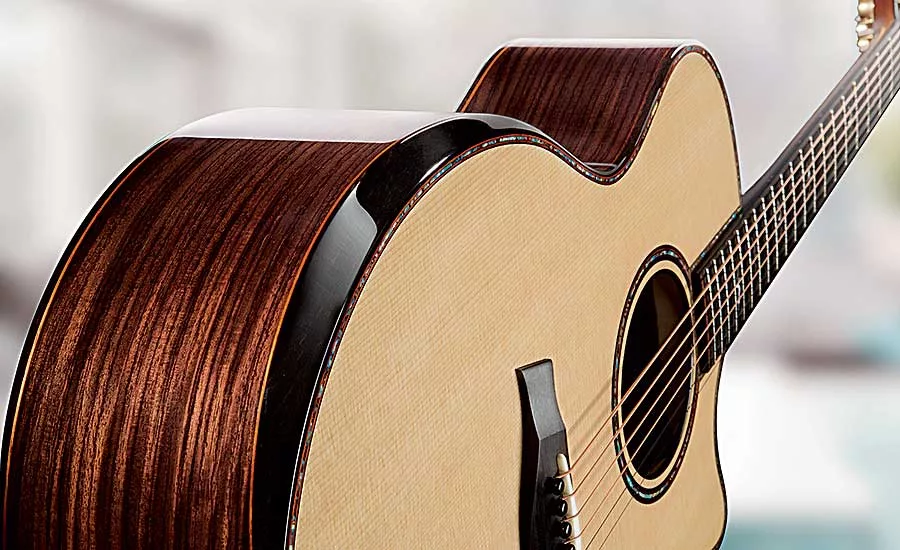
Taylor Guitars is the No. 1 manufacturer of acoustic guitars in the United States. Photo courtesy Taylor Guitars
Robots Strike Right Tone With Guitar Maker
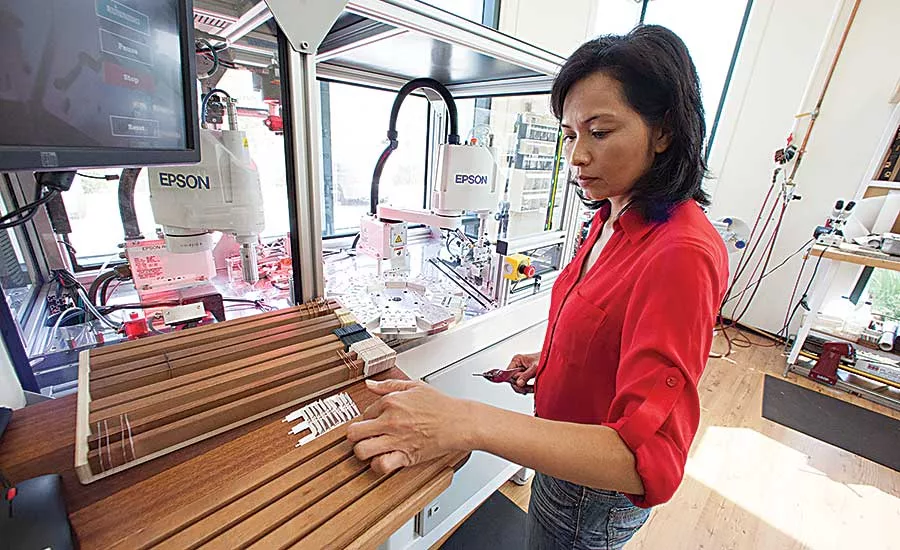
Components of the guitar pickup are inspected and placed in molds on a rotary indexing table for robotic assembly. Photo courtesy Epson Robots
Robots Strike Right Tone With Guitar Maker
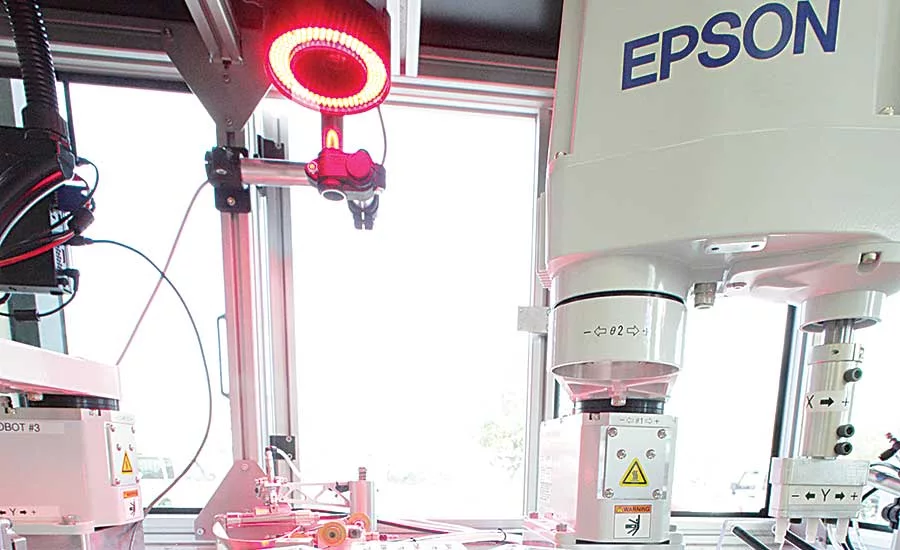
A high-precision robot equipped with custom end-of-arm tooling inserts piezo blocks in the pickup assembly. Photo courtesy Epson Robots
Robots Strike Right Tone With Guitar Maker
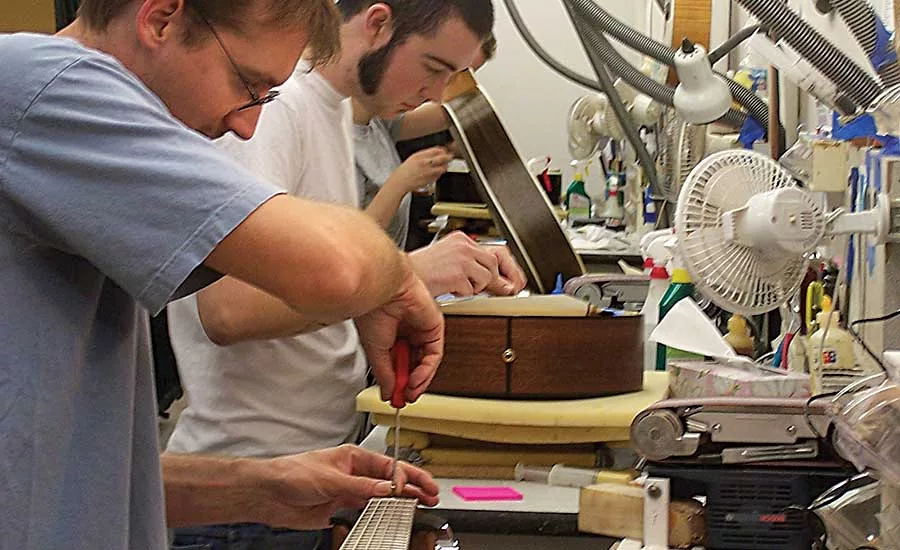
Taylor Guitars’ innovative manufacturing process combines handcraftsmanship and robotics. Photo courtesy Taylor Guitars
Robots Strike Right Tone With Guitar Maker
November 9, 2018

Assembling an acoustic guitar of world-class caliber requires more technology than you might realize. Hand craftsmanship is still the hallmark of Taylor Guitars, which has been in business nearly 45 years. But technology now plays a more integral role in both the guitar maker’s groundbreaking designs and the pioneering manufacturing process to produce them.

Taylor Guitars builds premium acoustic guitars at its facilities in El Cajon, CA, and Tecate, Mexico. Renowned for blending innovative manufacturing techniques with an artisan’s attention to detail, Taylor pioneered the use of CNC milling, laser cutting and robotics in guitar construction. Large-payload robots assist with polyurethane spray application and buffing of the wood finishes. Compact, high-speed robots assemble guitar electronics.

High-precision SCARA robots made by Epson Robots help assemble Taylor’s acoustic pickups. A guitar pickup acts like a microphone. When you hit the guitar strings, it creates vibrations. Taylor’s pickup uses the compression from piezoelectric material to sense the vibrations and translate them into electrical signals. Those signals can then be amplified by an acoustic guitar amplifier, mixing board or public address system.

Traditionally, piezoelectric pickups were positioned under the guitar saddle. The Taylor Expression System 2 (ES2) is an innovative pickup design developed by Taylor’s electronics team to enhance acoustic guitar amplification. The heart of the ES2 is Taylor’s patented behind-the-saddle pickup.

While the ES2 pickup improves the guitar’s amplified tone and responsiveness, it complicates the build process. By relocating the pickup behind the saddle, it makes the assembly process more difficult for human fingers, especially with consistency at higher production volumes.

“The Epson robot was brought in primarily to make our acoustic pickups,” says David Judd, a product developer at Taylor Guitars. “I was making them by hand. I could make 10 or 20 a day. At first we needed 100 a day, and then we’ve ramped up to close to 600 a day. So we wouldn’t have been able to do it without automation.”

The piezo blocks are small and have a tight fit in the ES2 pickup assembly, which is tightly wrapped in adhesive. If done by hand with tools, each assembly step increases the possibility of damaging the materials.

Looking for quick answers on assembly and manufacturing topics? Try Ask ASM, our new smart AI search tool. Ask ASM →

Two Epson G3 high-speed SCARA robots handle the intricate assembly work. As a division of Japan-based Seiko Epson Corp., Epson Robots has a history rooted in small parts assembly. In the early 1980s, the company began developing robots to improve the productivity and quality of its in-house watchmaking processes. Today, Epson robots still assemble Seiko watches and Epson printer components.

“We really like the Epson G3 because when you tell it to do something, it does that exactly the same every time,” says Judd.

The assembly process starts with the piezoelectric material fed onto a conveyor from a vibratory feeder. A color-sensing camera determines the polarity of each two-sided piezo block. Any piezo blocks presenting bronze side up are rerouted through the feeder to present with the silver side facing up.

While the camera determines piezo block polarity, a worker inspects and places pieces of the assembly in the pickup molds, which are arranged on a rotary indexing table. The paper backing is removed from the adhesive by automated tooling custom-made by Taylor’s engineers.

Then, an Epson G3 robot places insulation and installs a printed circuit board (PCB). The other Epson robot is equipped with custom end-of-arm tooling to pick three piezo blocks at a time from the conveyor and place them in the appropriate slots of the pickup assembly. Once the piezo blocks and PCB are installed, the pickup assembly is folded and an Epson robot transports the completed assembly to a wrapping station.

Throughout the assembly process, a combination of machine vision cameras and a laser sensor are used to verify correct placement of the piezo blocks, assess final assembly and confirm the presence of components in the pickup assembly.

“As far as features of Epson robots, one thing I like is you don’t need a teach pendant, you can operate the robot’s motion and create programs all directly from a PC,” says Taylor’s robotics engineer Tyler Robertson. “The programming language is flexible enough that we have been able to integrate third party vision systems without much effort, as well as Ethernet communication, which allowed us to avoid a lot of wiring and make the integration of that vision system quite a bit easier.”

Epson RC+ Software has an intuitive graphical interface that significantly reduces programming time. A wide variety of fieldbus interface options are supported, including Ethernet/IP, DeviceNet, Profinet and EtherCAT. An open-architecture environment and easy-to-use options, including integrated vision, force guidance, conveyor tracking, and a GUI builder reduce overall development time.

Taylor Guitars dubbed the robotic assembly cell “Foldy” for the folding process of the pickup assembly.

“We try to nickname robots and machines because it helps people remember what we’re referring to,” says Robertson. “Components move into the system and the assembly is folded together with a combination of robot motion and custom automated tooling.”

He says this iteration of Foldy has been in place for almost two years. Another Foldy iteration has been on the job for over five years.

“It has kept the precision and repeatability over the last five years and we haven’t had to worry,” says Robertson. “We haven’t had to replace any parts. We’ve done virtually no maintenance whatsoever.”

Looking forward to the future, Foldy will have new tooling and equipment implemented as part of continuous improvement. Taylor is also readying a new robot cell for applying adhesives, which will also use an Epson G3 robot as the main motion system.

“Small parts assembly and applying adhesives are perfect applications for SCARA systems,” says Robertson.

Epson G3-Series SCARA robots are the reliable choice for these high-precision applications. The rigid arm design reduces vibration, while Epson’s PowerDrive servo technology yields high-performance results in a compact form factor.

For more information, call Epson Robots at 562-290-5910 or visit www.epsonrobots.com.

KEYWORDS: factory automation flexible assembly SCARA robot

Share This Story

Looking for a reprint of this article?
From high-res PDFs to custom plaques, order your copy today!

Phil Baratti, Application Engineering Manager, Epson Robots, Carson, CA

Recommended Content

JOIN TODAY
To unlock your recommendations.

Already have an account? Sign In

  • Made in the U.S.A.

    Consumer Products Manufacturing: Made in the USA

    Supply chain lessons learned during the coronavirus...
    Automated Assembly Systems
    By: Austin Weber
  • Best Practices for Press-Fit Assembly

    Best Practices for Press-Fit Assembly

    In manufacturing, ironclad formulas for success are hard...
    Assembly Presses
    By: Jim Camillo
  • aem0523leader-tesla1.jpg

    Tesla Rethinks the Assembly Line

    Engineers at Tesla Inc. have developed a new process that...
    Electrification
    By: Austin Weber
Manage My Account
  • eMagazine Subscription
  • Assembly Newsletters
  • Online Registration
  • Subscription Customer Service
  • Manage My Preferences

More Videos

Sponsored Content

Sponsored Content is a special paid section where industry companies provide high quality, objective, non-commercial content around topics of interest to the ASSEMBLY audience. All Sponsored Content is supplied by the advertising company and any opinions expressed in this article are those of the author and not necessarily reflect the views of ASSEMBLY or its parent company, BNP Media. Interested in participating in our Sponsored Content section? Contact your local rep!

close
  • ultrasonic welding
    Sponsored bySonobond Ultrasonics

    Engineering Efficiency in High-Performance Assembly: How Ultrasonic Welding Enhances Throughput, Reliability and Quality

  • UV curing system
    Sponsored byDymax

    Why UV Intensity Alone Doesn’t Define Curing Performance

  • wooden pallets
    Sponsored byLEAN Manufacturing Products

    Eliminating Waste on the Shop Floor: Applying Lean Principles to Improve Manufacturing Efficiency

Popular Stories

ASSEMBLY News Now, episode-30: Volvo Redesigns EV Manufacturing

Volvo Redesigns EV Manufacturing

Boeing CEO Kelly Ortberg announces 1 billion investment

Boeing Plans $1 Billion Wichita Investment, Workforce Training Center

GE Appliances Worker on Line

GE Appliances Expands Factory AI With 800 Gemini Enterprise Agents

Watch the latest episode of ANN now!

Events

July 24, 2025

From Shop Floor to CFO: How Manufacturers Are Closing the Loop Between Operations and Finance

On Demand Learn how manufacturers are bridging the gap between the shop floor and ERP systems to gain real-time visibility, streamline operations, and kick-start digital transformation—without waiting years.

Sponsored by:

PicoStratusGreen
July 30, 2025

Buffer Analysis and Design Fundamentals for Manufacturing Excellence

On Demand In this presentation, Dr. Herman Tang shares practical insights from his industry experience and research on buffer management in manufacturing operations.

View All Submit An Event

Poll

Difficult Assembly Processes

Which assembly process gives you the most difficulty?
View Results Poll Archive

Products

Manufacturing Cost Policy Deployment (MCPD) Profitability Scenarios: Systematic and Systemic Improvement of Manufacturing Costs

Manufacturing Cost Policy Deployment (MCPD) Profitability Scenarios: Systematic and Systemic Improvement of Manufacturing Costs

See More Products
Register for webinar - Modernizing Automotive Assembly: Why Upgrading Legacy MES is a Business Imperative

Related Articles

  • Personalized Production: The ‘Brilliant Factory’ Will Match Right Parts With Right Tools

    See More
  • Integrator Improves Inspection of Engine Head Gaskets

    Robots Unleash Creativity of Casting-Equipment Maker

    See More
  • Chinese Appliance Maker to Buy Kuka Robots?

    See More

Related Products

See More Products
  • Designing with Plastics

  • reducing.jpg

    Reducing Process Costs with Lean, Six Sigma, and Value Engineering Techniques

  • integration.jpg

    Integration of Mechanical and Manufacturing Engineering with IoT: A Digital Transformation

See More Products

Related Directories

  • Taylor Guitars

  • Tone Americas Inc.

  • Epson Robots

    DistributorsCALIFORNIAEpson Robots1650 Glenn Curtiss St.Carson,  CA(562) 290-5997  www.epsonrobots.cominfo@robots.epson.com
×

Never miss the latest news and trends driving the manufacturing industry

Stay in the know on the latest assembly trends.

JOIN TODAY!
  • RESOURCES
    • Advertise
    • Contact Us
    • Directories
    • Manufacturing Division
    • Store
    • Want More?
  • SIGN UP TODAY
    • Create Account
    • eMagazine
    • Newsletters
    • Customer Service
    • Manage Preferences
  • SERVICES
    • Marketing Services
    • Reprints
    • Market Research
    • List Rental
    • Survey/Respondent Access
  • STAY CONNECTED
    • LinkedIn
    • Facebook
    • Instagram
    • YouTube
    • X (Twitter)
  • PRIVACY
    • PRIVACY POLICY
    • TERMS & CONDITIONS
    • DO NOT SELL MY PERSONAL INFORMATION
    • PRIVACY REQUEST
    • ACCESSIBILITY

Copyright ©2026. All Rights Reserved BNP Media, Inc. and BNP Media II, LLC.

Design, CMS, Hosting & Web Development :: ePublishing