Shape Memory Alloys: New Ways of Using Heat for a Technology Advantage
Improve appliance design by using heat generated during normal appliance operation to drive Shape Memory Alloy technology.

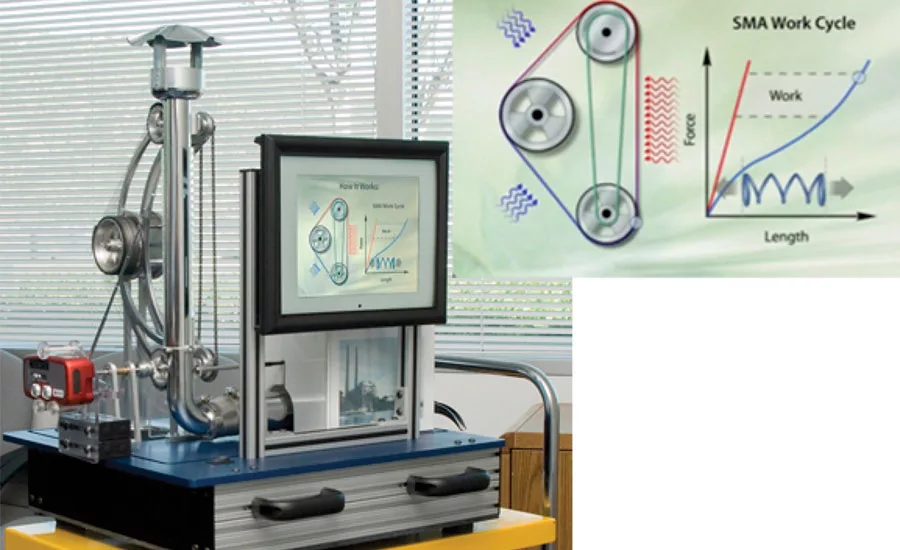
Imagine a kitchen oven without external sensors or electronics that could control air temperature, automatically lock the door during high-temperature cleaning cycles, and cut power during overheating while dispensing fire-extinguishing materials. This oven relies on shape memory metals (SMAs) reaching predefined high transition temperatures, changing their shape to perform work, and resetting again when the temperatures cool.
Temperature has been used for many years to accomplish work in appliances with more conventional technologies like bi-metals or wax actuators. Today’s SMAs let you do this with lower cost, less mass, more work output, more cycles, and have an ability to target temperatures of activation more accurately and reliably. These breakthroughs allow new advances in appliances.
This article will cover several conceptual applications. These concepts and a growing number of different next generation hardware designs are evolving to provide new opportunities.
Technology Background
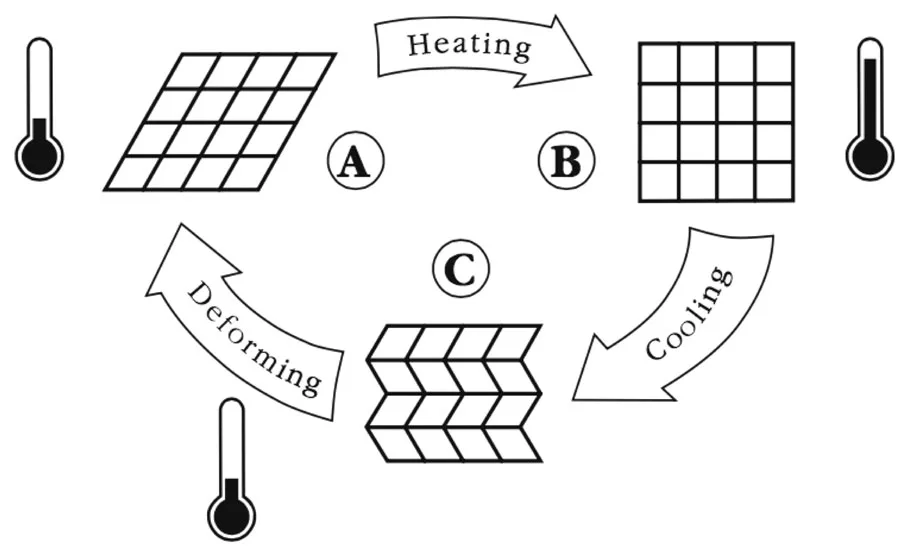
The underlying principle with SMAs is their ability to change their crystal form, or atomic structure, depending on the temperature of the material, basically becoming a solid state actuator. When the material is in the cool martensite phase it has a B19 or monoclinical crystal phase and when in the hot austenite phase an ordered B2 form. For a specific alloy and manufacturing process, the material can predictably change from one phase and related form to another, have predictable temperatures of transformation, and with predictable force levels. The cool martensite phase can be deformed with less force than the recovery forces of the hot austenite phase allowing a useable work delta between them.
A simple example would be an SMA helical with hooks on the ends. When cold the SMA helical could be easily deformed and stretched with the appropriate steel return spring. Upon heating the helical to its transition temperature, the helical would then shorten back to the original length, and reverse to elongate upon cooling again.
This phenomenon can be demonstrated either by electrically heating the material or through ambient temperature changes. The focus of this article is how the material can be used with ambient temperature, specifically regulating temperatures, controlling valves or similar systems with only temperature, sensing entire systems versus measuring temperature in one or a few locations, taking action based on temperature, and the notions of moving heat from one location to another and to provide work from low grade waste heat.
Comprehensive Temperature Regulation
Looking for quick answers on assembly and manufacturing topics? Try Ask ASM, our new smart AI search tool. Ask ASM
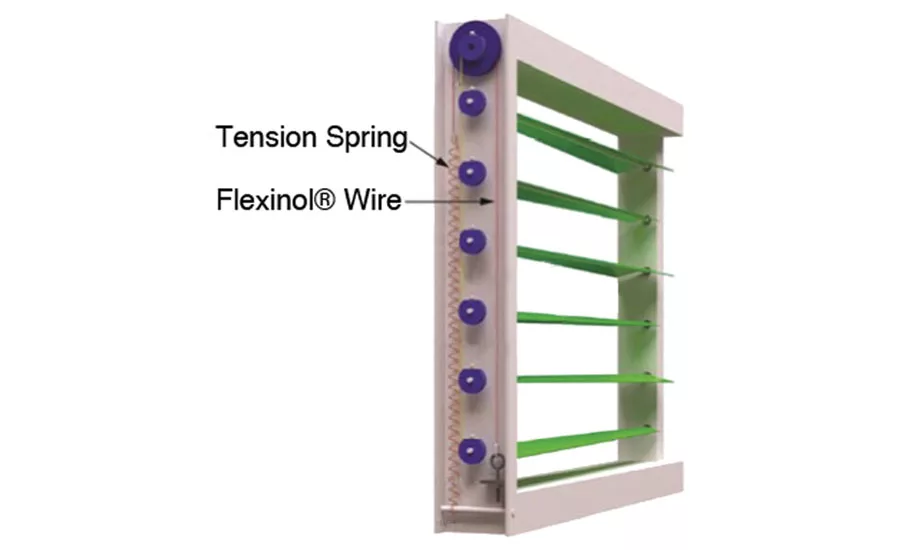
Using only the hot and cold temperatures generated by the sun rising and setting each day, shape memory alloys can be used to regulate the internal temperature of a structure. Currently in homes and businesses, temperatures are regulated by heaters and air conditioners that work to create a comfortable internal environment, despite the outside elements. Energy is used to run these systems while the natural energy created by the earth heating and cooling each day is wasted. With the use of SMAs, this natural energy can be utilized to increase or decrease heat transfer rates (whichever is favorable dependent on the season) through walls, vents, and windows in such systems as blinds, attic vents, and perhaps even “breathing walls” with SMA activated vents all along the façade of a building.
In one such example, a system of blinds was used to cover a large span of sliding glass doors in a residence. SMAs were created with transition temperatures that matched the climate of the area, and the desired effect of the blinds. The SMA mechanism was oriented exposed to the outside air, so that during the daytime the heat of the sun contracted the SMAs and closed the blinds. This created shade inside the space and kept the internal temperature at a comfortable level against the high heat of the outside environment. When the outside temperature dropped below a preset transition temperature programed into the wire, the wire was stretched back out again using a bias force mechanism, shifting the blinds open. This would let in the cold night air to cool the home. This type of mechanism could in fact work the opposite way in the alternate season if designed properly. In this example, the blinds were also multicolored, adding a unique design element to the façade of the home.
A similar theory can be used to vent attics. Physics tells us that heat rises, thus the attic is the warmest space in a house, often reaching temperatures well above 100°F in the summertime in hot climates. With no way for the hot air to escape, a heat sink is created at the top of a home, causing increased air conditioning usage simply to balance out the temperature of the home to a comfortable level. With an SMA based attic vent, the SMA mechanism would be placed inside the space utilizing the trapped heat. The SMA would heat up and contract when a predetermined temperature was reached, allowing vents to open and release the trapped hot air to the outside environment.
With the increasing focus on smart structures and green initiatives the future of architectural design is leading to passive and active systems to reduce energy usage.
Controlling Valves and Actuators in Appliances and other Systems
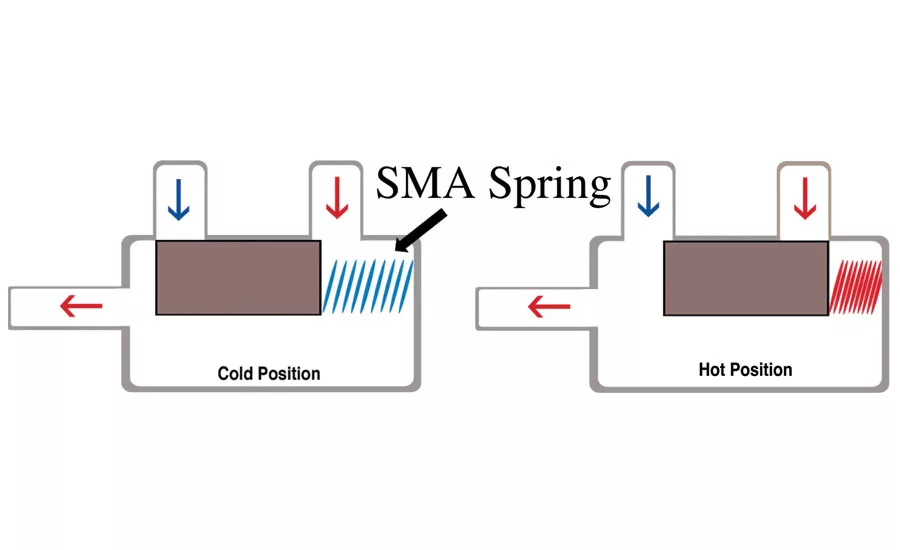
SMA technology can optimize performance of standard valves and other similar systems. Just by using the ambient temperature of the appliance, like hot oven air or hot water from a dishwasher, the SMA can react to perform a function.
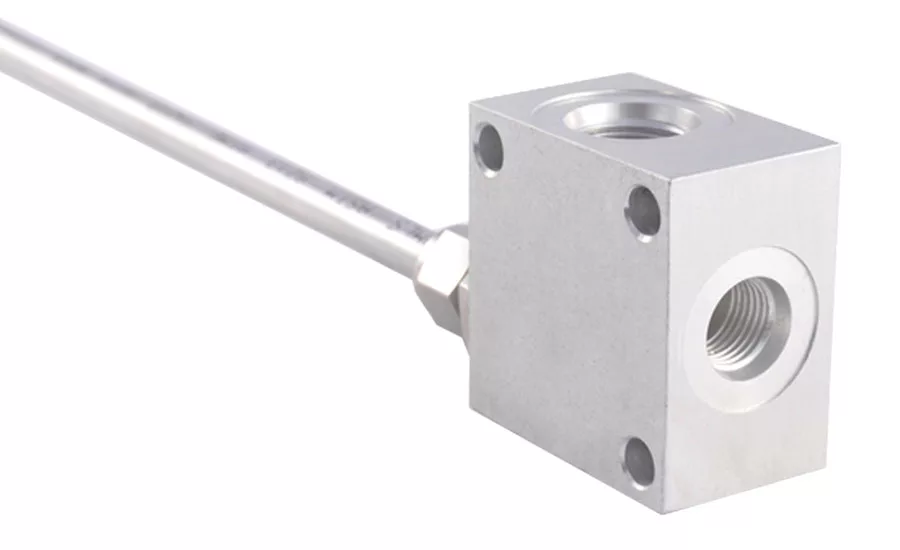
When the hot fluid or air enters the valve, the temperature alone will force the SMA to go through a phase change and perform work, depending on the design. An existing example produced today are anti-scald valves, and the potential extends to many other similar applications.
Other solutions are possible like an SMA valve that can activate a self-starting fire extinguisher in ovens if dangerously high temperatures are reached. SMAs could also turn off the gas to an oven or other appliance if exposed to these same dangerously high temperatures preventing often catastrophic fires. Another advantage SMA technology brings is the ability to sense temperature over a large area, or the whole oven versus one or two locations without any need for electrical controls or other sensors. Other applications like opening the soap dispenser or other controls when exposed to hot (or cold) water in dishwashing systems are also possible.
Ovens that are equipped with a self-cleaning feature commonly reach temperatures between 800°F to 1,000°F, which are maintained for hours at a time. Under these kinds of conditions, it is a fairly common occurrence for electronic control panels and fuses to burn out, possibly unlocking the oven door or preventing it from locking in the first place. SMAs create the possibility of locking based entirely on temperature near the system, removing electronics from the equation, and reducing the chances of lock failure.
Motor Overheat Protection Using SMAs
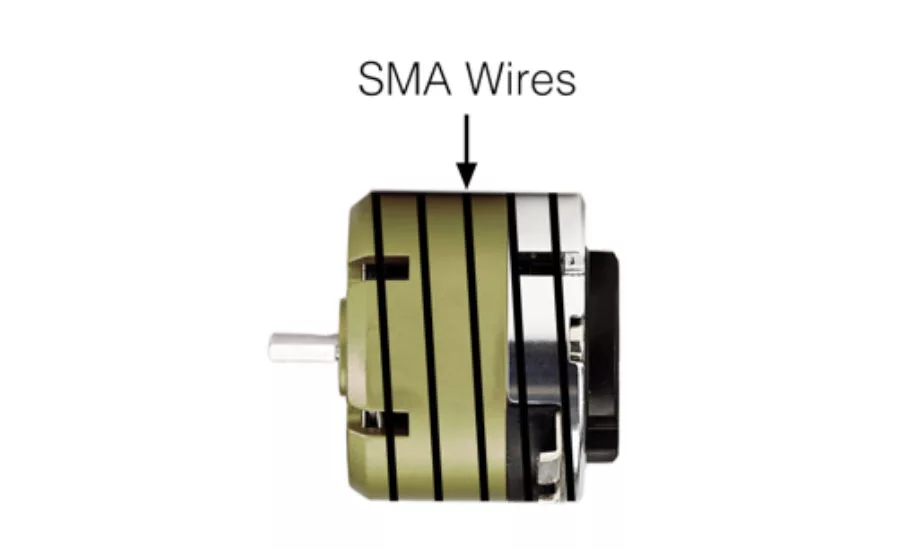
Overheating motors resulting from common issues such as overload, frequent stops and starts, and even environmental reasons can be addressed in new ways using the SMA phenomena. For example, simply wrapping SMA actuator wire around and/or throughout a motor or appliance, designed to contract and trigger a mechanical actuation, can be done reliably and repeatedly. Because SMAs can be made in a wide range of sizes and forms, they can be used in small and harder to get to places without adding significantly to weight and cost.
Using Heat to Accomplish Work, and Relocate Heat
Over the last several decades SMAs have been explored heavily as an alternative energy source, most recently in 2010 with the US Department of Energy ARPA-E program. The notion is that low grade waste heat (roughly defined as < 200°C and as little as 10°C temperature differences between the heat source and ambient temperatures) be used to move the material back and forth between its transition temperatures and through this process accomplish usable work and ideally generate electricity. The results from this work indicate that yes, it is possible; however, today the efficiency levels keep the cost greater than fossil fuel based solutions.
Although the thermo to mechanical efficiency of the SMA heat engine is relatively low (approximately 0.5% to 3%) the latent heat in the SMA element between phases demonstrated a unique ability to move heat from one location to another, with the potential to span larger distances than existing solutions today. So, in addition to turning a fan (to even air temperate for more controlled cooking) or some other mechanical work, moving heat from one location to another has evolved in new ways. For example in high power battery applications the ability to move heat away, physically separate batteries, and/or break a circuit within a battery or between batteries simply based on temperature is possible in new forms.
What This Means For Your Design
Although SMAs are new compared to commodity solutions they continue to open the door to new opportunities in both appliances and many other markets. However, because SMAs are emerging they do remain more difficult to implement, but that fact alone makes the products they are used in highly unique and competitive, oftentimes making them not only difficult to copy but to stand out in their field.
Looking for a reprint of this article?
From high-res PDFs to custom plaques, order your copy today!