Five Things: Additive Manufacturing
1. BMW Advances Industrial-Scale 3D Printing
The BMW Group is using generative design software and additive manufacturing to make production parts at an industrial scale. The automaker believes the technologies offer several advantages, including fast availability of components, flexible component design, and the ability to manufacture parts without elaborate tools.
“Additive manufacturing helps us to speed up development cycles and get our vehicles to series maturity faster,” says Daniel Schäfer, senior vice president for production integration and pilot plants at BMW. “It also shortens production times for components while meeting rigorous quality requirements.”
In June 2020, BMW opened an Additive Manufacturing Campus just outside Munich. The facility provides training in additive manufacturing and is the primary location for producing prototype parts. It employs 80 people and operates some 50 metal and polymer additive manufacturing systems. (More than 50 additional systems are operating at other BMW production sites around the world.)
Already, BMW is using additive manufacturing to make metal and plastic production parts for Rolls-Royce Motor Cars. These include rigid, functional parts for the vehicle body and passenger compartment.
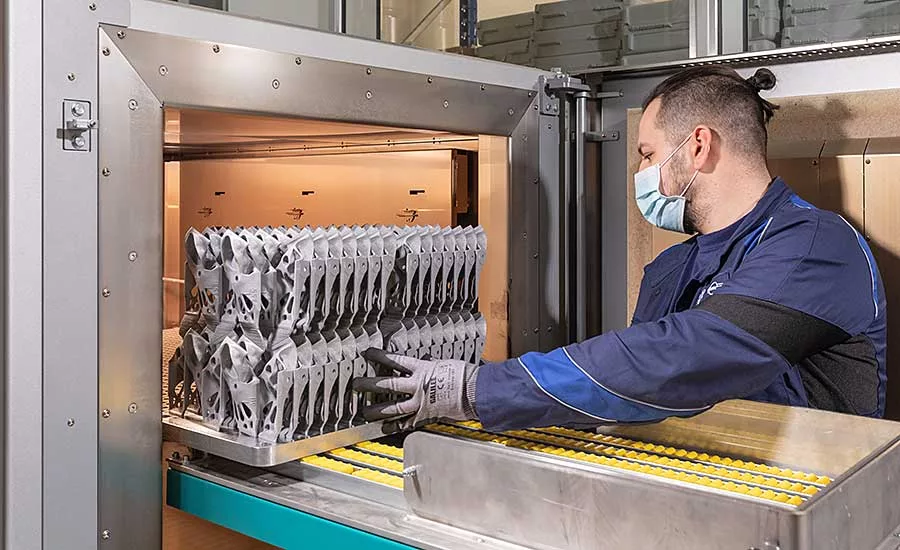
BMW’s factory in Landshut, Germany, produces metal parts for engines, suspensions and bodies; plastic parts for vehicle exteriors; carbon-fiber body components; cockpit and equipment options; electric drive systems; special motors; and propeller shafts. Many metal parts are made using the laser beam melting process, in which 3D components are digitally “cut” into 2D layers of metal particles. Cohesion of the particles is achieved via a laser that exposes the contours and surfaces of the 2D layers, causing the powder to melt and bond locally at these points. The steps are repeated layer by layer as the building platform lowers after each exposure to make room for a new layer of powder. After the last layer has been exposed, the parts, including the platform on which they were built, are de-powdered and removed from the system. The parts are then separated from the platform.
The degree to which additive manufacturing can be used in parts production is ascertained in the early stages of vehicle development. Engineers analyze hundreds of components, focusing on cost, weight and geometry compared with conventionally made parts. Artificial intelligence software helps engineers identify candidates for 3D printing quickly, while generative design software enables engineers to come up with completely new designs. Additive manufacturing is particularly suited to making parts created via generative design. Their complex forms and structures are typically impossible to produce with conventional methods.
2. Microporous 3D Printing Material Can Create Sponge-Like Parts
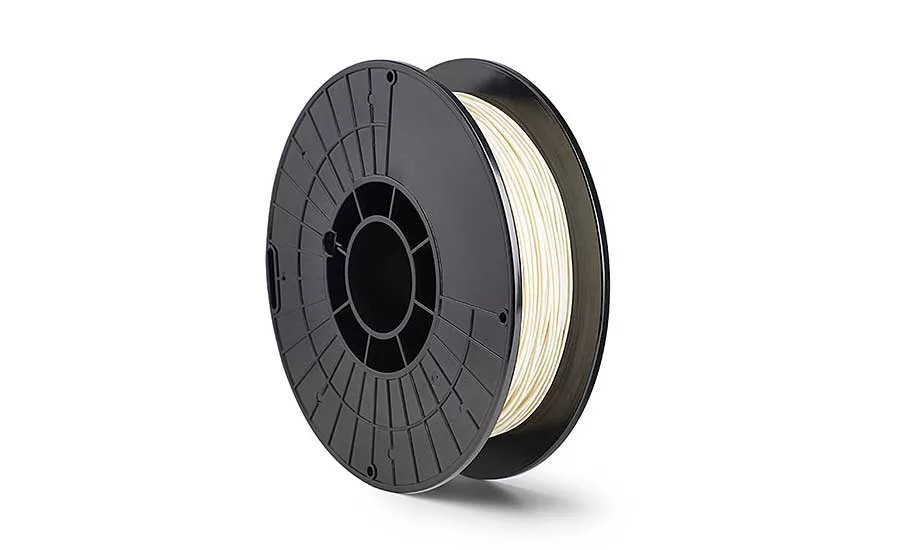
Infinite Material Solutions LLC has introduced a new 3D printing material, Caverna PP, an extrudable thermoplastic with a water-soluble, co-continuous, microporous morphology. In simpler terms: It’s a 3D printing filament that allows engineers to create lightweight foam parts resembling a sponge.
Looking for quick answers on assembly and manufacturing topics? Try Ask ASM, our new smart AI search tool. Ask ASM
Designed for use in fused filament fabrication systems, Caverna PP is a blend of two polymers: a soluble material to be removed through dissolution, and an insoluble build material—polypropylene—that remains in place. After dissolution, the water-soluble material leaves behind a cave-like network of microporous, interconnected channels inside the build material, making it light, soft and porous.
The company expects the material will open up new applications for additive manufacturing, such as separators, footwear and personal protective equipment. For example, the material could be used to make armrests, hand brake handles and other automotive interior components. It could also be used to make filters for air or water. One area of interest is the potential to create porous tooling for the production of vacuum-formed parts. Caverna PP’s co-continuous distribution of tiny pores, 1 to 4 microns in diameter, could allow for consistent airflow, eliminating the need to drill holes and maximizing material distribution.
Caverna PP joins two other novel materials in Infinite’s portfolio: AquaSys 120 and AquaSys 180 water-soluble support filaments. These materials pair with popular build materials, such as PLA and PEEK, to support complex designs, then dissolve quickly in tap water to leave behind a finished part. Infinite recommends pairing Caverna PP with AquaSys 120 for one-step dissolution. Engineers can print the part, leave it to dissolve, and come back to find a complete build with a microporous structure.
Caverna PP is available in 1.75- and 2.85-millimeter-wide filaments. For more information, visit https://infinitematerialsolutions.com.
3. Toymaker Uses 3D Printers to Enable Kids to Make Custom Toys
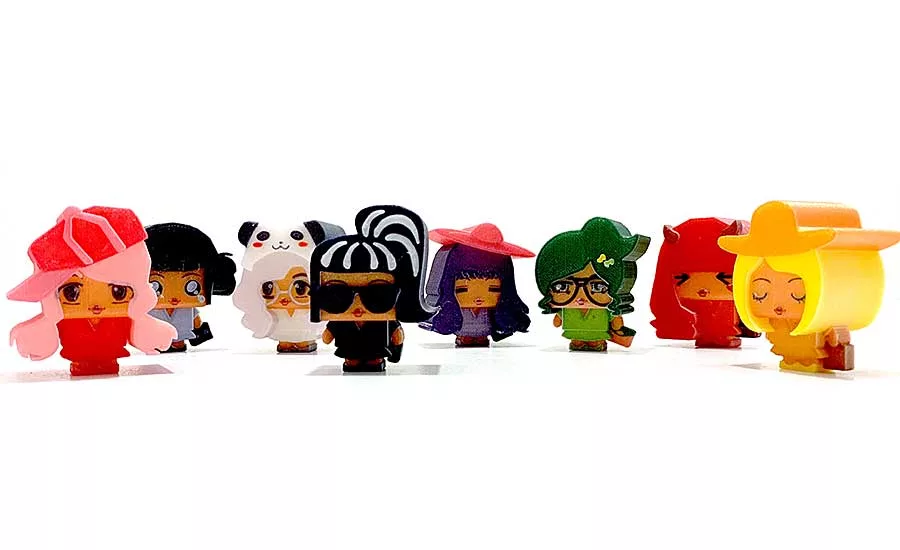
Toronto-based toymaker Little You has developed an online platform that lets children create unique, custom anime figures that can be 3D printed and delivered to their door.
The company is the brainchild of artist Christina Guo, who came up with the idea while studying at OCAD University.
Originally, the figures could only be produced in 3D color sandstone, which is made from a gypsum based powder, similar to plaster. However, the fragile material required careful handling.
Now, the company is also offering the figurines in Rizium GF, a composite thermoplastic from RIZE Inc. Rizium GF is printed using the fused filament fabrication method on RIZE 3D printers. During the 3D printing process, the filament is heated to a semi-molten state and the plastic is extruded layer by layer. RIZE adds another level to the process with its proprietary augmented polymer deposition technology, which embeds color inks directly into the part.
The recyclable, environmentally friendly material is tough enough to endure hours of rugged play. Children can play with the figures at home, the park, the pool or anywhere life takes them. If the toys get dirty, they can be washed. The colors don’t fade.
“With RIZE, Little You sets our users’ imaginations free to make amazing full-color custom toys with the click of a mouse,” says Christina Guo. “Together we’re taking our users’ experience to the next level.”
For more information, visit https://rize3d.com.
4. NASA Tests Capabilities of 3D Printed RF Circuits
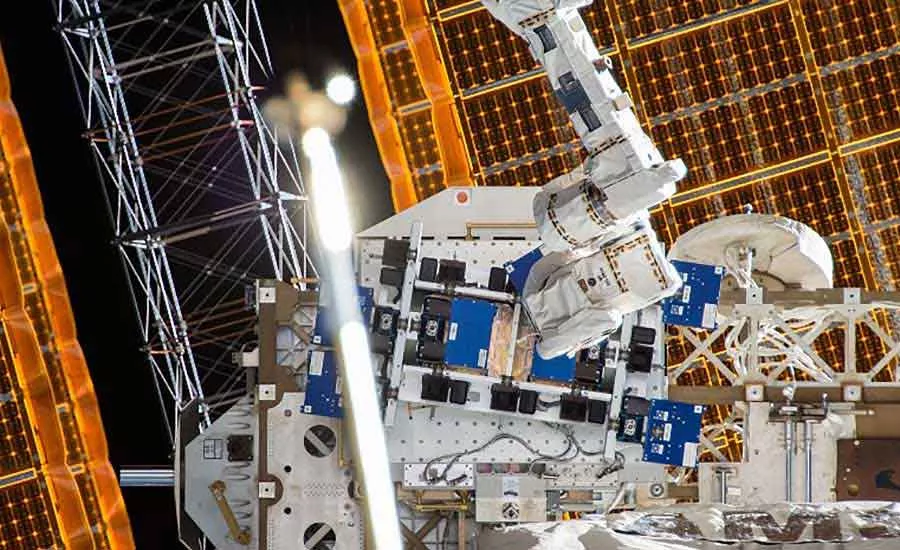
NASA is testing a 3D-printed radio frequency (RF) circuit on the International Space Station.
The circuit was made by Nano Dimension Ltd. and designed and integrated by L3Harris. It is being used in an experiment to test the viability of using additive manufacturing to create RF circuits for space systems, especially nanosatellites. It will communicate with a ground-based satellite tracking system at Embry Riddle Aeronautical University in Daytona Beach, FL. The project is the first systematic experiment by L3Harris and Nano Dimension to test the capabilities of 3D printed high-performance electronic devices in space.
Nano Dimension fabricated the single RF board using its DragonFly LDM additive manufacturing system. The board includes the antenna, the electronic traces for mounting all the functional components, and the signal ground plane. Designed to operate at 2.4 gigahertz, the device will be tested at three points: preflight, in-flight and postflight. On board the space station, the circuit will fly in low Earth orbit for six months.
Additive manufacturing could play a key role in making electronic devices for space. The technology promises to reduce weight, increase performance, speed development time, and provide the ability to fabricate complex shapes and systems that traditional manufacturing methods cannot.
“Additive manufacturing is playing a critical role in advancing the development and applications of small satellites and nanosatellites,” says Arthur Paolella, Ph.D., senior scientist for the Space and Airborne Systems segment of L3Harris.
5. 20 Million
In February, additive manufacturing services provider Shapeways announced that it has produced more than 20 million parts using 10 printing technologies and 90 materials and finishes. More than 1 million customers from 160 countries have contracted with the New York City-based company since 2018 to manufacture a variety of parts and products, including prosthetics, personal protective equipment, device mounts for off-road vehicles, and even beehives.
Looking for a reprint of this article?
From high-res PDFs to custom plaques, order your copy today!