Assembly Magazine logo
search
Ask ASSEMBLY AI
cart
facebook twitter linkedin youtube
  • Sign In
  • Create Account
  • Sign Out
  • My Account
Assembly Magazine logo
  • TRENDS
    • Ask ASSEMBLY AI
    • Trends
    • News
    • New Products
  • INDUSTRIES
    • Aerospace
    • Appliance
    • DFMA Assembly
    • Medical Devices
    • Green Manufacturing
    • Lean Manufacturing
    • Machinery Assembly
    • Electronics Assembly
    • Automotive
  • TECHNOLOGIES
    • Adhesives & Dispensing
    • Assembly Presses
    • Automated Assembly Systems
    • Manufacturing Management
    • Manufacturing Software
    • Motion Control
    • Screwdriving & Riveting
    • Robotics
    • Test & Inspection
    • Plastics & Metal Welding
    • Wire Processing
    • Workstations
  • AUTONOMOUS & ELECTRIC MOBILITY
    • AEM Magazine Archives
    • Autonomy
    • Electrification
    • Mobility Services
    • Assembly & Testing
    • AV/EM News
  • MEDIA
    • Ask ASSEMBLY AI
    • Podcasts
    • Assembly News Now
    • Assembly TV
    • Webinars
    • eBooks
  • EVENTS
    • Calendar
    • The ASSEMBLY Show
  • MORE
    • Exclusives >
      • Plant of the Year
      • Capital Spending
    • Buyers Guide >
      • Supplier Insights
    • Classifieds
    • Featured Products
    • Newsletters
    • Store
    • White Papers
    • Columns
    • Sponsor Insights
  • INFOCENTER
    • Assembly & Test Solutions
  • EMAGAZINE
    • eMagazine
    • Archive Issues
    • Advertise
    • Contact Us
    • Sign Up
ColumnsRobotics AssemblyTest and Inspection Assembly

Strain Gauge Enables Bipedal Robot to Walk
By Jim Camillo
Strain Gauge Enables Bipedal Robot to Walk
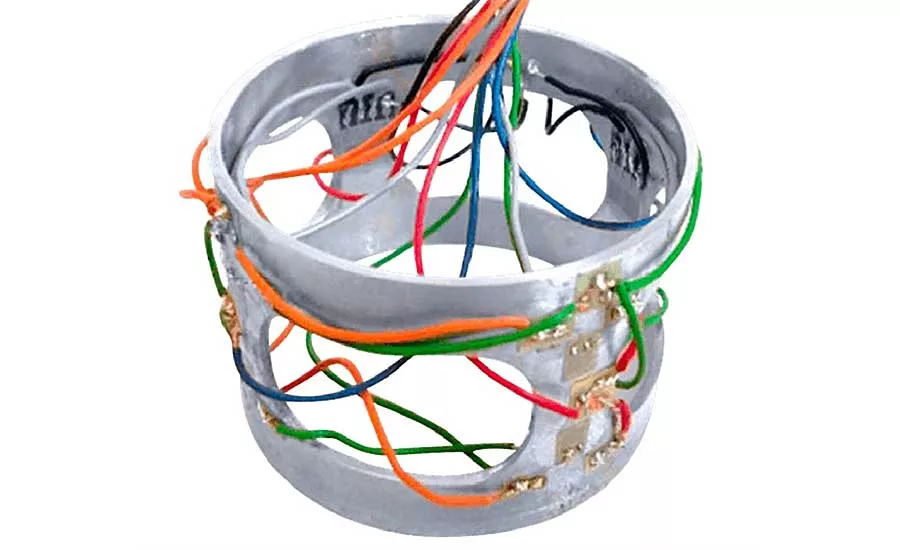
Researchers at the Technical University of Darmstadt developed this prototype sensorial foot for load-bearing walking robots using strain gauges rather than more expensive and advanced sensors. Photo courtesy HBM
Strain Gauge Enables Bipedal Robot to Walk
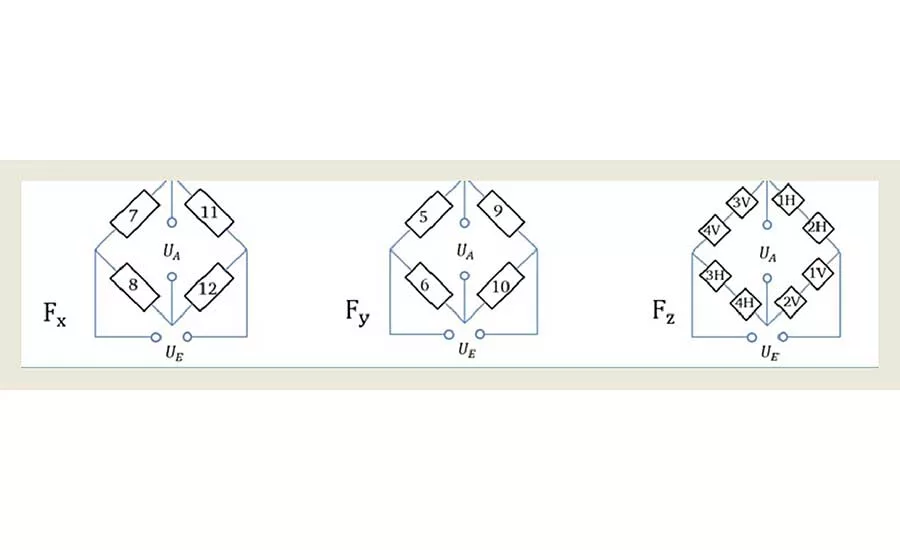
The gauges were positioned in three full-bridge (square) configurations. On the right is the bridge containing four strain gauge rosettes. Bridges on the left and center each feature four standard strain gauges. Graphic courtesy HBM
Strain Gauge Enables Bipedal Robot to Walk
October 21, 2021

Technical universities are often taken for granted in their development of manufacturing technology. Thankfully, this is not the case in Germany.

In Munich, the Fraunhofer network of 72 technical institutes serves as an example of how researchers and manufacturers can successfully work closely together to advance industry. Not far away, in Darmstadt, sits another technical university filled with many types of researchers, including those that specialize in robotics.

In 2017, researchers in the Simulation, System Optimization and Robotics Department undertook a unique and challenging project: Develop a prototype sensorial foot for load-bearing walking robots using cost-effective strain gauges rather than more expensive and advanced sensors.

Step one in the process was obtaining economical strain gauges that offer high accuracy and performance. The Darmstadt team looked first to HBM (now an HBK company) based on its reputation, proximity and previous university research projects involving strain gauges.

A total of 12 gauges were obtained from HBM. Four are model K-TA11K3/350 strain gauge rosettes. The other eight are model K-LU13K1.6/350 standard gauges. All of them are coated with phenolic resin-based P250 adhesive to quicken installation and minimize output signal scattering.

Next, the team carefully positioned the gauges in three full-bridge (square) configurations on an aluminum cylinder that serves as the robot foot. One bridge is inside the cylinder and two are on the outside. Several side holes allow gauge wiring to easily pass in and out of the cylinder.

The researchers chose the full bridge configuration, rather than a quarter or half-bridge one, primarily because it measures even the smallest resistance changes. They also like that it is linear, and gauge output is directly proportional to an applied force, with no approximation.

Looking for quick answers on assembly and manufacturing topics? Try Ask ASM, our new smart AI search tool. Ask ASM →

On the bridge positioned within the cylinder, four K-TA11K3/350 strain gauge rosettes measure the Z force. A rosette refers to two tiny gauges positioned next to each other to measure strains along different directions. In this case, one rosette is located on each side of the square. For each of the two outer bridges, four K-LU13K1.6/350 gauges measure the X and Y forces separately.

After installing the gauges, the team set up its ANSYS Workbench 19.1 software to display any bridge deflection and qualitative gauge strain (in each force direction) during testing. Gauge calibration was then performed, with a focus on measuring range (±0.156 volt) and input signal (11.42 to -28.90 millivolts, depending on force direction).

Finally, the team completed the prototype’s initial test run with impressive results. For the X force, the gauges showed an average relative error of only 1.5 percent with a mean absolute deviation of 3.

The Y force results showed an average relative error of 2.6 percent with a mean absolute deviation of 4, and the Z force results were 3.1 percent for a deviation of 23. A follow-up project is being conducted at the university to further optimize these results.

One of HBM’s newest strain gauge series is the KFU, which is designed for structural tests in high-temperature conditions up to 350 C. The gauges come with a 1-meter-long wire, and are available with a 2- or 5-millimeter grid, depending on the application requirements.

For more information on strain gauges, call 800-578-4260 or visit www.hbm.com/en.

KEYWORDS: force measurement strain gauge

Share This Story

Looking for a reprint of this article?
From high-res PDFs to custom plaques, order your copy today!

Jim was a senior editor of ASSEMBLY and has more than 30 years of editorial experience. Before joining ASSEMBLY, Camillo was the editor of PM Engineer, Association for Facilities Engineering Journal and Milling Journal. Jim has an English degree from DePaul University.

Recommended Content

JOIN TODAY
To unlock your recommendations.

Already have an account? Sign In

  • Made in the U.S.A.

    Consumer Products Manufacturing: Made in the USA

    Supply chain lessons learned during the coronavirus...
    Automated Assembly Systems
    By: Austin Weber
  • Best Practices for Press-Fit Assembly

    Best Practices for Press-Fit Assembly

    In manufacturing, ironclad formulas for success are hard...
    Assembly Presses
    By: Jim Camillo
  • aem0523leader-tesla1.jpg

    Tesla Rethinks the Assembly Line

    Engineers at Tesla Inc. have developed a new process that...
    Industries
    By: Austin Weber
Manage My Account
  • eMagazine Subscription
  • Assembly Newsletters
  • Online Registration
  • Subscription Customer Service
  • Manage My Preferences

More Videos

Sponsored Content

Sponsored Content is a special paid section where industry companies provide high quality, objective, non-commercial content around topics of interest to the ASSEMBLY audience. All Sponsored Content is supplied by the advertising company and any opinions expressed in this article are those of the author and not necessarily reflect the views of ASSEMBLY or its parent company, BNP Media. Interested in participating in our Sponsored Content section? Contact your local rep!

close
  • ultrasonic welding
    Sponsored bySonobond Ultrasonics

    Engineering Efficiency in High-Performance Assembly: How Ultrasonic Welding Enhances Throughput, Reliability and Quality

  • UV curing system
    Sponsored byDymax

    Why UV Intensity Alone Doesn’t Define Curing Performance

  • wooden pallets
    Sponsored byLEAN Manufacturing Products

    Eliminating Waste on the Shop Floor: Applying Lean Principles to Improve Manufacturing Efficiency

Popular Stories

ASSEMBLY News Now, episode-30: Volvo Redesigns EV Manufacturing

Volvo Redesigns EV Manufacturing

Boeing CEO Kelly Ortberg announces 1 billion investment

Boeing Plans $1 Billion Wichita Investment, Workforce Training Center

GE Appliances Worker on Line

GE Appliances Expands Factory AI With 800 Gemini Enterprise Agents

Watch the latest episode of ANN now!

Events

July 24, 2025

From Shop Floor to CFO: How Manufacturers Are Closing the Loop Between Operations and Finance

On Demand Learn how manufacturers are bridging the gap between the shop floor and ERP systems to gain real-time visibility, streamline operations, and kick-start digital transformation—without waiting years.

Sponsored by:

PicoStratusGreen
July 30, 2025

Buffer Analysis and Design Fundamentals for Manufacturing Excellence

On Demand In this presentation, Dr. Herman Tang shares practical insights from his industry experience and research on buffer management in manufacturing operations.

View All Submit An Event

Poll

Difficult Assembly Processes

Which assembly process gives you the most difficulty?
View Results Poll Archive

Products

Manufacturing Cost Policy Deployment (MCPD) Profitability Scenarios: Systematic and Systemic Improvement of Manufacturing Costs

Manufacturing Cost Policy Deployment (MCPD) Profitability Scenarios: Systematic and Systemic Improvement of Manufacturing Costs

See More Products
Register for webinar - Modernizing Automotive Assembly: Why Upgrading Legacy MES is a Business Imperative

Related Articles

  • Boston Dynamics Atlas humanoid robot

    Large Behavior Model Enables Humanoid Robot to Multi-Task

    See More
  • Humanoid Robot Designed to Replace Factory Workers

    See More
  • Robot Gets to Work Quicker on Transport Unit

    Robot Gets to Work Quicker on Transport Unit

    See More

Related Products

See More Products
  • Introduction to the Design and Behavior of Bolted Joints, Fourth Edition: Non-Gasketed Joints

  • value stream.jpg

    Using Hoshin Kanri to Improve the Value Stream

  • pocket.jpg

    How To Implement Lean Manufacturing, Second Edition

See More Products

Related Directories

  • HowToRobot

  • AGT Absolute Gauge Technologies

  • One-Off Robotics

    One-Off Robotics is an advanced equipment manufacturer designing and building the world's most innovative robotic fabrication systems. We specialize in robotic metal additive manufacturing and robotic milling, offering both stationary and portable, field-deployable systems engineered for demanding production environments. Our technologies enable additive, subtractive, and hybrid fabrication processes, supporting applications across Defense, Aerospace, Research, and Specialized Production sectors.
×

Never miss the latest news and trends driving the manufacturing industry

Stay in the know on the latest assembly trends.

JOIN TODAY!
  • RESOURCES
    • Advertise
    • Contact Us
    • Directories
    • Manufacturing Division
    • Store
    • Want More?
  • SIGN UP TODAY
    • Create Account
    • eMagazine
    • Newsletters
    • Customer Service
    • Manage Preferences
  • SERVICES
    • Marketing Services
    • Reprints
    • Market Research
    • List Rental
    • Survey/Respondent Access
  • STAY CONNECTED
    • LinkedIn
    • Facebook
    • Instagram
    • YouTube
    • X (Twitter)
  • PRIVACY
    • PRIVACY POLICY
    • TERMS & CONDITIONS
    • DO NOT SELL MY PERSONAL INFORMATION
    • PRIVACY REQUEST
    • ACCESSIBILITY

Copyright ©2026. All Rights Reserved BNP Media, Inc. and BNP Media II, LLC.

Design, CMS, Hosting & Web Development :: ePublishing