Assembly Magazine logo
search
Ask ASSEMBLY AI
cart
facebook twitter linkedin youtube
  • Sign In
  • Create Account
  • Sign Out
  • My Account
Assembly Magazine logo
  • TRENDS
    • Ask ASSEMBLY AI
    • Trends
    • News
    • New Products
  • INDUSTRIES
    • Aerospace
    • Appliance
    • DFMA Assembly
    • Medical Devices
    • Green Manufacturing
    • Lean Manufacturing
    • Machinery Assembly
    • Electronics Assembly
    • Automotive
  • TECHNOLOGIES
    • Adhesives & Dispensing
    • Assembly Presses
    • Automated Assembly Systems
    • Manufacturing Management
    • Manufacturing Software
    • Motion Control
    • Screwdriving & Riveting
    • Robotics
    • Test & Inspection
    • Plastics & Metal Welding
    • Wire Processing
    • Workstations
  • AUTONOMOUS & ELECTRIC MOBILITY
    • AEM Magazine Archives
    • Autonomy
    • Electrification
    • Mobility Services
    • Assembly & Testing
    • AV/EM News
  • MEDIA
    • Ask ASSEMBLY AI
    • Podcasts
    • Assembly News Now
    • Assembly TV
    • Webinars
    • eBooks
  • EVENTS
    • Calendar
    • The ASSEMBLY Show
  • MORE
    • Exclusives >
      • Plant of the Year
      • Capital Spending
    • Buyers Guide >
      • Supplier Insights
    • Classifieds
    • Featured Products
    • Newsletters
    • Store
    • White Papers
    • Columns
    • Sponsor Insights
  • INFOCENTER
    • Assembly & Test Solutions
  • EMAGAZINE
    • eMagazine
    • Archive Issues
    • Advertise
    • Contact Us
    • Sign Up
IndustriesAerospace Assembly

Relativity Space Takes 3D Printing to New Extremes

By Austin Weber
Relativity Space Takes 3D Printing to New Extremes
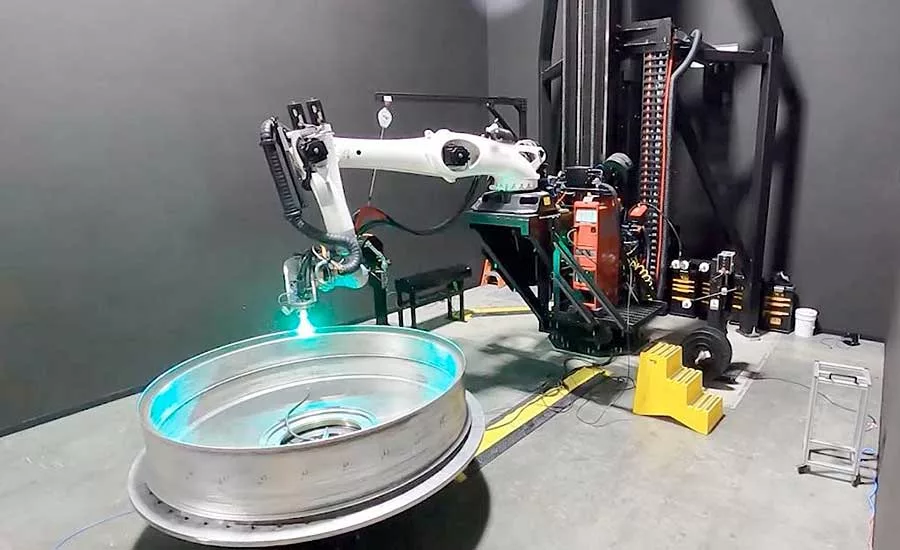
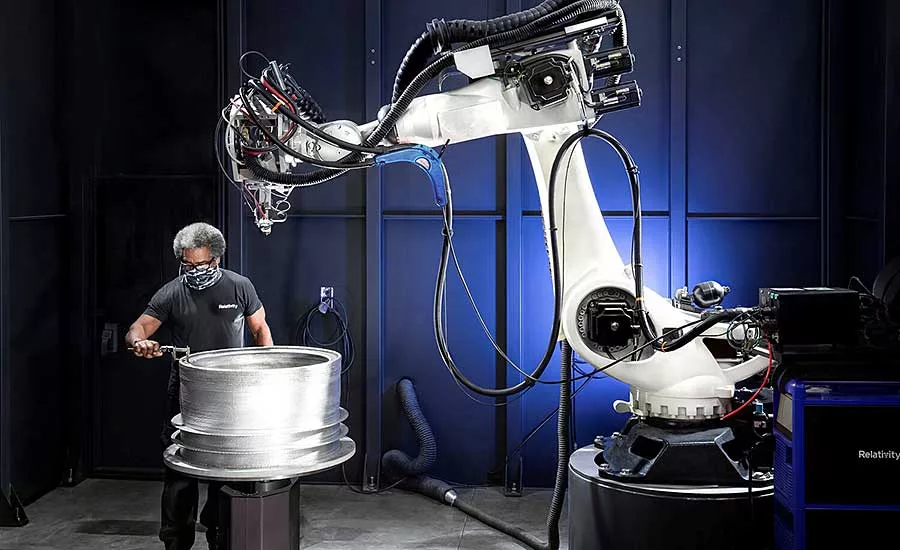
Relativity Space's Stargate 3D printer was developed in-house. Photo courtesy Relativity Space Inc.
Relativity Space Takes 3D Printing to New Extremes
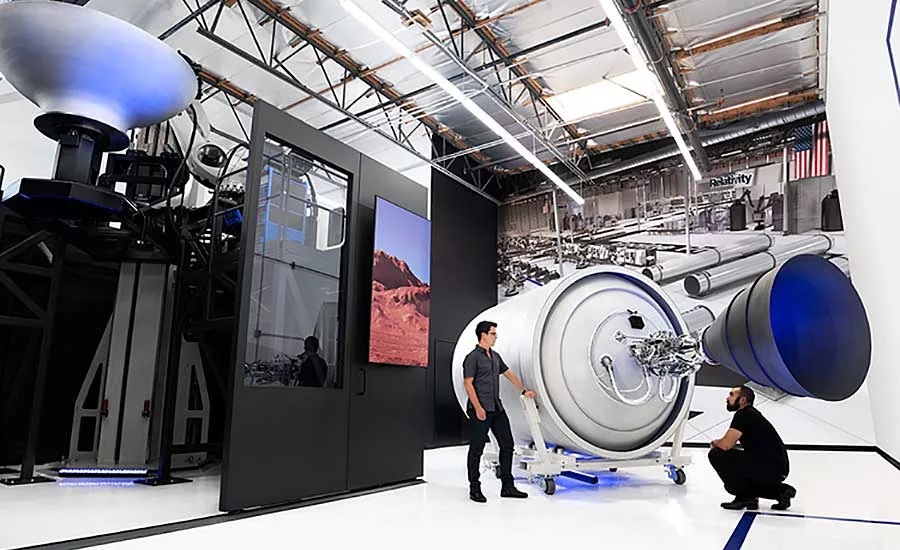
Relativity Space recently acquired a 1-million-square-foot factory in Long Beach, CA, that was once used by Boeing and McDonnell Douglas. Illustration courtesy Relativity Space Inc.
Relativity Space Takes 3D Printing to New Extremes

By using additive manufacturing, Relativity Space plans to build rockets in 60 days or less. Photo courtesy Relativity Space Inc.
Relativity Space Takes 3D Printing to New Extremes
Relativity Space plans to disrupt and revolutionize the traditional way of mass-producing rockets. Photo courtesy Relativity Space Inc.
Relativity Space Takes 3D Printing to New Extremes
Relativity Space’s rockets will be used for heavy lift applications, such as launching small satellites into low-Earth orbit. Illustration courtesy Relativity Space Inc.
Relativity Space Takes 3D Printing to New Extremes
March 16, 2022

Traditionally, additive manufacturing has been used in the aerospace industry to print small metal parts, such as brackets and fuel nozzles. But, Relativity Space Inc. hopes to change that scenario by thinking big. The start-up company plans to print entire rockets using state-of-the-art technology.

Additive manufacturing “prints” solid objects from a digital file by depositing one layer of material on top of another, rather than starting with a piece of metal and cutting or milling it away. It allows companies to more easily manufacture complex shapes and structures that are difficult to make. There’s also less waste compared to traditional manufacturing techniques, which require longer setup times and higher material costs.

Relativity Space recently acquired a 1-million-square-foot factory in Long Beach, CA, that was once used by Boeing to assemble the C-17 Globemaster military cargo plane. Before that, the 93-acre site was home to McDonnell Douglas, which produced jetliners such as the MD-80 and DC-8 at the site adjacent to Long Beach Airport.

Relativity Space has been transforming the facility into a “factory of the future” centered around Stargate, a machine developed in-house that it claims is the world’s largest 3D printer. The company has also invested in state-of-the-art artificial intelligence technology and robots to boost production efficiency.

With in-process monitoring, a series of Stargate printers will analyze production in real time, detect any quality issues, and use sensors and predictive analytics tools to print structures with extremely tight dimensional tolerances. The machines can produce unique geometries that are not possible using traditional aerospace manufacturing methods.

“Incorporating AI-driven controls, [our] printers continuously optimize production, resulting in exponentially compounded quality and time improvements, lower costs and product designs not possible in traditional aerospace manufacturing,” claims Tim Ellis, CEO of Relativity Space. “As a vertically integrated technology platform, [we are] at the forefront of an inevitable shift toward software-defined manufacturing.

“By fusing 3D printing, artificial intelligence and autonomous robotics, we are pioneering the factory of the future,” says Ellis. “Disrupting 60 years of aerospace, [we] offer a radically simplified supply chain, building a rocket with 100 times fewer parts in less than 60 days.”

Looking for quick answers on assembly and manufacturing topics? Try Ask ASM, our new smart AI search tool. Ask ASM →

Because of additive manufacturing technology, Ellis expects to reduce the part count on a typical rocket from 100,000 to 1,000 components. The company’s six-axis robots can emit about 10 inches of material onto a large turntable fixture every second. The directed energy deposition printing process uses proprietary alloys designed to meet mission-critical performance requirements.

Ellis wants to disrupt and revolutionize the traditional way of mass-producing rockets. In the past, the slow production process has relied on complex supply chains, large factories, fixed tooling and extensive manual labor. The entire assembly process typically takes two years or more.

With his new production paradigm, Ellis intends to reduce the development cycle from 48 months to six months and the actual build time from 24 months to two months.

“We’re on a mission to create an entirely new tech stack for aerospace manufacturing,” explains Ellis. “Building on six years of development to date, we’re now ready to take our in-house developed tools to the next level and create an entire factory operating system to transform aerospace through data, machine learning and an entirely new way of developing products. Relativity is blazing a new path for rockets and aerospace.”

Relativity Space’s two rockets will be used for heavy lift applications, such as launching CubeSats and other small satellites into low-Earth orbit. Its first rocket, dubbed the Terran 1, is scheduled to make its first test flight laterthis year at Cape Canaveral Space Force Station. The Terran R, a larger, fully reusable launch vehicle, is scheduled to lift off in 2024. Both two-stage rockets will sport “Printed in the USA” graphics.

Terran 1 is 115-feet tall and 7.5-feet wide, with a maximum payload capacity of 2,756 pounds. Terran R will be 216-feet tall and 16-feet in diameter, with a payload capacity of 44,100 pounds.

The rockets’ engines, which will also feature printed parts, will be fueled with liquid methane and liquid oxygen. The first stage of the Terran 1 will be powered by nine Aeon 1 engines that will each produce 23,000 pounds of force at launch. The Terran R will use seven Aeon R engines. The second stages of both rockets will be powered by one Aeon 1 Vacuum engine that will generate up to 28,300 pounds of force.

Relativity Space claims that the Terran 1 is the most pre-sold rocket in history prior to launch. The company has already secured contracts from both commercial and government entities, including NASA.

KEYWORDS: additive manufacturing factory automation

Share This Story

Looking for a reprint of this article?
From high-res PDFs to custom plaques, order your copy today!

Austinweber headshot
Austin has been senior editor for ASSEMBLY Magazine since September 1999. He has more than 21 years of b-to-b publishing experience and has written about a wide variety of manufacturing and engineering topics. Austin is a graduate of the University of Michigan.

Recommended Content

JOIN TODAY
To unlock your recommendations.

Already have an account? Sign In

  • Made in the U.S.A.

    Consumer Products Manufacturing: Made in the USA

    Supply chain lessons learned during the coronavirus...
    Automated Assembly Systems
    By: Austin Weber
  • Best Practices for Press-Fit Assembly

    Best Practices for Press-Fit Assembly

    In manufacturing, ironclad formulas for success are hard...
    Assembly Presses
    By: Jim Camillo
  • aem0523leader-tesla1.jpg

    Tesla Rethinks the Assembly Line

    Engineers at Tesla Inc. have developed a new process that...
    Assembly and Testing
    By: Austin Weber
Manage My Account
  • eMagazine Subscription
  • Assembly Newsletters
  • Online Registration
  • Subscription Customer Service
  • Manage My Preferences

More Videos

Sponsored Content

Sponsored Content is a special paid section where industry companies provide high quality, objective, non-commercial content around topics of interest to the ASSEMBLY audience. All Sponsored Content is supplied by the advertising company and any opinions expressed in this article are those of the author and not necessarily reflect the views of ASSEMBLY or its parent company, BNP Media. Interested in participating in our Sponsored Content section? Contact your local rep!

close
  • ultrasonic welding
    Sponsored bySonobond Ultrasonics

    Engineering Efficiency in High-Performance Assembly: How Ultrasonic Welding Enhances Throughput, Reliability and Quality

  • UV curing system
    Sponsored byDymax

    Why UV Intensity Alone Doesn’t Define Curing Performance

  • wooden pallets
    Sponsored byLEAN Manufacturing Products

    Eliminating Waste on the Shop Floor: Applying Lean Principles to Improve Manufacturing Efficiency

Popular Stories

Ferrari

Ferrari Unveils Four-Door EV

ASSEMBLY News Now, episode-30: Volvo Redesigns EV Manufacturing

Volvo Redesigns EV Manufacturing

Robots working at Toyota Plant in Japan

Toyota Deploys Geekplus Robots for Factory Material Handling

Watch the latest episode of ANN now!

Events

July 24, 2025

From Shop Floor to CFO: How Manufacturers Are Closing the Loop Between Operations and Finance

On Demand Learn how manufacturers are bridging the gap between the shop floor and ERP systems to gain real-time visibility, streamline operations, and kick-start digital transformation—without waiting years.

Sponsored by:

PicoStratusGreen
July 30, 2025

Buffer Analysis and Design Fundamentals for Manufacturing Excellence

On Demand In this presentation, Dr. Herman Tang shares practical insights from his industry experience and research on buffer management in manufacturing operations.

View All Submit An Event

Poll

Difficult Assembly Processes

Which assembly process gives you the most difficulty?
View Results Poll Archive

Products

Manufacturing Cost Policy Deployment (MCPD) Profitability Scenarios: Systematic and Systemic Improvement of Manufacturing Costs

Manufacturing Cost Policy Deployment (MCPD) Profitability Scenarios: Systematic and Systemic Improvement of Manufacturing Costs

See More Products
ebook

Related Articles

  • Air Force lab takes 3D printing to new heights.

    Air Force Lab Takes 3D Printing to New Heights

    See More
  • Volvo Truck Plant Uses 3D Printing to Make Tools

    See More
  • Fiat Chrysler Uses 3D Printing to View Inner Workings of Axle

    See More

Related Products

See More Products
  • 0001219.jpeg

    3D Printing 2E, Understanding Additive Manufacturing

  • Introduction to the Design and Behavior of Bolted Joints, Fourth Edition: Non-Gasketed Joints

  • pocket.jpg

    How To Implement Lean Manufacturing, Second Edition

See More Products

Related Directories

  • dSPACE

    dSPACE develops and distributes integrated hardware and software tools for developing and testing electronic control units and mechatronic controls. The company's customer base includes virtually all major vehicle manufacturers and suppliers. Visit www.dspaceinc.com.
  • 3D Infotech

  • Carbide 3D

×

Never miss the latest news and trends driving the manufacturing industry

Stay in the know on the latest assembly trends.

JOIN TODAY!
  • RESOURCES
    • Advertise
    • Contact Us
    • Directories
    • Manufacturing Division
    • Store
    • Want More?
  • SIGN UP TODAY
    • Create Account
    • eMagazine
    • Newsletters
    • Customer Service
    • Manage Preferences
  • SERVICES
    • Marketing Services
    • Reprints
    • Market Research
    • List Rental
    • Survey/Respondent Access
  • STAY CONNECTED
    • LinkedIn
    • Facebook
    • Instagram
    • YouTube
    • X (Twitter)
  • PRIVACY
    • PRIVACY POLICY
    • TERMS & CONDITIONS
    • DO NOT SELL MY PERSONAL INFORMATION
    • PRIVACY REQUEST
    • ACCESSIBILITY

Copyright ©2026. All Rights Reserved BNP Media, Inc. and BNP Media II, LLC.

Design, CMS, Hosting & Web Development :: ePublishing