Assembly Magazine logo
search
Ask ASSEMBLY AI
cart
facebook twitter linkedin youtube
  • Sign In
  • Create Account
  • Sign Out
  • My Account
Assembly Magazine logo
  • TRENDS
    • Ask ASSEMBLY AI
    • Trends
    • News
    • New Products
  • INDUSTRIES
    • Aerospace
    • Appliance
    • DFMA Assembly
    • Medical Devices
    • Green Manufacturing
    • Lean Manufacturing
    • Machinery Assembly
    • Electronics Assembly
    • Automotive
  • TECHNOLOGIES
    • Adhesives & Dispensing
    • Assembly Presses
    • Automated Assembly Systems
    • Manufacturing Management
    • Manufacturing Software
    • Motion Control
    • Screwdriving & Riveting
    • Robotics
    • Test & Inspection
    • Plastics & Metal Welding
    • Wire Processing
    • Workstations
  • AUTONOMOUS & ELECTRIC MOBILITY
    • AEM Magazine Archives
    • Autonomy
    • Electrification
    • Mobility Services
    • Assembly & Testing
    • AV/EM News
  • MEDIA
    • Ask ASSEMBLY AI
    • Podcasts
    • Assembly News Now
    • Assembly TV
    • Webinars
    • eBooks
  • EVENTS
    • Calendar
    • The ASSEMBLY Show
  • MORE
    • Exclusives >
      • Plant of the Year
      • Capital Spending
    • Buyers Guide >
      • Supplier Insights
    • Classifieds
    • Featured Products
    • Newsletters
    • Store
    • White Papers
    • Columns
    • Sponsor Insights
  • INFOCENTER
    • Assembly & Test Solutions
  • EMAGAZINE
    • eMagazine
    • Archive Issues
    • Advertise
    • Contact Us
    • Sign Up
ColumnsMoser on Manufacturing

US Manufacturing: Stabilized and Poised for Growth!
By Harry Moser
asb0423moser1.jpg

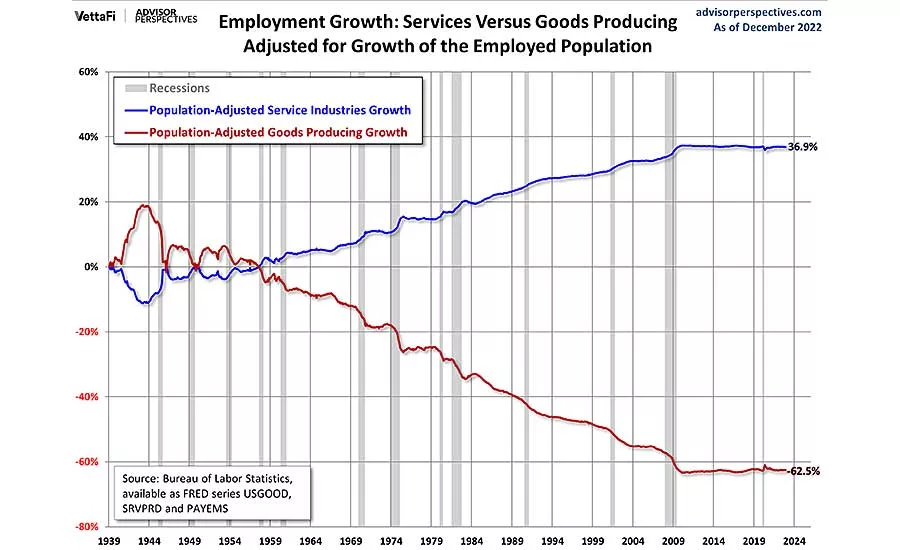
Contrary to popular belief, the ratio of manufacturing jobs to service jobs went flat around 2010 and has remained unchanged since. Source: Bureau of Labor Statistics

moser2.PNG

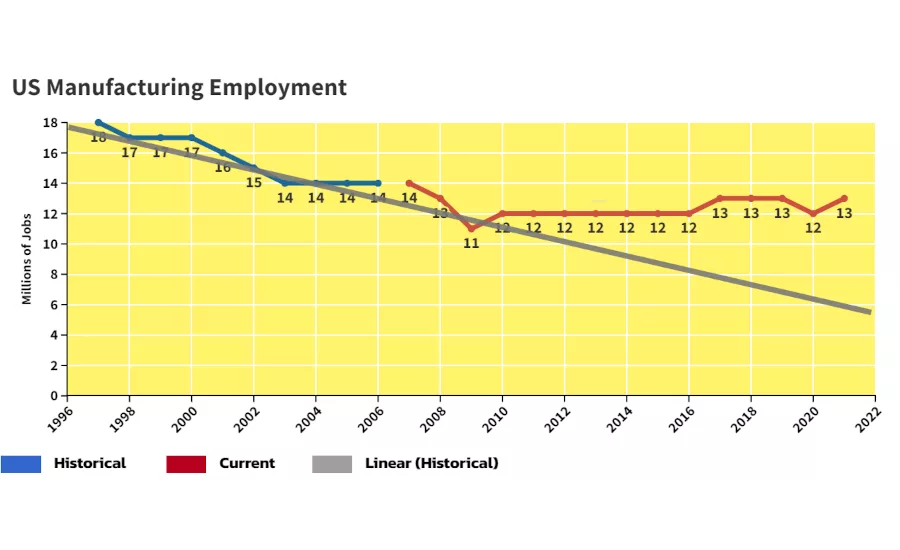
Current manufacturing employment is about 6 million higher than one would have predicted in 2008. Source: Bureau of Labor Statistics

asb0423moser3.jpg

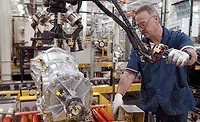
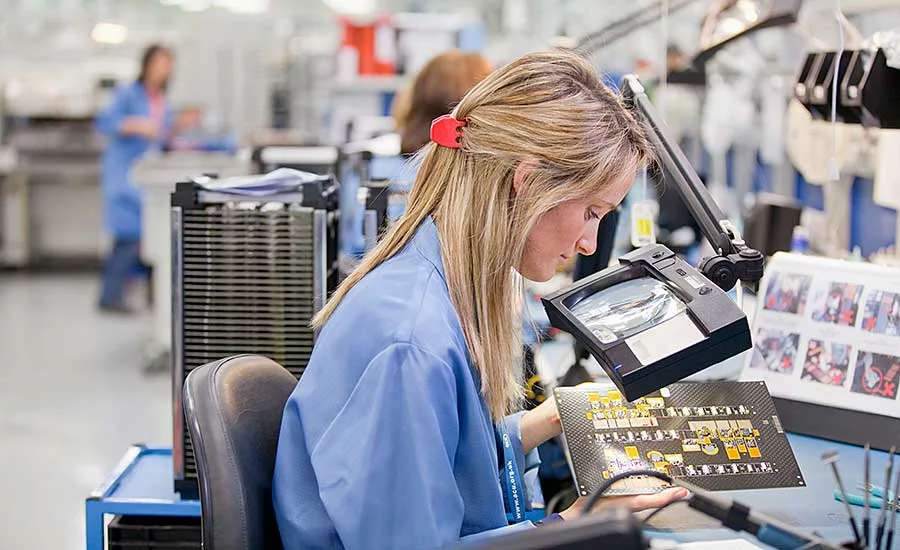
Ideally, the U.S. must increase the manufacturing workforce by 40 percent, or approximately 5 million people, over the next 20 years. Photo courtesy Renishaw plc
asb0423moser1.jpg
moser2.PNG
asb0423moser3.jpg
April 13, 2023

It is perceived wisdom that the U.S. economy has been shifting from manufacturing to services. This is believed to be an inevitable trend for most developed countries as they lose manufacturing to lower wage countries via offshoring.

The U.S. Labor Department data tracks employment by industry groups which can be classified by either goods production or services. Figure 1 shows the ratio of the two since 1939.

Note that the employment percentages were balanced in the late 1930s. Manufacturing then surged as the country prepared for and fought World War II. By the 1950s, manufacturing employment moved downward and services employment trended upward.

Figure 1 clearly shows that this long-term, “inevitable” trend stopped about 12 years ago. The ratio went flat around 2010 and has remained unchanged since. Figure 2 confirms this observation. Current manufacturing employment is about 6 million higher than one would have predicted in 2008.

The exciting trend of the past 12 years is largely due to less offshoring and more reshoring and foreign direct investment. A smaller percentage is due to less rapid productivity growth than in earlier periods. What can we conclude? Manufacturing has stabilized, and it is time for dramatic growth as reshoring surges.


The Way Forward: Increasing U.S. Competitiveness

The United States should put new emphasis on strengthening the quality and quantity of its manufacturing workforce. To balance our $1.2 trillion goods trade deficit, the country needs to increase its production capacity, increase its workforce, and lower manufacturing costs. Ideally, we need to increase the manufacturing workforce by 40 percent, or approximately 5 million people, over the next 20 years. To do that, we will need to add 250,000 workers per year in excess of losses to retirement. Apprenticeships and immigration are the best means to close the skills gap.

The government should lower the value of the U.S. dollar. Most economists agree that the dollar is overvalued by 25 to 30 percent, due to its status as the world’s reserve currency. This “exorbitant privilege” makes the U.S. a great location for banking and a poor location for manufacturing.

Looking for quick answers on assembly and manufacturing topics? Try Ask ASM, our new smart AI search tool. Ask ASM →

The U.S. should address its tax policy. The most timely action is to maintain immediate expensing of capital expenditures. The 100 percent rate established in the 2017 tax bill has started to phase out in 2023. Investments in needed productivity will decline.

U.S. manufacturing will need to add 250,000 workers per year over the next 20 years.

The U.S. should reduce the cost of healthcare and end the practice of employer-provided, tax-free healthcare. Healthcare costs are incorporated in every manufacturer’s overhead, driving up costs and prices. For U.S. companies, healthcare expenditures per employee alone are about equal to what Chinese companies pay for employee wages.

These measures underpin the Reshoring Initiative’s Competitiveness Toolkit. The first two alone would balance the U.S. goods trade deficit over time. These actions show that enabling domestic production and re-industrialization is highly feasible. The time to act is now. We should rejoice for the stabilization of the last 12 years and commit to closing the gap vs. services dramatically over the next 20 years.

Are you thinking about reshoring? Now is an especially good time for companies to re-evaluate the choice of domestic vs. offshore production and the resulting impact on sustainability. Our mission is to get companies to do the math correctly using our Total Cost of Ownership Estimator (TCO). By using TCO, companies can better evaluate sourcing, identify alternatives, and even make a case when selling against offshore competitors.

For help, call me at 847-867-1144 or email harry.moser@reshorenow.org.


About the Author

Harry Moser is the president of the Reshoring Initiative. His column will appear every other month, alternating with Austin Weber’s “On Campus.” Has your company reshored production? Are you thinking about it? We’d like to hear of your success or help you achieve it. With your approval, we would love to report on your successes or opportunities in future issues. Contact harry.moser@reshorenow.org.

KEYWORDS: apprenticeship programs skilled labor shortage workforce development

Share This Story

Looking for a reprint of this article?
From high-res PDFs to custom plaques, order your copy today!

Harry Moser is the president of the Reshoring Initiative. His column will appear every other month, alternating with Austin Weber’s “On Campus.” Has your company reshored production? Are you thinking about it? We’d like to hear of your success or help you achieve it. With your approval, we would love to report on your successes or opportunities in future issues. Contact harry.moser@reshorenow.org.

Recommended Content

JOIN TODAY
To unlock your recommendations.

Already have an account? Sign In

  • Made in the U.S.A.

    Consumer Products Manufacturing: Made in the USA

    Supply chain lessons learned during the coronavirus...
    Automated Assembly Systems
    By: Austin Weber
  • Best Practices for Press-Fit Assembly

    Best Practices for Press-Fit Assembly

    In manufacturing, ironclad formulas for success are hard...
    Assembly Presses
    By: Jim Camillo
  • aem0523leader-tesla1.jpg

    Tesla Rethinks the Assembly Line

    Engineers at Tesla Inc. have developed a new process that...
    Assembly and Testing
    By: Austin Weber
Manage My Account
  • eMagazine Subscription
  • Assembly Newsletters
  • Online Registration
  • Subscription Customer Service
  • Manage My Preferences

More Videos

Sponsored Content

Sponsored Content is a special paid section where industry companies provide high quality, objective, non-commercial content around topics of interest to the ASSEMBLY audience. All Sponsored Content is supplied by the advertising company and any opinions expressed in this article are those of the author and not necessarily reflect the views of ASSEMBLY or its parent company, BNP Media. Interested in participating in our Sponsored Content section? Contact your local rep!

close
  • ultrasonic welding
    Sponsored bySonobond Ultrasonics

    Engineering Efficiency in High-Performance Assembly: How Ultrasonic Welding Enhances Throughput, Reliability and Quality

  • UV curing system
    Sponsored byDymax

    Why UV Intensity Alone Doesn’t Define Curing Performance

  • wooden pallets
    Sponsored byLEAN Manufacturing Products

    Eliminating Waste on the Shop Floor: Applying Lean Principles to Improve Manufacturing Efficiency

Popular Stories

ASSEMBLY News Now, episode-30: Volvo Redesigns EV Manufacturing

Volvo Redesigns EV Manufacturing

Boeing CEO Kelly Ortberg announces 1 billion investment

Boeing Plans $1 Billion Wichita Investment, Workforce Training Center

automated consumer goods assembly system

Best Practices for Cycle Time Optimization

Watch the latest episode of ANN now!

Events

July 24, 2025

From Shop Floor to CFO: How Manufacturers Are Closing the Loop Between Operations and Finance

On Demand Learn how manufacturers are bridging the gap between the shop floor and ERP systems to gain real-time visibility, streamline operations, and kick-start digital transformation—without waiting years.

Sponsored by:

PicoStratusGreen
July 30, 2025

Buffer Analysis and Design Fundamentals for Manufacturing Excellence

On Demand In this presentation, Dr. Herman Tang shares practical insights from his industry experience and research on buffer management in manufacturing operations.

View All Submit An Event

Poll

Difficult Assembly Processes

Which assembly process gives you the most difficulty?
View Results Poll Archive

Products

Manufacturing Cost Policy Deployment (MCPD) Profitability Scenarios: Systematic and Systemic Improvement of Manufacturing Costs

Manufacturing Cost Policy Deployment (MCPD) Profitability Scenarios: Systematic and Systemic Improvement of Manufacturing Costs

See More Products
Register for webinar - Modernizing Automotive Assembly: Why Upgrading Legacy MES is a Business Imperative

Related Articles

  • Report: Missouri's Auto Industry Poised for Growth

    See More
  • Innovation Is a Game Changer for US Manufacturing and Workforce Development

    Innovation Is a Game Changer for US Manufacturing and Workforce Development

    See More
  • Manufacturing Is Poised for a Promising Future in the Northeast

    See More

Related Products

See More Products
  • supply chain.jpg

    ERP Systems for Manufacturing Supply Chains

  • cover

    Operational Leadership Uncensored: Real Talk for Burgeoning Manufacturing Leaders

  • continuous.jpg

    Continuous and Embedded Learning for Organizations

See More Products

Events

View AllSubmit An Event
  • April 22, 2026

    Recruiting Basics for Manufacturing Hiring Managers

    On Demand From interviewing and onboarding techniques that help new hires feel like part of the team to approaches for creating a diverse and inclusive workforce, this webinar covers it all.
  • December 4, 2025

    Cut Scrap and Prevent Rework: Smarter AI Inspection for Manufacturing

    On Demand If you’re ready to cut scrap, prevent rework, and build with confidence, this is a conversation you won’t want to miss. Sponsored by:
View AllSubmit An Event
×

Never miss the latest news and trends driving the manufacturing industry

Stay in the know on the latest assembly trends.

JOIN TODAY!
  • RESOURCES
    • Advertise
    • Contact Us
    • Directories
    • Manufacturing Division
    • Store
    • Want More?
  • SIGN UP TODAY
    • Create Account
    • eMagazine
    • Newsletters
    • Customer Service
    • Manage Preferences
  • SERVICES
    • Marketing Services
    • Reprints
    • Market Research
    • List Rental
    • Survey/Respondent Access
  • STAY CONNECTED
    • LinkedIn
    • Facebook
    • Instagram
    • YouTube
    • X (Twitter)
  • PRIVACY
    • PRIVACY POLICY
    • TERMS & CONDITIONS
    • DO NOT SELL MY PERSONAL INFORMATION
    • PRIVACY REQUEST
    • ACCESSIBILITY

Copyright ©2026. All Rights Reserved BNP Media, Inc. and BNP Media II, LLC.

Design, CMS, Hosting & Web Development :: ePublishing