Stretch Bolts for Precise Assembly
Torque is an imperfect measure of how tightly a bolted joint has been fastened. Friction, torsional stress and other variables can obscure what engineers really want to know: the clamp load on the joint.
For most bolted joints, the imperfect correlation between torque and clamp load is no big deal. Economy and speed are more important than knowing the precise clamp load. However, for other bolted joints, such as those that must contain a pressurized fluid or gas, it's critical to know exactly how much clamping force is applied by the bolt. For these assemblies, hydraulic bolt tensioners are an effective alternative.
To understand how hydraulic bolt tensioners work, think of a bolt as a spring, says Ali A. Namous, senior application engineer with SKF Linear Motion and Precision Technologies (Bethlehem, PA). The most common way to stretch this spring is by turning the nut. Once the nut contacts the joint, turning it further pulls the bolt head toward the nut, creating tension in the bolt. A hydraulic bolt tensioner bypasses the middleman, the nut, and pulls directly on the bolt. Once the bolt has stretched enough to produce the desired clamp load, the nut is simply spun down against the joint to keep the bolt at that tension.
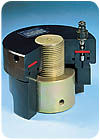
A bolt tensioner consists of seven main parts. The brace is screwed onto the end of the bolt above the nut. The puller, a hydraulic cylinder, attaches to the brace and tugs on the bolt. (In some models, the puller attaches directly to the bolt. A brace is not required.) A load cell attached to the puller measures how much force is being exerted by the cylinder. The skirt, or bridge, is placed over the nut on the assembly. It compresses the assembly as the hydraulic cylinder pulls on the bolt. A socket, or retaining disk, grips the nut so it can be turned down to contact the assembly after the bolt has been stretched. Holes are drilled along the outer surface of the socket so a rod, called a tommy bar, can be inserted to rotate the nut. A pump supplies hydraulic fluid to one or more pullers through high-pressure hoses.
Depending on the size, composition and number of bolts, 16,000 to 22,000 psi of hydraulic pressure is applied to the cylinder, says George A. Sturdevant, president of Fastorq Bolting Systems (Houston). "You need that kind of pressure to keep the diameter of the cylinder at a manageable size," he explains.
Before the process begins, the nut is fastened loosely against the assembly. When the puller is actuated, it stretches the bolt and pushes against the skirt. The nut lifts off the assembly 0.015 to 0.02 inch. When the correct amount of tension has been applied to the bolt, the nut is returned to its seated position by rotating the socket manually with the tommy bar. With the nut tight against the assembly, the pressure in the cylinder is released. The bolt remains stretched, and the clamp load is locked in.
"Instead of trying to estimate how much tension you'll achieve by applying torque to a nut or bolt, you apply the required tension directly to the bolt," says Sturdevant.
To speed up the process, the braces on some bolt tensioners are equipped with Zip nuts. These braces are pushed on and pulled off the bolt threads, rather than screwed on and of
Advantages and Limitations
Compared with electric and pneumatic nutrunners, hydraulic bolt tensioners have several advantages."One thing that makes bolt tensioners attractive is their simplicity," says Sturdevant. "Nutrunners drive the fastener through a planetary gear train or impacting hammers. They have a lot of moving parts, and they require a lot of maintenance. A bolt tensioner is essentially a hydraulic cylinder with a threaded hole in one end. It's very durable."
The primary advantage of bolt tensioners is how accurately they tighten bolted joints. When a power tool applies torque to a nut, a portion of the energy going into the joint is lost due to friction between the face of the nut and the assembly, explains Namous.
"If you want to tighten a big bolt to the yield point, you may actually be undertightening it, because a lot of the force was needed to overcome friction," he says.
Friction is also problematic because it's inconsistent, especially at high torque values. "One bolt may get 80 percent of the required force; another may get 120 percent," says Namous.
Another benefit of bolt tensioners is that several bolts can be tightened simultaneously using multiple tensioners and a single hydraulic pump. Indeed, Fastorq recently completed a tensioning system for the U.S. Navy that tightens 27 bolts at the same time.
The ability to tighten multiple bolts at once is a distinct advantage when assembling large joints with gaskets, such as the cylinder head on a diesel truck engine. When such joints are fastened with a nutrunner, assemblers must take care to tighten the bolts in a particular sequence, to ensure a good seal and prevent distressing the gasket. With multiple bolt tensioners working simultaneously, pressure is applied to the gasket evenly.
In some cases, every bolt in the assembly can be tightened at the same time. In others, a portion of the bolts can be fastened. For example, if there are 16 bolts in the assembly, eight tensioners can be used to tighten every other bolt, or four tensioners can be used to fasten every fourth bolt.
One limitation of bolt tensioners is their inflexibility, says Sturdevant. Unlike nutrunners, which can handle a wide range of fastener sizes and torque loads, bolt tensioners can only accommodate a narrow range of fastener sizes and thread counts. "If you had a 2-inch bolt with eight threads per inch, you'd need a bolt tensioner just for that fastener," he says
Applying the Technology
Hydraulic bolt tensioners are not new. The technology has been around since the 1940s, and it's been used for decades by the energy industry to tighten bolts on things such as pipelines and nuclear reactors. Among manufacturers, the technology is enjoying renewed interest due to demand for greater accuracy, repeatability and control in the assembly of bolted joints.Hydraulic bolt tensioners fasten bolted joints in many high-reliability applications, including windmills, steam and gas turbines, pressure vessels, mining equipment, cranes, presses, heat exchangers, and diesel engines for trucks, tractors and locomotives. Bolt tensioners tighten the bolts that attach the wings to the fuselage of a jet aircraft. NASA uses a custom-built bolt tensioner to tighten the studs that anchor the space shuttle's booster engines to the launch pad.
"Forty years ago, you could afford to overdesign a bolted joint by 300 percent," says Sturdevant. Today, with the demand for weight and material savings in trucks, cars and other large assemblies, engineers have been forced to reduce the safety factor in their designs. To compensate, engineers require greater control over the bolt-tightening process.
Bolt tensioners can be used with any bolt type, size or material. Tensioners are available for bolts ranging in size from 0.2 to 20 inches in diameter. The devices are most often used on bolts from 0.75 to 6 inches in diameter, since torque tools for such big fasteners are particularly cumbersome.
"With a bolt tensioner, you can usually use a smaller bolt than you would need if you were using a torque wrench, because the bolt will only experience an axial load," says Namous. "With a torque wrench, the bolt will experience both an axial load and a torsional load."
For bolt tensioners to work, there must be enough room around and above each bolt for the equipment to be applied. In addition, the bolt must be long enough for the brace to engage its threads effectively. A rule of thumb is that the bolt should at least extend past the nut by the length of its diameter.
"If you have a 1-inch diameter bolt, the bolt should extend 1 inch past the nut," explains Sturdevant. "The bolt could be longer than that, but if it's very much shorter, you run the risk of not having enough threads [for the brace to engage]. And, when you pull the bolt into tension, you risk stripping the threads and firing off the bolt tensioner like a rocket."
Looking for a reprint of this article?
From high-res PDFs to custom plaques, order your copy today!