Robotics: Delta Robots Change the Game
Delta robots excel at picking and placing simple parts at high speeds.

In the world of cosmetics, the packaging is just as important as the product itself. Few companies know this better than Geka Brush, a global manufacturer of brushes, applicators and bottles for liquid cosmetics.
At its plant in Bechhofen, Germany, Geka produces caps for mascara bottles on a high-speed automated assembly line. The system presses screw-tops into decorative covers, then welds the brushes into place.
Originally, the caps were deposited onto a conveyor at the end of the line, where an operator would place them into a plastic tray. When the tray was full, the operator covered it with a thin plastic sheet and loaded it into a box. This preserves the glossy surface finish of the caps.
However, the person packing the caps could not keep up with the system’s output. Geka needed a way to automate the packaging step, as well. The company found an answer in the IRB 340 Flexpicker, a delta robot from ABB Robotics.
With the robot, Geka boosted production by 30 percent, from 23,000 caps per hour to 30,000 caps per hour. The robot packages two brushes every 2.2 seconds. Now, the same person tends three assembly and packaging systems, instead of just one.
Geka is one of a growing number of manufacturers that have begun taking advantage of the unique capabilities of the delta robot. Although the delta has been available since 1997, it did not take hold with manufacturers until four or five years ago.
“[Early on,] we had a robot without a home,” admits Rick Tallian, consumer industry manager for ABB Robotics, which secured one of the first licenses to produce the robot from its inventor, a Swiss engineering professor. “We didn’t even have a controller that was sophisticated enough to run it.”
Today, thanks to improvements in technology for motion control, vision guidance and conveyor tracking, the delta is enjoying a surge in popularity in a variety of industries, including consumer goods, electronics, solar energy, food, pharmaceuticals and medical devices.
“We now have more than 4,000 of these robots in the field,” boasts Tallian. “Most of that growth has come since 2005.”

In contrast, the motors for driving the delta robot are located in a central hub above the work area. Depending on the design, three or four lightweight, carbon-fiber arms extend down from the hub, giving the robot a spider-like appearance. Jointed in the middle, the arms bend inward and connect with a small tooling plate to which the end-effector is attached.
Each forearm is connected to a motor in the hub. Coordinated movement of the forearms up or down pushes the elbows inward or outward, which moves the plate in the X, Y and Z axes and gives the robot a cylindrical work envelope. A fourth arm extends from the center of the hub to rotate the end-effector. As the robot moves up and down and side to side, the tooling plate remains parallel with the work surface.
“The delta robot is a low-inertia system,” explains Tallian. “The robot isn’t carrying any motors around in the linkages. All the major weight of the robot is stationary.”
This design gives the robot exceptional speed in pick-and-place operations. For example, ABB’s IRB 340 can achieve a top speed of 10 meters per second. The robot can move a 0.1-kilogram payload 25 millimeters up, 305 millimeters across and 25 millimeters down in 0.33 second. With a 1-kilogram payload, it can perform the same routine in 0.38 second.
“The robot can perform 120 to 200 pick-and-place cycles per minute,” says Tallian.
The IRB 340’s work envelope is 300 millimeters tall and 1,130 millimeters in diameter. It can position parts with a repeatability of ±0.1 millimeter.
The IRB 360-ABB’s follow-up to the IRB 340-can handle a 3-kilogram payload and has a work envelope 1,600 millimeters in diameter. Both the IRB 340 and IRB 360 are available in wash-down and clean-room versions.

The Quattro s650H from Adept Technology Inc. has four arms instead of three. Its work envelope is 500 millimeters tall and 1,300 millimeters in diameter. With its maximum payload of 6 kilograms, it can perform a pick-and-place routine of 25 millimeters up, 305 millimeters across and 25 millimeters down in 0.43 second.
Adept’s Quattro is not only fast, it’s also energy-efficient. Recently, the company measured the energy consumed by the Quattro, a SCARA and a serial-link robot when performing a pick-and-place task with the same payload and motion profile. Adept found that the delta consumed 35 percent less energy than the SCARA and 43 percent less energy than the serial-link arm.
FANUC Robotics America Inc. offers two delta robots, the M-1iA and M-3iA.
The work envelope of the M-1iA is 100 millimeters tall and 280 millimeters in diameter. With its maximum payload of 0.5 kilogram, the M-1iA can perform a pick-and-place routine of 25 millimeters up, 200 millimeters across and 25 millimeters down in 0.3 second. It can position parts with a repeatability of ±0.02 millimeter.
This compact robot-it weighs just 17 kilograms-can be mounted to a ceiling or to a desktop with a stand. It can even be mounted at an angle. At Automation Technology Expo South in Charlotte, NC, last April, FANUC displayed an M-1iA picking and placing AA batteries at a rate of 108 parts per minute.
“A serial-link robot can’t even come close to the acceleration rates of a delta robot,” says Chris Blanchette, national distribution account manager at FANUC Robotics. “An application that requires four delta robots would need eight serial-link robots.”
The M-3iA is a larger version of the M-1iA. Its work envelope is 500 millimeters tall and 1,350 millimeters in diameter. It carries a maximum payload of 6 kilograms.
FANUC’s delta robots are unique in that they offer two additional axes of motion at the wrist. The fifth axis tilts up to 150 degrees. The sixth axis provides an additional 360 degrees of rotation.
The additional axes of motion enable the robot to pick parts with more complex shapes or parts that are lying at an angle, says Blanchette. It also allows the robot to perform more complex tasks, such as inserting fuses into circuit boards or placing lenses onto optical assemblies.

Some applications don’t require the high speeds and accelerations of a delta robot, while other applications simply can’t handle it. “Our robot can accelerate at almost 15 g,” says Tallian. “So once it picks up something, it had better be able to hold onto it. Some products can be damaged by that kind of acceleration.”
Delta robots are best-suited for high-speed pick-and-place applications involving lightweight parts with simple geometries. The reason is timing. If the robot has to perform a pick-and-place operation at a rate of 120 parts per minute, it has approximately 0.5 second to complete one cycle. If the robot needs more than 100 milliseconds to pick or place the part, it won’t be able to meet the target rate.
“If you have to do some sophisticated gripping of the part, you’ll eat up too much time, and you won’t be taking advantage of the speed of the robot,” says Tallian.
Although delta robots can accommodate traditional two- and three-fingered grippers, vacuum cups are the preferred end-effector because of their light weight and fast actuation, says Blanchette.
Manufacturers of solar panels use delta robots to place photovoltaic silicon wafers onto glass substrates. A manufacturer of energy-efficient lighting uses delta robots to place lenses onto LED arrays. A manufacturer of a disposable consumer product employs several delta robots to snap together five plastic parts and place the finished assembly into a box.
Although delta robots excel at pick-and-place applications, they can perform other operations, too. FANUC Robotics has been leading the way in expanding the roles for these robots. At the International Manufacturing Technology Show last month in Chicago, FANUC displayed deltas:
dispensing thermal adhesive onto heat sinks for solar collectors.
deburring and grinding.
assembling small gears with feedback from force sensors.
In the latter application, the robot places one gear atop another. The force sensor detects when the gears contact each other, and the robot rotates the second gear until it meshes with the first. The robot then slides the gear fully into place.
* Robots Light the Way to Faster Assembly.
* Small Robots Deliver Big Results.
* Robotic Screwdriving.
FANUC’s delta robots are unique in that they offer two additional axes of motion at the wrist. The fifth axis tilts up to 150 degrees. The sixth axis provides an additional 360 degrees of rotation. Photo courtesy FANUC Robotics America Inc.
In the world of cosmetics, the packaging is just as important as the product itself. Few companies know this better than Geka Brush, a global manufacturer of brushes, applicators and bottles for liquid cosmetics.
At its plant in Bechhofen, Germany, Geka produces caps for mascara bottles on a high-speed automated assembly line. The system presses screw-tops into decorative covers, then welds the brushes into place.
Originally, the caps were deposited onto a conveyor at the end of the line, where an operator would place them into a plastic tray. When the tray was full, the operator covered it with a thin plastic sheet and loaded it into a box. This preserves the glossy surface finish of the caps.
However, the person packing the caps could not keep up with the system’s output. Geka needed a way to automate the packaging step, as well. The company found an answer in the IRB 340 Flexpicker, a delta robot from ABB Robotics.
With the robot, Geka boosted production by 30 percent, from 23,000 caps per hour to 30,000 caps per hour. The robot packages two brushes every 2.2 seconds. Now, the same person tends three assembly and packaging systems, instead of just one.
Geka is one of a growing number of manufacturers that have begun taking advantage of the unique capabilities of the delta robot. Although the delta has been available since 1997, it did not take hold with manufacturers until four or five years ago.
“[Early on,] we had a robot without a home,” admits Rick Tallian, consumer industry manager for ABB Robotics, which secured one of the first licenses to produce the robot from its inventor, a Swiss engineering professor. “We didn’t even have a controller that was sophisticated enough to run it.”
Today, thanks to improvements in technology for motion control, vision guidance and conveyor tracking, the delta is enjoying a surge in popularity in a variety of industries, including consumer goods, electronics, solar energy, food, pharmaceuticals and medical devices.
“We now have more than 4,000 of these robots in the field,” boasts Tallian. “Most of that growth has come since 2005.”
These compact delta robots can move a 0.5-kilogram payload 200 millimeters in just 0.3 second. Photo courtesy FANUC Robotics America Inc.
Delta Design
Also known as a parallel-link robot, the delta robot is radically different from Cartesian, SCARA and serial-link robots. In those robots, the motors for moving each axis are part of the arm itself. Thus, the first axis of a serial-link robot moves not only the mass of its own motor and gears, but those of five other axes, too. That design is good for carrying heavy payloads, but it’s less conducive for high speeds and high accelerations.In contrast, the motors for driving the delta robot are located in a central hub above the work area. Depending on the design, three or four lightweight, carbon-fiber arms extend down from the hub, giving the robot a spider-like appearance. Jointed in the middle, the arms bend inward and connect with a small tooling plate to which the end-effector is attached.
Each forearm is connected to a motor in the hub. Coordinated movement of the forearms up or down pushes the elbows inward or outward, which moves the plate in the X, Y and Z axes and gives the robot a cylindrical work envelope. A fourth arm extends from the center of the hub to rotate the end-effector. As the robot moves up and down and side to side, the tooling plate remains parallel with the work surface.
“The delta robot is a low-inertia system,” explains Tallian. “The robot isn’t carrying any motors around in the linkages. All the major weight of the robot is stationary.”
This design gives the robot exceptional speed in pick-and-place operations. For example, ABB’s IRB 340 can achieve a top speed of 10 meters per second. The robot can move a 0.1-kilogram payload 25 millimeters up, 305 millimeters across and 25 millimeters down in 0.33 second. With a 1-kilogram payload, it can perform the same routine in 0.38 second.
“The robot can perform 120 to 200 pick-and-place cycles per minute,” says Tallian.
The IRB 340’s work envelope is 300 millimeters tall and 1,130 millimeters in diameter. It can position parts with a repeatability of ±0.1 millimeter.
The IRB 360-ABB’s follow-up to the IRB 340-can handle a 3-kilogram payload and has a work envelope 1,600 millimeters in diameter. Both the IRB 340 and IRB 360 are available in wash-down and clean-room versions.
Delta robots have a cylindrical work envelope. Photo courtesy ABB Robotics
Variations on a Theme
At least two other robot suppliers now offer delta robots.The Quattro s650H from Adept Technology Inc. has four arms instead of three. Its work envelope is 500 millimeters tall and 1,300 millimeters in diameter. With its maximum payload of 6 kilograms, it can perform a pick-and-place routine of 25 millimeters up, 305 millimeters across and 25 millimeters down in 0.43 second.
Adept’s Quattro is not only fast, it’s also energy-efficient. Recently, the company measured the energy consumed by the Quattro, a SCARA and a serial-link robot when performing a pick-and-place task with the same payload and motion profile. Adept found that the delta consumed 35 percent less energy than the SCARA and 43 percent less energy than the serial-link arm.
FANUC Robotics America Inc. offers two delta robots, the M-1iA and M-3iA.
The work envelope of the M-1iA is 100 millimeters tall and 280 millimeters in diameter. With its maximum payload of 0.5 kilogram, the M-1iA can perform a pick-and-place routine of 25 millimeters up, 200 millimeters across and 25 millimeters down in 0.3 second. It can position parts with a repeatability of ±0.02 millimeter.
This compact robot-it weighs just 17 kilograms-can be mounted to a ceiling or to a desktop with a stand. It can even be mounted at an angle. At Automation Technology Expo South in Charlotte, NC, last April, FANUC displayed an M-1iA picking and placing AA batteries at a rate of 108 parts per minute.
“A serial-link robot can’t even come close to the acceleration rates of a delta robot,” says Chris Blanchette, national distribution account manager at FANUC Robotics. “An application that requires four delta robots would need eight serial-link robots.”
The M-3iA is a larger version of the M-1iA. Its work envelope is 500 millimeters tall and 1,350 millimeters in diameter. It carries a maximum payload of 6 kilograms.
FANUC’s delta robots are unique in that they offer two additional axes of motion at the wrist. The fifth axis tilts up to 150 degrees. The sixth axis provides an additional 360 degrees of rotation.
The additional axes of motion enable the robot to pick parts with more complex shapes or parts that are lying at an angle, says Blanchette. It also allows the robot to perform more complex tasks, such as inserting fuses into circuit boards or placing lenses onto optical assemblies.
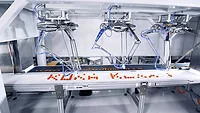
With vision guidance and conveyor tracking, delta robots can rapidly pick parts distributed randomly on a conveyor. Photo courtesy ABB Robotics
Ideal Applications
Delta robots are not for every application. “In many cases, [a tabletop serial-link robot] may be a much better fit than a delta robot,” warns Tallian.Some applications don’t require the high speeds and accelerations of a delta robot, while other applications simply can’t handle it. “Our robot can accelerate at almost 15 g,” says Tallian. “So once it picks up something, it had better be able to hold onto it. Some products can be damaged by that kind of acceleration.”
Delta robots are best-suited for high-speed pick-and-place applications involving lightweight parts with simple geometries. The reason is timing. If the robot has to perform a pick-and-place operation at a rate of 120 parts per minute, it has approximately 0.5 second to complete one cycle. If the robot needs more than 100 milliseconds to pick or place the part, it won’t be able to meet the target rate.
“If you have to do some sophisticated gripping of the part, you’ll eat up too much time, and you won’t be taking advantage of the speed of the robot,” says Tallian.
Although delta robots can accommodate traditional two- and three-fingered grippers, vacuum cups are the preferred end-effector because of their light weight and fast actuation, says Blanchette.
Manufacturers of solar panels use delta robots to place photovoltaic silicon wafers onto glass substrates. A manufacturer of energy-efficient lighting uses delta robots to place lenses onto LED arrays. A manufacturer of a disposable consumer product employs several delta robots to snap together five plastic parts and place the finished assembly into a box.
Although delta robots excel at pick-and-place applications, they can perform other operations, too. FANUC Robotics has been leading the way in expanding the roles for these robots. At the International Manufacturing Technology Show last month in Chicago, FANUC displayed deltas:
dispensing thermal adhesive onto heat sinks for solar collectors.
deburring and grinding.
assembling small gears with feedback from force sensors.
In the latter application, the robot places one gear atop another. The force sensor detects when the gears contact each other, and the robot rotates the second gear until it meshes with the first. The robot then slides the gear fully into place.
ASSEMBLY ONLINE
For more information on robotic assembly, visit www.assemblymag.com to read these articles:* Robots Light the Way to Faster Assembly.
* Small Robots Deliver Big Results.
* Robotic Screwdriving.
Looking for a reprint of this article?
From high-res PDFs to custom plaques, order your copy today!