50 Years of Assembly: Robots to Change the Future-Again
ASSEMBLY magazine is celebrating its 50th anniversary this year. To mark the occasion, we are publishing a series of articles examining the past, present and future of various assembly technologies.


Compared with earlier models, today's robots are faster, smarter, stronger, smaller and more accurate. Photo courtesy DENSO Corp.
The article reported on the TransfeRobot 200, which had recently been introduced by the Robodyne Div. of U.S. Industries Inc. The tabletop device was little more than an electromechanical linear actuator that could extend and retract horizontally. A bulky, swiveling wrist at the end of the actuator could be equipped with a gripper or a dispensing valve. The article described how manufacturers were using the robot to lubricate clock bearings, place small parts for an electric typewriter, and load automotive steering components into a press. Edwin F. Shelley, then vice president of U.S. Industries, boldly predicted that American manufacturers would be using 100,000 of the machines within a few years.
Shelley was perhaps a bit overoptimistic for the time. Indeed, U.S. Industries no longer exists. In a way, however, Shelley’s prediction eventually did come true. According to the Robotic Industries Association (RIA, Ann Arbor, MI), approximately 168,000 robots are now employed in U.S. factories, performing assembly, screwdriving, riveting, welding, soldering, dispensing, machine tending, trimming, deburring, palletizing, painting, test and inspection. There are six-axis robots, Cartesian robots, delta robots and SCARAs. There are robots big enough to carry engine blocks and small enough to fit on a dinner plate. There are robots that can move at 5,400 millimeters per second and robots that can place parts with micron-level accuracy and repeatability.
Considering the breadth and capability of today’s robots, it’s hard to imagine how they could have evolved from those early, bulky machines of the 1960s. It’s like trying to trace the path from Chuck Berry to Metallica. Yet those early robots created nothing less than a revolution in manufacturing.

In early robots, rotational axes were powered by chain drives. Today, they are run by harmonic drives, cycloidal drives and rotary vector gears. Photo courtesy NASA
Early Models
The first industrial robot, the Unimate from Unimation Inc., had a work envelope of 350 cubic feet. Its hydraulically powered arm could extend 7 feet, pivot vertically from 4 to 94 inches above the floor, and rotate horizontally through an arc of 220 degrees. A wrist at the end of the arm could rotate 180 degrees and pivot through an arc of 220 degrees. It occupied 20 square feet of floor space.An internal magnetic memory drum stored 200 sets of positional data for point-to-point programming. The drum also stored digital commands that synchronized the robot with other machines on the line, such as a parts feeders, conveyors and machine tools.
At top speed, the Unimate could move parts weighing 25 pounds, but it could handle parts as large as 100 pounds at slower speeds. Fingers fitted with pads or hooks could be attached to a standard gripper assembly. The robot could also be equipped with brackets that enabled it to manipulate power tools.
The Unimate was deployed for the first time in 1961 at the General Motors Corp. plant in Trenton, NJ, where it unloaded a die-casting machine. Six years later, GM was using the Unimate for spot welding and attaching clips to seat frames. In 1970, the automaker built the first automated spot welding line, consisting of 28 robots, at its assembly plant in Lordstown, OH.
Another early robot was the Versatran from American Machine & Foundry Co. With a work envelope of more than 60 cubic feet, the robot looked like a tank turret. The robot’s 42-inch horizontal arm could slide back and forth along its axis through a range of 30 inches. It could also move 30 inches up and down. The turret could swivel the arm through a horizontal arc of 240 degrees.
Handling 20-pound parts, the robot could perform 1,200 transfer operations per hour. Moving point to point, the robot could be programmed to stop at 90 positions, and it could perform 12 operations at each position. An optional control console enabled the robot to move along a continuous path for applications such as paint spraying. In this case, a multichannel tape recorder continuously controlled each motion of the robot simultaneously to permit smooth motion through space. A continuous path program could operate 13 minutes before repeating.
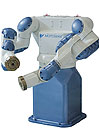
The new DA20 robot consists of two six-axis arms attached to a rotating base. Both arms can work together on one task or the two manipulators can work independently. Photo courtesy Motoman Inc.
Smarter, Faster, More Reliable
Robots have come a long way since those early models. Rotational axes that were once powered by chain drives are now run by harmonic drives, cycloidal drives and rotary vector gears. Linear motion that was once produced by hydraulics is now done with ballscrews, belts or linear motors. Vision systems have given robots the ability to retrieve randomly oriented parts, while force sensors have enabled robots to perform such tasks as inserting circuit boards into slots.In short, robots have become smarter, faster, stronger, smaller and more accurate. Twenty years ago, a SCARA might need 2 seconds to perform the standard pick-and-place motion of 1 inch up, 12 inches across, 1 inch down and back again. “Today, a SCARA can do that in 0.29 second. You can barely see that!” marvels Peter Cavallo, sales manager for DENSO Robotics (Long Beach, CA). Moreover, the robot can do that with an accuracy of 20 microns.
“Motors have become smaller and smaller while generating more and more torque,” adds Craig Jennings, president of Motoman Inc. (West Carrollton, OH). “[This has allowed us to] increase the payload of the robot while making the arm thinner and smaller. In fact, a robot that can handle 20 kilograms today is smaller than a robot that could only handle 10 kilograms years ago.”
Early robots were driven by DC brush motors. Today, robots are powered by AC servomotors with absolute encoders. “In the old days, a robot would have to go to a predefined point every time it started up. Now, it doesn’t have to. The robot knows exactly where it is,” says Cavallo.
Joe Gemma, North American sales manager for Stäubli Corp. (Duncan, SC), says a key development was to move electrical cables and pneumatic lines for the robot inside the arm instead of outside. “That design change enabled robots to work in the semiconductor industry and other applications where it’s critical to maintain a clean environment,” says Gemma, whose company acquired Unimation in 1988. “It also allowed robots to work in hazardous and dirty environments.”
Robot controllers evolved in the same way as computers, becoming markedly smaller, more powerful and easier to use. The earliest controllers were big, bulky boxes with limited processing capability. For example, the Versatran’s controller was the size of a small dresser. Today, one controller the size of a bread box can direct four robots and several external axes of motion simultaneously.
“Today, all control software is Windows-based, which has made programming a lot simpler. The power of the PC has really opened up the capabilities of the robot,” says John C. Clark, national sales manager for EPSON Robots (Carson, CA).
Another big change is cost. Today’s robots are dramatically less expensive than their forebears. In 1972, a Unimate cost about $35,000. That’s approximately $163,000 in today’s dollars. In contrast, during the first quarter of this year, North American suppliers sold 4,153 robots worth $260.6 million, according to RIA data. That equates to $62,750 per robot, or nearly one-third less than the Unimate. What’s more, assem-blers can purchase a tabletop Cartesian robot for automated fastening, soldering or dispensing for well under $10,000.
“The price of robots has come down with every generation,” says Cavallo.
Into the Future
The same advances that have shaped robotics for the past 40 years will shape the technology during the next 40 years. Controllers will become ever smaller and more powerful. Motors and motion control hardware will get smaller, stronger and more precise. Advances in optical and haptic sensors will give robots human-like vision and touch. Mobile platforms and advanced safety technology will give six-axis robots the same mobility as people, enabling the machines to move anywhere on the shop floor.Industries that drove the development of robotics in the past-automotive, consumer electronics, medical devices, semiconductors-will continue to drive robotics in the future. However, new industries, such as composite manufacturing, wood products and food, will also influence the technology.
“More and more robots will be associated with handling food products,” predicts Clark. “Those robots will have smooth sides and rounded edges to inhibit bacteria growth, and end-effectors will be designed to avoid crushing soft items.”
A glimpse at the future can be seen in machines such as Motoman’s new DA20 dual-arm robot. Reminiscent of a human torso, the robot consists of two six-axis arms attached to a rotating base. Each axis is a separate actuator. That is, the motor, encoder, reducer and brake are built into a single unit. (Ordinar-ily, these would be separate elements.) The new design also puts less distance between axes, enabling the robot to move more like a snake than a human arm. Compared with a traditional six-axis robot, an actuator-based robot can carry less payload but has much greater mobility and a smaller footprint.
Each arm on the DA20 has a reach of 756 millimeters, a repeatability of ±0.1 millimeter, and a maximum payload of 20 kilograms. Both arms can work together on one task or the two manipulators can work independently to perform separate tasks. The robot can transfer a part from one arm to the other without having to set the part down. It also enables “jigless” operations, with one arm holding a part while the other performs operations on the held part.
“With two six-axis arms attached to a torso that can rotate, the robot can accomplish tasks that, in the past, were limited strictly to humans,” says Jennings. “If you add a mobility platform, sensors and speech capability, something like Rosie the Robot from ‘The Jetsons’ is not so far-fetched.”

In the future, robotic grippers will look more like the human hand. Photo courtesy Schunk Inc.
Robots Get a Grip
As amazing as modern robots are, they would be useless without a reliable way to pick up and relinquish parts. Indeed, the development of grippers has been just as important to the widespread acceptance of robotics as the microprocessor and the harmonic drive.“Robots become more efficient, reliable and smarter each year, putting more demands on the end-effector,” says Milton Guerry, North American vice president of Schunk Inc. (Morrisville, NC). “Grippers have to follow robots by carrying more load, lasting longer and offering innovative features, such as environmental protection and advanced sensing. It’s not enough to just grip a part and hope for the best. The gripper must participate with the system to ensure a controlled process.”
In the early days of robotics, end-effectors were custom-made for each application. They were also heavy and unreliable. Most early grippers were hydraulic or pneumatic: A toggle or linkage mechanism was driven by an attached or integrated cylinder, explains Angie Freiburger, marketing coordinator for PHD Inc. (Fort Wayne, IN). This design provided high gripping force in a relatively small package.
“Today’s grippers are much more capable and complex,” says Freiburger. “They use many different drive systems, including toggle, rack and pinion, cams, scrolls and combinations of these systems.”
Grippers and end-effectors are now available in various shapes, sizes and styles to suit any application and environment, from foundries to clean rooms. They are also lighter and more durable than their ancestors. “Common two-finger grippers today are as much as four times more efficient [than] the first standard grippers,” says Guerry.
Some grippers have sophisticated feedback systems. For example, a gripper can be equipped with sensors to tell the robot controller when it is open or closed, and when it has successfully picked up a part. A gripper with an analog position sensor can measure the part as it’s being handled, while a gripper with a force sensor allows engineers to measure and control the grip force applied to the part.
In the future, robotic grippers will look more like the human hand. “When you consider the tasks that can be handled by the human hand and by end-effectors, there really is no comparison,” says Guerry. “Working with a robotic end-effector should give any engineer a real appreciation for the complexity of the human hand.”
Looking for a reprint of this article?
From high-res PDFs to custom plaques, order your copy today!