Automated Screwdriving: What's New
In today’s economy, manufacturers must find ways to assemble more product with less labor. As a result, they are increasingly using fully and semiautomatic screwdriving equipment to boost productivity and improve quality.
To help manufacturers reach these goals, robot and screwdriver suppliers are expanding their product lines and enhancing the capabilities of their products. Handheld units are becoming smaller and more powerful. Controllers are becoming more user-friendly. And an array of screwdriving robots-from tabletop Cartesians to six-axis articulated models-are increasingly replacing human operators on the assembly line.
While the economy is a big reason behind the growth in automated screwdriving-it’s definitely not the only reason. Technological advances are playing a role, too. For example, in robotic screwdriving systems, the tool has become more tightly integrated with the robot controller, making it easier to set assembly profiles and get process feedback.
“There are more ways then ever before for us to get screwdriving information [to and from] the robot,” says Mike Cicco, general manager of material handling for FANUC Robotics America Inc. This information includes screw depth, torque, driver speed, pass-fail status, and failure location.
Of course, SCARAs have improved, too. Several new SCARAs have recently been introduced, and they’re faster and more nimble than Cartesians in many screwdriving applications.
One of them is the G1 mini SCARA from EPSON Robots. Besides having a small footprint, the G1 is unique in that it is available in both three-axis and four-axis versions. The three-axis version is particularly suited to screwdriving, because it’s less likely to be affected by torque reaction from the driver. Traditionally, the fourth axis on a SCARA-the rotational, or theta, axis-is the weakest joint on a SCARA robot. With the right linear guides for the Z axis, the G1 can install fasteners with a downward force of 5 kilograms.
Depending on the model, it has a maximum reach of 175 or 225 millimeters. The Z axis has a maximum stroke length of 100 millimeters. With a repeatability of ±5 microns, the robot can handle some precise assembly applications. Indeed, Seiko Watch Corp. uses the G1 to install micro screws in watches.
Another new screwdriving SCARA is the Viper MBC from Visumatic Industrial Products. The system automatically feeds and installs a wide range of fasteners, including screws, nuts, bolts, pins, clips, brass rings and barbed darts.
The system consists of a four-axis SCARA, a choice of DC electric screwdrivers, and a feeder that automatically delivers each fastener directly to the driver bit. The Viper MBC has a maximum reach of 350 to 550 millimeters, depending on the model. The driver can apply 150 in-lb of torque, and fastening can be controlled by torque and angle.
The Z axis is designed to be stiff in the vertical direction-because it has to push parts together during fastening-and a bit compliant in the horizontal plane, to accommodate imperfect relative positioning between the tooling tip and the assembly.
The Viper MBC has a zero-offset design. The tooling is located at the end of the second SCARA joint, so joints 3 and 4 are spared the effects of torque from tightening. Joints 3 and 4 carry just one-third of the tooling mass. This simplifies programming, improves repeatability, increases travel speed, and extends the life of the robot.
The system is preprogrammed, so it can be placed in a fully automated assembly line and be ready to go with minimal setup.
FANUC’s latest offerings include the compact M-1iA delta robot and M-10iA and M-20iA serial-link robots.
Although delta robots are typically thought of as pick-and-place machines, a screwdriver can be mounted to the M-1iA for small assembly applications. In fact, some Asian manufacturers are using the robot for just that purpose. With a reach of 280 millimeters, the robot is available in both four- and six-axis versions.
The M-10iA and M-20iA are six-axis units with advanced servo technology for maximum speed and acceleration. These robots have a hollow upper arm and wrist, so electrical cables, air lines and feeding tubes for the screwdriver can be neatly contained within the arm. This prevents issues with snagging or rubbing. In addition, a shelf is located on the back of the upper arm for mounting peripheral equipment.
JR Automation, a robotics integrator, recently installed 24 M-10iA and six M-20iA units in an automobile plant. The installation involved three workcells, each containing 10 robots.
The new RSF robot-assisted screwdriving system, developed by Weber Screwdriving Systems Inc. and fastener manufacturer EJOT GmbH & Co., is being used by European automakers such as Lamborghini, Lotus and Audi to assemble body panels made of aluminum and other metals.
Flow drilling screws, made by EJOT, are blow-fed automatically to the screwdriving spindle, which is mounted to a heavy-duty, six-axis, serial-link robot. With high thrust and fast driver speed, the screw is driven through the solid material in a single operation. The system advances the screw, creates and threads the hole, then tightens the screw to a predefined torque. Cycle time is just 1.5 seconds.
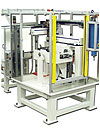
Dixon Automatic Tool Inc. recently standardized its workcell platform design. This change makes the workcells more affordable and more adaptable to lean manufacturing practices.
“Manufacturers can customize a workcell for an application at a lower cost,” says Brian Droy, vice president of sales for Dixon. “The predesign also allows for quicker delivery, which is critical as new product platforms are launched.”
DEPRAG Inc. has introduced three standardized workcells. One of them, the DCAM, is a modular, compact unit that can be equipped with one to three programmable axes of linear motion. The base module consists of a powder-coated steel frame with a height- adjustable table, a closed or open top cover, and a foot support. The base can be mounted to the floor or a table.
The work area is 600 by 600 by 150 millimeters. The cell can be equipped with a rotary indexing table, a linear transfer system, or a slide table. Parts can be loaded manually or automatically.
In addition to screwdriving, the DCAM can be outfitted for labeling, testing, lubricating, marking and pick-and-place operations.
The DCAM is being used for a number of assembly applications, including diplexer components, circuit board contacts and display components for cell phones.
“This product really blurs the border of manufacturing engineering and IT,” says Jim Graham, president of Weber Screwdriving Systems. “The capabilities of the hardware-firmware interface allow easy adaptability and customization for clients through software design.”
At the AUTOMATICA 2010 trade show, held in Munich, Germany, DEPRAG introduced its new controller, the DCOS. The controller’s DPU 100 processing unit can control complex motion sequences with very short cycle times (typically less than 6 milliseconds). It also allows networking with shopfloor computer networks and software, including SCADA and MES systems.
“We’re seeing significant interest from the revived furniture industry because the machine contributes to lower assembly costs,” says Tom Rougeux, sales manager of Design Tool.
“Furniture manufacturers like that it combines two machines in one, and it does the work of four people.”
The DTI 5000 handheld automatic screwdriver is customized to each application. The feeder is paired with a pneumatic screwdriver in pistol-grip or in-line configurations.
The feed mechanism can be disassembled and reassembled in seconds without the use of tools, so engineers can quickly access the system if a jam occurs due to a foreign object or a defective screw.
The system has an automatic timed shut off feature, which reduces wear on the feeder bowl and makes the unit more efficient. The machine automatically shuts off if unit is not cycled for 7 to 8 seconds. It restarts when the operator drives another screw.
A major plumbing products manufacturer uses the device to fasten hinges to toilet seats. Another manufacturer uses it to assemble LED light fixtures.
*More user-friendly vision systems for robotic screwdriving.
*More seamless integration of screwdriving equipment into robots.
*Expanded programming features for greater control.
*Easier achievement of Six Sigma quality through enhanced inspection.
*Electric tools with better process verification and more I/O.
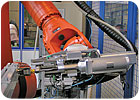
JR Automation, a robotics integrator, recently
installed 30 M-10iA robots in an automobile plant. The installation involved
three workcells, each containing 10 robots. Photo courtesy JR Automation
To help manufacturers reach these goals, robot and screwdriver suppliers are expanding their product lines and enhancing the capabilities of their products. Handheld units are becoming smaller and more powerful. Controllers are becoming more user-friendly. And an array of screwdriving robots-from tabletop Cartesians to six-axis articulated models-are increasingly replacing human operators on the assembly line.
While the economy is a big reason behind the growth in automated screwdriving-it’s definitely not the only reason. Technological advances are playing a role, too. For example, in robotic screwdriving systems, the tool has become more tightly integrated with the robot controller, making it easier to set assembly profiles and get process feedback.
“There are more ways then ever before for us to get screwdriving information [to and from] the robot,” says Mike Cicco, general manager of material handling for FANUC Robotics America Inc. This information includes screw depth, torque, driver speed, pass-fail status, and failure location.
Viper MBC automatically feeds and installs a wide range of
fasteners, including screws, nuts, bolts, pins, clips, brass rings and barbed
darts. Photo courtesy Visumatic Industrial Products
Robotic Screwdrivers
Some robot manufacturers, such as Janome Industrial Equipment USA Inc., have equipped desktop Cartesian systems to perform screwdriving. These robots continue to shrink in size and are a less expensive alternative to SCARA robots.Of course, SCARAs have improved, too. Several new SCARAs have recently been introduced, and they’re faster and more nimble than Cartesians in many screwdriving applications.
One of them is the G1 mini SCARA from EPSON Robots. Besides having a small footprint, the G1 is unique in that it is available in both three-axis and four-axis versions. The three-axis version is particularly suited to screwdriving, because it’s less likely to be affected by torque reaction from the driver. Traditionally, the fourth axis on a SCARA-the rotational, or theta, axis-is the weakest joint on a SCARA robot. With the right linear guides for the Z axis, the G1 can install fasteners with a downward force of 5 kilograms.
Depending on the model, it has a maximum reach of 175 or 225 millimeters. The Z axis has a maximum stroke length of 100 millimeters. With a repeatability of ±5 microns, the robot can handle some precise assembly applications. Indeed, Seiko Watch Corp. uses the G1 to install micro screws in watches.
Another new screwdriving SCARA is the Viper MBC from Visumatic Industrial Products. The system automatically feeds and installs a wide range of fasteners, including screws, nuts, bolts, pins, clips, brass rings and barbed darts.
The system consists of a four-axis SCARA, a choice of DC electric screwdrivers, and a feeder that automatically delivers each fastener directly to the driver bit. The Viper MBC has a maximum reach of 350 to 550 millimeters, depending on the model. The driver can apply 150 in-lb of torque, and fastening can be controlled by torque and angle.
The Z axis is designed to be stiff in the vertical direction-because it has to push parts together during fastening-and a bit compliant in the horizontal plane, to accommodate imperfect relative positioning between the tooling tip and the assembly.
The Viper MBC has a zero-offset design. The tooling is located at the end of the second SCARA joint, so joints 3 and 4 are spared the effects of torque from tightening. Joints 3 and 4 carry just one-third of the tooling mass. This simplifies programming, improves repeatability, increases travel speed, and extends the life of the robot.
The system is preprogrammed, so it can be placed in a fully automated assembly line and be ready to go with minimal setup.
FANUC’s latest offerings include the compact M-1iA delta robot and M-10iA and M-20iA serial-link robots.
Although delta robots are typically thought of as pick-and-place machines, a screwdriver can be mounted to the M-1iA for small assembly applications. In fact, some Asian manufacturers are using the robot for just that purpose. With a reach of 280 millimeters, the robot is available in both four- and six-axis versions.
The M-10iA and M-20iA are six-axis units with advanced servo technology for maximum speed and acceleration. These robots have a hollow upper arm and wrist, so electrical cables, air lines and feeding tubes for the screwdriver can be neatly contained within the arm. This prevents issues with snagging or rubbing. In addition, a shelf is located on the back of the upper arm for mounting peripheral equipment.
JR Automation, a robotics integrator, recently installed 24 M-10iA and six M-20iA units in an automobile plant. The installation involved three workcells, each containing 10 robots.
The new RSF robot-assisted screwdriving system, developed by Weber Screwdriving Systems Inc. and fastener manufacturer EJOT GmbH & Co., is being used by European automakers such as Lamborghini, Lotus and Audi to assemble body panels made of aluminum and other metals.
Flow drilling screws, made by EJOT, are blow-fed automatically to the screwdriving spindle, which is mounted to a heavy-duty, six-axis, serial-link robot. With high thrust and fast driver speed, the screw is driven through the solid material in a single operation. The system advances the screw, creates and threads the hole, then tightens the screw to a predefined torque. Cycle time is just 1.5 seconds.
Standardized workcells, similar to this one, are more
adaptable for lean manufacturing practices. Photo courtesy Dixon Automatic Tool
Inc.
Workcells
Preconfigured workcells are another option for automatic screwdriving. Such cells can operate as stand-alone units or they can be linked to other screwdriving or processing cells. They can be loaded and unloaded by an operator, or they can be integrated into a fully automated assembly system.Dixon Automatic Tool Inc. recently standardized its workcell platform design. This change makes the workcells more affordable and more adaptable to lean manufacturing practices.
“Manufacturers can customize a workcell for an application at a lower cost,” says Brian Droy, vice president of sales for Dixon. “The predesign also allows for quicker delivery, which is critical as new product platforms are launched.”
DEPRAG Inc. has introduced three standardized workcells. One of them, the DCAM, is a modular, compact unit that can be equipped with one to three programmable axes of linear motion. The base module consists of a powder-coated steel frame with a height- adjustable table, a closed or open top cover, and a foot support. The base can be mounted to the floor or a table.
The work area is 600 by 600 by 150 millimeters. The cell can be equipped with a rotary indexing table, a linear transfer system, or a slide table. Parts can be loaded manually or automatically.
In addition to screwdriving, the DCAM can be outfitted for labeling, testing, lubricating, marking and pick-and-place operations.
The DCAM is being used for a number of assembly applications, including diplexer components, circuit board contacts and display components for cell phones.
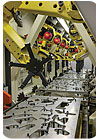
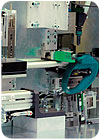
Screws are automatically installed to assemble the
handle of a vacuum cleaner. Photo courtesy DEPRAG Inc.
Controllers
First introduced by Weber Screwdriving in 2006, the C50S system controller is now in its second generation format. Used with the RSF robot, the Windows IP-based controller reports and records every variable in the screwdriving process. It also controls peripheral equipment and processes. With the C50S, engineers can access quality data on every assembly at any time from anywhere in the world. With customer permissions and prior arrangements, Weber can also externally monitor and control their customers’ assembly strategies.“This product really blurs the border of manufacturing engineering and IT,” says Jim Graham, president of Weber Screwdriving Systems. “The capabilities of the hardware-firmware interface allow easy adaptability and customization for clients through software design.”
At the AUTOMATICA 2010 trade show, held in Munich, Germany, DEPRAG introduced its new controller, the DCOS. The controller’s DPU 100 processing unit can control complex motion sequences with very short cycle times (typically less than 6 milliseconds). It also allows networking with shopfloor computer networks and software, including SCADA and MES systems.
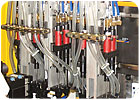
A 10-spindle machine installs screws on a garage door
panel. Once the spindle heads retract, the panel advances and the process is
repeated. Cycle time is about 5 seconds. Photo courtesy Design Tool Inc.
Stationary Machines and Handhelds
The DTI 2000 is a pocket cutter and screw insertion machine made by Design Tool Inc. The machine automatically routs a pocket, drills a pilot hole, and inserts a screw into face-frame rails of any width or length. Cycle time for all three operations is 4 seconds or less. The pocket is routed at 15 degrees and its width is 7/16 inch. The screw is inserted to a depth so the screw point is at the outer edge but not protruding.“We’re seeing significant interest from the revived furniture industry because the machine contributes to lower assembly costs,” says Tom Rougeux, sales manager of Design Tool.
“Furniture manufacturers like that it combines two machines in one, and it does the work of four people.”
The DTI 5000 handheld automatic screwdriver is customized to each application. The feeder is paired with a pneumatic screwdriver in pistol-grip or in-line configurations.
The feed mechanism can be disassembled and reassembled in seconds without the use of tools, so engineers can quickly access the system if a jam occurs due to a foreign object or a defective screw.
The system has an automatic timed shut off feature, which reduces wear on the feeder bowl and makes the unit more efficient. The machine automatically shuts off if unit is not cycled for 7 to 8 seconds. It restarts when the operator drives another screw.
A major plumbing products manufacturer uses the device to fasten hinges to toilet seats. Another manufacturer uses it to assemble LED light fixtures.
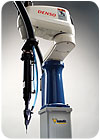
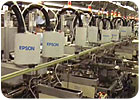
The G1 SCARA robot was designed to install micro
screws in watches. Photo courtesy EPSON Robots
The Future?
Looking ahead, suppliers are excited about the future of automated screwdriving. Among the new machine technologies and capabilities they foresee are:*More user-friendly vision systems for robotic screwdriving.
*More seamless integration of screwdriving equipment into robots.
*Expanded programming features for greater control.
*Easier achievement of Six Sigma quality through enhanced inspection.
*Electric tools with better process verification and more I/O.
Looking for a reprint of this article?
From high-res PDFs to custom plaques, order your copy today!