What’s New With Pulse Tools
in the world of assembly, there is no official competition to determine the best power tool of the 21st century (thus far). But, if there was, pulse tools would definitely be in the running. The reason: In the past 15 years, they have become much more than just ergonomically friendly and capable of high run-down speeds.
“A lot of pulse tools were sold in the 1980s and 1990s for their ergonomic benefits, and justifiably so,” notes Neil Maniccia, division sales manager for ASG, Div. of Jergens. “In recent years, though, electric and cordless versions have become available that offer greater flexibility. The pneumatic tools also are smaller, consume less air and offer a better power-to-weight ratio.”
These latter benefits are important to one transaxle supplier. For the past year, the company’s assemblers have been using pistol-grip pneumatic pulse tools to build transaxles for a global agricultural equipment manufacturer. The tools’ lower air consumption means lower operating costs.
Automotive suppliers are increasingly using pulse tools. Several, for example, use cordless models to fasten a wide range of nonsafety-critical components. These include fenders, bumpers, dashboards, cylinder blocks and crankshafts.
Furniture manufacturers have also become big fans of pulse tools. Their assemblers especially like the tools’ ergonomic benefits and accuracy capability compared to that offered by manual screwdrivers.
When introduced in the early 1960s, pulse tools drew little interest from manufacturers. That all changed in the late 1970s, when Japanese automakers began using the technology. Today, manufacturers worldwide in many industries increasingly use pulse tools to take advantage of their ergonomic and many other assembly benefits, ranging from torque accuracy to low vibration and quiet operation (about 80 decibels).
Pick Your Pulse
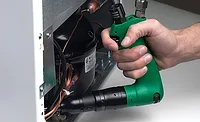
A pulse tool is operated like any other power tool. The assembler manually sets the desired torque, places the socket on the fastener and presses the trigger.
Looking for quick answers on assembly and manufacturing topics? Try Ask ASM, our new smart AI search tool. Ask ASM
Pulse tools are discontinuous drive tools, meaning they apply torque in increments rather than one continuous effort. These short pulses minimize or eliminate torque reaction experienced by the assembler.
The tools come in inline, pistol-grip and right-angle configurations and feature a motor (air, electric or battery powered) connected to a pulse unit. Within the pulse unit is an oblong inner chamber filled with hydraulic fluid. Also in the chamber are one to three blades that rotate around a driveshaft connected to the tool’s anvil.
“It’s important to distinguish between oil and mechanical pulse tools,” explains Maio. “In an oil tool, hydraulic fluid in the chamber is compressed to create a pressure differential. This differential produces a torque impulse that is transmitted to the fastener. In other words, hydraulic fluid pressurization alone turns the fastener. This is similar to how pressurized hydraulic fluid raises a bucket on an excavator, but on a much, much smaller scale.
“Mechanical pulse tools, in contrast, rely on a cam-type mechanism within the chamber to create force. The fluid mainly absorbs vibration and lubricates moving parts. Also, these tools produce fewer pulses with a higher force, whereas oil pulse tools produce more pulses with a lower individual force.”
Before a fastener is seated, the tool runs at free speed (4,000 to 8,000 rpm) but does not pulse. Its pulse unit and motor rotate at the same speed, and the blades contact the chamber’s inner wall. Once the fastener achieves a seating torque, the anvil slows down but the pulse unit continues at its original speed.
The blades push inward toward the anvil’s center, compressing the springs. This action reduces the volume within the chamber and increases pressure on the hydraulic fluid. As the pulse unit continues to rotate, fluid pressure builds to the point that it pushes against the blades and forces the anvil to rotate.
Once the fluid reaches maximum pressure, the narrowest section of the chamber (called the seal point) transmits energy from the rotating unit and fluid to the anvil to produce a pulse of torque. Each pulse lasts from 2 to 4 milliseconds. Depending on the joint, eight to 10 pulses is usually enough to tighten a fastener.
Pulse tools are categorized according to clutch type: shutoff or non-shutoff. Initially, all pulse tools were non-shutoff, meaning they pulse as long as the operator presses the trigger.
Non-shutoff tools require a skilled operator to achieve torque accuracy and prevent premature tool wear. In general, non-shutoff tools are best suited for low-volume applications, those requiring up to 20 ft-lb of torque or tight-tolerance repeatability, or when the operator must physically evaluate the condition of the joint after fastener installation.
Shutoff pulse tools have been available for the last decade or so and are designed to automatically cut off power to the motor once preset torque has been reached. Some models rely on a small bypass valve to trigger shutoff. When hydraulic fluid reaches a certain pressure, the valve bleeds off fluid that pushes back a rod to open a secondary valve and cut off power. Certain pneumatic
models trigger shutoff based on the volume of air that passes through the motor or mechanical centrifugal force.
According to Dave Wise, global product manager for Apex Tool Group LLC, shutoff tools improve accuracy and repeatability by eliminating operator influence. These tools also offer shorter cycle times, resulting in less wear on the tool and operator.
Many models of pneumatic, electric and cordless pulse tools feature a strain-gauge transducer on the anvil for accurate torque measurement. They also feature sensors to acquire various types of torque and angle data, as well as pulse counts, during fastening.
Introduced in early 2014, the pneumatic pistol-grip H series from Apex features a high-precision shutoff mechanism that provides torque accuracy to within ±10 percent. The tools also feature a centrifugal speed governor, which reduces drive speed by 50 percent, air consumption and noise, and prevents premature shutoff even when the tool runs at full capacity.
An oil reserve automatically replenishes the tool during operation. Torque range of the 14-model series is 4 to 120 newton-meters.
Electric and cordless tools offer several distinct benefits. For example, electric tools are more efficient and use less energy than pneumatic tools, although they are more expensive. These tools also offer outstanding speed and torque control during run-down, maintain a constant speed under load and can be run at multiple preset speeds. Plus, an operator interface is standard equipment on many electric tools.
Desoutter Industrial Tools developed its ELRT electric pulse tool in 2013 for a one-year trial in Toyota plants in Japan and the United States. Russ Hughes, product marketing manager for Desoutter, says assemblers there used the tool to assemble side curtain air bags. After the trial proved successful, Desoutter brought the tool to market in mid-2014.
According to Hughes, the ELRT features a proprietary, patent-pending pulse mechanism that needs much less maintenance than standard hydraulic pulse units. In addition, the tool has a rotational speed of 4,600 rpm, produces 10 to 25 newton-meters of torque and features an embedded transducer for full traceability.
AIMCO’s UDP-TA tools plug directly into 100 to 115 VAC wall outlets. The lightweight tools (2.9 or 3 pounds) come with a top or bottom cable, as well as an integrated as-needed fan that cools the brushless motor featuring rare earth magnets. Torque range and free speed of the 12-model series are 4.5 to 8 newton-meters and 3,000 to 4,800 rpm, respectively.
Fourteen models of EH2 electric pulse tools are available with shutoff or non-shutoff capability. Small models weigh 2 to 4 pounds and have torque capacities from 10 to 120 newton-meters. Large models weigh 5 to 8.3 pounds and produce 120 to 230 newton-meters of torque. All models run in reverse to remove fasteners. A rubber-covered grip isolates the tools from cold temperatures and vibration.
With cordless power tools, assemblers needn’t worry about where they are going to plug in or any cord-related issues—including the risk of electrical shock, and having dirt or debris from the cord wipe off onto the item being assembled. Cordless tools also make it easier to drive fasteners in close quarters, such as under an overhead restriction.
Although cordless tools operate at a much-lower rpm than pneumatic models (2,200 versus 9,500), they don’t sacrifice much in terms of power. Hughes says Desoutter will introduce a mid-torque (45 newton-meters) cordless pulse tool this summer, with plans to introduce a high-torque (up to 200 newton-meters) transducerized model within the next 18 months.
Error-proofing with a pulse tool tends to focus on two factors: the installed fastener’s final angle of rotation and required pulse count. Some tools feature an encoder that records the angle of each pulse and then adds them together to obtain the final angle.
“If the application requires 10 pulses, and the controller counts only two or three, you know something is wrong with that assembly,” explains Wise. “The fastener may be cross-threaded, a gasket could be missing or a part could be out of tolerance.”
Few suppliers customize their pulse tools. But, in 2013, AIMCO added a special gearhead to its UL-70S inline pneumatic tool for a large U.S. automaker. The gearhead makes it easier for assemblers to install bolts in tight spaces such as door hinges.
John Olson, power tool group manager for Panasonic Eco Solutions Co. North America, says a global tractor manufacturer is in the process of replacing nearly 1,000 tools at one plant with Panasonic mechanical pulse tools. These tools have error-proofing with wireless receivers and an enable/disable feature. According to Olson, the company’s EYFL, EYFM and EYFP series offer virtually no torque reaction to the operator up to 650 newton-meters. They also have a rehit-prevention feature that disables the tool for a period of time (up to 3 seconds in 0.1-second intervals) after shutoff. Torque ranges are as follows: EYFL, 3 to 22, 6 to 30 and 15 to 53 newton-meters; EYFM, 25 to 100 newton-meters; and EYFP, 160 to 650 newton-meters.
Still Some Limitations
The biggest drawback of pulse tools is they need frequent maintenance. Hydraulic fluid within the pulse unit breaks down due to heat, and it needs to be changed regularly, along with springs, O-rings and gaskets. Maintenance costs may be even greater if the tools are sent out rather than being worked on in-house.
“The pulse unit itself must also be replaced or rebuilt occasionally, and this is expensive relative to the rest of the tool,” notes Maniccia. “Rebuilding a unit is a bit cheaper than buying a new one, but you can only rebuild it a few times.”
Another limitation is pulse tools are best applied to medium and hard joints, rather than soft and very soft joints. A soft joint significantly slows anvil speed when rotation resistance increases, leading to extended run-down times. This may be countered somewhat with a larger pulse tool.
Finally, the torque accuracy of pulse tools is usually ±10 to 20 percent. As a result, they are rarely used in industries such as aerospace, which typically require accuracy to within ±1 or 2 percent.
Some suppliers also note the importance of only using properly fitting sockets with a pulse tool, due to its high free speed. Poor-fitting sockets increase wobble and reduce torque delivery. They also shorten tool life by increasing vibration and wear on the anvil.
Looking for a reprint of this article?
From high-res PDFs to custom plaques, order your copy today!