GE Revives Appliance Park
On a blustery, cold February morning, with political and corporate dignitaries on hand, General Electric officially opened a new water heater assembly plant at its famous Appliance Park manufacturing complex in Louisville, KY. Just six weeks later, GE opened the doors on a second new assembly plant at Appliance Park, this one dedicated to a new line of refrigerators.
The two facilities—the first new assembly lines at Appliance Park since 1957—are the vanguard of a five-year, $1 billion investment to boost GE’s appliance division and create more than 1,300 U.S. jobs by 2014. In May 2008, GE publicly considered selling off the division. Less than four years later, GE Appliances & Lighting was featured in a Super Bowl XLVI ad, and politicians, union leaders and executives are calling the company a case study for the future of U.S. manufacturing.
In Hot Water
The impetus for building the $38 million water heater plant was GE’s new GeoSpring hybrid water heater. Lean manufacturing and a more competitive wage structure for new employees led GE to select Louisville as the production site for the new water heater, instead of China, where an earlier version of the product was made.
The energy-efficient design of the water heater was also an important factor in persuading state and federal governments to champion its production in the United States, according to Steve Downer, GE’s general manager for water products. “The GeoSpring is the most energy-efficient water heater available today,” he says.
Kentucky Gov. Steve Beshear, Lt. Gov. Jerry Abramson, Louisville Mayor Greg Fischer, and U.S. Rep. John Yarmuth were all on hand at the plant’s opening to celebrate what they characterized as a victory for U.S. manufacturing in the green sector. “In this instance, government decided [the United States wasn’t] going to be outcompeted in energy-efficient appliances,” says Yarmuth.
GE estimates that manufacturing the water heater in China would have been approximately 7 percent to 10 percent cheaper, given that country’s incentives and labor costs, and specifically credited Abramson for leading the political efforts to make up that difference in federal and state tax incentives for both GE and consumers. (Abramson was mayor of Louisville from 1985 to 1998 and again from 2002 to 2010.)
The commonwealth and federal governments provided approximately $17 million in incentives for GE to build the water heater and refrigerator assembly plants and to make other improvements at Appliance Park during the next several years.
Those investments have paid off. According to a study commissioned by GE and conducted by independent consulting firm Tripp Umbach, Appliance Park directly and indirectly contributes $1.6 billion to Kentucky’s economy. That means $1 out of every $103 in the state’s economy is supported in part by Appliance Park.
In addition, the study found that GE helps support more than 12,000 jobs in Kentucky, including 5,000 GE employees. Besides Appliance Park, the conglomerate operates several other manufacturing facilities in Kentucky, including a GE Aviation engine plant, a GE Energy service center, and a GE Healthcare medical device assembly plant.
“We made a commitment early in my administration that energy-related development would be a high priority,” says Beshear. “We developed an aggressive plan to not only research and develop new kinds of energy production, but to attract businesses and projects that are similarly committed to cleaner, greener energy applications. GE’s new hybrid water heater is a perfect match for our energy commitment and our strong manufacturing core.”
From the Ground Up
Once GE committed to revitalizing the appliance division, the company decided to redesign the first generation GeoSpring from the ground up.
The redesign process benefited from the input of many constituent groups, including plumbers, installers and consumers, during usability testing at GE’s testing lab, which is also located at Appliance Park. The recently reopened lab is a sight to behold. The lab has several testing rooms where appliances can be set up for test subjects to operate in a typical end-use environment, while the design team observes their reactions behind a two-way mirror.
Compared with the earlier model, the new GeoSpring is quieter, easier to install, and $300 to $400 less expensive. It also generates more hot water (65 gallons of first hour delivery vs. 63 gallons).
More importantly, the new water heater is more energy-efficient than its previous incarnation. Water heaters are given an overall efficiency rating known as an energy factor (EF). The higher the EF, the more efficient the model. Water heaters with high EF ratings may cost more initially, but save energy and money in the long run. Whereas the old GeoSpring had an EF of 2.35, the new model has an EF of 2.4. GE estimates the new water heater will provide $325 in energy savings per year, compared with $320 with the previous model.
Much of this was accomplished with a hybrid heat pump and electric heating system. The hybrid technology was designed to absorb heat in ambient air and transfer it into the water. Since this requires much less energy than the energy used to generate radiant heat—as used in a conventional electric tank water heater—the water heater is more economical to operate.
Indeed, the new GeoSpring consumes approximately 1,830 kilowatt-hours of electricity per year. That compares with 4,879 kilowatt-hours of electricity per year for a conventional 50-gallon electric water heater.
“Approximately 50 percent of U.S. households use a standard electric water heater,” says Downer. “If 25 percent chose a GeoSpring instead of a standard 50-gallon electric water heater, more than four billion pounds of CO2 emissions from the U.S. grid could be avoided annually—equivalent to the annual emissions of more than 360,000 cars on U.S. roads.”
Collaborative Design
The redesigned water heater and the assembly line represent a major shift in the company’s manufacturing and design process toward greater on-site collaboration and lean processes.
The outbuildings of the now churning factory include the IDO Center, which houses GE’s design engineers. Marc Hottenroth, industrial design leader at GE, says his team of about 30 manufacturing engineers worked closely with the product design team throughout the entire process of configuring the revitalized factory for lean production of the water heater. Design engineers and manufacturing engineers were constantly running between their facilities to be personally on hand for decisions regarding the assembly line or the water heater. “The good thing about lean is you get lean,” jokes the now fit Hottenroth.
Both Hottenroth and Lou Lenzi, GE’s director of industrial design, stress that the benefits of their collaborative efforts were well-worth the workouts. “All the problem-solving is in real time,” says Lenzi. “There are no PowerPoint [presentations] and board room [meetings to sit through]; everybody is down here or up there [at the IDO center].”
“The trick is to think like you’re 12,” says Hottenroth of the team’s conceptual, Erector-Set approach to reimagining their assembly processes. Each member came in with seven ideas, and most of those were hashed out with simple models. “We went through a lot of foam and duct tape,” he says.
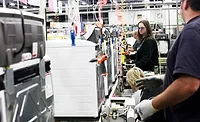
Among the more interesting designs on the assembly line was the boxing system. Rather than purchasing a large, $40,000 machine to lift boxes over the finished water heaters, the system’s operators devised their own rig and built it from parts obtained at a local hardware store.
The plant conversion itself benefited from an enormous amount of recyclable steel and concrete leftover from the plant’s last configuration in the 1950s. In fact, GE has recycled nearly 11,000 tons of structural steel at Appliance Park—that’s as much weight as 24 fully loaded Boeing 747s.
New Refrigerator Line
GE invested $250 million in the refrigerator assembly line, which will support some 600 jobs at full capacity.
The impetus for that line was GE’s new refrigerator models, which have bottom freezers with French doors. The refrigerators have a host of high-tech gadgets to attract consumers. For example, the GE Profile model is equipped with a water dispensing system that uses ultrasonic and proximity sensors to automatically detect and fill a glass or pitcher. The GE Cafe model can dispense hot water as well as cold water—an industry first. And, the freezers on all models are insulated with cyclopentane foam, a material that produces significantly less greenhouse gases during manufacturing and recycling.
To focus on the new models, GE moved production of side-by-side refrigerators from Appliance Park to its assembly plant in Bloomington, IN.
As they did with the water heater line, manufacturing and design engineers collaborated to save material and labor costs at the same time they improved quality.
Following the principles of lean manufacturing, the cross-functional team found numerous ways to simplify assembly. Screws were eliminated in favor of snap-fits. The team removed 20 parts from just one subassembly, the vegetable pan. Even though the new refrigerator has more features than the previous model, the team removed 50 percent of the wiring.
According to GE, the average new model has 100 fewer parts than previous models.
| For more information on appliance assembly, check out these articles: |
| Appliance Assembly: Less is More |
| Appliance Assembly: Fastening or Bonding? |
| Appliance Assembly: Engineers Get Touchy-Feely |
Lean was also applied to the assembly line. Kenny Farnsley, an hourly kaizen promotion officer, found a way to improve the evaporator assembly process that saved GE $1 million in investment cost. Starting with crude models, Farnsley developed a series of simple, reliable machines that produce a good quality part. Those right-sized machines saved the company 70 percent vs. standard automated equipment.
Geoffrey Henderson, a team leader, found a way to reduce shoulder injuries while boxing up the refrigerators for shipping. Instead of throwing the box over the top over the refrigerator, the operator stands on a 6-foot platform to place the box over the appliance—virtually eliminating lifting.
Simple ideas like that have yielded major benefits. The length of the assembly line was reduced by half. And, by working concurrently, rather than consecutively, the team brought the refrigerator to market in 25 percent less time than the previous model.
Today’s Appliance Park is proof that when businesses, unions and employees work together, we can deliver innovative solutions to the marketplace and demonstrate that U.S.-based manufacturing can be competitive,” says Chip Blankenship, president and CEO of GE Appliances and Lighting.
Looking for quick answers on assembly and manufacturing topics? Try Ask ASM, our new smart AI search tool. Ask ASM
Looking for a reprint of this article?
From high-res PDFs to custom plaques, order your copy today!