Assembly Magazine logo
search
Ask ASSEMBLY AI
cart
facebook twitter linkedin youtube
  • Sign In
  • Create Account
  • Sign Out
  • My Account
Assembly Magazine logo
  • TRENDS
    • Ask ASSEMBLY AI
    • Trends
    • News
    • New Products
  • INDUSTRIES
    • Aerospace
    • Appliance
    • DFMA Assembly
    • Medical Devices
    • Green Manufacturing
    • Lean Manufacturing
    • Machinery Assembly
    • Electronics Assembly
    • Automotive
  • TECHNOLOGIES
    • Adhesives & Dispensing
    • Assembly Presses
    • Automated Assembly Systems
    • Manufacturing Management
    • Manufacturing Software
    • Motion Control
    • Screwdriving & Riveting
    • Robotics
    • Test & Inspection
    • Plastics & Metal Welding
    • Wire Processing
    • Workstations
  • AUTONOMOUS & ELECTRIC MOBILITY
    • AEM Magazine Archives
    • Autonomy
    • Electrification
    • Mobility Services
    • Assembly & Testing
    • AV/EM News
  • MEDIA
    • Ask ASSEMBLY AI
    • Podcasts
    • Assembly News Now
    • Assembly TV
    • Webinars
    • eBooks
  • EVENTS
    • Calendar
    • The ASSEMBLY Show
  • MORE
    • Exclusives >
      • Plant of the Year
      • Capital Spending
    • Buyers Guide >
      • Supplier Insights
    • Classifieds
    • Featured Products
    • Newsletters
    • Store
    • White Papers
    • Columns
    • Sponsor Insights
  • INFOCENTER
    • Assembly & Test Solutions
  • EMAGAZINE
    • eMagazine
    • Archive Issues
    • Advertise
    • Contact Us
    • Sign Up
Electronics AssemblyOn Campus

Georgia Tech Pushes the Boundaries of Electronics

By Austin Weber
September 4, 2012

Imagine owning a television with the thickness and weight of a sheet of paper. Some day in the near future, it will be possible, thanks to the growing field of printed electronics.

The process, which allows manufacturers to print or roll materials onto surfaces to produce an electronically functional device, is already used in organic solar cells and organic light-emitting diodes (OLEDs) that form the displays of cell phones. Batteries, antennas, memories, sensors and other electronic components can also be printed.

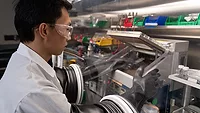
This emerging technology is expected to grow by tens of billions of dollars over the next decade. Engineers at the Georgia Tech Center for Organic Photonics and Electronics (COPE) are at the forefront. The nine-year-old R&D facility specializes in creating flexible materials and devices for use in information technology, telecommunications, energy and defense applications.

“A major focus for innovation at COPE is the synthesis of new organic and hybrid compounds to further improve the performance of optoelectronic devices in the field of printed electronics,” says Bernard Kippelen, COPE director and a professor in the School of Electrical and Computer Engineering.

“These material discovery efforts are integrated with studies that focus on the processing, coating and patterning of the new materials using various vacuum deposition techniques, or coating and printing techniques that can be easily scaled up and moved rapidly into production,” adds Kippelen.

“We believe that developing new inks for today’s printed electronic manufacturing industry has value, but are convinced that our mission goes beyond that,” Kippelen points out. “We also work on the packaging of flexible printed electronic devices, an area of research that is often overlooked.”

COPE currently includes 35 faculty members from seven different colleges at Georgia Tech. They interact with 90 undergrads, 40 graduate students and 25 research scientists.

“By making COPE a focal point for campus-wide efforts in the field and including faculty, researchers and students from seven different schools, we leverage a range of expertise that includes chemical, electrical, mechanical and materials engineering,” explains Kippelen. “This allows us to address many of the science and engineering challenges of the emerging technologies in this field.”

Kippelen and his colleagues are currently involved a number of research projects that are sponsored by both public and private funding. Research areas include organic and hybrid photovoltaic technologies, OLEDs for solid-state lighting and displays, organic materials for all-optical switching, and printable organic field-effect transistors for flexible electronics.

One challenge that COPE is tackling is manufacturing flexible electronics at low cost in ambient conditions. In order to create light or energy by injecting or collecting electrons, printed electronics require conductors—usually calcium, magnesium or lithium—with a low-work function.

These metals are chemically very reactive. They oxidize and stop working if exposed to oxygen and moisture. This is why electronics in solar cells and TVs, for example, must be covered with a rigid, thick barrier such as glass or expensive encapsulation layers.

The Georgia Tech engineers have developed a technique to reduce the work function of a conductor. They spread a very thin layer of a polymer, approximately one to 10 nanometers thick, on the conductor’s surface to create a strong surface dipole.

“These polymers are inexpensive, environmentally friendly and compatible with existent roll-to-roll mass production techniques,” says Kippelen. “Replacing the reactive metals with stable conductors, including conducting polymers, completely changes the requirements of how electronics are manufactured and protected. Their use can pave the way for lower cost and more flexible devices.”

Kippelen and his colleagues evaluated the polymers’ performance in organic thin-film transistors and OLEDs. They have also built the world’s first fully plastic solar cell.

Looking for quick answers on assembly and manufacturing topics? Try Ask ASM, our new smart AI search tool. Ask ASM →

KEYWORDS: printed electronics

Share This Story

Looking for a reprint of this article?
From high-res PDFs to custom plaques, order your copy today!

Austinweber headshot
Austin has been senior editor for ASSEMBLY Magazine since September 1999. He has more than 21 years of b-to-b publishing experience and has written about a wide variety of manufacturing and engineering topics. Austin is a graduate of the University of Michigan.

Recommended Content

JOIN TODAY
To unlock your recommendations.

Already have an account? Sign In

  • Made in the U.S.A.

    Consumer Products Manufacturing: Made in the USA

    Supply chain lessons learned during the coronavirus...
    Automated Assembly Systems
    By: Austin Weber
  • Best Practices for Press-Fit Assembly

    Best Practices for Press-Fit Assembly

    In manufacturing, ironclad formulas for success are hard...
    Assembly Presses
    By: Jim Camillo
  • aem0523leader-tesla1.jpg

    Tesla Rethinks the Assembly Line

    Engineers at Tesla Inc. have developed a new process that...
    Electrification
    By: Austin Weber
Manage My Account
  • eMagazine Subscription
  • Assembly Newsletters
  • Online Registration
  • Subscription Customer Service
  • Manage My Preferences

More Videos

Sponsored Content

Sponsored Content is a special paid section where industry companies provide high quality, objective, non-commercial content around topics of interest to the ASSEMBLY audience. All Sponsored Content is supplied by the advertising company and any opinions expressed in this article are those of the author and not necessarily reflect the views of ASSEMBLY or its parent company, BNP Media. Interested in participating in our Sponsored Content section? Contact your local rep!

close
  • ultrasonic welding
    Sponsored bySonobond Ultrasonics

    Engineering Efficiency in High-Performance Assembly: How Ultrasonic Welding Enhances Throughput, Reliability and Quality

  • UV curing system
    Sponsored byDymax

    Why UV Intensity Alone Doesn’t Define Curing Performance

  • wooden pallets
    Sponsored byLEAN Manufacturing Products

    Eliminating Waste on the Shop Floor: Applying Lean Principles to Improve Manufacturing Efficiency

Popular Stories

ASSEMBLY News Now, episode-30: Volvo Redesigns EV Manufacturing

Volvo Redesigns EV Manufacturing

Boeing CEO Kelly Ortberg announces 1 billion investment

Boeing Plans $1 Billion Wichita Investment, Workforce Training Center

GE Appliances Worker on Line

GE Appliances Expands Factory AI With 800 Gemini Enterprise Agents

Watch the latest episode of ANN now!

Events

July 24, 2025

From Shop Floor to CFO: How Manufacturers Are Closing the Loop Between Operations and Finance

On Demand Learn how manufacturers are bridging the gap between the shop floor and ERP systems to gain real-time visibility, streamline operations, and kick-start digital transformation—without waiting years.

Sponsored by:

PicoStratusGreen
July 30, 2025

Buffer Analysis and Design Fundamentals for Manufacturing Excellence

On Demand In this presentation, Dr. Herman Tang shares practical insights from his industry experience and research on buffer management in manufacturing operations.

View All Submit An Event

Poll

Difficult Assembly Processes

Which assembly process gives you the most difficulty?
View Results Poll Archive

Products

Manufacturing Cost Policy Deployment (MCPD) Profitability Scenarios: Systematic and Systemic Improvement of Manufacturing Costs

Manufacturing Cost Policy Deployment (MCPD) Profitability Scenarios: Systematic and Systemic Improvement of Manufacturing Costs

See More Products
Register for webinar - Modernizing Automotive Assembly: Why Upgrading Legacy MES is a Business Imperative

Related Articles

  • aerospace1.jpg

    Hypersonic Aircraft Push the Boundaries of 3D Printing

    See More
  • Science Of Soldering© Class At Georgia Tech

    See More
  • battery manufacturing

    Georgia Tech Develops Safer, Cheaper, More Powerful Batteries

    See More

Related Products

See More Products
  • smart.jpg

    Handbook of Smart Manufacturing Forecasting the Future of Industry 4.0

  • history.jpg

    Faster, Better, Cheaper in the History of Manufacturing: From the Stone Age to Lean Manufacturing and Beyond

  • digitalization.jpg

    The Digitalization of the 21st Century Supply Chain

See More Products

Related Directories

  • Summit Interconnect

    Summit Interconnect is the largest privately held PCB manufacturer in North America, delivering a broad range of advanced, high-reliability technologies, from complex printed circuit boards to full assembly services. With eight high-tech facilities and thousands of employees, we partner with customers to push the boundaries of what is possible, helping to create inventive and transformative electronic products.
  • Techcon Systems

    Over the years, you've known our fluid and adhesive dispensing products for their superior accuracy and durability. They have offered improved industrial hygiene and enhanced productivity, making processes more efficient and creating value for you. Moving forward, our innovation road map pushes the boundaries even further, with the introduction of new intelligent solutions.
×

Never miss the latest news and trends driving the manufacturing industry

Stay in the know on the latest assembly trends.

JOIN TODAY!
  • RESOURCES
    • Advertise
    • Contact Us
    • Directories
    • Manufacturing Division
    • Store
    • Want More?
  • SIGN UP TODAY
    • Create Account
    • eMagazine
    • Newsletters
    • Customer Service
    • Manage Preferences
  • SERVICES
    • Marketing Services
    • Reprints
    • Market Research
    • List Rental
    • Survey/Respondent Access
  • STAY CONNECTED
    • LinkedIn
    • Facebook
    • Instagram
    • YouTube
    • X (Twitter)
  • PRIVACY
    • PRIVACY POLICY
    • TERMS & CONDITIONS
    • DO NOT SELL MY PERSONAL INFORMATION
    • PRIVACY REQUEST
    • ACCESSIBILITY

Copyright ©2026. All Rights Reserved BNP Media, Inc. and BNP Media II, LLC.

Design, CMS, Hosting & Web Development :: ePublishing