New Materials Allow Soldiers to Shed Weight
The U.S. Army is enlisting more aluminum and composites.
Weight issues are not something that’s common with U.S. Army soldiers. The military organization prides itself on running a lean, mean fighting machine. But, even so, the Army is on a weight-loss program when it comes to vehicles, artillery, ordnance, helmets, electronic gear and other devices.
Lightening the load in the field is a top priority today. Army engineers are developing a variety of new applications for aluminum, carbon-fiber composites, magnesium, titanium and other lightweight materials.
“Advanced, high-strength 7000 series aluminum alloys, ultra-high strength thin-gauge steels, lower-cost titanium alloys, and a wide range of magnesium alloys designed specifically for defense applications are of particular interest to the Department of Defense,” says Bob Kratzenberg, project manager for government applications at EWI. “These high-performance metals exhibit the potential for reducing weight while improving overall performance of defense systems.”
“By making the equipment as light as possible and as useful as possible, there is a better chance the soldier may keep it on,” notes Neven Gibbs, a retired U.S. Army cavalry sergeant. “Getting lost behind a group of soldiers on a long march or extended movements isn’t a problem. You just follow all of the discarded extra stuff they really don’t need or aren’t going to carry anymore.”
“Of the many risks dismounted soldiers face in the field, one of the most common is injury from carrying their gear—often topping 100 pounds—for extended periods over rough terrain,” adds Joseph Hitt, Ph.D., program manager for the Warrior Web project at the Defense Advanced Research Projects Agency. “Heavy loads increase the likelihood of musculoskeletal injury, exacerbate fatigue … and impede soldiers’ physical and cognitive abilities to perform mission-oriented tasks.”
The ultimate goal is to develop a lightweight exoskeleton that gives soldiers superhuman strength. For instance, Lockheed Martin engineers recently developed a device called the human universal load carrier (HULC). The hydraulically powered HULC features a titanium frame that allows soldiers to easily carry loads of up to 200 pounds.
Lighter body armor and head protection provides soldiers greater mobility on the battlefield. “The consequences of today’s conflicts demand that soldiers be more mobile and vehicles be smaller to navigate the narrow corridors of urban canyons,” notes Tim Swinger, global business manager for advanced fibers and composites at Honeywell Inc. “Soldiers cannot move building to building with heavy armor.
Looking for quick answers on assembly and manufacturing topics? Try Ask ASM, our new smart AI search tool. Ask ASM
“Additionally, soldiers and vehicles are often airlifted into combat zones, so every pound counts,” Swinger points out. “Ballistic-resistant solutions must be lighter in weight for the person or vehicle to realize no net weight gain.”
Honeywell engineers recently developed a ballistic material called Spectra Shield, which is made from ultra-high-molecular-weight polyethylene.
Parallel strands of fiber are bonded together with an advanced resin system.
The technology was recently used to produce next-generation combat helmets for the Army that are 16 percent to 24 percent lighter than what soldiers currently wear. In addition, the material provides increased ballistic performance against handgun rounds and fragments from improvised explosive devices.
Spectra Shield is also used in body armor, such as breast plates, side plates, vests, and throat and neck protection. In vehicles, the material is used to produce armored doors, side panels, roofs and floors.
“Spectra fiber is a high-modulus polyethylene, so it cannot be welded,” says Swinger. “Assemblies utilize adhesives and a variety of proprietary mechanical fastening techniques developed by the armor integrators.”
Lighter Loads
American soldiers carry so many electronic devices in their field packs these days that the weight of batteries is becoming a major concern. Lighter-weight power sources can significantly reduce the heavy packs, which often weigh up to 40 pounds, carried by many armed service members.
According to the U.S. Army Research Laboratory, a typical infantry battalion spends more than $150,000 on batteries alone each year, the second highest expense next to munitions. Battery weight is one-fifth of the total weight a soldier typically carries in theater.
Army engineers are currently developing a new type of battery to improve soldiers’ agility on the battlefield while meeting the demands of an increased power burden stemming from new networked electronic devices. The conformal wearable battery (CWB) is flexible and integrates into body armor.
“The CWB provides more power, reduces the need for battery recharging and spares, and serves as a single source of power for all worn electronic devices,” says Christopher Hurley, an electronics engineer who leads the battery development projects team at the U.S. Army Research, Development and Engineering Command. “It conforms to the body, which is a significant improvement from traditional batteries that are bulky and rectangular.
“Traditionally, batteries were designed to be placed in battery boxes and large communication equipment, and not to be worn by the soldier to power his electronics,” explains Hurley. “The Army’s conventional batteries can no longer handle the power demands for worn devices such as Nett Warrior, a handheld tool that provides situational awareness and mission command capabilities.
“These networked systems are always sending and receiving data, similar to leaving a cell phone on during a flight,” Hurley points out. “They continuously search for a signal, which rapidly drains the battery.
“Our [goal] is to develop smaller, lighter, cost-effective power sources,” adds Hurley. “Providing a wearable, ergonomic, comfortable footprint is key.”
The CWB was designed to be worn within a tactical vest and enable 72 hours of continuous operation. It is a centralized power source for all the things that a soldier needs to carry—GPS, smart phone, radio and other electronics—and eliminates the need to carry extra batteries for each individual item.
“When you slip a conformal battery into the protective vest and over the [small arms protective insert] plate, it’s virtually invisible and transparent to the soldier,” claims Hurley. “The battery allows the soldier to share valuable, limited real estate. He can hang his magazine, grenades or flashlight over the battery.”
Engineers at the Picatinny Arsenal recently reduced the weight of several weapons widely used by light and special operations forces. For example, the new 60-millimeter mortar system is 21 percent lighter than legacy weapons and has already been successfully deployed in the field. An 81-millimeter mortar system, which is scheduled for deployment next year, is 16 percent lighter.
“The weight savings was achieved by using lighter weight materials in the main components, such as the bipod, cannon and base plate,” says Peter Burke, deputy product manager for guided precision munitions and mortar systems at Picatinny Arsenal. “The bipods offered a good opportunity for weight savings, as they had the most number of parts.
“We primarily achieved weight savings in the bipod by using materials such as aluminum, titanium and a Nylon-Kevlar composite,” Burke points out. “These materials have the strength required, while remaining 30 percent to 50 percent lighter than steel.”
Fuel-Efficient Vehicles
The U.S. Army operates the largest fleet of ground vehicles in the world. More than 300,000 trucks and trailers in all sorts of shapes and sizes form the backbone of the military. In addition to transporting troops, they’re used for hauling ammunition, artillery, food, fuel and water across all types of terrain.
The Army is in the process of replacing its legacy vehicles with new trucks that consume less fuel, are highly maneuverable and significantly lighter, while also protecting troops better. According to some experts, improving fuel efficiency by just 1 percent will result in 6,000 fewer soldiers being put at risk by driving highly targeted fuel convoys in combat locations.
Lightweight materials have the potential to cut overall costs because of reduced fuel consumption. For example, composite materials are more than 50 percent lighter than traditional armor materials, making the vehicles easier to transport and maneuver. The improved agility of the vehicles can also help them survive tough missions.
“[Composites] lower the overall weight of [trucks] while improving the vehicle’s ability to withstand the increased threats seen in combat today,” says Honeywell’s Swinger. “The decrease in weight helps to decrease each vehicle’s maintenance and fuel costs, and can limit the number of resupply trips through dangerous routes.”
In addition to carbon-fiber composites, Army generals are also bullish on aluminum, especially for armored combat vehicles where weldability is a material requirement. Engineers at Alcoa Inc. recently developed an aluminum chassis and cab structure for the Army’s Fuel-Efficient Ground Vehicle Demonstrator (FED).
The lightweight, fuel-efficient prototype uses ArmX armor plate that is 10 percent lighter than a comparably sized steel vehicle. A lighter engine, driveline and chassis reduce fuel consumption by 7 percent.
“Lighter aluminum vehicles can accelerate and brake faster than their heavier, steel-intensive counterparts,” claims Tony Morales, global marketing director for aerospace and defense at Alcoa. “Additionally, aluminum is up to 50 percent lighter, yet provides more structural stiffness than steel.”
According to Morales, forged aluminum suspension components used on the FED deliver strength equivalent to steel at dramatically lower weight. One-piece aluminum forgings also eliminate welding, require minimal machining, easily bolt into place and reduce parts count significantly.
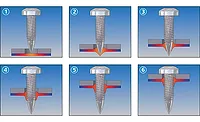
Many structural components of the FED are joined with bobtail fasteners, which deliver strong joints without compromising the integrity of the materials, which can occur with conventional welding techniques. In addition, they enhance long-term vehicle durability by maintaining joint strength when absorbing sudden impacts.
Alcoa engineers also used friction stir welding on the FED prototype. It improved quality by reducing weld-induced distortion to join several aluminum alloys. Friction stir welding also allowed assemblers to weld the thick aluminum plates that were integral to the vehicle’s blast shield.
Many next-generation military vehicles will be assembled with friction stir welding technology, says EWI’s Kratzenberg. “It offers great advantages for producing defense vehicle systems [that feature] significantly reduced plate distortion and shrinkage,” he explains. “It [also eliminates] the need for a filler metal and, being a machine tool-type process, it is highly operator independent and repeatable.”
Looking for a reprint of this article?
From high-res PDFs to custom plaques, order your copy today!