Assembly Magazine logo
search
Ask ASSEMBLY AI
cart
facebook twitter linkedin youtube
  • Sign In
  • Create Account
  • Sign Out
  • My Account
Assembly Magazine logo
  • TRENDS
    • Ask ASSEMBLY AI
    • Trends
    • News
    • New Products
  • INDUSTRIES
    • Aerospace
    • Appliance
    • DFMA Assembly
    • Medical Devices
    • Green Manufacturing
    • Lean Manufacturing
    • Machinery Assembly
    • Electronics Assembly
    • Automotive
  • TECHNOLOGIES
    • Adhesives & Dispensing
    • Assembly Presses
    • Automated Assembly Systems
    • Manufacturing Management
    • Manufacturing Software
    • Motion Control
    • Screwdriving & Riveting
    • Robotics
    • Test & Inspection
    • Plastics & Metal Welding
    • Wire Processing
    • Workstations
  • AUTONOMOUS & ELECTRIC MOBILITY
    • AEM Magazine Archives
    • Autonomy
    • Electrification
    • Mobility Services
    • Assembly & Testing
    • AV/EM News
  • MEDIA
    • Ask ASSEMBLY AI
    • Podcasts
    • Assembly News Now
    • Assembly TV
    • Webinars
    • eBooks
  • EVENTS
    • Calendar
    • The ASSEMBLY Show
  • MORE
    • Exclusives >
      • Plant of the Year
      • Capital Spending
    • Buyers Guide >
      • Supplier Insights
    • Classifieds
    • Featured Products
    • Newsletters
    • Store
    • White Papers
    • Columns
    • Sponsor Insights
  • INFOCENTER
    • Assembly & Test Solutions
  • EMAGAZINE
    • eMagazine
    • Archive Issues
    • Advertise
    • Contact Us
    • Sign Up
Medical Devices AssemblyDFMA AssemblyPlastics & Metal Welding Assembly

Robust Joint Design for Ultrasonic Welding of Medical Devices

By Charles Aubin, Ben Piecuch
January 7, 2014

Ultrasonic welding is particularly suited for assembling medical devices because it uses the device material itself to create the joint, obviating the need for adhesives. A fast, clean, efficient and repeatable process, ultrasonic welding is ideal for joining just about any plastic parts for many applications. To obtain these advantages, however, engineers must select a weldable material, design the joint, develop the fixtures, optimize the welding process, and finally, control it.

Ultrasonic welding joins thermoplastic parts by using high-frequency vibration (typically 20 to 40 kilohertz) to melt material at the junction of the parts. First patented in the 1960s, ultrasonic welding has since been refined for use in many applications. Related processes include ultrasonic staking, swaging and spot welding.

Many thermoplastics, both amorphous (such as polystyrene) and semicrystalline (such as nylon), can be ultrasonically welded. Ideally, both parts in a weld are made from the same material. However, many combinations of unlike plastics can be ultrasonically welded if their melting temperatures are fairly close.

During ultrasonic welding, the two parts are fixtured so they are aligned and touching. At the start of the process, a horn, which transfers ultrasonic energy, moves down to apply pressure to the top part. The horn then vibrates at high frequency, and the friction of one part vibrating against the other produces heat. This softens and melts the plastic at the interface between the parts, creating a weld.

Joint Design

While the concept of ultrasonic welding is simple, the process of designing a robust joint and developing an effective weld process can be quite complex. Typically, it starts with a nominal joint design, a nest and horn design, and the energy coupler gain to obtain the nominal vibration amplitude at the welded surfaces. Then, the process iterates between adapting the geometry of the joint and optimizing the weld process parameters (energy coupler gain, energy and energy envelope, pressure, and duration).

To create a good weld, the parts must make initial contact over a relatively small area compared to the finished weld area. This allows initiation of melting soon after ultrasonic vibrations are applied.

There are two common approaches for creating the small initial contact area: an energy-director joint and a shear joint.

Looking for quick answers on assembly and manufacturing topics? Try Ask ASM, our new smart AI search tool. Ask ASM →

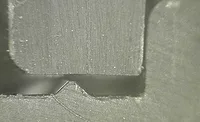
An energy director is a feature molded into the bottom of the top part. The energy director is triangular in section, with the point of the triangle providing the initial contact between the two parts. The energy director concentrates the vibrational energy in a small contact area.

A shear joint provides strength and may be used to create a hermetic seal. The parts are designed to interfere initially in a small area. As ultrasonic vibrations are applied and the horn presses down on the parts, the top part melts its way into the bottom part. Many joint geometries are possible, but all use some way of providing a small initial contact area for the weld.

Beyond the Basics

Once you understand the fundamentals of joint design for ultrasonic welding, you can design joints that have features and functions other than just joining the two parts together.

For example, we recently designed an implantable, pressurized medical device that requires several ultrasonic welds for its manufacture. The final weld joins the cover of the device housing to the base. These two large circular parts, approximately 70 millimeters in diameter, telescope together as they are welded. In addition to providing structural integrity, the joint encompasses other functions and features.

For example, the joint includes features to control the weld and assembly geometry. Alignment is critical for a quality joint. Various features can be molded into the parts to align and locate them with respect to each other. The ultrasonic tool nest and horn can also be designed with features to ensure correct alignment during welding.

For example, a chamfer along the ID of the base part will push the upper piece inward as the weld progresses. Such a chamfer centers the two concentric enclosure pieces of our pressurized device. Alternatively, a slip fit could be designed between adjacent surfaces. This would prevent the top part from sliding away from the base part during welding.

To maintain a consistent height of the assembly, a stop can be molded into the base part. This is simply a shelf that prevents the top part from moving downward any further than necessary.

Engineers can also design joint features to contain flash and particles generated during welding. Flash or loose particles in a sensitive area could cause a medical device to fail.

In our pressurized device, the joint is designed so any flash occurs on the exterior of the device, where it can be removed by normal cleaning processes. In addition, we molded a small recess into the ID of the top part. This provides a small rectangular open area, or “flash trap,” inside the joint that provides a place for excess molten plastic to go when the shear joint is welded.

Finally, engineers can design the joint with features to retain functional or cosmetic components. In our device example, when the joint is welded, it holds and compresses a four-sided O-ring to ensure a hermetic seal. Soft plastic suture feet around the periphery enable surgeons to suture the device in place.

Optimizing the Process

Developing an ultrasonically welded joint is not an exact science. Every part and every weld has its individual characteristics. Making the joint design and the welding process work together will require some iteration. First, determine what the joint needs to do and how you will measure its strength and functionality. You may want to perform pull and shear testing or pressurized leak testing, in addition to visual inspection of the weld.

After you have developed an initial joint geometry, make a set of prototype parts at the nominal dimensions and prepare, perhaps, two more sets with different fits (tighter or looser, for example), while keeping the other dimensions the same. One approach for a disk-shaped assembly of two parts that telescope together might be to use the same ID on the outer part and vary the OD on the inner part for a tighter or looser fit. Adjust the design and run further tests until you have a joint that welds well.

 When you have achieved a joint design and weld process that work together, you can look forward to consistently clean, fast welds in your medical device assembly process. 

KEYWORDS: joint design shear joint ultrasonic welding

Share This Story

Looking for a reprint of this article?
From high-res PDFs to custom plaques, order your copy today!

Charles Aubin, Director of Mechanical Engineering, Proven Process Medical Devices Inc., Mansfield, MA
Ben Piecuch, Senior Mechanical Engineer, Proven Process Medical Devices Inc., Mansfield, MA

Recommended Content

JOIN TODAY
To unlock your recommendations.

Already have an account? Sign In

  • Made in the U.S.A.

    Consumer Products Manufacturing: Made in the USA

    Supply chain lessons learned during the coronavirus...
    Automated Assembly Systems
    By: Austin Weber
  • Best Practices for Press-Fit Assembly

    Best Practices for Press-Fit Assembly

    In manufacturing, ironclad formulas for success are hard...
    Assembly Presses
    By: Jim Camillo
  • aem0523leader-tesla1.jpg

    Tesla Rethinks the Assembly Line

    Engineers at Tesla Inc. have developed a new process that...
    Automotive Assembly
    By: Austin Weber
Manage My Account
  • eMagazine Subscription
  • Assembly Newsletters
  • Online Registration
  • Subscription Customer Service
  • Manage My Preferences

More Videos

Sponsored Content

Sponsored Content is a special paid section where industry companies provide high quality, objective, non-commercial content around topics of interest to the ASSEMBLY audience. All Sponsored Content is supplied by the advertising company and any opinions expressed in this article are those of the author and not necessarily reflect the views of ASSEMBLY or its parent company, BNP Media. Interested in participating in our Sponsored Content section? Contact your local rep!

close
  • ultrasonic welding
    Sponsored bySonobond Ultrasonics

    Engineering Efficiency in High-Performance Assembly: How Ultrasonic Welding Enhances Throughput, Reliability and Quality

  • UV curing system
    Sponsored byDymax

    Why UV Intensity Alone Doesn’t Define Curing Performance

  • wooden pallets
    Sponsored byLEAN Manufacturing Products

    Eliminating Waste on the Shop Floor: Applying Lean Principles to Improve Manufacturing Efficiency

Popular Stories

ASSEMBLY News Now, episode-30: Volvo Redesigns EV Manufacturing

Volvo Redesigns EV Manufacturing

Boeing CEO Kelly Ortberg announces 1 billion investment

Boeing Plans $1 Billion Wichita Investment, Workforce Training Center

automated consumer goods assembly system

Best Practices for Cycle Time Optimization

Watch the latest episode of ANN now!

Events

July 24, 2025

From Shop Floor to CFO: How Manufacturers Are Closing the Loop Between Operations and Finance

On Demand Learn how manufacturers are bridging the gap between the shop floor and ERP systems to gain real-time visibility, streamline operations, and kick-start digital transformation—without waiting years.

Sponsored by:

PicoStratusGreen
July 30, 2025

Buffer Analysis and Design Fundamentals for Manufacturing Excellence

On Demand In this presentation, Dr. Herman Tang shares practical insights from his industry experience and research on buffer management in manufacturing operations.

View All Submit An Event

Poll

Difficult Assembly Processes

Which assembly process gives you the most difficulty?
View Results Poll Archive

Products

Manufacturing Cost Policy Deployment (MCPD) Profitability Scenarios: Systematic and Systemic Improvement of Manufacturing Costs

Manufacturing Cost Policy Deployment (MCPD) Profitability Scenarios: Systematic and Systemic Improvement of Manufacturing Costs

See More Products
Register for webinar - Modernizing Automotive Assembly: Why Upgrading Legacy MES is a Business Imperative

Related Articles

  • Joint Design for Ultrasonic Welding

    Joint Design for Ultrasonic Welding

    See More
  • branson-weld-bond

    Adhesive Bonding vs. Ultrasonic Welding for Assembly of Medical Devices

    See More
  • branson ultrasonics dcx digital power supply

    Part Design for Ultrasonic Welding

    See More

Related Products

See More Products
  • Joining and Assembly of Medical Materials and Devices, 1st Edition

  • Product Design for Manufacture and Assembly, Third Edition

  • design for.jpg

    Design for Six Sigma: A Practical Approach through Innovation

See More Products

Related Directories

  • Herrmann Ultrasonics Inc.

    Herrmann Ultrasonics is a leading global company in providing ultrasonic welding solutions with five decades of expertise. With our 360° ULTRASONIC ENGINEERING, we offer customer specific support from concept, to high volume manufacturing, to after sales support. We become our customer's trusted advisor and solutions provider for their ultrasonic welding projects. As part of our global network, we have ultrasonic laboratories located in 20 countries, providing local support.
  • Rinco Ultrasonics USA Inc.

    RINCO ULTRASONICS, established in 1976, is a Swiss manufacturer of the world's finest ultrasonic welding and cutting equipment. Specializing in Medical device assembly, Rinco is ISO14385 certified. Rinco's servo driven ultrasonic welder is the fastest, most precise and most user-friendly system available. Contact a Rinco expert for a consultation.
×

Never miss the latest news and trends driving the manufacturing industry

Stay in the know on the latest assembly trends.

JOIN TODAY!
  • RESOURCES
    • Advertise
    • Contact Us
    • Directories
    • Manufacturing Division
    • Store
    • Want More?
  • SIGN UP TODAY
    • Create Account
    • eMagazine
    • Newsletters
    • Customer Service
    • Manage Preferences
  • SERVICES
    • Marketing Services
    • Reprints
    • Market Research
    • List Rental
    • Survey/Respondent Access
  • STAY CONNECTED
    • LinkedIn
    • Facebook
    • Instagram
    • YouTube
    • X (Twitter)
  • PRIVACY
    • PRIVACY POLICY
    • TERMS & CONDITIONS
    • DO NOT SELL MY PERSONAL INFORMATION
    • PRIVACY REQUEST
    • ACCESSIBILITY

Copyright ©2026. All Rights Reserved BNP Media, Inc. and BNP Media II, LLC.

Design, CMS, Hosting & Web Development :: ePublishing