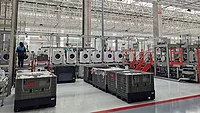
Presses And Appliance Assembly
If you’ve shopped for a home appliance recently, you know they come with a bewildering array of features and price points. Even a device as seemingly simple as a gas stove can have a price tag in the hundreds or the thousands.
But, whether the appliance is basic model or high-end one, a countertop device or a refrigerator, chances are good that a pneumatic, hydropneumatic or electric press was used to assemble some of its components. Applications for presses in appliance manufacturing include hinge assembly, bearing insertion, gearbox assembly, and sheet-metal joining.
“We’ve done more rails, racks and latches than I can count,” says Charles A. Rupprecht, executive vice president of Baltec Corp., a manufacturer of assembly presses and radial and orbital forming machines.
Most recently, Baltec supplied radial forming machines to attach the plastic wheels on a dishwasher rack. The wheel is slipped over a stainless steel axle, and the machine forms a head on end of the axle to secure the wheel.
“It sounds like a mundane process, but we had to employ our HPP-25 process controller for the project because the customer was very particular about how much free play the wheel should have,” recalls Rupprecht.
If the assembly is too tight, the wheel won’t move freely. If the assembly is too loose, the wheel will wobble, creating an impression of poor quality. The HPP-25 ensures that the wheel assembly is just right every time.
A unique feature of the controller is exact rivet recognition. This function recognizes the start of the rivet without the need to reduce pressure or speed during riveting—prior sensing is not necessary. The controller measures six process parameters: forming distance, riveting time, riveting force, spindle distance, external contact and rivet head height. The controller displays riveting data as curves, and data can be exported and imported via USB and Ethernet interfaces.
Looking for quick answers on assembly and manufacturing topics? Try Ask ASM, our new smart AI search tool. Ask ASM
Baltec has supplied riveters for other dishwasher components, too, such as an arm that adjusts the height of the top rack; the lever that locks and unlocks the door; and a telescopic track assembly. In the latter application, the forming machine heads three small-diameter tubular rivets inside a channel.
“The riveting process for all those applications is pretty basic, but the key thing is repeatability,” says Rupprecht. “Even though you’re making thousands of parts, they all have to move the same way.
“You get that by honing in on the process [and] making sure that you’re riveting to a specific force and stroke. That’s where process monitoring comes into play.”
Bearings and Gearboxes
Whether large or small, almost every appliance has an electric motor. (Some, like my vacuum cleaner, have two!) Presses are used to install bushings, bearings, armatures and other components.
Many appliances, such as washing machines, have gearboxes to provide various speed and torque options. Assembling the various gears onto shafts is a job for presses.
Troy Waldherr, North American sales manager for Tox Pressotechnik LLC, recalls helping an appliance manufacturer do just that. The manufacturer needed to press gears onto a shaft. To save on machining costs, there were no stops on the shaft, so the gears would have to be pressed to an absolute position. An electromechanical servo press with a planetary roller screw solved the problem.
With roller screws, the application load is transmitted from the nut to the screw shaft through the barrel-shaped surfaces of multiple threaded rollers. The total contact area between the shaft, the rollers and the nut is substantially larger compared with that of a ballscrew, resulting in larger load-carrying capacity, higher precision and rigidity, and increased service life.
Tox’s standard servo press, the EPMS, comes in six models, with capacities ranging from 5 to 200 kilonewtons. Stroke length ranges from 200 to 300 millimeters, and resolution ranges from 0.0003 to 0.0012 millimeter.
A load cell and encoder provide force and distance feedback, ensuring an accurate and repeatable pressing operation. “The press can be programmed to stop within so many microns of the desired position,” says Waldherr.
Once a gearbox is assembled, the work doesn’t stop there. Engineers will want to confirm that it performs as expected. That’s where a device like the TorquePRO motorized torque assembly and test system from Promess Inc. comes into play.
The device has the ability to both control and monitor torque and angle in real time through a closed-loop feedback system. The standard unit handles applications up to 200 newton-meters. Built-in mechanical overload protection makes it virtually impossible to damage the torque transducer through unexpected torque spikes.
“We have used the TorquePRO to drive washing machine gearboxes to verify that they have been assembled correctly,” says Glenn Nausely, president of Promess.
The device can test a gearbox in several ways. In one test, the device can spin the input shaft while the output shaft is not connected to anything. As it’s turning the input shaft, it’s measuring the torque.
“This test basically tells you how much drag you have inside the gearbox,” explains Nausley. “A perfectly assembled gearbox should have a minimal amount of internal drag. If something is too tight, if something is binding, our device will detect that. It’s also possible that the torque could be too light, which means the box is too loose.”
Next, the test can be repeated with a known drag on the output shaft. “If you put 1 newton-meter of resistance on the output shaft, and you measure 1.2 newton-meters of torque on the input shaft, you know you’re getting 20 percent loss within the gearbox, depending on the gear ratio,” says Nausley.
Lastly, the device can measure how much lash exists in both the positive and negative directions. “One of the problems with gear lash is noise,” Nausley explains. “If the box has too much lash, it tends to be loud. If there’s not enough lash, it tends to be inefficient.”
The TorquePRO can also be coupled with an electromechanical press to test a hinge for, say, an oven door, while it is being assembled. “We form the head to a minimal level, then we exercise the hinge and measure the torque,” says Nausley. “If it’s loose, we’ll form the head a little further and repeat the test. It’s an iterative process. We keep going until the hinge operates with the right amount of torque.”
Clinching Sheet Metal
Clinching is widely used in appliance assembly. Clinching produces a round, button-type connection between two to four layers of sheet metal. The process can join metal sheets of different thicknesses or materials. The process can even be used on stainless steel. Access to both sides of the assembly is required.
“Clinching has been used on washers, dryers, dishwashers, ranges, refrigerators, microwaves—pretty much anything that has a sheet metal enclosure,” says Waldherr.
Tox recently supplied a semiautomatic clinching system to assemble the stainless steel frame for a washing machine tub. The system simultaneously clinches five points on one side of the frame. Then, an operator rotates the frame 180 degrees, and the clinching process repeats on the other side. Spot welding was not possible because it might cause the stainless steel to rust.
The tools for clinching consist of a punch and a die. There are two types of dies: solid, fixed-cavity dies, and dies with moving components. The punch forces the layers of sheet metal into the die cavity. The pressure exerted by the press forces the punch-side metal to spread outwards within the die-side metal. Joints can range from 1.5 to 26 millimeters in diameter.
The minimum thickness for any one sheet in the assembly is 0.1 millimeter, and the entire stack can be up to 12 millimeters thick.
“The most important thing with clinching is to provide enough area to land the tooling,” says Waldherr. “We typically need an area about 14 millimeters in diameter. With lighter materials, we can sometimes get down to 10 millimeters.”
Clinching requires no fasteners. Therefore, the cost of fasteners and equipment to feed them is eliminated.
Compared with spot welding, clinching offers several advantages. For one, clinching will not damage anticorrosive coatings on the metal. Spot welding can destroy these coatings. Also, clinching requires none of the peripheral devices needed for spot welding, such as high-current electrical systems and ventilation equipment.
“Spot welds are stronger than a clinched joint. However, over time, the weld degrades under vibration,” says Waldherr. “A clinched joint does not degrade because there’s no crystalline region around the joint, like you get with spot welding.”
Looking for a reprint of this article?
From high-res PDFs to custom plaques, order your copy today!