Metal Stitching Joins Dissimilar Materials
Metal stitching can create strong joints in a variety of materials quickly and cost-effectively.
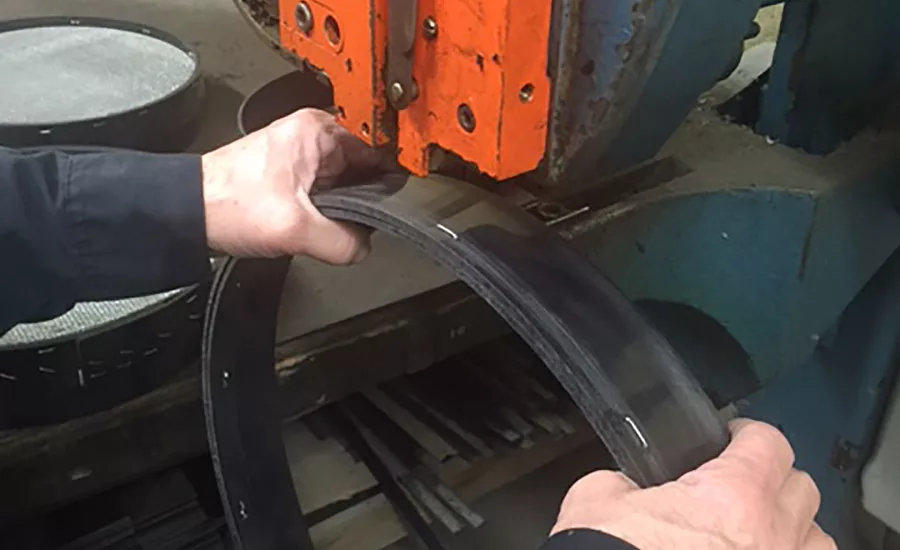
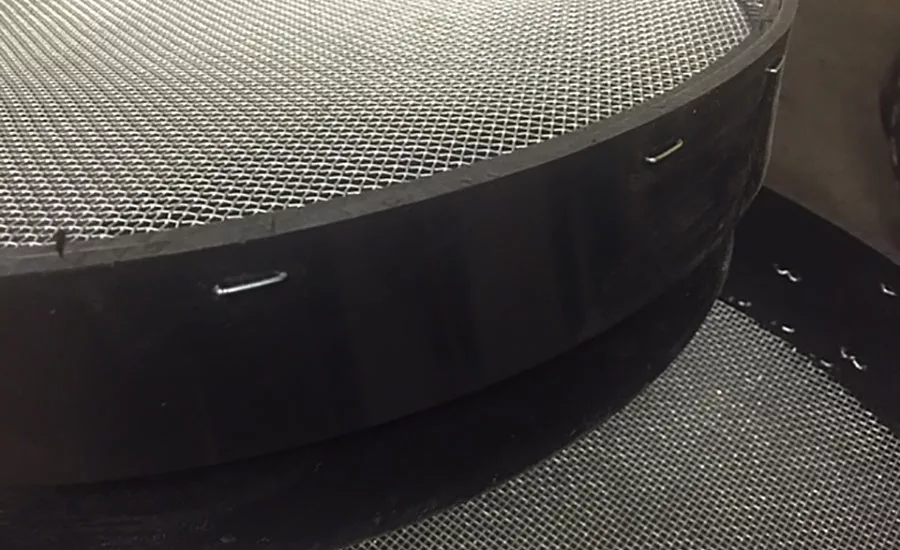
Staples secure the wire mesh of this sieve to a plastic ring. Photo courtesy Deluxe Stitcher Co.
Wire stitching for book binding has been an industry standard since Thomas Briggs invented the wire stitcher in 1896. Over the years, manufacturers began adapting the process to other industrial applications. While the basic principles of stitching remained the same, the technology and materials changed drastically. Stitching was done with wire rather than thread, and the process was used to join materials like plastic and metal, rather than paper. Today, stitching is used in a variety of assembly applications to create strong joints quickly and cost-effectively.
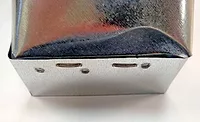
Metal stitching is the same process as paper stitching or stapling, but with equipment and wire sufficiently strong to penetrate metal and other materials. The difference between “stitching” and “stapling” is only that stitching uses wire from a coil, while stapling uses premade staples. The net result of either process is a staple.
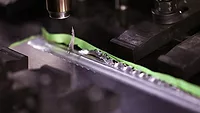
A metal stitcher produces a staple by measuring out a length of wire, cutting it off, forming it into a staple, and driving it into the work, thereby fastening the materials together. The total cycle time is approximately 0.2 second. There is no need to prepare the material in any way. The staple creates the perforation, clinching itself (against the machine’s anvil) on the back of the work.
The metal stitcher mechanism has four main components. First, drive gears pull a predetermined length of wire to produce the staple. Staple size can be varied significantly based on the thickness of the materials to be joined. Next, a set of formers fold the straight wire into a staple. A driver then presses the newly formed staple into the work being fastened. Lastly, an anvil (under the staple) clinches the wire into the commonly recognized staple shape. This process is not much different than a desktop stapler. The main difference is the strength and speed of the machine and the wire.
Advantages and Disadvantages
Many joining processes, such as welding, clinching, riveting and adhesive bonding, are very much material-dependent. For example, welded components typically must be the same material. It’s difficult (if not impossible) to weld aluminum and steel.
In contrast, metal stitching can fasten any material that can be penetrated by the wire. Materials such as plastic, rubber, carpet, fabric, aluminum, titanium, steel, stainless steel, brass, bronze and wood all work very well with metal stitching. In the automotive industry, for example, the process is commonly used to fasten rubber seals to doors or fabric to interior door panels.
The process is simple, quick and durable. Unlike screws and other mechanical fasteners that can loosen over time, staples are plastically deformed steel. The internal stress created by the forming process keeps the staple tight against the materials that have been stapled.
Looking for quick answers on assembly and manufacturing topics? Try Ask ASM, our new smart AI search tool. Ask ASM
Stitching offers numerous advantages:
It is highly effective for joining dissimilar materials. There is virtually no limitation on the materials that can be stitched.
It is versatile. Any material can be penetrated without fracturing.
It is fast. A machine can produce 80 to 100 stitches per minute.
It creates strong assemblies. Joints have high fatigue strength and high resistance to vibration. The shear and tensile strength of a stapled joint are approximately one-third those of a 0.125-inch-diameter rivet.
Setup is quick and easy. Operators can be quickly trained on the process. There’s no need for highly skilled labor.
Tooling costs are much less than riveting.
Stapling machines are simple to maintain.
There’s no need to clean the materials prior to assembly.
Stitching has some disadvantages, too:
Compared with welding, brazing, bolting and riveting, wire stitching is not as strong overall. Wire stitching depends on the strength of the substrate being stitched.
There is a limit to the total thickness of material that can be stitched.
Stitching Materials and Costs
Metal stitchers can form wire diameters ranging from 0.034 to 0.054 inch, with tensile strengths from 150 to 290 kilo-pounds per square inch (kpsi). Wire selection depends on the materials to be fastened. For harder materials, manufacturers should choose wire with a higher tensile strength and larger diameter.
Metal stitchers can use any diameter wire with a quick change of drivers and formers. For applications where corrosion resistance is critical, metal stitchers can use stainless steel wire. In theory, metal stitchers can use any wire that did not exceed a tensile strength of 290 kpsi and a diameter of 0.054 inch.
The cost of a metal stitcher can vary, depending on the specific application. Base models start at less than $10,000. Wire costs run approximately $5 per pound, or $0.20 for 100 staples. This cost is extremely competitive compared with rivets and screws.
Applications
For the process to work, the area to be stitched must be accessible from the side and the bottom to allow the stitcher to apply the staple (just like a desktop stapler). For unusual substrates, custom arms can be constructed to allow clinching to be performed. With customization, a wide range of applications are possible with metal stitchers.
Wire stitching lends itself well to automation. A metal stitching machine can be reduced to the stitching head, clutch and motor to create a device that can easily be mounted to the end of a robot or other moving arm. This allows stitching to occur wherever the material is located. With a simple 110-volt signal, the stitcher can be cycled once at each fastening position.
It’s also possible to position multiple stitching heads at strategic stationary locations and move the material past the heads, stopping just long enough to allow a staple to be inserted.
Stitching is used in myriad industries. For example, PrivacyLink in Smithfield, UT, manufactures fencing in a variety of materials and configurations. One of the company’s products is a chain-link fence interwoven with privacy slats made from an opaque high-density polyethylene. To prevent the slats from moving after installation, the company places seven to nine stitches in each slat.
The entire fence-manufacturing process is automated. A specialized wire-weaving machine (from Bergandi Machinery in Ontario, CA) creates the chain link and inserts the slats. A stitching machine then secures the slats.
Porvene Doors in Moreno Valley, CA, manufactures commercial roll-up doors. Each door has an inner liner of fabric, which helps to reduce the noise from rolling the door up and down. The fabric is attached to the metal slats using a metal stitcher. This permanent bond keeps the strip in place for years and makes the product durable and reliable.
Another company that uses metal stitching equipment produces low-cost sieves for material separation. Each sieve consists of a round exterior made of rubber or plastic, with a wire mesh in the middle. A stich is used to attach the wire to the rim. The entire assembly process can be completed in a minute.
Looking for a reprint of this article?
From high-res PDFs to custom plaques, order your copy today!