Adhesives for Speaker Assembly
Light-curing adhesives can help speaker manufacturers increase efficiency.
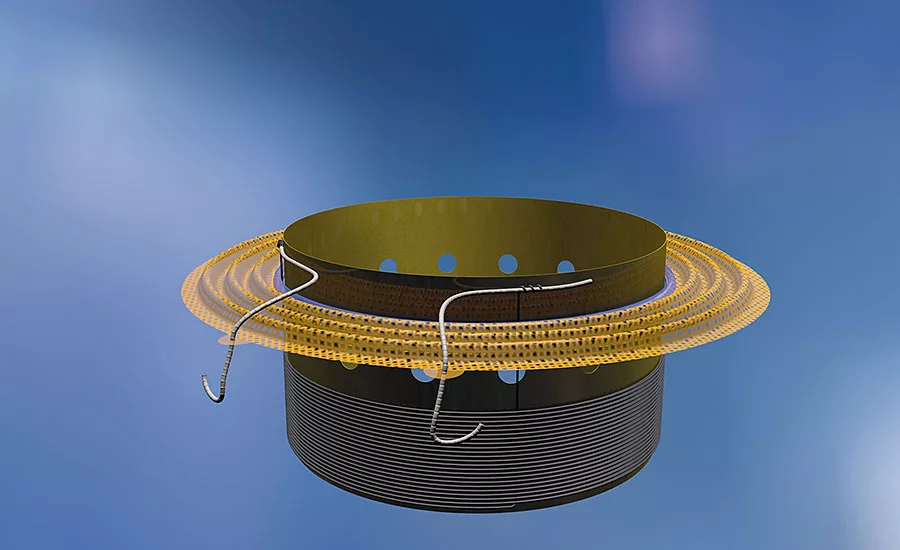
Adhesive bonds the spider to the voice coil, also known as the bobbin, which is usually made of paper or a polyimide-coated fabric with wires wrapped around it. Illustration courtesy DELO Industrial Adhesives
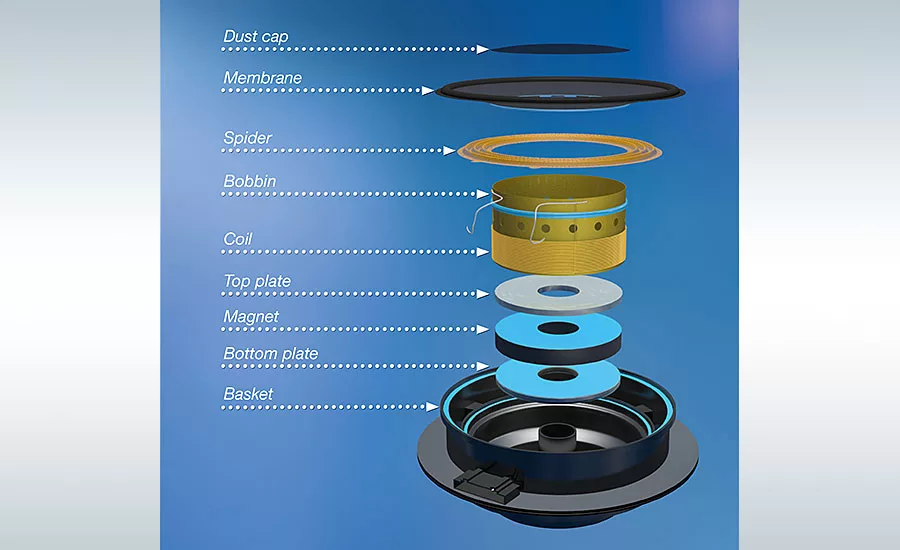
A typical loudspeaker is bonded in at least seven places. Illustration courtesy DELO Industrial Adhesives
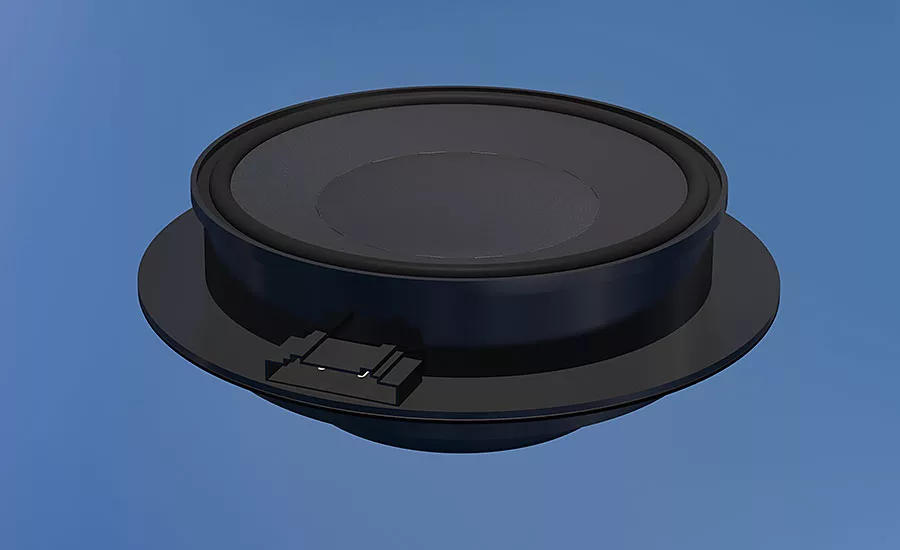
A typical loudspeaker is bonded in at least seven places. Illustration courtesy DELO Industrial Adhesives
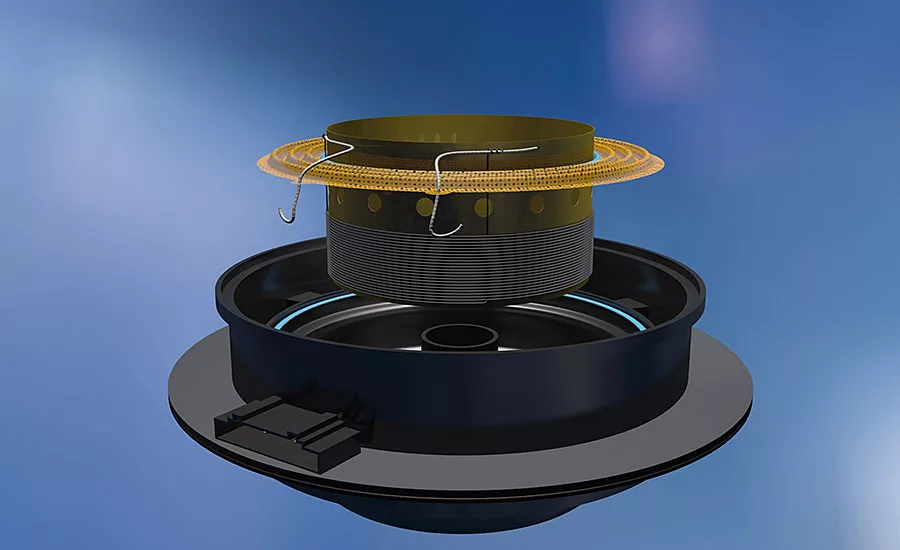
One-component polyurethanes are often used to bond the spider to a basket. However, because these adhesives cure so slowly, manufacturers must maintain large quantities of work in process. Illustration courtesy DELO Industrial Adhesives
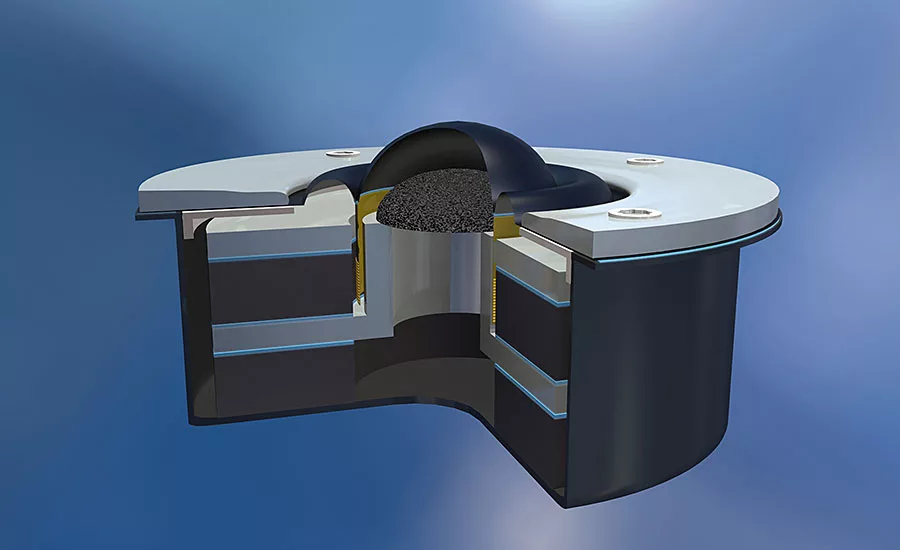
The pole piece (top) and yoke (bottom) are bonded to a magnet. Two-part methyl methacrylate adhesive is often used for this application. Illustration courtesy DELO Industrial Adhesives
The loudspeaker market is booming. In addition to designing to an outstanding product, efficient production is crucial for a speaker manufacturer to stay ahead of its competitors. Adhesives play an important role in this, but the potential they offer for increasing productivity has yet to be fully realized.
Superlative sound is something we have come to expect in recent years. Apart from the home entertainment market for conventional speakers, Bluetooth speakers and surround sound systems, there are two other important market segments: a smaller one, which includes speakers used in planes, and a significantly larger one that covers automotive loudspeakers.
In 2000, cars contained, on average, four loudspeakers and two tweeters. Today, cars are equipped with nearly 20 speakers. Besides the stereo system, speakers are now linked to a vehicle’s parking sensors, telecommunications system and navigation system. There are even speakers for the power train and exhaust systems. Given that more than 75 million cars are produced annually worldwide, the automotive speaker market is both highly competitive and lucrative.
Manufacturers tend to distinguish themselves through technical innovations, like a better sound experience, a more attractive design and a longer service life. The wide range of material combinations, along with stringent requirements for various components, underlies the importance of adhesives to speaker manufacturing. In fact, a typical loudspeaker is bonded in at least seven places. Using the right adhesive helps manufacturers create a high-quality and reliable product.
Adhesive Requirements
While high strength, full transparency, electrical conductivity or good sealing performance are usually among the most important properties of adhesives, it is the sound that counts when it comes to loudspeakers. Their quality of sound can be improved by adjusting the flexibility of adhesives in a way to provide optimal vibration damping, especially for the speaker’s movable parts. Both flexibility and strength are needed to protect speakers from damage caused by impact, shock or strong vibrations.
It is also important that the adhesive’s properties do not degrade during aging, although requirements vary depending on the industrial sector they are being used in. The highest demands are placed on products used in the automobile industry, since components in cars need to withstand variations in temperature, vibrations and humidity. For example, speakers installed in car doors are frequently exposed to slight moisture that comes from rain leaking in from the window.
This article will examine the most common bonding areas for speaker assembly and recommend adhesives for each application.
Looking for quick answers on assembly and manufacturing topics? Try Ask ASM, our new smart AI search tool. Ask ASM
Spider to Voice Coil
This bond connects the spider to the voice coil, also known as the bobbin, which is usually made of paper or a polyimide-coated fabric with wires wrapped around it. The spider is responsible for keeping the voice coil moving up and down in the center of the magnetic gap, causing the membrane to vibrate and create sound waves.
While cyanoacrylates are still widely used for this application, speaker manufacturers could significantly increase production efficiency by using UV- and light-curing acrylates. These adhesives cure in just a few seconds when exposed to high-energy light.
In the case of the spider, the highly absorbent polycotton material makes this process more difficult, but by using high-intensity spot lamps, intense light can penetrate through the fabric, allowing the adhesive to achieve its final strength within 10 seconds. In addition, specially developed acrylates provide thermal stability up to 150 C. Such temperatures arise from energizing the voice coil and are too great an obstacle for many standard adhesives and cyanoacrylates to overcome.
Spider to Basket
This application also holds potential for efficiency improvement. Some manufacturers use one-component polyurethanes, which cross-link slowly by reacting with ambient humidity. This forces manufacturers to maintain large quantities of work in process. Light-curing acrylates can be integrated into the process, with cycle times of up to 10 seconds.
Since the spider is deflected and bent upward, a high peel resistance is advantageous for the adhesive. Suitable products should reach values of more than 20 newtons per centimeter. As with light-curing acrylates, the adhesive can be colored to match the application requirements.
For quality control, a fluorescent additive can be mixed into the adhesive to facilitate automated inspection by a vision system. Occurring directly after dispensing, such an inspection can automatically determine if the right amount of adhesive was applied in the right locations or pattern.
Membrane to Voice Coil
Connecting the membrane to the voice coil is yet another application that can benefit from light-curing adhesives, depending on the order of the process steps. A high peel resistance is important for vibration compensation when sound is created. Depending on the adhesive, maximum cycle times of 8 seconds are possible.
This bonding area, which is vital for acoustic performance, is particularly demanding. The viscosity and flow properties of the adhesive will ensure optimal wetting and act like a mechanical fastener.
Bonding the Magnet
To achieve impact resistance and fast curing, adhesives for bonding speaker magnets need to meet certain criteria. Light-curing adhesives are not suitable, since light cannot be transmitted through metal.
Two-component methyl methacrylates in no-mix systems are mainly used in this application. In this process, an activator is applied to one component, while the resin is applied to the other one. The adhesive begins to cross-link when they are joined.
After 5 minutes, the adhesive reaches handling strength so the components can be transferred to the next stage in the assembly process. Methyl methacrylates achieve good values in drop tests and other reliability tests. However, these adhesives must be stored at a temperature of 40 C and a humidity of 93 percent.
To accelerate the assembly process, manufacturers may also consider anaerobic adhesives that can be pre-fixed by light. This would only require a slightly thicker fillet, where the adhesive would cure within seconds to such an extent that processing can be continued. Final strength would then be reached after 24 hours under exclusion of oxygen.
Less Challenging Applications
Loudspeaker bonding also includes applications that are less challenging or leave little room for enhancing productivity. This includes the membrane-to-basket connection. Cyanoacrylate adhesives provide sufficient strength for this type of bonding and cure within 8 to 15 seconds at room temperature with a relative humidity of 40 to 80 percent. Given the larger quantities of adhesive and larger needle diameters, the risk of clogging is reduced compared to more miniaturized applications.
Loudspeakers are manufactured in an established and elaborate production process. However, optimization is still possible, especially by using UV acrylates. The properties of these adhesives can be adjusted to meet acoustic requirements, and the addition of fluorescence can facilitate inline inspection for quality control. With light-curing adhesives, manufacturers can significantly increase production efficiency and provide a competitive advantage.
Looking for a reprint of this article?
From high-res PDFs to custom plaques, order your copy today!