Hot-Melt Adhesives for Electronics Assembly
A new generation of hot-melts is being used to assemble smartphones, tablet computers and other electronic devices.
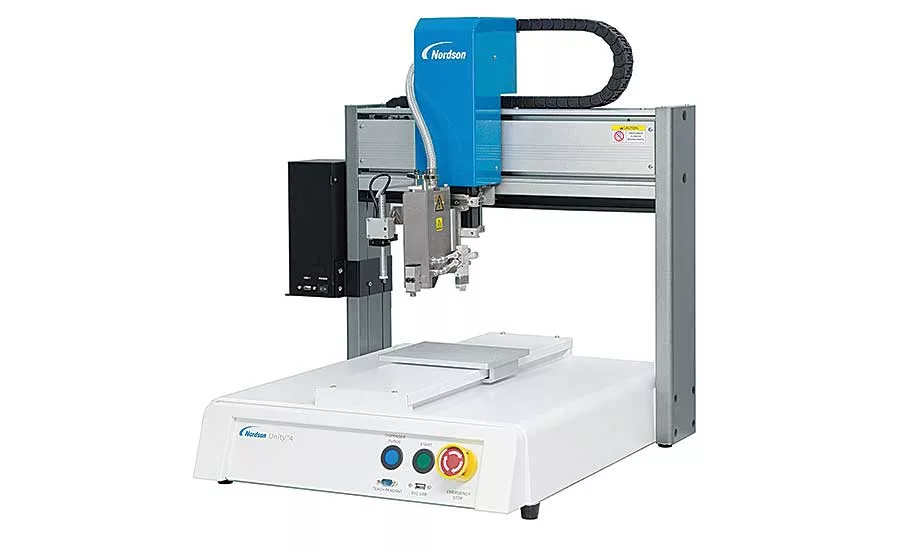
Hot-melts can be applied with a traditional contact dispensing process or with a jetting valve. Either way, the equipment should be designed specifically for dispensing hot-melts. Photo courtesy Nordson Corp.
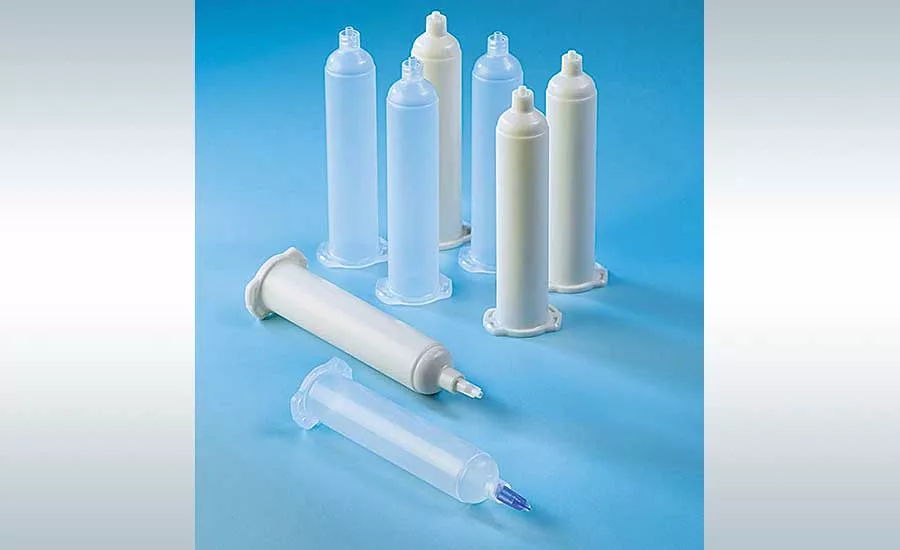
HiTemp disposable syringe barrels come in two models. The standard barrel withstands 125 C for eight hours at up to 87 psi. The Extreme barrel withstands 180 C for eight hours at up to 100 psi. Photo courtesy Nordson EFD
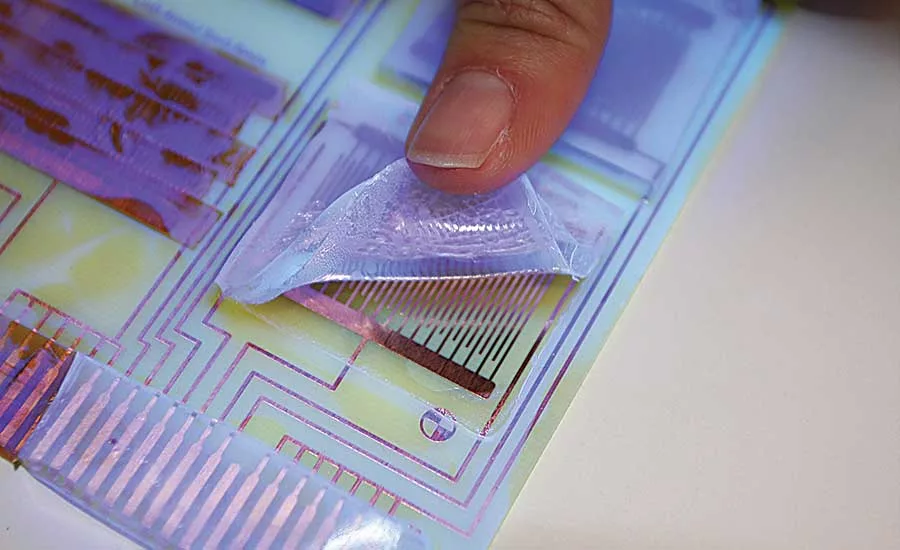
Technomelt AS 8998 is a hot-melt masking material that peels off quickly and cleanly after conformal coating. Photo courtesy Henkel Corp.
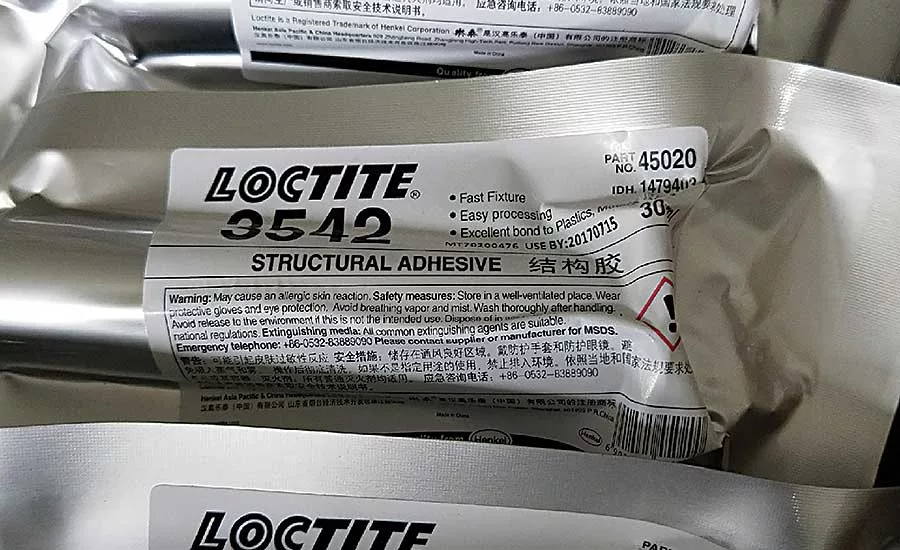
Loctite 3542 is a toughened, one-component PUR hot-melt adhesive with low halogen content for structural bonding of handheld electronic devices. Photo courtesy Henkel Corp.
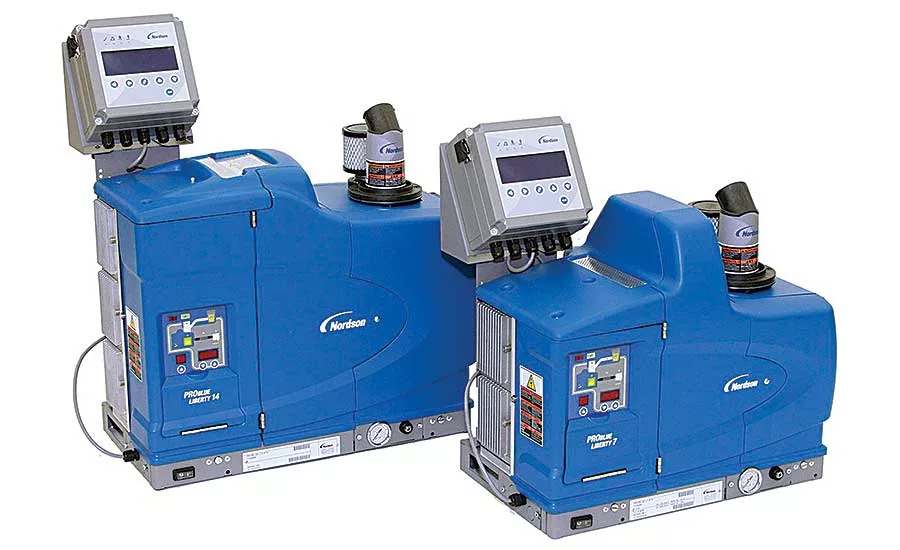
The ProBlue Liberty is a tankless melter and fill system for hot-melt adhesives. The integrated storage container is available in single-feed or multi-feed configurations. Photo courtesy Nordson Corp.
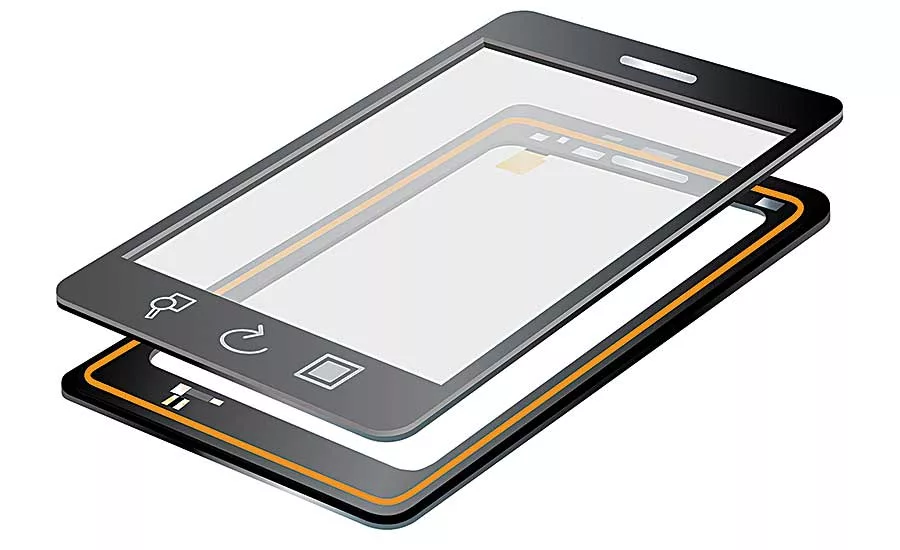
In the past, double-sided tapes were used to bond a display to into the case of a smartphone. However, today’s infinity-edge designs mean less real-estate to which tapes can adhere. Photo courtesy Dow Corning Corp.
Hot-melt adhesives are used in a wide range of applications. They seal cardboard cartons; bond veneer to plywood; attach appliqué to fabric; and secure carpeting in automotive interiors.
Until recently, however, consumer electronics was one of the last applications associated with hot-melt adhesives. Now, a new generation of hot-melts is being used in the assembly of smartphones, tablet computers, wearable electronics, wireless speakers and other mobile electronic devices.
“There are quite a few applications for hot-melt adhesives in electronics assembly,” says Terry Dunbar, global key account manager at Nordson Corp.
Hot-melts are solvent-free adhesives that are solid at temperatures below 80 C. Above that temperature, they are low-viscosity liquids that rapidly set upon cooling. While some liquid adhesives can take eight to 24 hours to set, hot-melts typically have hold times between one and five minutes. This lowers assembly time and decreases work-in-process inventory.
Hot-melt adhesives have numerous advantages for assembling consumer electronics:
- Fast bond formation allows for high line speeds.
- A variety of dispensing methods gives engineers flexibility for part design.
- They bond both porous and nonporous surfaces.
- Good gap-filling capability allows for greater tolerances in part design.
- They have excellent moisture resistance.
- They have a long shelf life and do not need refrigeration or other environmental controls.
Several hot-melt chemistries are available. Silicone reactive hot-melts, polyurethane reactive (PUR) hot-melts, and polyolefin hot-melts are increasingly taking the place of tapes and other adhesives for assembling displays, cases, covers and batteries.
Silicone Hot-Melts
Dow Corning Corp. has introduced EA-45XX and EA-4600 silicone hot-melt adhesives for electronics assembly. These reactive, moisture-cure adhesives are applied as a hot liquid that cools at room temperature to quickly form strong, but flexible, viscoelastic bonds to plastic and metal substrates that are commonly used in smart devices.
The recommended application temperature is 120 to 140 C. The adhesives can be dispensed using standard hot melt dispensers, including jet valves. The materials can be dispensed in beads as thin as 0.5 millimeter.
Looking for quick answers on assembly and manufacturing topics? Try Ask ASM, our new smart AI search tool. Ask ASM
They achieve instant green strength when dispensed, allowing handling and assembly operations to proceed before full cure. When exposed to high temperatures, the materials soften to allow reworking of the parts, but they regain their typical properties after cooling.
After cure, the adhesives provide long-lasting protection against
chemicals, moisture, dust and other environmental contaminants. Additionally, due to silicone’s natural flexibility, these adhesives can absorb impact energy to enhance the shock and impact resistance of the device.
The adhesives are low in odor and have less than 15 grams per liter of volatile organic compounds. They do not contain skin-sensitizing monomeric di-isocyanates.
PUR Hot-Melts
Henkel Corp. offers a number of PUR hot-melts for electronics assembly. For example, Loctite 3542 is a toughened, one-component PUR hot-melt adhesive with low halogen content for structural bonding of handheld electronic devices. It is well-suited for bonding metal, ink-coated glass and plastics where shock and impact resistance are required. The product is applied warm and cools to provide initial tack. Over time, it reacts with moisture to cross-link to a thermoset polymer with excellent toughness and durability. The fully cured product does not remelt.
The adhesive is applied at a temperature of 90 to 110 C. Formulated for robotic dispensing, the material has a relatively long open time: At 25 C, a 1-millimeter bead will have an open time of four minutes.
PUR hot-melts are widely used in electronics assembly for applications such as bonding the display into the phone case. In the past, double-sided tapes were used. However, new infinity-edge designs provide less real-estate to which tapes can bond.
“We’re talking widths of 0.4 to 0.5 millimeter. That’s not a lot of room for a double-sided tape,” Dunbar points out. “Even if you were able to get a thin piece of tape in there, it just doesn’t have the necessary bond strength. The assembly will fail the drop test and the thermal cycling test.
“Additionally, electronics manufacturers are trying make their mobile devices more waterproof. Really thin tape doesn’t have a lot of compliance or prevent water ingress. A thicker bead of hot-melt material will provide some gap-fill capability and help to waterproof the assembly.”
Flexible lithium-ion batteries are another application for PUR hot-melts. “In the past, the edges of these batteries would be folded up and sealed with a single-sided Kapton tape,” says Dunbar. “Now, battery manufacturers are using a bead of PUR.”
PUR hot-melts are also replacing double-sided tape for holding the battery in place inside a mobile device. “With Nordson slot-coating technology, we can dispense a strip of hot-melt 8 millimeters wide and about 100 microns thick,” explains Dunbar. “It’s the same physical geometry as a piece of tape, but it’s applied using an X-Y table and a dispense valve, which will provide substantial savings in labor and material.”
Other applications for PUR hot-melts include compact camera modules, wireless speakers, headphones and wearable electronics.
Hot-Melt Masking Agent
Not all hot-melts are adhesives. Henkel recently introduced a hot-melt masking material, Technomelt AS 8998, to protect electronic components prior to conformal coating or chemical deposition processes.
“Technomelt AS 8998 is compatible with common automated dispensing systems to allow for quick, precise deposition in very small areas, ensuring accurate coverage only where needed with no material migration,” explains Art Ackerman, global product manager for circuit board protection at Henkel. “This is a tremendous improvement over manual taping methods that are labor-intensive with limited accuracy, particularly with miniaturized parts.”
Technomelt AS 8998 is a silicone-free, halogen-free, RoHS-compliant material that has excellent green strength immediately after dispensing and solidifies upon cooling. Compatible with numerous substrates, this slump-resistant hot-melt provides good adhesion during various coating processes. After coating, the material peels off quickly and cleanly, leaving defined edges and no residue.
Technomelt AS 8998 is compatible with thermal processes up to 100 C,
which aligns with most coating applications. Subsequent formulations with higher temperature resistance are in development.
Dispensing Hot-Melts
Hot-melt adhesives are typically supplied in 30-milliliter syringes, although 300-milliliter syringes are also available. Syringes can be made of heat-resistant plastic or aluminum. The former have the advantage of being disposable, but the latter can take more heat.
Nordson EFD recently introduced Unity HiTemp plastic syringe barrels. These disposable 30-cc barrels are available in two models. The standard HiTemp syringe barrel withstands 125 C for eight hours at up to 87 psi. The Extreme HiTemp syringe barrel withstands 180 C for eight hours at up to 100 psi. Standard HiTemp barrels can be used with all hot-melt adhesives, including PURs and silyl-modified polymers. Extreme HiTemp barrels can be used with polyamides and other hot-melts. They also block ultraviolet light at wavelengths between 200 and 500 nanometers.
Three components are needed to dispense hot-melt adhesives: a melter, a valve, and, because of the precision and volume requirements for electronics assembly, a Cartesian robot.
The melter heats the adhesive to a temperature of 110 to 190 C, depending on the chemistry. PURs are at the lower end of the temperature range; polyolefins are at the higher end. Hot-melt silicones are somewhere in the middle.
“It’s really important to maintain a consistent temperature,” advises Dunbar. “You want to control the temperature to ±1 to 2 degrees. Nordson equipment can do that because it has sufficient thermal mass wrapped around the adhesive. You don’t want to constantly raise and lower the temperature, because that can reduce the life of the material. You also don’t want to
overheat these materials, which can lead to charring.”
Hot-melts can be applied with a traditional contact dispensing process or with a jetting valve. Either way, the equipment should be designed specifically for dispensing hot-melts. “You don’t want to simply add a heater to a standard dispensing system,” urges Dunbar.
Dispensing nozzles should be made of brass or copper to conduct heat. “Some applications may require a nozzle preheater,” adds Dunbar. “If the nozzle is long, it can act like a heat sink, so we’ll program the robot to park the nozzle in preheater—think of it like a heated garage—to heat up the nozzle prior to dispensing. Once the material starts flowing through the nozzle, it heats up pretty good, but if it’s just sitting parked, the nozzle can become cool.”
Another concern with hot-melts: They can string. To get around that problem, Nordson has integrated special motion routines into its robot programming software. At the end of a bead, the robot can be set to automatically track the nozzle forward or backward over the dispense path so when the string snaps, it simply falls back onto the existing bead.
Looking for a reprint of this article?
From high-res PDFs to custom plaques, order your copy today!