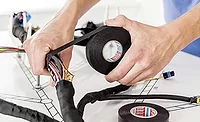
Options for Protecting Wire Harnesses
Wire harnesses need protection in harsh environments.
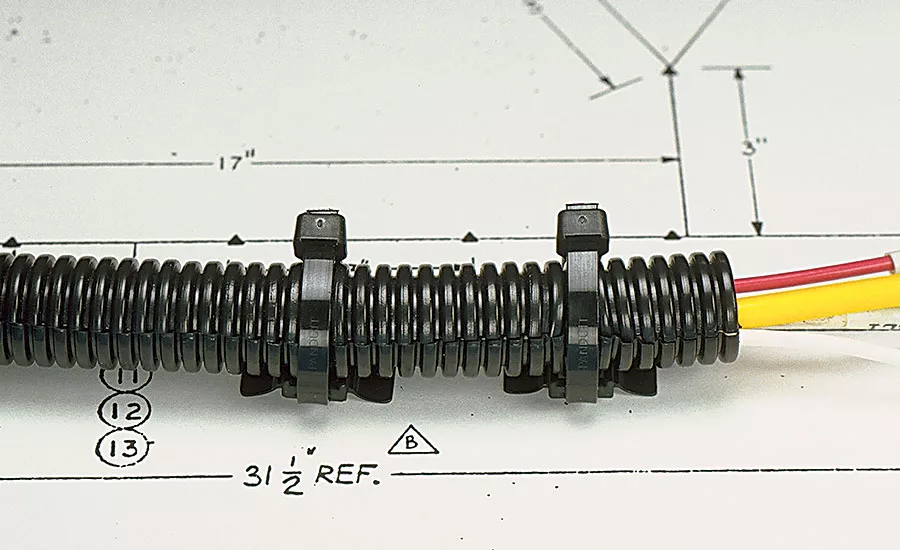
Cable and wire coverings provide an extra layer of insulation and protection from abrasion, chemicals, heat, moisture and vibration. Photo courtesy Panduit Corp.
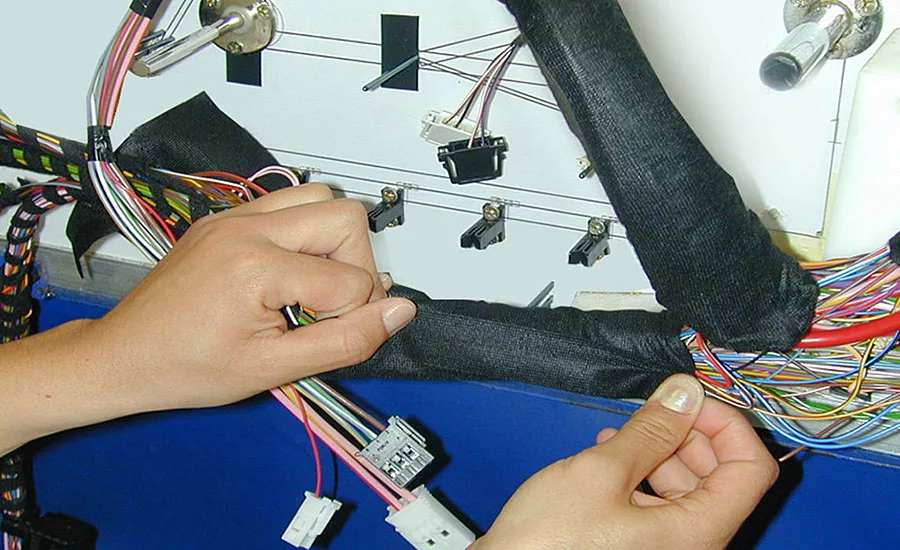
Partially coated sleeves are a popular alternative to adhesive tape. Photo courtesy Tesa Tape Inc.
This time of the year, many homeowners in the Midwest and Northeast start covering their barbecue grills, patio furniture, rosebushes and swimming pools. The type of cover they choose can make a big difference in how those objects survive cold winter temperatures and heavy snow.
Engineers face a similar decision when it comes to protecting wire bundles and cable assemblies. They have many options available, including cloth or vinyl tape, heat-shrink tubing, split loom and nylon braid. Which material to choose depends on the application, cost and performance requirements.
Wiring harnesses in many products, such as aircraft, cars, locomotives, ships, tractors, trucks and telecommunications gear, must withstand harsh operating environments and temperature extremes. Cable and wire coverings provide an extra layer of insulation and protection from abrasion, chemicals, electromagnetic interference, fluids, heat, moisture, moving parts, squeaks, rattles and vibration.
“The most important thing to do when selecting a covering is to understand the environment the wire harness will be operating in,” says James Brasch, product manager at Panduit Corp. “Abrasion products are not necessarily a one-size-fits-all solution. The wide variety of materials used in these products are designed to work in several different types of environments.”
In most industries, cable and wire coverings are selected by harness manufacturers, conforming to OEM specifications, to ensure reliable operation and safety. For instance, many European automakers prefer to wrap harnesses in fabric tape, while American automakers often specify corrugated loom or protective braids.
“The more a person can understand [about] the environment the harness is going into, the better choice they can make in choosing the right protection product for the job,” notes Brasch. “The materials used in its construction are chosen because they address particular issues. Always make sure that the product you choose is the right fit for the environment it is going into.”
In the past, wire harness coverings were not usually specified by engineers. Manufacturers often learned the hard way that protection is something that’s necessary in most modern wire harnesses.
Looking for quick answers on assembly and manufacturing topics? Try Ask ASM, our new smart AI search tool. Ask ASM
“As development of abrasion protection products and materials has become more and more prevalent over the years, some engineers have started to incorporate and specify certain products and materials for use in their wire harness designs,” says Brasch.
“However, there are still a large number of engineers who don’t address [this topic], because the larger focus of wire harness designs are the geometric and electrical requirements,” notes Brasch. “Because of the intense focus on these requirements, cable bundle protection is generally an afterthought.
“While cost can be a concern for some [manufacturers], we typically see that material performance is the primary concern for engineers,” adds Brasch. “Engineers want to ensure that the [covering] being specified into their design will operate ideally in the environment that the wire harness is to be used.
“This is a matter of selecting the right tool for the job,” Brasch points out. “Cost is typically more of a concern for a buyer within the company than for an engineer.”
Multiple Options
Wire harness protection is available in multiple configurations based on factors such as color, material and size. Each option provides different pros and cons that engineers must consider. For instance, some are easier to install than others.
Popular cable and wire harness coverings include:
- Heat shrink tubing—wraps snugly around wires and smooths out rough surfaces, providing thermal and electrical insulation. Adhesive-backed tubing provides a strong seal against moisture and chemicals that can corrode harness components. Requires a heat gun to apply, which adds to production time. It can also be difficult to apply to an entire harness.
- Sleeving—Expandable or wrapable sleeving is easy to install and highly flexible, enabling fast, easy wire bundling. Braided polyethylene sleeving is popular, because it’s durable and lightweight. Full flexibility is maintained in any direction, even at low temperatures. Cable assemblies and wire bundles can be flexed repeatedly without damage.
- Spiral wrap tubing—allows cables or wires to enter and exit the covering at multiple points. Both polyamide and polyethylene are available. Multiple color choices allow for easy identification. For instance, orange is typically used on high-voltage applications.
- Split loom tubing—a slit down the side makes it easy to insert cables or wires. The slit closes after installation, which eliminates the need to heat shrink or spot tape the ends, which cuts down on production time. Plastic tubing is typically made out of polyamide, polyethylene or polypropylene. However, it can be awkward to handle and does not compress wiring.
- Tape—single-coated, pressure-sensitive tapes are available with a variety of backing materials and pressure-sensitive adhesives. PVC is the most common backing material for harness tape, but other materials are available, including cloth, felt, foam and foil. Precut lengths of material are not necessary; only a tape roll is needed. Wire harnesses can be taped manually or with manually fed benchtop machines and fully automated systems. However, stiffness can be an issue, since tapes minimize the flexibility of the harness.
“[Although] a large variety of wire harness coverings are in use today, we have seen an increase in the use of braided sleeving and printable heat shrink,” says Brasch. “Braided sleeving is preferred for its ease of installation, flexibility, and reduced weight and volume. Printable heat shrink is preferred for its ease of use for identification purposes.
“Heat shrink tubing is the most widely used type of wire harness covering used today,” claims Brasch. “This is not surprising, considering the large number of terminals typically found in a wire harness assembly.
“Beyond the need to protect and insulate connections, we have found that the product used most often to protect and route cable bundles in a wire harness is braided expandable sleeving,” adds Brasch. “The advantages of braided sleeving include its ability to provide continuous abrasion protection along the entire length of the cable bundle. The open weave construction does not trap heat or humidity, and it is extremely lightweight and durable.”
“Heat shrink tubing is the most widely used protection in today’s cable assembly supply chain,” says Neal Allen, regional sales manager at Helukabel USA. “[Assemblers] use this because it is very inexpensive, easy to use and provides the smallest outer diameter. It also provides protection against any intrusion of water or contaminants.”
According to Allen, more manufacturers are looking for “green” alternatives today. “Thermoset material commonly used in rubber tubing is not recyclable,” he explains. “However, heat shrink tubing, which often is made from polyamide or polyolefin material, is recyclable.”
“The market is still dominated by traditional tapes and convolute, mainly due to cost and proven reliability,” adds Scott Plamondon, director of sales at Federal-Mogul Systems Protection. “But, engineered tapes and textile sleeving continue to gain market share. This growth is primarily driven by trends such as lightweighting, flexibility installation benefits and higher performance needs.”
Industry Variation
The type of covering that’s used on cable assemblies and wiring harnesses tends to vary from industry to industry.
“The popularity of certain products depends upon the [type of manufacturer] using it,” says Brasch. “For example, in the automotive market, corrugated loom tubing is the most popular product. In aerospace, spiral wrap is more popular. Braided sleeving is preferred for bus, truck and rail applications.
“Each of these products addresses specific issues found in the applications for each of these markets, while still providing the flexibility and protection demanded in these applications,” Brasch points out.
“The electronics industry usually wants flexibility,” notes Allen. “Heavy industrial manufacturers, such as machine tool builders, look for liquid tightness and chemical resistance.”
The aerospace industry usually uses heat shrink tubing with a military-grade specification. These coverings need to be nontoxic when exposed to heat. Low-smoke, zero-halogen materials are commonly used, as well.
Lightweighting is a big issue today for many manufacturers. As a result, convoluted tubing, which is larger and heavier than other types of coverings, is becoming less popular with engineers.
“Adhesive cloth tape can provide as much as 10 percent component weight savings vs. the use of traditional harness coverings, such as convoluted tubing,” claims Sam Brackett, wire harness market manager at Tesa Tape Inc., which specializes in the auto industry.
“Thermal management is another issue that affects the type of covering used today,” explains Brackett. “Cloth tape backed with an acrylic adhesive is still popular for under-the-hood applications. But, as engines run hotter in smaller spaces, there’s more need to protect harnesses from radiant heat. So, we’re now seeing more demand for tapes coated with reflective coverings, such as aluminum foil.
“Flexibility also continues to be a big trend,” says Brackett. “Ergonomic issues arise as wire harnesses run through different parts of an automobile. Therefore, there’s more demand today for sleeves instead of adhesive tapes.
“If you spiral wrap with a traditional adhesive tape, it tends to make the wire bundle stiffer,” warns Brackett. “We offer several varieties of sleeves that are only partially coated so that the majority of the wire bundle is not touching any adhesive. That makes it much more flexible.”
“Trends in the core auto industry typically drive trends in wire harness coverings,” says Federal-Mogul's Plamondon. “Hotter engines [due to emission requirements] and increased electrification in the vehicle result in higher temperature conditions, reduced packaging space, and more complex routing designs. These challenges are driving the increased need for thermal and abrasion protection coverings.
“Increased focus on safety and fuel economy also play a role in driving higher performance and lower weight requirements of the coverings, Plamondon points out. "Evaluation of the covering’s total cost (part price, plus installation cost) creates a need for increased flexibility and other features for improved installation of wire harness coverings."
Looking for a reprint of this article?
From high-res PDFs to custom plaques, order your copy today!