Options for Wire Labeling
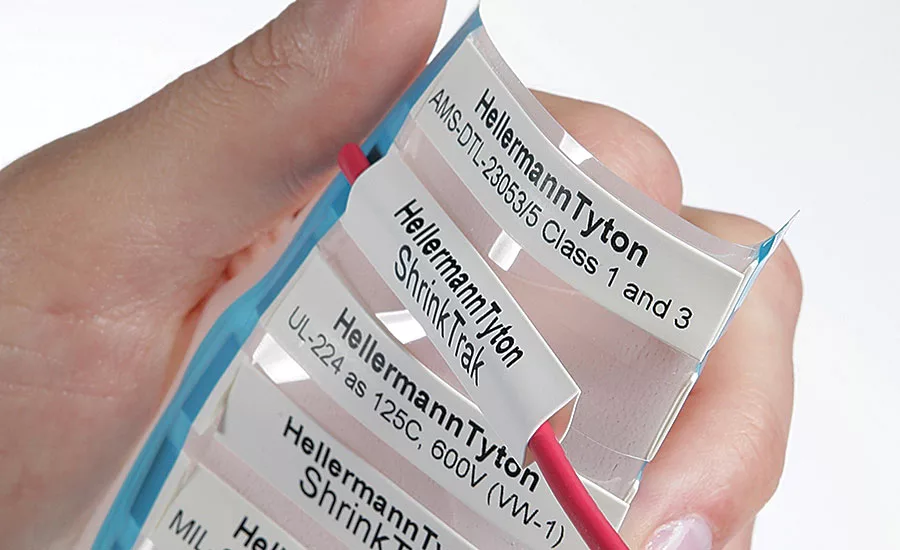
Text and graphics are directly printed on heat-shrink tubing, which is manually placed over a wire or cable and heated by a heat gun or a light source machine. Photo courtesy HellermannTyton
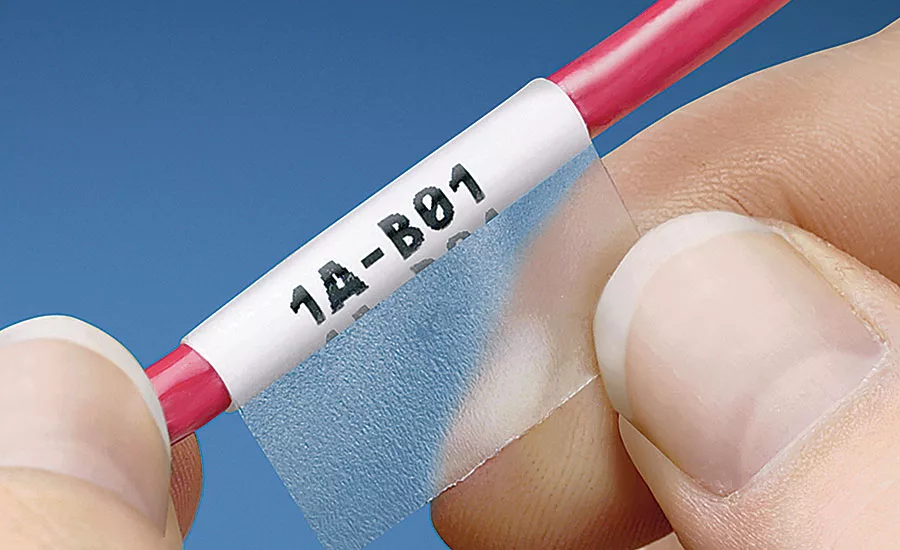
Self-laminating labels feature a clear section that overlaps and adheres to the printed area and serves as a protective lamination. Photo courtesy Panduit Corp.
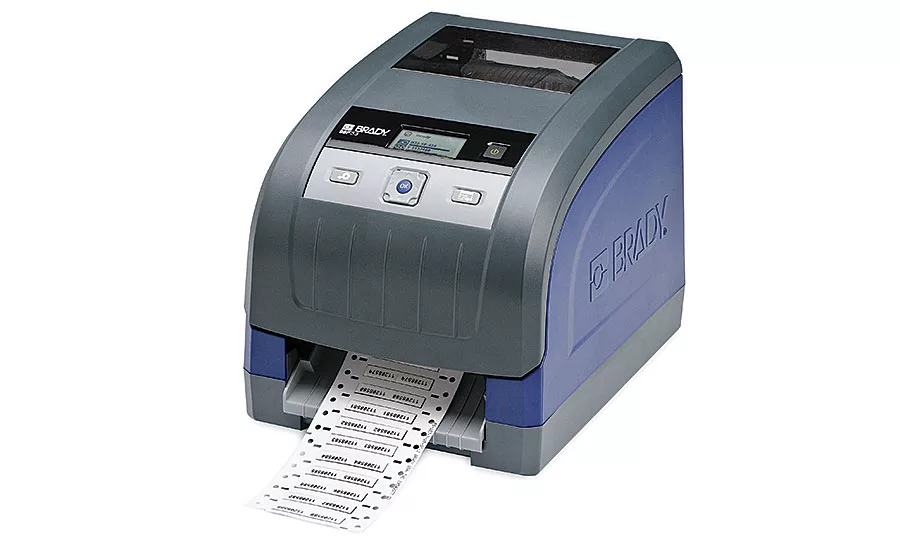
Manufacturers with high-mix environments like the BBP33 desktop printer because it enables 20-second material changeovers. Photo courtesy Brady Corp.
There are two ways to look at labels. One way is to be like Michael Jordan, who considers them an annoyance. (Think of his Hanes underwear commercials.) The opposite viewpoint is to acknowledge that properly labeled wires ensure correct installation and high performance in harnesses and electrical panels.
Consider, for example, the challenge of labeling all the harnesses that get installed on a ship. Until two years ago, one U.S. shipbuilder relied on a two-printer label printing system featuring software that required manual entry of information to transfer it onto five sizes of heat-shrink tubing (HST). This system was time-consuming, labor-intensive and wasted many labels due to printing errors.
To eliminate these problems, the shipbuilder replaced its old system with a networked six-printer system developed by Brady Corp. Five of the printers each mark a specific size of tubing. The other printer prints on die-cut polyester labels.
After selecting a set of wires to be labeled, the operator uses customized Brady software to retrieve specific data from a database and send it to the appropriate printers that print it on the correct size tubing. He then collects the finished set of sleeves and places them in a bag. Finally, he prints a polyester label and places it on the bag that is delivered to the harness assemblers.
“This system saves labor by eliminating manual data entry and the need to constantly change tubing material,” notes Jon Giaimo, national account manager for aerospace and defense at Brady Corp. “The shipbuilder also likes that it requires very little training for new operators, and ensures that assemblers get labels that are always accurate.”
HST has been a popular method of labeling wire for many decades, along with peel-and-stick labels and plastic carriers. All three approaches provide manufacturers with a reliable way of labeling harnesses and panels—regardless of whether they’re used in tiny electronic devices or huge rockets sent into outer space.
Technology Followers
Printing technology is continually improving. This is great news for suppliers of labels and label-making equipment.
Looking for quick answers on assembly and manufacturing topics? Try Ask ASM, our new smart AI search tool. Ask ASM
“The wire identification market always follows and adapts to the latest printing technology,” explains Giaimo. “This is true about the advances in ink quality, label materials and printing methods: from dot matrix, to laser, to inkjet, to thermal transfer.”
Early in the 20th century, harness assemblers had few labeling options. They were often forced to either make a small crayon mark on the wire, wrap it with one or more pieces of tape or write information on a piece of paper and tape it to the wire. Because none of these methods offered much staying power, the assembler would usually have to reapply the mark, tape or paper during harness assembly, installation or after installation.
Labeling got a bit easier in the 1940s when Brady started selling books of preprinted numbers, letters, symbols and colors with an adhesive backing. Each book contained many sheets with small square labels. Assemblers simply removed the labels as needed to properly identify one or more wires. Brady still offers these books, which feature a comb design that allows companies to easily refill the book with more than 250 different refill packs.
In the early 1960s, the Raychem Corp. (now TE Connectivity) developed HST with cross-linked polymeric materials. However, printing on the material proved to be a real challenge.
Mario Appello, global engineering manager for identification solutions at TE Connectivity, says the company initially had to use an IBM wheel writer with slow-drying ink that could smudge when the sleeve was handled. After that, the company switched to dot-matrix and thermal-transfer printers when those technologies became available in the 1980s and 1990s, respectively.
Several important industry developments also occurred during this time and afterward. First, several suppliers began offering custom preprinted peel-and-stick labels. These labels were made of vinyl and came in different sizes with one or several lines of information.
Portable printers became available in the late 1980s, enabling manufacturers to print their own labels on demand. Early printers featured dot matrix technology, but eventually evolved to ink-jet cartridges and lasers for sharper printing and easier-to-read text and graphics.
Plastic carriers (or holders) were developed in the 1990s as a way to further protect labels and keep them in place on a wire or cable of any diameter. That decade also saw the introduction of several new inks, laminates, label materials and adhesives.
Complementing these advances has been the ongoing development of label design software. Todd Fries, marketing manager for identification systems at HellermanTyton, recommends manufacturers use a software program that can process highly variable information, print graphics and bar codes, and directly import data from a spreadsheet to avoid human typing errors and optimize production.
Sticking With Simple
“Adhesive labels are the most economical and versatile marking option,” says Fries. “This is because each label can contain different information, and label application is easy and fast. Also, this type of label can usually be applied before or after termination.”
The most popular peel-and-stick types are preprinted self-laminating, flag and rotating labels. Self-laminating labels feature a clear section that overlaps and adheres to the printed area and serves as a protective lamination.
Each side of a flag label contains information that is easily visible to the end-user. When both sides are pressed together around a wire, the label protrudes. Another benefit, according to Fries, is flag labels can be applied before or after wire termination. However, they may catch on obstructions when pulling wire through plenums or other confined spaces.
Rotating labels are also self-laminating, but they turn slightly after installation to allow visibility from any angle. In addition, they allow repositioning along the length of the wire before and after cutting or termination. This flexibility lessens material waste, improves aesthetics and eases installation in high-density or space-restrained applications.
Panduit’s Turn-Tell R100X150V1T rotating label is white and requires thermal transfer printing of black characters. The label can be used with 6 to 10 AWG wire or cable, as well as Category 5e, 6 and 6e unshielded twisted pairs and Category 5e FTP cable. It is 1 inch wide and 1.5 inches long.
If the application requires placing a simple, nonadhesive identifier around several wires, a tiptag is a good option. Made of cross-laminated polyolefin, the tag features die-cut tie slits for mechanical fastening. Text is thermal transfer printed for high contrast and durability. Tiptags offer excellent strength and tear resistance, and are halogen-free for low-smoke and low-fire-hazard applications.
Peel-and-stick labels are made of various materials. Low-cost vinyl and expensive polyester can be used when high temperatures and harsh chemicals are not a concern. High-temperature polyamide is recommended for PCBs because it can withstand wave and reflow soldering.
Vinyl cloth labels can be cleanly removed and reapplied. Nylon and polyester cloth labels are ideal for industrial applications where harnesses are exposed to moisture, oil, dirt and extreme temperatures.
Tube Tied
Like a belt that is tightened, HST wraps snugly around wires and terminals to protect them from abrasion and keep them bundled. An HST label is typically placed manually over a wire or cable and heated by a heat gun or a light source machine.
Text and graphics are directly printed on the tubing by either suppliers (during or after extrusion) or harness manufacturers in their shops, says Richard Deutsch, sales manager for Murrplastik. The tubing is fed through a marking device, most commonly a thermal transfer printer or hot stamp machine. Printed information can include serial and product numbers, safety warnings, instructions for use, date of manufacture and company name or logo.
The U.S. military frequently prints text and numbers on the tubing, but keeps it loose so the tubing can be easily moved up and down the harness. Appello says that aerospace manufacturers are increasingly using HST because the material is very light.
He also notes the increased use of HST by train manufacturers because it resists diesel fuel, oil and high temperatures. One such customer regularly prints batches of 2,000 sleeves, each of which contains 23 characters. Using a state-of-the-art thermal transfer printer, a batch is printed within 5 minutes.
Polyolefin is the most common HST material because it is relatively inexpensive and has a temperature rating of -55 to 135 C. ShrinkTrak, from HellermannTyton, is a polyolefin tubing that requires thermal transfer printing. It comes in eights diameters (0.125, 0.188, 0.25, 0.375, 0.5, 0.75, 1 and 1.5 inches) and four lengths (0.48, 0.63, 0.95 and 1.9 inches) with a wall thickness of 0.53 to 0.91 inch. The tubing has a 3-to-1 shrink ratio, accepts various color markings and features a side or center slit for easy application.
Stephen Earley, global product manager for identification solutions at TE Connectivity, says that many aerospace and train manufacturers are using HST made of ZHD-SCE, which is TE Connectivity’s latest printable tubing material. It resists diesel fuel, meets international fire standards, contains no halogen and is low in toxicity.The tubing has a 2-to-1 shrink ratio, withstands temperatures from -67 to 257 F and comes in diameters of 0.094 to 1.5 inches.
Other HST materials include PVC, fluoropolymer, PTFE and polyvinylidene fluoride, which have temperature ratings from 105 to 260 C. PTFE is often used in aerospace applications because of its high temperature rating (260 C).
Many desktop printers are designed to handle HST, including the BBP33 from Brady. Giaimo says manufacturers with high-mix environments like the unit because material changeovers can be accomplished in 20 seconds. They also like that it enables printing from a PC and does not require material calibration, which can result in wasted labels.
An operator simply drops in the ribbon and label cartridge, locks it in place and starts typing. The printer prints labels from 0.5 to 4 inches wide, and is compatible with LabelMark, CodeSoft and MarkWare PC software.
Brady also makes the Wraptor machine, which automatically prints and applies a wire label in one step. Cycle time is 4.5 to 5 seconds. The machine prints 1D and 2D characters, and handles labels from 0.25 to 2 inches wide. It also allows peripheral printing from a PC.
Carry On
Two types of plastic carriers are available, both of which allow assemblers to perform on-the-spot labeling and change the label before or after termination. Snap-on (or clip–on) carriers are preferred for smaller gauge wire (16 to 24 AWG). This type of carrier contains several of the same preprinted letters or numbers (black, on white or yellow) that are individually moved down the carrier and snapped onto the wire as needed for proper identification.
Slide-on (or slip- or push-on) carriers are made of clear plastic that easily slides over the wire or cable. Besides securing and protecting inserted labels, these carriers provide visual access to label information from any angle. This is true whether the wire or cable is small or large.
“The person using clip-on wire markers must stay focused,” says Jay Whitaker, product manager for Panduit Corp. “It can be confusing when the wire identifier requires several characters.”
Earley says several customers prefer the push-on carriers for high-volume applications. In addition, he says that carriers can last 20 or more years when properly installed.
Giaimo says that the Australian market frequently uses clip- or snap-on carriers with a printed insert to mark wire. He also notes that, in general, Asian manufacturers use printed PVC tubing pieces more extensively than those in the United States.
The Pictor2 inkjet printer from Murrplastik uses a proprietary ink that produces durable markings on thin (2 millimeters) polycarbonate mats. A variety of mats and colors are available, all of which can be inserted into plastic carriers.
Deutsch says the printer produces photorealistic quality (720 dpi) markings at a very high speed. He also says different label types can be mixed together on a single project, enabling on-the-fly printing. The machine’s printing capacity is 600,000 characters per cartridge.
Looking for a reprint of this article?
From high-res PDFs to custom plaques, order your copy today!