Adhesives Aid Truck and Trailer Assembly
High-strength adhesives and sealants can improve the durability and appearance of trailers and truck bodies, while enhancing throughput.
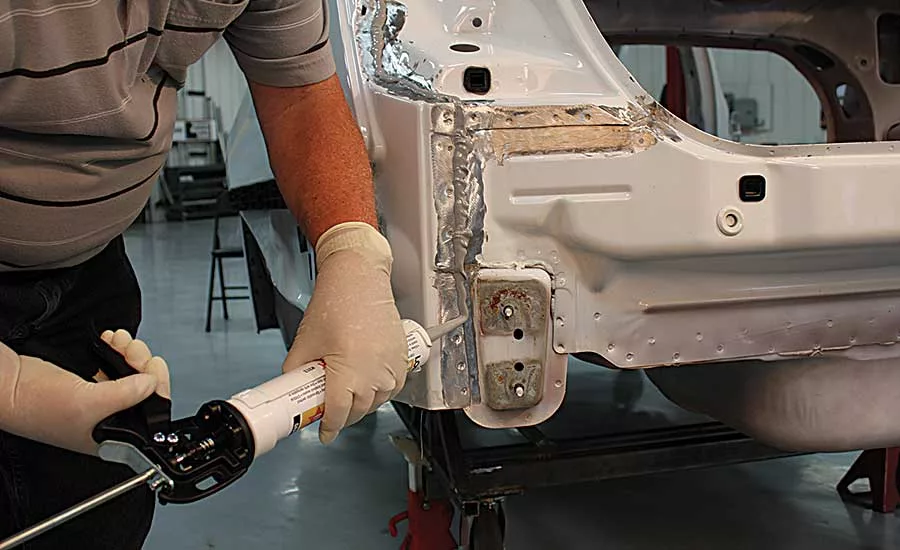
Seam sealers are available in one- and twocomponent formulations. The photo depicts a seam sealer being applied to a rear body panel. Photo courtesy Lord Corp.
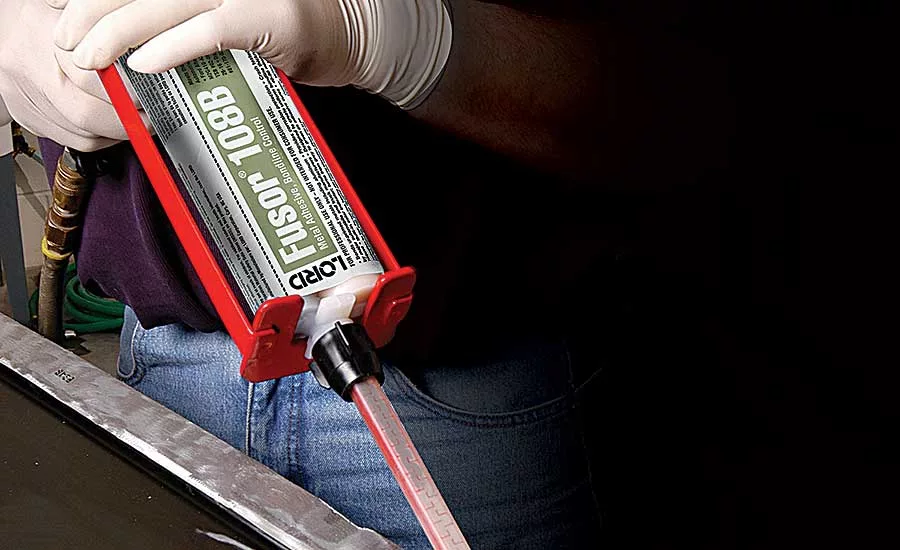
Fusor 108B is a two-part structural acrylic adhesive for bonding aluminum and steel. It can be used for panel bonding, weld bonding and rivet bonding. Photo courtesy Lord Corp.
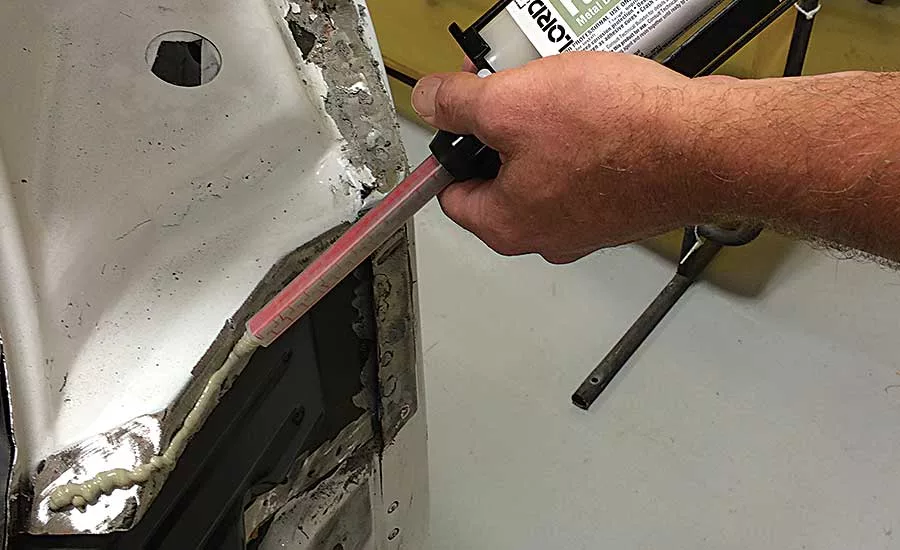
A major advantage of acrylics is that they bond to metals and composites with minimal surface preparation. Photo courtesy Lord Corp.
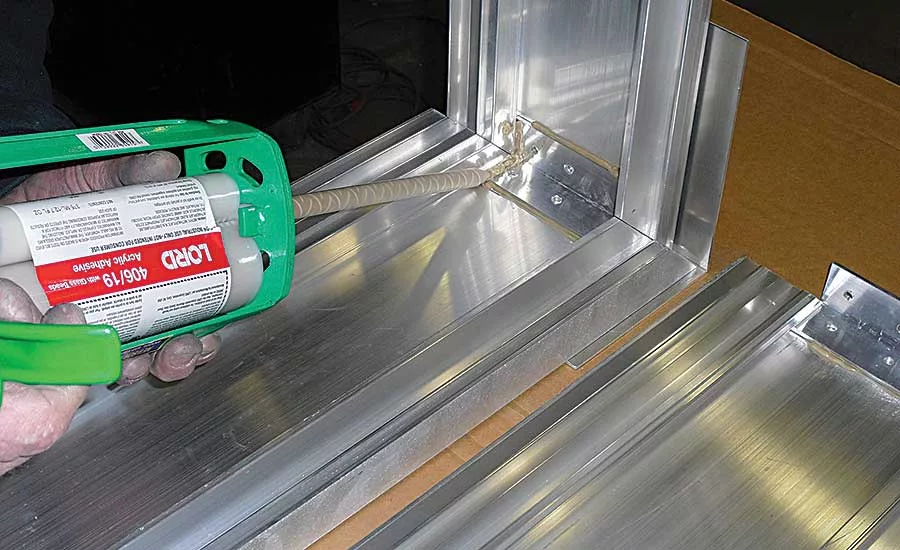
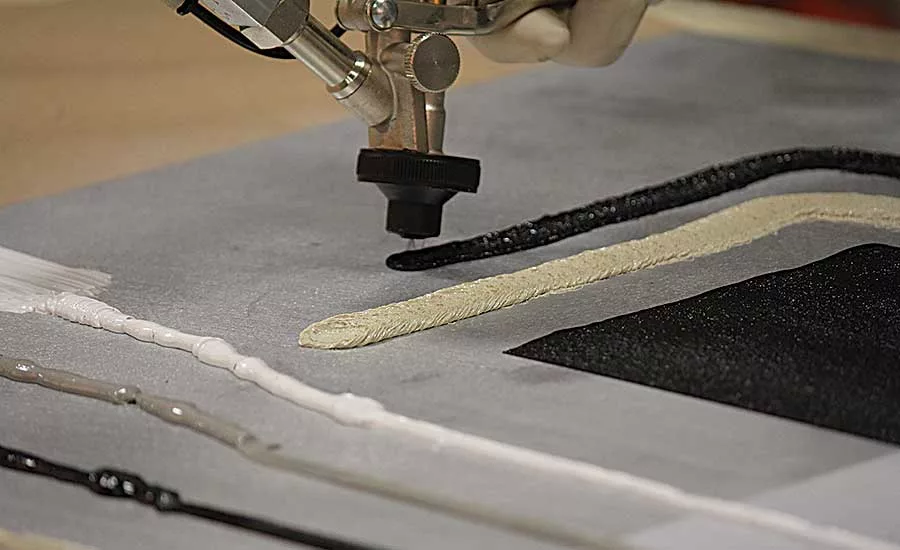
Lord 406 is a two-part, structural acrylic adhesive for bonding metals and thermoplastics. Glass beads mixed into the adhesive ensure a uniform thickness to the bond line. Photo courtesy Lord Corp.
The main objective for manufacturers of commercial transportation equipment is to profitability build high-quality products. One way to meet this objective is to assemble trailers and truck bodies with advanced structural adhesives and seam sealers. High-strength adhesives and sealants can improve the longevity and durability of trailers and truck bodies, while enhancing throughput and takt times.
Using adhesives and sealants in truck and trailer assembly offers many benefits:
Better structural integrity. Structural adhesives eliminate stress concentrations, diminish squeaks and rattles, and improve fatigue performance. Closure-panel and body-panel bonding have been trusted applications in the automotive market for more than 30 years.
Noise, vibration and harshness (NVH) improvements. Liquid-applied sound deadeners (LASDs) dampen vibration, rattles and noise in floor panels, underbodies and cabins. Sealants also provide a quieter ride by eliminating air gaps that can lead to wind noise.
Corrosion protection. Sealants are especially formulated to prevent car parts from corroding.
Nicer appearance. Transportation companies want truck and trailer bodies with a high-end appearance. Adhesives and sealants allow engineers to reduce the number of welds and fasteners needed to assemble truck and trailer bodies, leading to sleeker, more innovative designs.
Improved throughput. Structural adhesives allow manufacturers to bond and seal in one step, which shortens the assembly line layout. With fewer fasteners to install or joints to weld, manufacturers can produce more trucks and trailers with the same number of personnel.
Structural Adhesive Chemistries
Structural adhesive chemistries include acrylics, urethanes and epoxies. Acrylics are one of the strongest adhesives (shear strength of more than 3,000 psi) and require only minimal surface preparation. Urethanes are also strong (shear strength of more than 2,000 psi) and flexible. Some can also be sanded. Epoxy adhesives work well in both high and low temperatures and exhibit similar shear strengths compared with urethane products.
Looking for quick answers on assembly and manufacturing topics? Try Ask ASM, our new smart AI search tool. Ask ASM
Adhesives can be used to bond metal to metal, plastic to metal, and plastic to plastic.
Metal-to-metal bonding is limited to nonstructural applications. Metal-bonding products are available in acrylic, epoxy and urethane formulations. Curing times run the gamut from slow to medium to fast. Fast-set adhesives cure to handling strength in 45 to 60 minutes. Medium-set formulas cure to handling strength in 90 to 120 minutes.
Plastic-to-metal and plastic-to-plastic adhesives offer the ability to securely bond dissimilar materials. These adhesives are available as urethanes and epoxies, in fast-set and slow-set cure times.
Acrylic, methyl methacrylate adhesives are a great choice for metal-to-metal bonding, including aluminum, cold-rolled steel, galvanized steel and stainless steel. These adhesives also bond well to many types of composites and allow for cross-bonding of bare metals to composites.
A major advantage of acrylics is that they bond to metals and composites with minimal surface preparation. They cure rapidly, produce high-strength bonds, and resist extreme environmental conditions. Some disadvantages include the odor of unmixed material, as well as difficulty bonding to porous substrates, such as wood, paper and concrete.
Two-component urethanes are ideal for bonding thermoplastics, thermoset plastics, painted metals and porous substrates. These are adhesives are economical and easy to dispense from bulk supplies. Two-component urethanes are flexible and have excellent weathering performance. However, urethanes cure slower than acrylics and do not bond well to bare metals.
Epoxies are an older, general-purpose adhesive chemistry. They bond a wide range of substrates, including metals, plastics and stone. Epoxies form high-strength bonds; have a high degree of environmental and chemical resistance; and can be exposed to temperatures exceeding 400 F. Conversely, this chemistry is often rigid and brittle. It also cures more slowly than acrylics and urethanes.
Adhesives work best when parts are designed for shear or compression loads. Adhesives perform less favorably under peel or tension loads. Overlap joints should be approximately 1 inch wide for best results.
Understanding the open time of the adhesive and the time to reach handling strength is important to building a process. Ambient temperature can affect open time and handling strength. Adhesives will cure slower in colder environments, and they will set up faster when the temperature is warmer. Proper fixturing is critical to building quality parts. The fixtures must securely hold parts until sufficient handling strength has been reached.
Initially, assemblers typically dispense adhesives using handheld cartridges. Once proficiencies and higher volumes are realized, it may be beneficial to use meter-mix-dispense systems along with automation to provide pinpoint accuracy, save on material costs, and reduce waste. Adhesive manufacturers can provide information on what type of dispensing systems work best for specific adhesive materials.
Manufacturing With Seam Sealers
Seam sealers seal flanges and joints to prevent water leaks and corrosion. A variety of chemistries are available, including urethanes, epoxies or MS polymers (silyl-modified polyethers). They are offered in one- and two-component formulations. Two-component sealers will cure through a chemical reaction; one-component sealers cure through a moisture reaction. One-component sealers will set in one hour and fully cure in approximately 72 hours. Two-component sealers set up quickly in 5 to 15 minutes and are fully cured in 24 hours. Older sealers cured through evaporation of solvents.
Certain one-component sealers, such as windshield urethane, will not attain a strong bond directly to metal. For metal-to-metal applications, use direct-to-metal sealers for the best results and to prevent corrosion.
There are three common methods of using seam sealers. One is to apply the sealer over the joint to cosmetically hide it or seal it. Another option is a weld-
through sealer. The sealer is applied in the joint between panels. The panels are then joined via resistance spot welding or mechanical fasteners, such as rivets. Finally, there are LASDs. These seam sealers are applied to a panel to add mass, stiffen the metal, or create an insulting layer. LASDs can be applied with a trowel or spray gun.
A controlled-flow seam sealer is ideal for use on sloped surfaces, roof channels, drip rails, and truck-bed floor seams. The formula is easy to dispense in a smooth bead. Self-leveling seam sealers are used mainly on roof-ditch areas, but can also be used on core supports, aprons, truck seams and roof-deck quarter panels. This sealer self-levels within the applied area. Sprayable sealers are applied to trunk floors and wheelhouse areas to provide a textured surface. They can also be used as a stone-guard coating for rocker panels and the lower portions of exterior body skins. With an atomized pneumatic spray gun, the operator can control the thickness and texture of the sealer.
For more information adhesives and sealants, call 877-ASK-LORD or visit www.lord.com.
Looking for a reprint of this article?
From high-res PDFs to custom plaques, order your copy today!