Wiring Autonomous Vehicles
Next-generation electrical systems will be critical to automated cars.
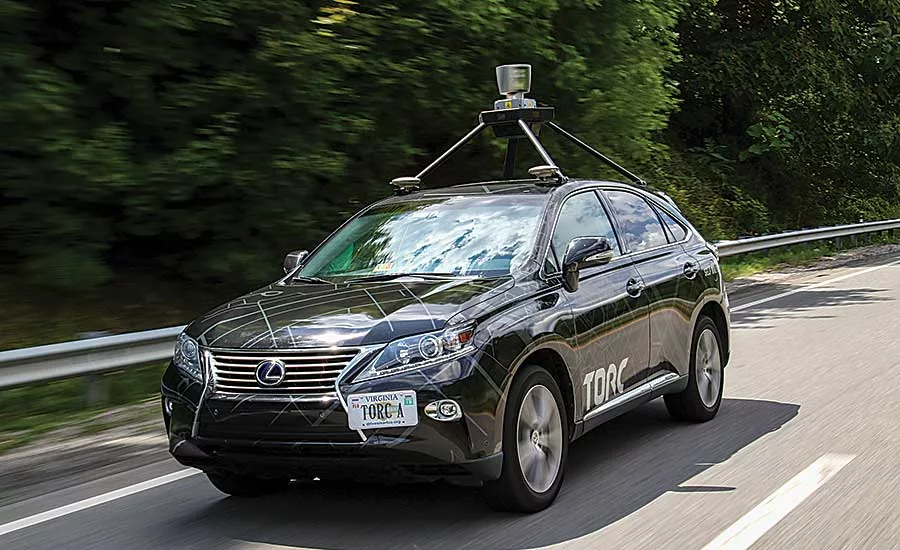
Automakers and suppliers are scrambling to develop automated driving technology. Photo courtesy Torc Robotics Inc.
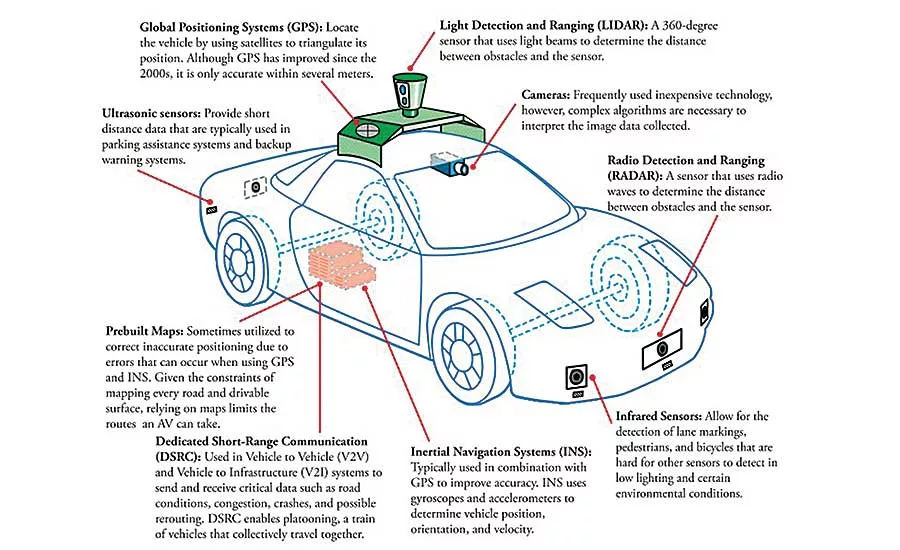
Key components that make automated driving possible include cameras, lidar and radar. Illustration courtesy University of Michigan
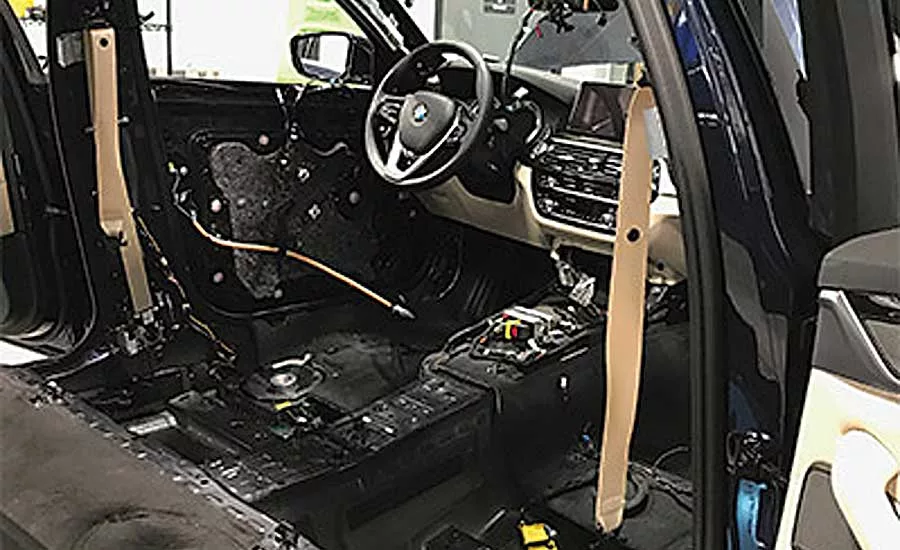
Demand for wiring harnesses will grow with the development of automated cars. Photo courtesy Delphi Automotive
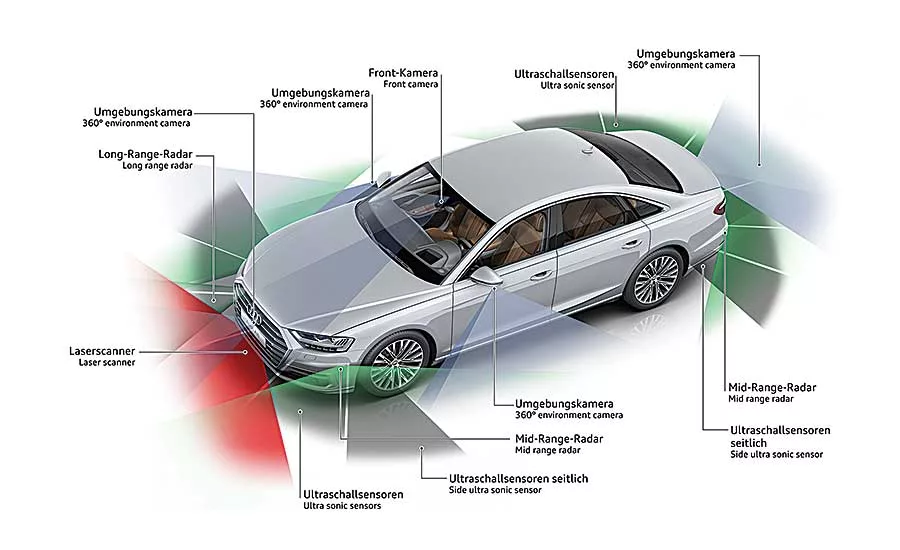
Sensors and actuators located all around automated cars constantly gather and share real-time information. Illustration courtesy Audi AG
The automotive industry is undergoing the biggest transformation in its 130-year history. Automakers and suppliers around the world are scrambling to develop autonomous vehicles. And, they’re under increasing pressure from outsiders ranging from Silicon Valley tech giants to startup entrepreneurs.
Caught in the midst of all the hoopla surrounding driverless technology is the good old wire harness. Cable, wire and next-generation electrical systems will play a key role in the success and safety of self-driving cars and trucks. And, the move to increasingly electrify vehicles will put new pressure on automotive engineers.
In fact, one of the biggest challenges to the adoption of automated cars isn’t the engine or drivetrain—it’s cable and wiring. That’s because emerging electrical systems will need to handle an enormous amount of data quickly and reliably.
Signals from on-board sensors, other vehicles, road-based infrastructure and satellites will be streaming to a high-performance computer. That computer, in turn, will be transmitting signals to braking, steering and other control systems.
As powerful electrical systems operate vehicles, cable and wire harnesses will become more important than ever.
“The wiring harness is here to stay,” claims Don Price, collaborative research leader for the electrical wiring component applications partnership at the United States Council for Automotive Research LLC (USCAR), a cooperative technical consortium that serves FCA Automotive, Ford Motor Co. and General Motors Co.
“Demand for wiring harnesses will grow with the development of automated cars,” says Price, a former Ford engineer. “They will continue to be the physical backbone of all point-to-point communication within the car.
Looking for quick answers on assembly and manufacturing topics? Try Ask ASM, our new smart AI search tool. Ask ASM
“Some people think that won’t be the case, because of all the talk about wireless systems,” adds Price. “Wireless technology will only apply to communication outside of the car, such as vehicle-to-vehicle networks.”
The Great Race
The race is on to develop “automated” driving technology, which, according to the Society of Automotive Engineers (SAE) is the preferred term to use—not autonomous, driverless or self-driving.
Last month, the U.S. House of Representatives unanimously passed a bill (H.R. 3388) that’s expected to spur the development of automated cars. The landmark legislation will enable companies to deploy those vehicles on public roads more quickly and curb states from slowing their spread. Under the bill, automakers can add hundreds of thousands of automated cars to America’s roads in the next few years.
Automated cars also took center stage at the recent auto show in Frankfurt, Germany. Audi unveiled the Aicon, while Daimler showed the EQ and Renault rolled out the Symbioz. All three concept cars provide a glimpse of where the industry is headed in the not too distant future.
Some of the most intriguing vehicles under the spotlight in Frankfurt last month touted all-electric power trains. For instance, the Audi Aicon features four electric motors and an 800-volt charging system.
“Electric vehicles have an architecture that is well-suited for automated driving applications,” says Nick Smith, business development director at Mentor Automotive, a division of Siemens that provides hardware and design tools in the areas of automotive connectivity, electrification and vehicle architecture.
Earlier this year, Mentor launched the DRS360 platform, which is a tool for designing electrical and electronic systems for automated driving applications.
“Self-driving cars will depend on a complex network of advanced safety systems, including actuators, microprocessors and thousands of sensors,” explains Smith. “Electrified power trains add a load of extra complexity. Engineers have to design automated car electrical systems for high-voltage applications.”
During the next decade, more and more electric cars will be hitting the road. The Nissan-Renault-Mitsubishi alliance plans to launch 12 pure electric vehicles by 2022. Volkswagen claims all 300 models in its lineup will have electric versions by 2030. And, Volvo says it will stop producing vehicles powered by internal combustion engines by the end of this decade.
Many Tier One suppliers are also getting ready for the automated car era. They’re investing in companies that specialize in next-generation technology, such as lidar, a sensor system based on laser light that, in combination with cameras and radar, enables automated driving. Delphi Automotive is partnering with Innoviz Technologies, while Magneti Marelli recently acquired a stake in LeddarTech.
Other components that will make automated driving a reality include high-performance computer platforms, robust actuation systems, thermal cameras, ultrasonic sensors and infrared sensors.
“How a vehicle reacts to a situation depends on what it sees and hears through its sensors,” says Glen De Vos, chief technology officer at Delphi Automotive. “There are three basic types of perception technologies required: vision (cameras), lidar and radar.
“Each sensor has its strengths,” explains De Vos. “Radar isn’t impacted by weather. Lidar provides very accurate range and distance information. Vision provides object classification accuracy.
“By combining all three, the system can generate a comprehensive view of what’s around the vehicle, adding redundant safety and confidence,” De Vos points out.
Automotive engineers are working toward achieving several levels of autonomy. Their long-term goal is to advance well beyond today’s vehicles, which are equipped with many types of advanced driver assistance systems, such as adaptive cruise control, antilock brakes and lane-departure warning.
The next step is to enable drivers to relinquish control of a vehicle’s safety-critical functions, depending on traffic and environmental conditions.
The SAE has designated six levels of automated driving systems, ranging from no automation (Level 0) to full driving automation (Level 5).
Level 3 refers to highly automated driving where the driver still needs to be able to take over the vehicle upon request. Level 4 automation means that a car can handle most driving situations itself. The holy grail is Level 5—complete automation in any type of driving condition.
Automakers are jockeying for bragging rights. For instance, Audi claims that its 2018 A8 luxury sedan is the world’s first production car to offer Level 3 autonomy. The company plans to have a Level 4 car available by 2020.
Other automakers are taking a more cautious approach. For example, Honda intends to have vehicles capable of Level 3 freeway driving on the market by 2020. It doesn’t expect to have cars with Level 4 capability ready until 2025.
According to the Center for Automotive Research, most Level 5 vehicles will be commercially available by 2030, approximately 10 years after Level 4 vehicles first hit the road.
Some predictions are even bolder. RethinkX, a Silicon Valley think tank, predicts that “one of the fastest, deepest, most consequential disruptions of transportation in history” will occur within the next decade. However, the sobering reality is that many regulatory, legal and infrastructure hurdles still need to catch up to automated driving technology.
Electrical Connectivity
No matter when automated cars start to be mass produced, one thing is certain: electrical connectivity will be critical. Automotive engineers first must find a way to make all components work flawlessly within an architecture that can handle much heavier electrical loads.
“Level 5 systems will require at least 40 to 50 teraflops of computing power, which is 20 times what today’s vehicles have,” say De Vos. “Within a few years, we’ll have to move information 10 times faster than today. There’s going to be a major transformation, which will result in a more complex wiring harness.”
“The sensors required for automated driving require much higher resolution and provide significantly more data,” adds Sam Abuelsamid, a senior analyst at Navigant Research. “For example, a wheel speed sensor used for antilock brakes provides a single digital data point with no more than 256 bits of resolution. On the other hand, a lidar sensor typically provides 300,000 or more points per second.
“The signal reliability for automated vehicles is also much more crucial,” explains Abuelsamid. “With traditional systems, if an electrical connection fails, the subsystem may be disabled, but the driver still has full control. In an automated car, that may no longer be true if there are no controls for the human occupants.
“As we evolve to automated vehicles, we’ll need significantly more data bandwidth within the vehicle network, which will likely necessitate Ethernet connectivity,” warns Abuelsamid. “The wiring and connections will need to be either much more robust and reliable or have added redundancy.”
“Because of all the faster data speeds and higher bandwidths, more coaxial cable and twisted-pair wiring will be used in automated cars,” says USCAR’s Price. “Some estimates call for more than 40 coax wires per vehicle just for use with antennas, cameras and Ethernet connections. That will require a huge change in the assembly process.”
Unshielded twisted pair wiring has the advantage of providing electromagnetic conductivity resistance without expensive, heavy shielding.
“It allows for a tighter bend radius for improved cable management in high-density systems,” explains Pete Doyon, vice president of product management at Schleuniger Inc., which supplies wire processing equipment to many companies developing automated driving systems, including new players such as Uber.
“The twisted-pair design also helps to dramatically reduce termination issues,” adds Doyon. “The cables are inherently balanced and provide better mechanical reliability than parallel-pair products.”
“Automated cars will also add to the overall complexity of wiring harnesses,” Doyon points out. “The amount of data that’s going to be generated will be phenomenal in order for onboard computer systems to make life and death decisions in a split second. Data and signal wires will become a more critical piece of the puzzle.”
According to Doyon, many devices will require more than a single wire. They’ll be connected with multiconductor cables because of output requirements. That will increase the overall size and weight of wiring harnesses.
“Instead of having a dozen smaller harnesses that all plug together, the auto industry is now using much larger harnesses,” says Doyon. “Super large harnesses decrease the amount of connectors and terminals that are needed.”
With automated driving systems, failure is not an option. A component that stops working or functions intermittently could cause a fatal accident. As a result, early generations of automated cars will feature redundant systems.
“That way, one failure will not cause a catastrophic incident,” says Doyon. “However, that also means there will be more wires and electrical circuits, which will create weight and space challenges."
“Weight and installation space are the most important requirements from our customers,” says Bernd Buhmann, senior vice president of marketing at Leoni AG, a leading supplier of automotive wiring harnesses. “For autonomous cars, it is more critical to limit needed weight and space in order to integrate all new functionalities.
“Autonomous cars generate more data and need more data,” explains Buhmann. “The car must be able to react on those topics. Those cars need redundant power supplies and have to connect a lot more sensors inside the vehicle.
“For data and power distribution, more intelligent devices are needed, using new electronic components for fusing and switching power,” adds Buhmann. “Methods to calculate failure rates for safety critical applications are not in place yet and need to be developed.”
“Today, a lot of wire that’s used for automotive applications is 26 gauge,” says Doyon. “Many people are comfortable cutting, stripping and crimping that size of wire. But, we’re now beginning to see more interest in smaller 28 gauge wire, especially for signal and data applications.
“Unfortunately, small terminals are not yet available for automotive applications involving wire that size,” Doyon points out. “You have to fold the end of the wire in half to get more cross section so that it will fit in a larger terminal.”
As automated cars start to emerge, there will also be growing demand for aluminum wire to address lightweighting issues.
“Many automakers have already switched to aluminum for large cables that are used with batteries and other applications that require anything larger than 10 gauge,” says Doyon. “However, smaller gauges of aluminum wire present numerous challenges, such as brittleness and oxidation issues after the insulation is stripped.
“Aluminum is very soft, ductile and malleable,” adds Doyon. “It tends to relax, which makes it difficult to process.
“But, there are a lot of R&D efforts going on in the auto industry,” notes Doyon. “We’re currently working with many wiring harness suppliers to make aluminum a viable option for use in automated cars.”
Looking for a reprint of this article?
From high-res PDFs to custom plaques, order your copy today!