Assembly Magazine logo
search
Ask ASSEMBLY AI
cart
facebook twitter linkedin youtube
  • Sign In
  • Create Account
  • Sign Out
  • My Account
Assembly Magazine logo
  • TRENDS
    • Ask ASSEMBLY AI
    • Trends
    • News
    • New Products
  • INDUSTRIES
    • Aerospace
    • Appliance
    • DFMA Assembly
    • Medical Devices
    • Green Manufacturing
    • Lean Manufacturing
    • Machinery Assembly
    • Electronics Assembly
    • Automotive
  • TECHNOLOGIES
    • Adhesives & Dispensing
    • Assembly Presses
    • Automated Assembly Systems
    • Manufacturing Management
    • Manufacturing Software
    • Motion Control
    • Screwdriving & Riveting
    • Robotics
    • Test & Inspection
    • Plastics & Metal Welding
    • Wire Processing
    • Workstations
  • AUTONOMOUS & ELECTRIC MOBILITY
    • AEM Magazine Archives
    • Autonomy
    • Electrification
    • Mobility Services
    • Assembly & Testing
    • AV/EM News
  • MEDIA
    • Ask ASSEMBLY AI
    • Podcasts
    • Assembly News Now
    • Assembly TV
    • Webinars
    • eBooks
  • EVENTS
    • Calendar
    • The ASSEMBLY Show
  • MORE
    • Exclusives >
      • Plant of the Year
      • Capital Spending
    • Buyers Guide >
      • Supplier Insights
    • Classifieds
    • Featured Products
    • Newsletters
    • Store
    • White Papers
    • Columns
    • Sponsor Insights
  • INFOCENTER
    • Assembly & Test Solutions
  • EMAGAZINE
    • eMagazine
    • Archive Issues
    • Advertise
    • Contact Us
    • Sign Up
IndustriesAerospace AssemblyAppliance AssemblyAutomotive AssemblyScrewdriving and Riveting AssemblyTest and Inspection Assembly

Best Practices for Tool Maintenance

Even the most technologically advanced fastening tools require regular maintenance and calibration
By John Sprovieri
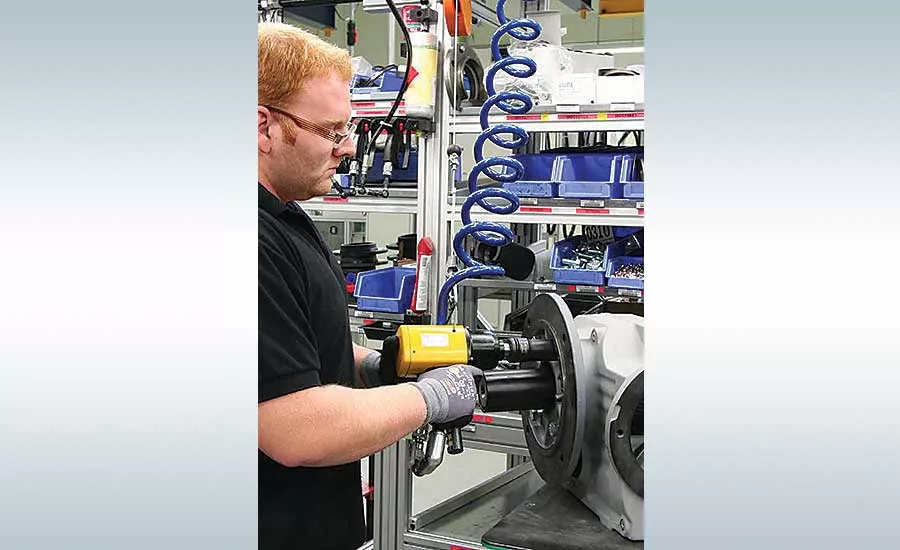
Pneumatic tools must be supplied with clean, dry, lubricated air. Separating humidity from the air will prevent corrosion in the air motor. Photo courtesy Apex Tool Group
The hydraulic fluid in pulse tools must be changed regularly
The hydraulic fluid in pulse tools must be changed regularly. The frequency of oil changes is based on the number of pulses—not run-downs—the tool performs. Photo courtesy Atlas Copco
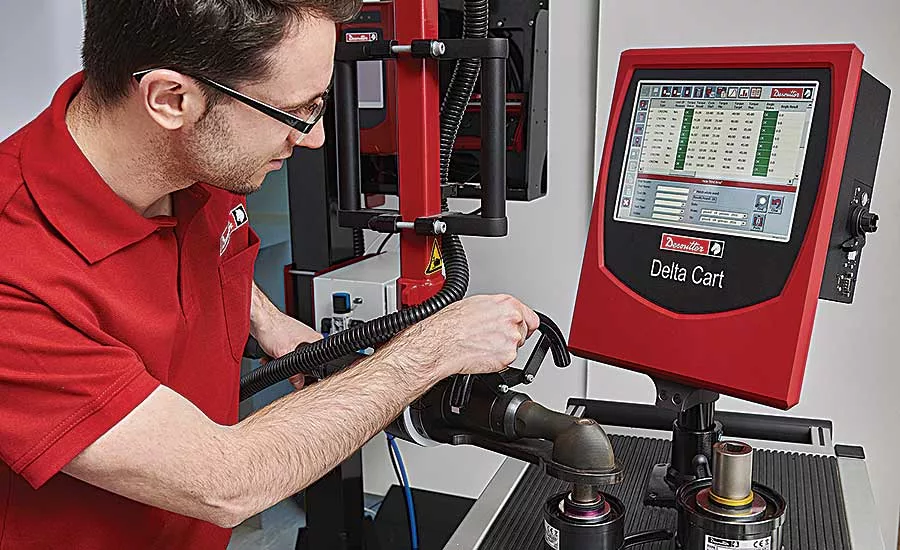
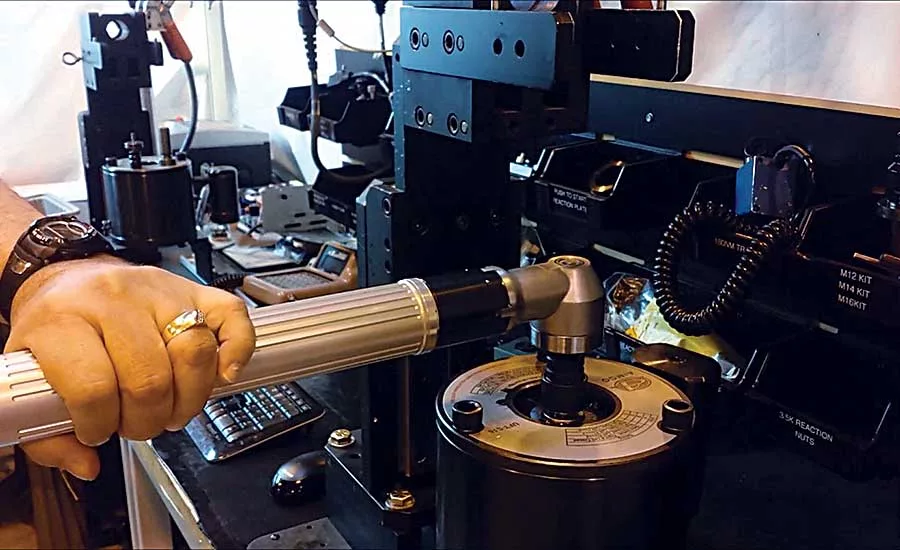
With the right equipment, assembly tools can be calibrated in-house
With the right equipment, assembly tools can be calibrated in-house. Photo courtesy Desoutter Industrial Tools
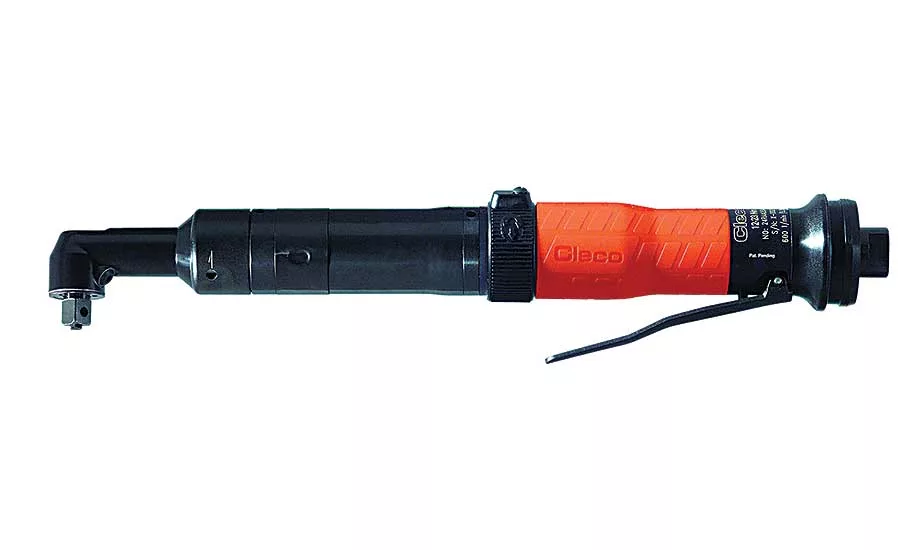
A right-angle tool typically requires more maintenance than an inline model
A right-angle tool typically requires more maintenance than an inline model, due to the bevel gears in the tool’s head. Photo courtesy AIMCO
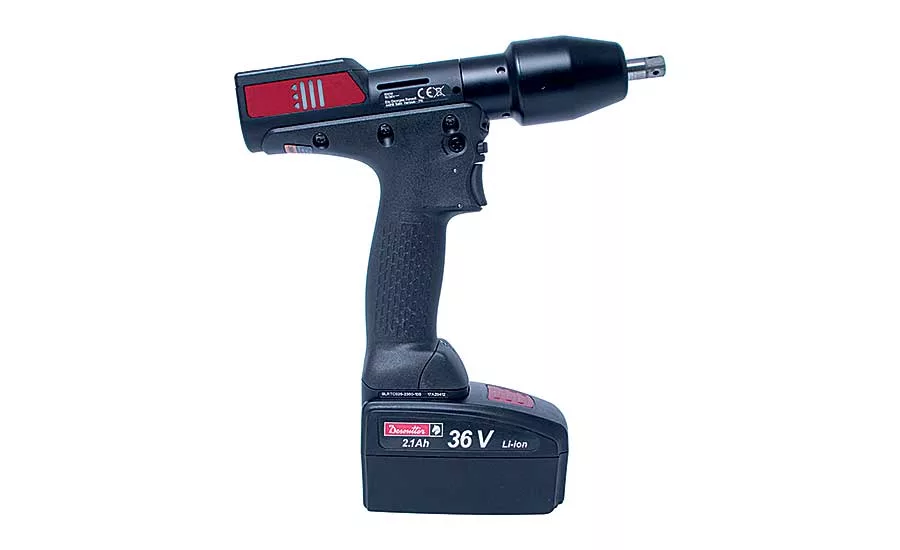
The E-Pulse electric pulse tool
The E-Pulse electric pulse tool can complete more than a half million cycles before any preventive maintenance is needed. Photo courtesy Desoutter Industrial Tools
Pneumatic tools must be supplied with clean, dry, lubricated air. Separating humidity from the air will prevent corrosion in the air motor. Photo courtesy Apex Tool Group
The hydraulic fluid in pulse tools must be changed regularly
With the right equipment, assembly tools can be calibrated in-house
A right-angle tool typically requires more maintenance than an inline model
The E-Pulse electric pulse tool
November 8, 2018

Fastening tools are the workhorses of any assembly operation. Consider a high-volume automotive plant. If a vehicle contains 1,000 threaded fasteners and an assembly line is turning out 250,000 vehicles annually, that’s more than 250 million run-downs each year.

Under that kind of workload, regular maintenance and calibration of fastening tools is critical to maintaining quality and protecting a plant’s capital investment.
What maintenance to perform, and how often to perform it, depends on many factors, including the type of tool, the production volume, the application, and even the joint type.

For example, a right-angle tool typically requires more maintenance than an inline model, due to the bevel gears in the tool’s head. “Our general recommendation is that maintenance should be performed every 500,000 cycles for right-angle tools and every 1 million cycles for inline tools,” says Russ Hughes, product marketing manager for Desoutter Industrial Tools.


Pneumatic Tools

Pneumatic tools are durable and require little maintenance. When they do need to be fixed, the repairs are simpler and less costly than repairs to electric tools. An air motor can’t burn out when stalled. Pneumatic tools can take a lot of abuse without the need for protection circuits, load monitoring or overload control devices. Any electric or cordless tool, no matter how well-designed, runs a slightly higher risk of being damaged from overload.

Pneumatic tools are powered by compressed air running through an air motor. Think of the air motor as a windmill. Compressed air blows against the windmill and turns a driveshaft, and that rotary motion is eventually transferred to the fastener. Thus, pneumatic tools need to be supplied with clean, dry, lubricated air. Separating humidity from the air will prevent corrosion in the air motor.

Once per week, engineers should check the condition of air hoses, power cables and connections. Tool suspension components, torque reaction devices and FRL units should also be inspected.

Looking for quick answers on assembly and manufacturing topics? Try Ask ASM, our new smart AI search tool. Ask ASM →

With every 100,000 run-downs, the gear head should be lubricated. The tool housing, baseplate, socket and socket bushings should be inspected, and any worn components should be replaced.

With every 250,000 run-downs, it’s a good idea to disassemble the motor and check the rotor blades for wear. The front and end plates should be inspected, and the motor bearings should be replaced. The valves, seals and clutch should be inspected. The gearing in angled heads, crowfoot tools and tube nut tools should be inspected, as well.

Besides regular maintenance, engineers can optimize the performance of air tools in other ways. For example, engineers should avoid using air tools at the high end of their torque range. The desired torque should be in the middle of the tool’s torque rating.


Pulse Tools

Hydraulic pulse tools are discontinuous-drive tools that apply torque in increments rather than one continuous effort. When the fastener is running free, the tool isn’t pulsing, and the driveshaft moves very fast. Once the fastener is snug, the tool begins to pulse, applying short bursts of torque lasting a few milliseconds.

The source of the pulses is a rotating hydropneumatic mechanism. The advantage of this design is that the hydraulic fluid absorbs most of the vibration from the fastening process. And, because torque is applied in short pulses, torque reaction is minimal or nonexistent.

As with any pneumatic tool, engineers should check the hose and connections periodically and make sure the tool is supplied with clean, dry, lubricated air. In addition, the hydraulic fluid must be changed regularly. The frequency of oil changes is based on the number of pulses—not run-downs—the tool performs.

Over time, the pulsing wears out the hydraulic fluid, causing it to lose consistency and turn dark. The longer the tool pulses on each run down, the faster the fluid wears out. As a result, the type of joint will determine how frequently the oil must be changed. Soft joints require more pulses than hard joints, resulting in shorter intervals between changes.

There are two ways to determine how many pulses are produced by a tool during a run-down. Some torque testers can directly count pulses during a run-down. Alternatively, engineers can use a stopwatch to measure how much time elapses from when the bolt or nut is seated to when the tool shuts off. If the tool pulses 10 to 20 times per second, and each run-down takes 2 seconds, that’s 20 to 40 pulses per rundown. Thus, 1,000 run-downs are equivalent to 20,000 to 40,000 pulses. A rule of thumb is to change the oil every 500,000 pulses.

Without knowing the number of pulses, engineers can still get an inkling of when to change the oil by monitoring the performance of the tool. If a shut-off tool pulses for more than 4 seconds during a run-down, engineers should consider changing the oil. Similarly, if the tool can’t reach its stated maximum torque capacity, it might mean the oil needs to be changed.


Early Warnings

Just as today’s cars alert their owners when an oil change is required, today’s fastening tools can alert engineers when maintenance is needed. A tool’s controller can be programmed to alert maintenance technicians after a certain number of run-downs or a certain number of weeks.

In addition, analysis of statistical process control data can provide early warning signs that a tool is about to exceed its upper and lower control limits.

“That’s part of what Industry 4.0 is all about—predictive maintenance, less downtime and more productivity,” says Hughes.


Testing and Calibration

At a minimum, fastening tools should be calibrated once per year, or any time they receive preventive maintenance. Calibration involves comparing two torque values with each other using a defined measurement system: the value given by the tool to be calibrated and the value given by the reference. If the torque is outside acceptable tolerance limits during calibration, the tool must be adjusted.

Calibrating a tool is not the same as auditing it. “With auditing, you’re checking to make sure the tool is performing within limits,” explains Hughes.

How often a tool should be audited depends on the type of tool and the application. Is the tool being used to fasten the side panels of a washing machine? Or is it being used to assemble the landing gear of an airplane? The latter would require more frequent auditing than the former.

Hughes says one aerospace manufacturer audits its fastening tools before and after each shift. In the past, that wasn’t always the case. Then, if the maintenance department found a tool that was performing outside of its control limits, technicians would have to check every fastener installed with that tool.


Outsource It

For manufacturers that lack the time or resources to adequately maintain their fastening tools, most suppliers offer annual preventive maintenance programs. One such supplier is Atlas Copco. The company’s Reliability Centered Maintenance (RCM) program is customized to each factory’s fastening operations, accounting for tool mix, production volume, torque settings and other variables.

Are such programs worthwhile? According to Atlas Copco, an automotive engine plant evaluated three maintenance strategies. One strategy was simply to repair tools when they broke. That led to a tool failure rate of 32 percent per year. Another strategy was to do preventive maintenance in-house at standard intervals. That led to a failure rate of 13 percent per year. A third option was to rely on the RCM program. That led to a failure rate of just 2 percent per year.

Backup tools are another consideration. Assembly plants that run 24/7 may not have the luxury of taking tools off-line for maintenance.

“Some customers will use hand tools for backups. Others will have full-blown DC electric tools as backups,” says Hughes. “It depends on the
customer and the application. Is it handheld or fixtured? Is it a high-torque application that would prohibit the use of a hand tool? We always recommend keeping some backup equipment, but some customers just won’t do it.”

Spare parts are also a good idea. Hughes recalls one high-volume assembler that uses 23 inline fastening tools from Desoutter. “All totaled, those tools are doing 1 million run-downs per week,” he says. “The company keeps spare gear packs for the tools. Every 750,000 cycles, [technicians] remove the gear pack from the tool and install a new one that has been inspected and greased. Then they put the tool back together and calibrate it. They can do all that in 30 minutes. The old gearing is degreased, inspected, and repaired as needed. They have it down to a science.”


Electric Tool Offers Benefits of Hydraulic Pulse Tool, But With Less Maintenance

Hydraulic pulse tools are known for their ergonomic benefits and fast run-down speeds. The chief drawback of these tools is maintenance: The hydraulic fluid must be changed regularly.

The E-Pulse electric pulse tool from Desoutter Industrial Tools offers the benefits of a hydraulic pulse tool, but without the need for costly and time-consuming maintenance. The pulses are generated directly by the electric motor—there is no hydraulic fluid to change. The tool can complete more than a half million cycles before any preventive maintenance is needed.

Available in both cordless and corded models, the tool has a maximum free speed of 4,600 rpm. The pistol-grip tool is equipped with a transducer to measure torque and angle. It can detect rehit or stripped fasteners; it can keep a batch count; and it can store data from 10,000 rundowns.

For more information, call Desoutter at 877-224-7377 or visit www.desouttertools.com.

KEYWORDS: pneumatic tools pulse tools tool maintenance

Share This Story

Looking for a reprint of this article?
From high-res PDFs to custom plaques, order your copy today!

John has been with ASSEMBLY magazine since February 1997. John was formerly with a national medical news magazine, and has written for Pathology Today and the Green Bay Press-Gazette. John holds a B.A. in journalism from Northwestern University, Medill School of Journalism.

Recommended Content

JOIN TODAY
To unlock your recommendations.

Already have an account? Sign In

  • Made in the U.S.A.

    Consumer Products Manufacturing: Made in the USA

    Supply chain lessons learned during the coronavirus...
    Automated Assembly Systems
    By: Austin Weber
  • Best Practices for Press-Fit Assembly

    Best Practices for Press-Fit Assembly

    In manufacturing, ironclad formulas for success are hard...
    Assembly Presses
    By: Jim Camillo
  • aem0523leader-tesla1.jpg

    Tesla Rethinks the Assembly Line

    Engineers at Tesla Inc. have developed a new process that...
    Automotive Assembly
    By: Austin Weber
Manage My Account
  • eMagazine Subscription
  • Assembly Newsletters
  • Online Registration
  • Subscription Customer Service
  • Manage My Preferences

More Videos

Sponsored Content

Sponsored Content is a special paid section where industry companies provide high quality, objective, non-commercial content around topics of interest to the ASSEMBLY audience. All Sponsored Content is supplied by the advertising company and any opinions expressed in this article are those of the author and not necessarily reflect the views of ASSEMBLY or its parent company, BNP Media. Interested in participating in our Sponsored Content section? Contact your local rep!

close
  • ultrasonic welding
    Sponsored bySonobond Ultrasonics

    Engineering Efficiency in High-Performance Assembly: How Ultrasonic Welding Enhances Throughput, Reliability and Quality

  • UV curing system
    Sponsored byDymax

    Why UV Intensity Alone Doesn’t Define Curing Performance

  • wooden pallets
    Sponsored byLEAN Manufacturing Products

    Eliminating Waste on the Shop Floor: Applying Lean Principles to Improve Manufacturing Efficiency

Popular Stories

ASSEMBLY News Now, episode-30: Volvo Redesigns EV Manufacturing

Volvo Redesigns EV Manufacturing

Boeing CEO Kelly Ortberg announces 1 billion investment

Boeing Plans $1 Billion Wichita Investment, Workforce Training Center

GE Appliances Worker on Line

GE Appliances Expands Factory AI With 800 Gemini Enterprise Agents

Watch the latest episode of ANN now!

Events

July 24, 2025

From Shop Floor to CFO: How Manufacturers Are Closing the Loop Between Operations and Finance

On Demand Learn how manufacturers are bridging the gap between the shop floor and ERP systems to gain real-time visibility, streamline operations, and kick-start digital transformation—without waiting years.

Sponsored by:

PicoStratusGreen
July 30, 2025

Buffer Analysis and Design Fundamentals for Manufacturing Excellence

On Demand In this presentation, Dr. Herman Tang shares practical insights from his industry experience and research on buffer management in manufacturing operations.

View All Submit An Event

Poll

Difficult Assembly Processes

Which assembly process gives you the most difficulty?
View Results Poll Archive

Products

Manufacturing Cost Policy Deployment (MCPD) Profitability Scenarios: Systematic and Systemic Improvement of Manufacturing Costs

Manufacturing Cost Policy Deployment (MCPD) Profitability Scenarios: Systematic and Systemic Improvement of Manufacturing Costs

See More Products
Register for webinar - Modernizing Automotive Assembly: Why Upgrading Legacy MES is a Business Imperative

Related Articles

  • Best Practices for Conveyor Maintenance

    Best Practices for Conveyor Maintenance

    See More
  • Best Practices for Wire Termination

    See More
  • asmau0623screwdriving3.jpg

    Best Practices for Semiautomatic Screwdriving

    See More

Related Products

See More Products
  • Testing Adhesive Joints: Best Practices

  • supply chain.jpg

    Supply Chain Management Best Practices, 3rd Edition

  • Welding: Principles & Practices

See More Products
×

Never miss the latest news and trends driving the manufacturing industry

Stay in the know on the latest assembly trends.

JOIN TODAY!
  • RESOURCES
    • Advertise
    • Contact Us
    • Directories
    • Manufacturing Division
    • Store
    • Want More?
  • SIGN UP TODAY
    • Create Account
    • eMagazine
    • Newsletters
    • Customer Service
    • Manage Preferences
  • SERVICES
    • Marketing Services
    • Reprints
    • Market Research
    • List Rental
    • Survey/Respondent Access
  • STAY CONNECTED
    • LinkedIn
    • Facebook
    • Instagram
    • YouTube
    • X (Twitter)
  • PRIVACY
    • PRIVACY POLICY
    • TERMS & CONDITIONS
    • DO NOT SELL MY PERSONAL INFORMATION
    • PRIVACY REQUEST
    • ACCESSIBILITY

Copyright ©2026. All Rights Reserved BNP Media, Inc. and BNP Media II, LLC.

Design, CMS, Hosting & Web Development :: ePublishing