A reputation of quality drives Flocon Inc.

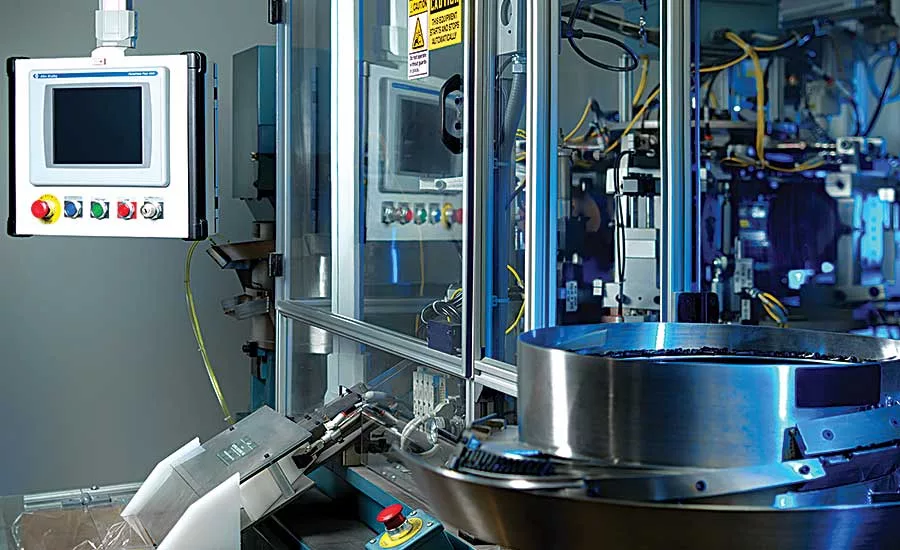
For nearly 30 years, Flocon Inc. has been manufacturing fluid applicators and dispensing systems in Illinois for applications in a wide variety of industries. Flocon’s products are used to dispense paint, lubricants, cleaning solvents, lotions, condiments, fragrance, hair spray and other fluids. Vice president Stephan Ballot attributes the decades of success to the company’s commitment to quality. With a goal of “zero field failures,” Flocon has been dedicated to manufacturing quality products without sacrificing time or cost. According to Ballot, this begins with the product design.
“Developing products that can be assembled is just as important as developing assembly processes that can put the products together,” he says. The idea is to develop products that can be manufactured and assembled in a way that is both cost and time efficient. This extend to the assembly process where semiautomatic, modular lines produce subassemblies that can be transformed into the many variations of a particular product.
Automation has been crucial to the quality of Flocon’s products. By implementing automation in the quality control department, as well as on the lines, data is provided on the parts throughout production. This data has allowed Flocon to quantify errors, going beyond accept or reject to knowing exactly how far off from “acceptable” a part may be.
Recently, we met with Ballot at Flocon’s new headquarters, a 670,000 square-foot campus in Woodstock, IL, to talk about automation and quality in their assembly process.
ASSEMBLY: This facility is five times larger than the previous facility in Cary. What prompted such a big move?
Ballot: We had outgrown our old facility. We were looking to expand our capacity, equipment and improve our processes. The move allowed us to have a more logical layout and flow of materials for use on an assembly line, as well as the staging of product between work-in-progress stages. More space also gave us logical areas for product inspection, hold and release, while allowing for much better visibility and control on the various stages of process.
Additionally, we wanted more space for collaboration and new product development.
Looking for quick answers on assembly and manufacturing topics? Try Ask ASM, our new smart AI search tool. Ask ASM
ASSEMBLY: How does the high mix of products impact the assembly process?
Ballot: We currently manufacture 22 different technologies of dispensers, each with hundreds of different configurations that require multiple processes and types of equipment. Our solution is modularized lines that allow us flexibility throughout production.
We can take starting components and turn them into a variety of different goods. In order to do so, we have to give ourselves multiple options for what equipment is going to be utilized and how. By establishing certain manufacturing and assembly productions as individual workcells, as opposed to continuous lines, it gives us flexibility and equipment utilization.
ASSEMBLY: What technologies have had the biggest impact on your processes?
Ballot: Automation has been incredible for us. Rotary indexes allow us to have semiautomatic lines that are more consistent and reduce the risk of worker injury from demanding, repetitive tasks. Within automation, the incorporation of vision systems and high-speed sensors builds quality control into the assembly process.
ASSEMBLY: Since the products are made at such high volumes, how were you able to find an assembly system that could match that?
Ballot: It’s been a combination of our own builds and outside equipment integrators. Some of the product lines are semiautomatic, where automation may be getting parts down the line with people feeding parts and putting the product together. The level of automation depends on what talent we have at the time, as well as how quickly we need to be developing. We will use outside machine builders that are highly specialized
for assembling small components at a high speed, which is crucial for us.
ASSEMBLY: How are you able to compete with imports from companies offering cheaper alternatives?
Ballot: Our first product line from 1989, which we still produce today, was competing against a series of similar technologies in Japan. At that time, Japan was a low-cost production country but what set us apart was our use of automation. Over these past 30 years we’ve built on that.
Automation keeps cost, quality and lead times consistent. It allows us to produce a predictable number of units in a period of time at a predictable cost, which gives us the opportunity to integrate new technology that continues to ensure high quality and low lead times.
ASSEMBLY: What does a system to assemble paint pens or spray valves look like?
Ballot: The typical line that we work with is a rotary index machine, and these are very compact from a plant footprint perspective. The goal that we have for a lot of our equipment is to have any individual work cell or machine assembling as few components as possible.
We feel this is better because, like people, machines that are focused on doing a few things very well will yield a much higher quality product.
This also allows us more flexibility—our typical machines will only assemble three or four components to make subassemblies that we can introduce to the next process. Our focus is making these subassemblies high-quality before they are brought to the next transformative step.
ASSEMBLY: What’s the most difficult aspect of this type of production?
Ballot: From a component standpoint, most of the products are designed to work with liquid chemicals, so there’s a tremendous amount of sensitivity to quality of seals. We take extra care in the design of equipment and the handling of components to ensure that we don’t damage or compromise any of the attributes of a good seal so as to prevent leakage, product loss or harm to an end user. The other side is that we are a fully integrated provider for certain products.
ASSEMBLY: What challenges does being a fully integrated provider present?
Ballot: For those products, not only are we manufacturing the device but also filling, labeling and packaging the entire final product. We produce a custom product line that involves 29 parts from 16 different vendors coming together in 13 transformative processes on 57 different machines for 5,400 different versions of an end product.
The complexity of this process is a challenge to lead time, machine function and quality. This also involves both human and machine production because of the number of transformative stages. There’s a great balance. Because of volume variety and cost, certain stages lend themselves better to automation or human assembly or semiautomatic assembly.
ASSEMBLY: How do you maintain all of the different machines and lines?
Ballot: There is a key staff internally that is here for maintenance and immediate attention to lines, such as general repairs and troubleshooting. This staff is also in charge of internal refurbishment and repurposing of machines, line change overs and the like. We also contract with third-party groups that help with our more specialized machines, such as the high speed machines that work at rates of 120 cycles per minute.
ASSEMBLY: Where do you see Flocon going in the future?
Ballot: In the short term, we have a number of new device technologies that we are going to begin commercializing. An issue that we’ve seen is a shortage of people, not just skilled, but people who want to work in manufacturing or industrial activities. To combat this, we’re developing further sophisticated automation that is simple to operate.
It is easy to create complex processes, but we are trying to keep things straightforward with easy to maintain uptimes and maintenance. We see ourselves investing more in internal skillsets and internal teams that develop, build and integrate a lot of equipment that is easy to work and train on, while also being more modular and flexible and easy to upgrade over time.
While we continue to modularize production and assembly, we want product engineering that is modular as well, so that the products can be unique enough to meet the customer demands yet similar enough to not slow down production. We want to design products that complement the production process.
Long term, our plan is to ensure that we are developing new technologies in both the devices and how the devices are put together.
Looking for a reprint of this article?
From high-res PDFs to custom plaques, order your copy today!