Generative Design Software Is Transforming the Design Process
Aided by cloud computing and artificial intelligence, generative design software is promising to transform the design process
This article is not as good as it could be.
I spent many days researching the topic, finding sources, conducting interviews, and finally writing and organizing what I learned. I could have included extra information or contacted additional sources. I could have polished one section or another. But, at some point, the article needed to be done. There are other articles to write. I trust you’ll find it useful—it fulfills the assignment’s requirements, at least—but, it is what it is.
Software helped. Microsoft Word made it easier to rewrite, reorganize and experiment with different ways of stating this or that. Grammar and spell checking routines caught a few errors. Sadly, however, the software didn’t write the article for me.
I daresay the process is not so different from that used by engineers when designing a new widget. You start with customer requirements; draft specifications; create concepts; experiment with materials; test designs; and tweak them until you arrive at something satisfactory. Manufacturing might suggest changes so it’s easier to produce. Management might demand that it be less expensive. Some part could be made better. Some shape could be more aesthetic. Ultimately, however, the design must be finalized. The meter is running, and there are other widgets to design. You hope consumers love it—it fulfills their requirements, at least—but, it is what it is.
Software helped. CAD software made it easier to draw and revise parts and assemblies. Design review software offered suggestions to improve manufacturability and reduce costs. Simulation software provided insight into how the design would work before resources were committed to molds or dies. Product life cycle management software ensured that design, manufacturing, service and the supply chain were all on the same page.
Sadly, however, no software could design the widget for you. You decided the shapes and dimensions of the parts based on your knowledge of the materials, the product specifications, past experience and even personal preferences. Designs were revised based on input from various constituencies. It was an iterative process.
While there may never be software to turn a jumbled collection of notes and background into a stellar magazine article, powerful new software—aided by cloud computing and artificial intelligence (AI)—is promising to transform the design process.
Looking for quick answers on assembly and manufacturing topics? Try Ask ASM, our new smart AI search tool. Ask ASM
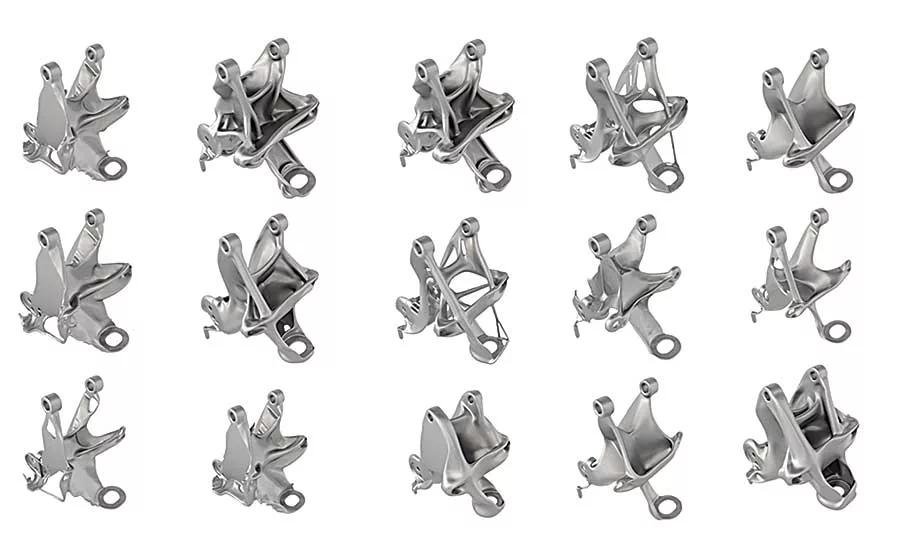
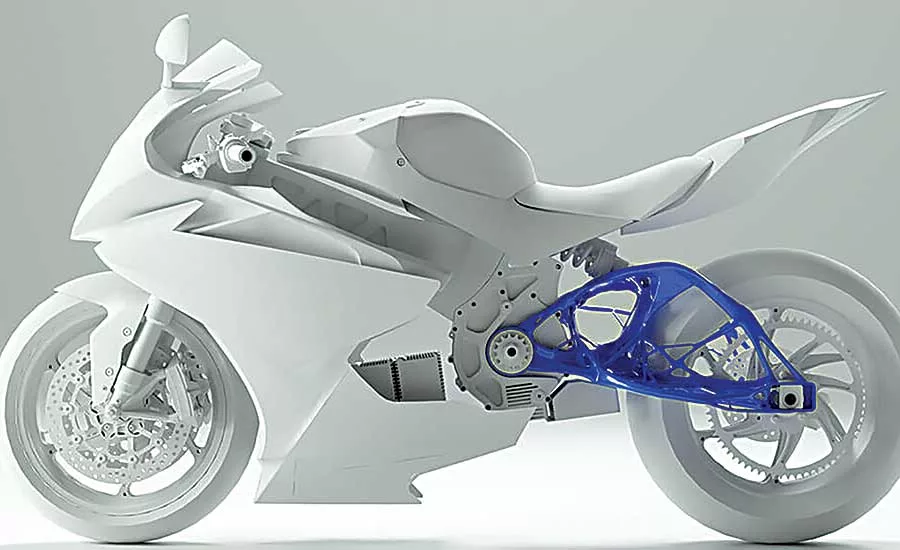
It’s known as generative design. Instead of evaluating design concepts after they’re developed, generative design lets engineers input design parameters, such as materials, size, weight, strength, manufacturing methods and cost constraints. Then, using AI-based algorithms and cloud computing, it outputs an array of design options that meet those
predetermined criteria. From there, engineers can filter through and choose the designs that best meet their requirements.
“Engineers always face time constraints,” says Brian Frank, senior product line manager for generative design and simulation at Autodesk. “They will solve the problem, but they may not always solve it well or in the best way possible. If they had more time, perhaps they would consider other options or revisit some design decisions.
“Generative design presents multiple ways to solve a problem. It can look at different materials and manufacturing processes and come up with multiple solutions to the problem. Each design will solve the problem, but they might all be very different. The software will look at different materials. It will look at milling the part, casting the part, or 3D printing it. Then, you can choose which solution works best for you, and you can have confidence in that decision.
“Using the power of cloud computing, the software can give you a hundred options within a couple of hours. You would never have time to do that manually, one design at a time.”
How it Works
Generative design software is not CAD software, but an adjunct to it. Generative design is available as part of Autodesk’s Fusion 360 CAD software, PTC’s Creo and Siemen’s NX. However, engineers do not necessarily have to change CAD platforms to take advantage of generative design.
“We’re augmenting CAD,” says Jesse Blankenship, senior vice president of technology for PTC. “We’re transforming it from the inside out: This is a real renaissance with CAD.”
Generative design is more than just topology optimization. A function of some CAD software packages, topology optimization is a mathematical method that optimizes material layout within a given design space, for a given set of loads, boundary conditions and constraints. Topology optimization is different from shape optimization and sizing optimization in that the design can attain any shape within the design space, instead of dealing with predefined configurations.
Topology optimization typically uses a finite element method to evaluate the design. The design is optimized using either gradient-based mathematical programming techniques, such as the optimality criteria algorithm and the method of moving asymptotes, or non-gradient-based algorithms, such as genetic algorithms.
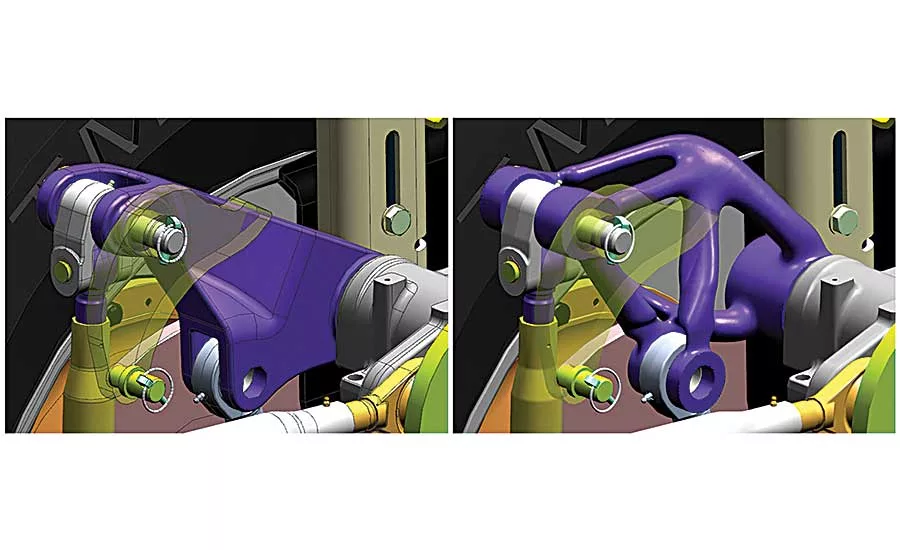
“With topology optimization, you start with a complete design, and the software tries to improve it by removing material,” explains Frank. “With generative design, you don’t have to start with a finished design. All you need are a few pieces of the puzzle.”
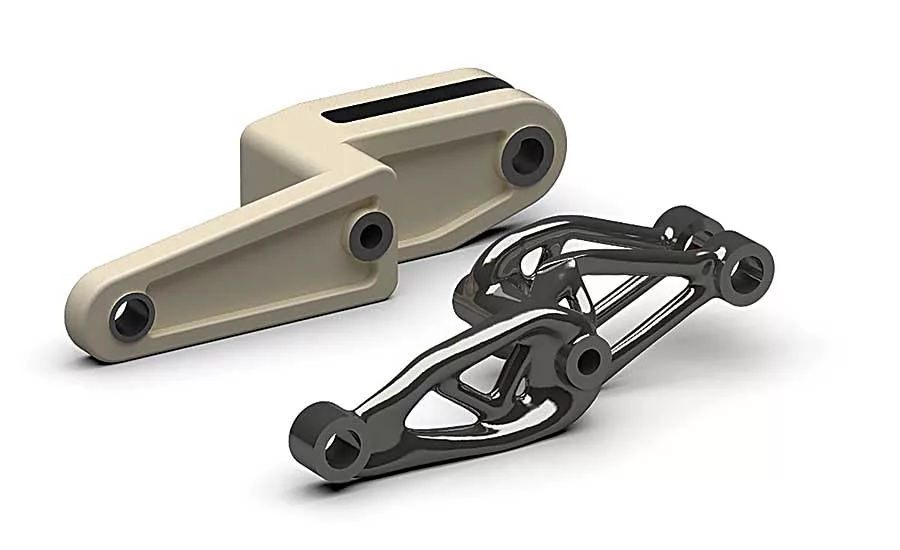
For example, when designing a lever mechanism, engineers would need to know the three points in space where the lever will connect to other parts of the machine. These are the locations or features, such as holes to accept a bolt or axle, that won’t change no matter what form the final part takes. These points are known as the “preserved geometry” of the part.
From there, engineers input various constraints and requirements. “The part must weigh no more than X grams.” “Point A will see a moment load of Y newton-meters.” Engineers can input cost requirements and safety factors, and they can ask the software to prioritize certain parameters, such as weight or strength.
Engineers can enter as much or as little information as they want. For example, if engineers already know the part must be made of, say, stainless steel, that information can be included in the constraints. If a material choice has not been made, engineers can let the software decide the best material based on the inputs. Similarly, engineers can input their preferred manufacturing methods, or let the software decide how best to make the part.
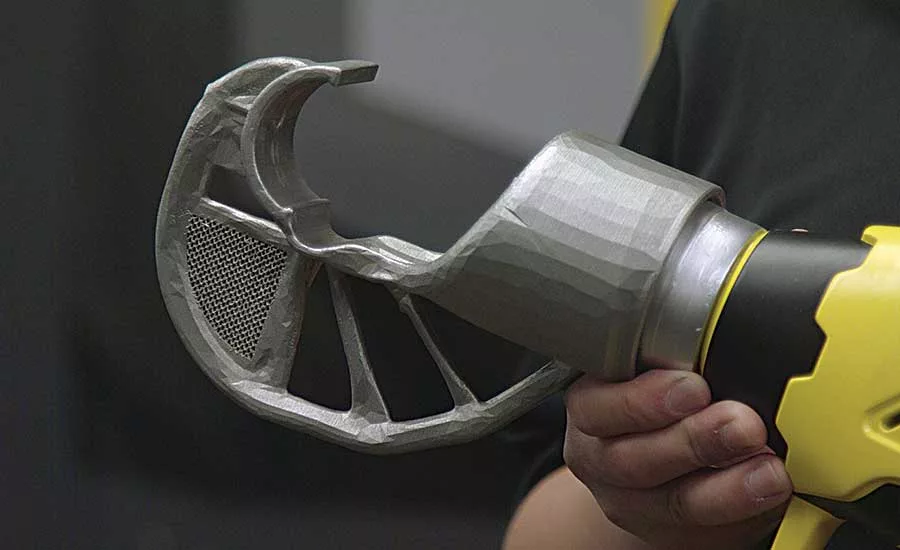
The latter feature is particularly valuable, in that it can guide engineers to a manufacturing method, such as 3D printing, that they may not have considered in the past. The software knows what can and cannot be done with a five-axis milling machine or a selective laser melting system, for example, and software developers are continually adding design rules for more manufacturing processes.
“Generative engineering is not solely about additive manufacturing—the software can consider any number of manufacturing processes,” insists Tod Parrella, product manager for NX Design. “However, the software can take maximum advantage of the design possibilities available through additive manufacturing.”
“You can tell the software which manufacturing process to use, or you can tell the software not to consider the process at all and just output the best shape that meets your constraints,” says Frank.
After all the constraints have been input, the software goes to work, generating hundreds of viable designs. “The software analyzes the design space. It understands where material needs to be and how things connect. And then it creates different iterations,” explains Frank.
How many designs are output depends on the input constraints, says Blankenship. For example, if engineers know the part must be made from steel and that it must be produced on a five-axis milling machine, the software will output fewer design options.
“However, you can ask the software to give you a spectrum of designs,” says Blankenship. “Maybe you want to vary the safety factor on a scale from one to 10. The software will generate those designs automatically, and do it in parallel. You don’t have to do all those designs manually.”
To avoid overwhelming the user with infinite variations, generative design uses AI algorithms and search engines to weed out unfeasible possibilities. For example, Siemens’ generative design software uses a hybrid and adaptive algorithm called SHERPA (Simultaneous Hybrid Exploration that is Robust, Progressive and Adaptive), explains Parrella. SHERPA employs multiple search strategies at once and adapts to the problem as it “learns” about the design space. SHERPA requires significantly fewer model evaluations than other methods to identify optimized designs. This efficiency can save days or even weeks of CPU time during common engineering optimization studies.
Once a design has been chosen, the software can export the design as an editable CAD file that can be used in downstream work flows. “Engineers can change the shape or thicken something up. It’s not a static thing,” says Frank. “It’s BREP [boundary representation] geometry that can be used downstream in any process, whether it’s stimulation, CAM, milling or additive manufacturing. You can put the file into your CAD model [of the overall assembly] for clash detection. Whatever you need.
“That’s what’s so compelling about generative design: You can go from an open design space—three points in space—to a CAD model that you can use downstream to actually make the design.”
Benefits of Generative Design
Generative design offers numerous benefits to manufacturers. First, it enables engineers to quickly find designs that strike the perfect balance between performance and cost.
With topology optimization, engineers must do a separate analysis on each design. Generative design works on multiple designs in parallel, and each iteration is a viable outcome. Engineers can “roll back” the design in time to see how the software arrived at the final design.
“That’s really powerful,” says Frank. “Maybe you don’t like the final shape, but you did like it two iterations previously. Maybe you like the aesthetics better or you think it’s going to perform better. You can choose that shape and bring it forward.”
Another major benefit of generative design is that it presents engineers with alternative methods of making something. Such was the case for Claudius Peters Group GmbH, a German manufacturer of machinery for handling and processing cement, gypsum and other raw materials. In 2017, the company used Autdesk’s generative design software to redesign a large, cast-metal part for handling clinker, a raw material needed to make cement. The part was heavy and expensive to make.
Claudius Peters’ engineers wanted to reduce the weight of the part by 25 percent. The generative design software suggested making the part from welded laser-cut plates instead of a casting. The new design was lighter, stronger, simpler and more cost-efficient.
“Our project team…understood that the electric light didn’t come from the continuous improvement of candles,” says Thomas Nagel, chief digital officer at Claudius Peters. “We needed a complete change. That’s how we came to try generative design. By inputting the project parameters, computers did the heavy lifting, freeing up our engineers to innovate.”
Another benefit of generative design is part consolidation. Fewer parts equates to less cost, since there’s less inventory, less handling, less inspection and fewer parts to assemble.
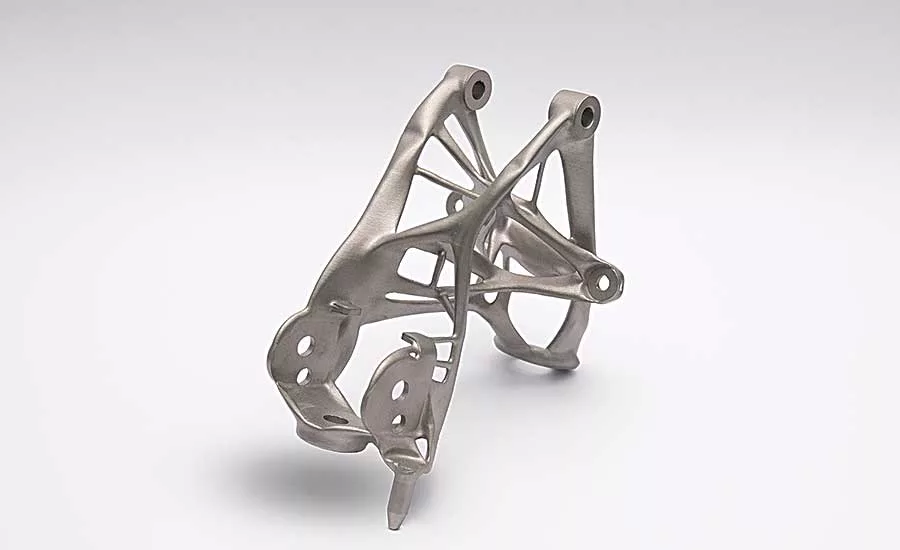
This is what General Motors discovered when it used Autodesk’s generative design software to create a new seat bracket for an electric vehicle. While the typical seat bracket is a boxy part consisting of eight pieces welded together, generative design came up with more than 150 alternative designs. The design GM chose consists of one stainless-steel piece instead of eight. Instead of stamping and welding, the new bracket is produced by 3D printing. The new part is 40 percent lighter and 20 percent stronger than its predecessor.
“The motivation to consolidate eight parts into one is twofold,” says Kevin Quinn, GM’s director of additive design and manufacturing. “One, we can optimize for mass. But another ancillary benefit is that you’re reducing all the supply-chain costs associated with having many different parts that may be made by many different suppliers, which then have to all be joined together.”
The experience has sold Quinn on the power of generative design.
“Generative design is a way for us to explore different design solutions for parts…of our vehicles by using the cloud and artificial intelligence to combine the engineer and the computer,” he says. “By getting them to work together, we can come up with part-design solutions that would be impossible to generate with either the computer or the engineer working on their own.”
Fact vs. Fiction
As with any cutting-edge technology, there are some misperceptions about generative design and what it can do. First, the software cannot design a part or assembly by itself. Engineers cannot simply enter a command like “make me a bicycle.” Rather, the software requires input from engineers, such as dimensions, loads and attachment points. The software will not put engineers out of work; it will help them come up with better designs more quickly.
“It may seem counterintuitive, but AI will increase jobs in manufacturing,” says Blankenship. “The learning curve for generative design is so much less than it is to acquire all the manufacturing know-how to design a good part. AI provides a quicker path to a better part, regardless of whether that part is cast, molded or printed, and it does so without the designer needing to know very much about how those processes work.”
“The goal of generative design is not push-button manufacturing—we’re a long way off from that,” adds Frank. “The goal is to streamline the iteration process. With generative design, you can create viable designs much more quickly—in hours or days instead of weeks or months. It’s like putting your engineering team on steroids.”
Generative design cannot replace the judgement of engineers. Rather, it presents a series of equally viable design options to choose from based on the inputs. It’s up to engineers to decide which option best suits the needs of their project and their company’s manufacturing capabilities. Indeed, engineers may ultimately choose none of the software’s recommended designs, but instead pick one as a starting point for further refinement.
“Just because the software recommends that a part be made with a particular shape or a particular manufacturing process, it doesn’t mean you have to make the part that way,” Frank points out. “Engineers can use that design as an inspiration and modify it however they wish.”
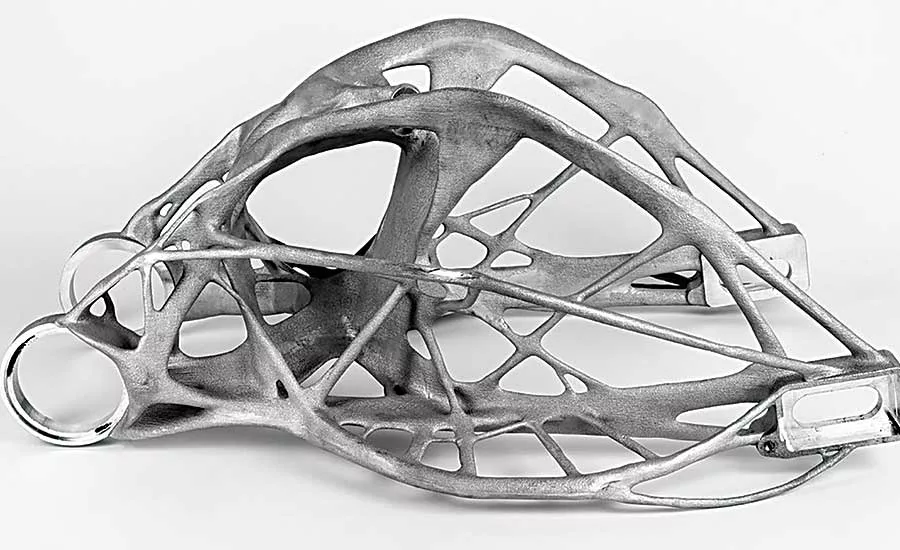
Another myth about generative design is that it’s only affordable for major manufacturing OEMs, like GM or Airbus. Small manufacturers are taking advantage of the software, too. For example, Frank says automotive racing teams are using generative design to redesign car parts to be lighter and stronger.
Design engineers aren’t the only ones using the software, either. Manufacturing engineers are using generative design to create fixtures and tooling that are lighter weight and less expensive.
“Anyone who’s using CAD today can benefit from generative design,” asserts Blankenship. “Certainly, it makes sense for aerospace and automotive manufacturers, which are so focused on weight-savings today. In aerospace, even a 1 percent savings in fuel costs can translate into millions of dollars per year.
“However, manufacturers in every industry are at least experimenting with generative design, because it can lead to product differentiation.”
Future versions of generative design software could include multiphysics tools, such as computational fluid dynamics and dynamic loading. Already, a part created through generative design in Siemens NX can be automatically routed through Siemens Simcenter to model, analyze and predict its performance.
“We’re just scratching the surface of how people are going to use this tool,” predicts Frank.
Looking for a reprint of this article?
From high-res PDFs to custom plaques, order your copy today!