Assembly Magazine logo
search
Ask ASSEMBLY AI
cart
facebook twitter linkedin youtube
  • Sign In
  • Create Account
  • Sign Out
  • My Account
Assembly Magazine logo
  • TRENDS
    • Ask ASSEMBLY AI
    • Trends
    • News
    • New Products
  • INDUSTRIES
    • Aerospace
    • Appliance
    • DFMA Assembly
    • Medical Devices
    • Green Manufacturing
    • Lean Manufacturing
    • Machinery Assembly
    • Electronics Assembly
    • Automotive
  • TECHNOLOGIES
    • Adhesives & Dispensing
    • Assembly Presses
    • Automated Assembly Systems
    • Manufacturing Management
    • Manufacturing Software
    • Motion Control
    • Screwdriving & Riveting
    • Robotics
    • Test & Inspection
    • Plastics & Metal Welding
    • Wire Processing
    • Workstations
  • AUTONOMOUS & ELECTRIC MOBILITY
    • AEM Magazine Archives
    • Autonomy
    • Electrification
    • Mobility Services
    • Assembly & Testing
    • AV/EM News
  • MEDIA
    • Ask ASSEMBLY AI
    • Podcasts
    • Assembly News Now
    • Assembly TV
    • Webinars
    • eBooks
  • EVENTS
    • Calendar
    • The ASSEMBLY Show
  • MORE
    • Exclusives >
      • Plant of the Year
      • Capital Spending
    • Buyers Guide >
      • Supplier Insights
    • Classifieds
    • Featured Products
    • Newsletters
    • Store
    • White Papers
    • Columns
    • Sponsor Insights
  • INFOCENTER
    • Assembly & Test Solutions
  • EMAGAZINE
    • eMagazine
    • Archive Issues
    • Advertise
    • Contact Us
    • Sign Up
Wire Processing AssemblyWorkstations Assembly

The Ergonomics of Wire Harness Assembly

Manual tasks pose numerous risks to assemblers
By Austin Weber
The Ergonomics of Wire Harness Assembly
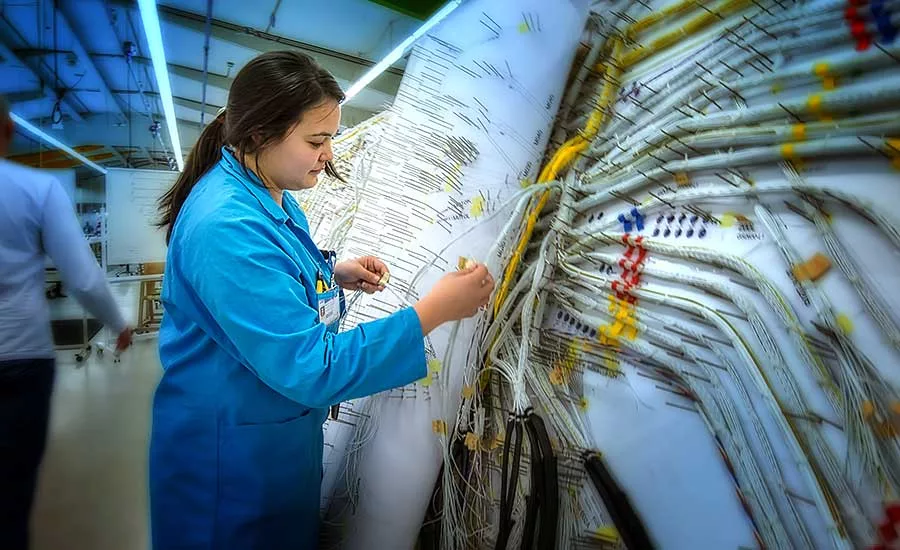
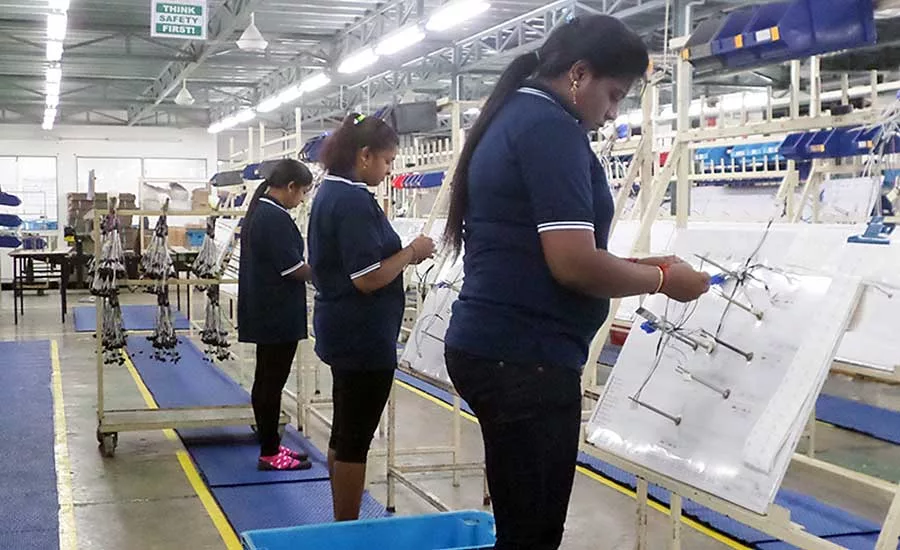
Poor postures are common with wire harness production, because most assemblers stand and bend over.
The Ergonomics of Wire Harness Assembly
Carpel tunnel and tendonitis are two of the more common repetitive motion injuries associated with wire processing.
The Ergonomics of Wire Harness Assembly
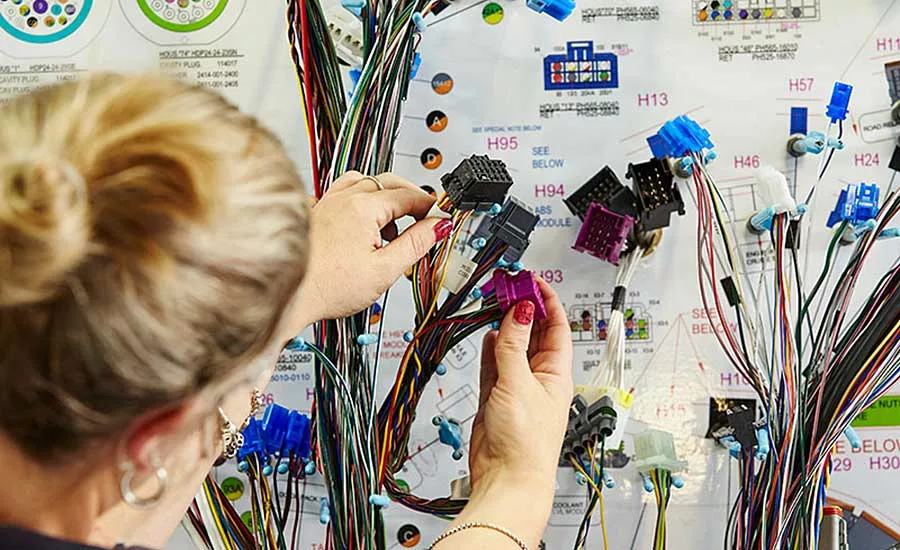
Inserting wires into connectors can cause finger and hand injuries.
The Ergonomics of Wire Harness Assembly
October 15, 2020

When it comes to assembling wire harnesses, humans still do it better than automation. That’s why wire processing remains a largely manual process. However, it also poses a number of ergonomic issues and concerns, including the risk of back, finger, neck, shoulder and wrist injuries.

Assemblers bend and reach to run wire from pin to pin. They use hand tools to cut, crimp, strip, tie and tape wires. Assemblers also insert wires into connectors and terminals. To prevent repetitive stress injuries, engineers must pay close attention to ergonomics.

Carpel tunnel and tendonitis are two of the more common repetitive motion injuries associated with wire processing. On final assembly lines, inserting harnesses into appliances, boats, buses, cars, planes, trains, tractors, trucks and other products also presents numerous ergonomic challenges.

“Wiring harness assembly is a big pain in the neck,” says Cindy Roth, CEO of Ergonomic Technologies Corp., a consulting firm that has worked with manufacturers in a variety of industries. “It’s lousy for any type of ergonomic interventions.

“The body parts at the highest risk of injury are calves, hands, necks and shoulders,” notes Roth. “Poor postures are common. That’s because most assemblers stand, bend over at their necks and hunch their shoulders. Hands also have to perform a lot of repetitive tasks that require forceful movements.”

“Wire harness assembly is very hand intensive,” adds Julia Abate, executive director of the Ergonomic Center of North Carolina. “Anytime you’re doing any manual tasks that are repetitive, such as wire cutting, stripping, crimping or wrapping, there’s a greater risk for injury. Holding wires or fitting wires into connectors requires a lot of two-finger and lateral pinches, which can cause problems.

“Seated work is OK, as long as there’s not a lot of reaching,” explains Abate. “But, the majority of wire harness assembly work is done standing.”

Looking for quick answers on assembly and manufacturing topics? Try Ask ASM, our new smart AI search tool. Ask ASM →

According to Abate, engineers should also pay careful attention to how much force is required for insertion. Another often-overlooked fact is that a lot of women work in wire harness production.

“Women don’t have the same amount of strength required for forceful grips and squeezing,” warns Roth. “Years ago, everything was designed for the 50th percentile male. Today, manufacturers need adjustable tools and workstations that can easily accommodate different people on multiple shifts.”

To address the issue, some suppliers have developed workstations that can be easily adjusted.

“Believe it or not, there are still shops that assemble harnesses using sheets of plywood held up by two-by-fours,” says Bob Simmons, senior vice president at Pro-Line, which offers a variety of manual and automated workstations for wire processing applications.

“For high-volume, low-mix wire harness production, workstations equipped with a hand crank and a manual tilt mechanism work well,” explains Simmons. “But, electric height-adjustable tables are preferred by manufacturers that specialize in low-volume, high-mix production.

“That enables operators to easily access different corners or sides of a harness,” Simmons points out. “On large boards, they can easily raise it to work on the bottom or lower it to work on the top. It eliminates the need to bend down and reach up all day, which can impact productivity.”

Ergonomics is based on addressing four primary biomechanical risk factors: the amount of force applied, how awkward the working postures are, how much time is spent in these awkward postures, and how often the forces and postures are repeated.

“The most effective thing you can do is to focus on the highest force tasks,” says Rick Barker, senior technical manager at VelocityEHS Humantech, an ergonomics consulting firm. “Crimping, bending wires and installing boxes in panels are common examples of high-force tasks.

“The next priority should be those tasks with the most severe awkward hand postures, such as wrapping and tying,” claims Barker. “To improve ergonomics, [it’s important] to examine the task components of each job.

“In some cases, an improved crimping tool is going to provide the biggest benefit,” notes Barker. “In others, the best answer might be a hand tool that provides leverage when bending wires.

“Wire harness designs can be quite different and the ergonomics considerations with a harness can be just as different,” says Barker. “You must look at the specific aspects of each unique harness rather than make generalizations. The key is to understand the unique demands of the specific design and determine which aspects could benefit most from an improvement.

“Thicker gauge wires are going to involve greater forces to cut, crimp and bend into position,” explains Barker. “Very fine gauge wires pose unique challenges relating to the types of grips and the prolonged, awkward postures, even if the forces aren’t nearly as high. One harness may have a considerable amount of tight hand-wrapping, while another may only require a few ties applied with a tool.”

“Wire harness manufacturing poses many ergonomic challenges due to the type of motions and the high number of repetitions required,” adds Scott Lesniak, business development manager at Panduit Corp. “Operations requiring hand actuation using a squeezing motion are the most common cause of injury. The higher the squeeze force, the more likely an operator will begin to have issues.”

To tackle the problem, Panduit recently developed the PAT 4.0 flush-mount fixture.

“The PAT 4.0’s flat design allows operators to apply cable ties by simply sliding the work into position, rather than lifting the work from the workstation and holding it in place,” explains Lesniak.

“The new flush-mount fixture also includes a lightweight trigger paddle that eliminates the need for a traditional-style foot pedal by actuating as the work is placed into the jaws of the installation tool,” says Lesniak. “Overall, this is the most ergonomic cable tie installation system available.”  

KEYWORDS: ergonomics flexible assembly lean engineering

Share This Story

Looking for a reprint of this article?
From high-res PDFs to custom plaques, order your copy today!

Austinweber headshot
Austin has been senior editor for ASSEMBLY Magazine since September 1999. He has more than 21 years of b-to-b publishing experience and has written about a wide variety of manufacturing and engineering topics. Austin is a graduate of the University of Michigan.

Recommended Content

JOIN TODAY
To unlock your recommendations.

Already have an account? Sign In

  • Made in the U.S.A.

    Consumer Products Manufacturing: Made in the USA

    Supply chain lessons learned during the coronavirus...
    Automated Assembly Systems
    By: Austin Weber
  • Best Practices for Press-Fit Assembly

    Best Practices for Press-Fit Assembly

    In manufacturing, ironclad formulas for success are hard...
    Assembly Presses
    By: Jim Camillo
  • aem0523leader-tesla1.jpg

    Tesla Rethinks the Assembly Line

    Engineers at Tesla Inc. have developed a new process that...
    Automotive Assembly
    By: Austin Weber
Manage My Account
  • eMagazine Subscription
  • Assembly Newsletters
  • Online Registration
  • Subscription Customer Service
  • Manage My Preferences

More Videos

Sponsored Content

Sponsored Content is a special paid section where industry companies provide high quality, objective, non-commercial content around topics of interest to the ASSEMBLY audience. All Sponsored Content is supplied by the advertising company and any opinions expressed in this article are those of the author and not necessarily reflect the views of ASSEMBLY or its parent company, BNP Media. Interested in participating in our Sponsored Content section? Contact your local rep!

close
  • ultrasonic welding
    Sponsored bySonobond Ultrasonics

    Engineering Efficiency in High-Performance Assembly: How Ultrasonic Welding Enhances Throughput, Reliability and Quality

  • UV curing system
    Sponsored byDymax

    Why UV Intensity Alone Doesn’t Define Curing Performance

  • wooden pallets
    Sponsored byLEAN Manufacturing Products

    Eliminating Waste on the Shop Floor: Applying Lean Principles to Improve Manufacturing Efficiency

Popular Stories

ASSEMBLY News Now, episode-30: Volvo Redesigns EV Manufacturing

Volvo Redesigns EV Manufacturing

Boeing CEO Kelly Ortberg announces 1 billion investment

Boeing Plans $1 Billion Wichita Investment, Workforce Training Center

GE Appliances Worker on Line

GE Appliances Expands Factory AI With 800 Gemini Enterprise Agents

Watch the latest episode of ANN now!

Events

July 24, 2025

From Shop Floor to CFO: How Manufacturers Are Closing the Loop Between Operations and Finance

On Demand Learn how manufacturers are bridging the gap between the shop floor and ERP systems to gain real-time visibility, streamline operations, and kick-start digital transformation—without waiting years.

Sponsored by:

PicoStratusGreen
July 30, 2025

Buffer Analysis and Design Fundamentals for Manufacturing Excellence

On Demand In this presentation, Dr. Herman Tang shares practical insights from his industry experience and research on buffer management in manufacturing operations.

View All Submit An Event

Poll

Difficult Assembly Processes

Which assembly process gives you the most difficulty?
View Results Poll Archive

Products

Manufacturing Cost Policy Deployment (MCPD) Profitability Scenarios: Systematic and Systemic Improvement of Manufacturing Costs

Manufacturing Cost Policy Deployment (MCPD) Profitability Scenarios: Systematic and Systemic Improvement of Manufacturing Costs

See More Products
Register for webinar - Modernizing Automotive Assembly: Why Upgrading Legacy MES is a Business Imperative

Related Articles

  • KSK harness

    Meeting the Challenges of KSK Wire Harness Assembly

    See More
  • University of Tennessee engineers have developed a robotic wire harness assembly system.

    Young Engineers Tackle Robotic Wire Harness Assembly

    See More
  • NECYazaki.png

    Yazaki and NEC Use AI to Control Wire Harness Assembly Robots

    See More

Related Products

See More Products
  • smart.jpg

    Handbook of Smart Manufacturing Forecasting the Future of Industry 4.0

  • history.jpg

    Faster, Better, Cheaper in the History of Manufacturing: From the Stone Age to Lean Manufacturing and Beyond

  • digitalization.jpg

    The Digitalization of the 21st Century Supply Chain

See More Products

Related Directories

  • Proline

    Pro-Line offers Modular Ergonomic Industrial Workbenches. Including four leg benches, height adjustable benches, assembly workstations, wire harness benches, clean room, Ball Transfers, packaging benches, modular cabinets and Lab furniture and more. Many units "IN STOCK".
  • A'Gain Digitech Pvt. Ltd.

    A' gain Digitech is a technology company with specialized solution A'Gain Smart Board 1 : The ASB 1 is an embedded system developed to transform the wire harness assembly process. It is a tech-forward, practical & versatile solution to the challenges posed by traditional assembly boards. Wire harness manufacturing anchored on the ASB 1 delivers excellent results for productivity, capacity building & scalability. QUAD 64 Quad 64 is a technology product developed to simplify and enhance wire harness testing processes across enterprises. The apparatus is a compact, integrated, and interconnected system supported by a software-based Data Management dashboard with an intuitive GUI. A first-of-its-kind patented product that is poised to disrupt & revolutionize harness testing.
×

Never miss the latest news and trends driving the manufacturing industry

Stay in the know on the latest assembly trends.

JOIN TODAY!
  • RESOURCES
    • Advertise
    • Contact Us
    • Directories
    • Manufacturing Division
    • Store
    • Want More?
  • SIGN UP TODAY
    • Create Account
    • eMagazine
    • Newsletters
    • Customer Service
    • Manage Preferences
  • SERVICES
    • Marketing Services
    • Reprints
    • Market Research
    • List Rental
    • Survey/Respondent Access
  • STAY CONNECTED
    • LinkedIn
    • Facebook
    • Instagram
    • YouTube
    • X (Twitter)
  • PRIVACY
    • PRIVACY POLICY
    • TERMS & CONDITIONS
    • DO NOT SELL MY PERSONAL INFORMATION
    • PRIVACY REQUEST
    • ACCESSIBILITY

Copyright ©2026. All Rights Reserved BNP Media, Inc. and BNP Media II, LLC.

Design, CMS, Hosting & Web Development :: ePublishing