Software Keeps STIHL’s Assembly Machines Up and Running
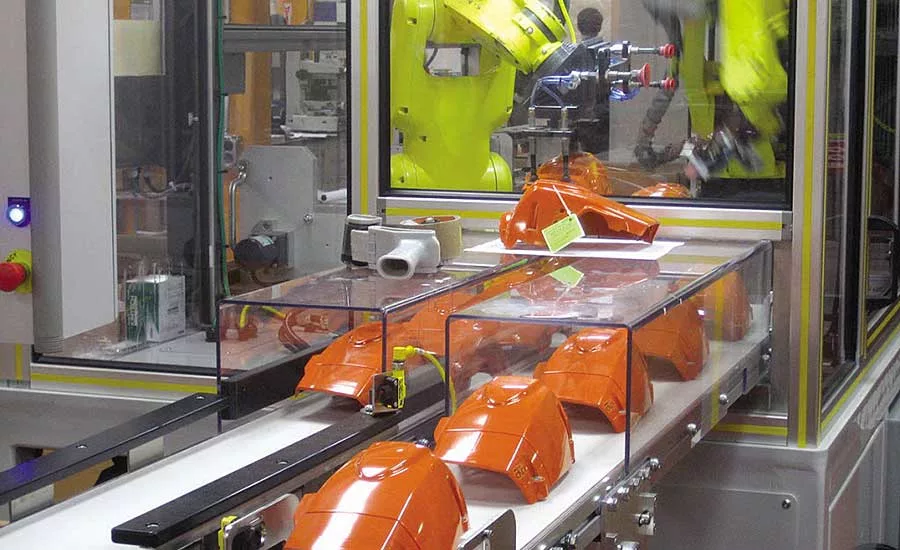
Versiondog software helps STIHL back up data and manage the control programs for production equipment. Photo courtesy STIHL Group
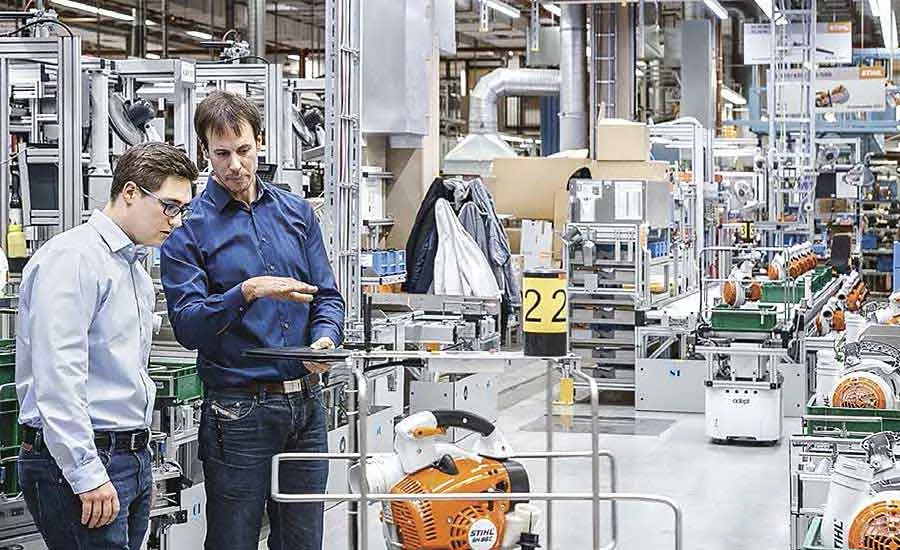
Building services engineers work with Versiondog software, too. They use it for managing circuit diagrams and ventilation and light controller programs. Photo courtesy STIHL Group
STIHL is a German manufacturer of chainsaws, trimmers, blowers and other handheld power equipment. Founded in 1926, the family-owned company is only chain saw manufacturer to make its own saw chains and guide bars. The company’s factory in Virginia Beach, VA, is ASSEMBLY magazine’s 2014 Assembly Plant of the Year.
At STIHL manufacturing facilities, maintenance is organized into two divisions. Each division has its own maintenance team that uses their technical expertise to monitor and maintain the plant’s daily operations. Situated above them is a central maintenance pool, which is made up of specialists whose job it is to support the on-site teams when there are time constraints or when specialized know-how is required.
Due to their geographical proximity, the maintenance teams working at STIHL’s assembly plants in Waiblingen and Ludwigsburg, Germany, can easily exchange ideas and share experiences. That isn’t quite the case with the STIHL maintenance teams located in Switzerland, the USA, Brazil and China. However, the lack of frequency is made up for by the quality of the exchanges; when they do take place, they are run in the form of workshops conducted by in-house staff who make production equipment for the company.
STIHL believes that designing and making its own production equipment gives the company an important competitive advantage. The goal is to ensure the greatest possible utilization of plant capacity. According to Thomas Ruppmann, who has been involved in the design of production facilities at STIHL since 1991, it is invaluable for operations that “the plant constructors are in-house and readily available. When we build our own plants, then we are responsible for them for their entire service life. This means that, from the planning stage to the manufacturing stage, it is in our interest to ensure that the quality of the machinery is as high as possible so that it will pose few problems in the future.”
One tool that helps STIHL engineers keep equipment up and running is Versiondog software from AUVESY GmbH. The software provides uniform central data storage, automatic data backup, version management with detailed change detection, and clear documentation.
Ruppmann has been a versiondog user since the very beginning. “We always carry out user management in twos, then we create a backup job and check to see that the system continues to run as it should,” he says.
Ruppmann’s team is supported by central IT, who are responsible for ensuring the availability of the network infrastructure and server. Ruppmann previously worked with an older version-control system called VersionWorks and later helped the company to transition to Versiondog. “It is a convenient, easy-to-use tool that helps us greatly in our daily work,” he says.
Looking for quick answers on assembly and manufacturing topics? Try Ask ASM, our new smart AI search tool. Ask ASM
At the beginning of the backup era, data management was not yet a problem, at least not when it came to the task of looking for the latest software version, Ruppmann explains. This was because large programming devices were wheeled into the production areas. As such, “it was always clear where the data was,” Ruppmann recalls.
However, as the task of backing up data began to involve the use of portable data storage devices, especially USB sticks, it began to get more difficult. There was a risk of misplacing data storage devices. As such, the reason for introducing Versiondog did not so much stem from a need to reduce time spent looking for the latest software version. Rather, it was part of an ongoing endeavor to optimize processes.
Bit by bit, Versiondog was implemented across all machines and in all areas of production. Today, at the STIHL headquarters in Waiblingen, some 220 users work with Versiondog. Even though production facilities constitute the focal point of Versiondog’s work, the software is not only involved in production. Building services engineers work with the software, too. They use it for managing circuit diagrams and ventilation and light controller programs. It also helps those involved in quality assurance testing.
Since the requirements of these functional areas vary, access rights are allocated differently. The information needed by the facility management is different from that required by maintenance. Versiondog enables managers to control access rights. For assembly line construction, access rights are restricted, particularly where specialized knowledge is involved.
“We are already using the system when we make production equipment to archive intermediate stages of construction,” says Ruppmann.
Occasionally, during the commissioning stage of a plant, a section may need to be reprogrammed. On those occasions, it is beneficial to go back to a previous version.
“I can certainly say that we have found a tool with which we are able to access all necessary information about the plant on the spot,” says Ruppmann. “This ease of access frequently helps to reduce downtime at the plant.”
With the help of an extensive WLAN system, it is possible to use Versiondog to access program versions of individual PLCs, as well as electrical and pneumatic circuit diagrams, which the maintenance team also refer to as “Quicktipps.”
It is possible to access instructions and documents of both common and not-so-common devices from all production areas.
The first task for Versiondog was the task of backing up PLC software. The more the team’s confidence in using the application grew, the more possibilities the software revealed. One feature of the software that is appreciated is the fact that it can integrate important editors, so engineers can work in a familiar environment.
“All we have to do is define the directories and project tree structure. There is no need to additionally program the system to do this,” Ruppmann explains.
Today, all STIHL production facilities in Germany have implemented Versiondog as part of their data management strategy. This encompasses some 3,000 machines and 7,600 components. Each production facility has set up three components as standard: controller programs, circuit diagrams and documentation. If needed, engineers can add additional subdirectories—for instance, for robots or tightening system controllers.
Documentation includes a variety of files, including PDFs and Excel spreadsheets—everything to do with control technology that can be saved in a file format. Since the introduction of Versiondog, some 46,000 file versions have been created and checked in. Despite that high total, the software does not require a lot of memory. The amount of storage required on the server amounts to less than 1.5 gigabytes.
At STIHL, only the latest version of a file is checked out by default to save time. “What’s more,” says Ruppman, “the process of carrying out a comparison of an S7 unit, for example, is very quick.”
Versiondog’s “Factory Floor Status” feature is a useful WebClient add-on that enables engineers to see the status of all devices and equipment that are integrated in the system according to a number of device-specific monitors, such as installed firmware, MLFB numbers, force values, RAM use and cycle time.
Devices are backed up at STIHL on a daily basis to ensure that the latest production data is always available. Backups enable the detection of unintended changes. As backups are run in the background, they do not have to be constantly monitored. When anomalies are detected, members of the appropriate team will receive immediate notification via email.
Ruppmann says he rarely needs to call the AUVESY support hotline. “The system is stable and very intuitive to use,” he says.
It only takes a short amount of time to train new team members to use the system, and acceptance of the software is high.
For more information on manufacturing software, visit https://auvesy-mdt.com/en.
Looking for a reprint of this article?
From high-res PDFs to custom plaques, order your copy today!