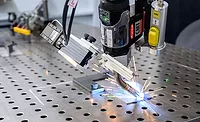
Cobots Can Weld
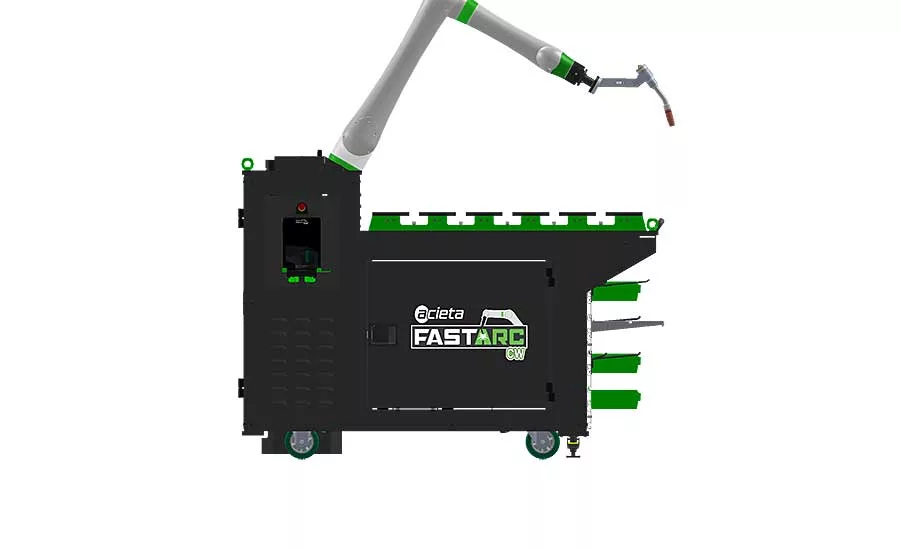
The FastARC CW includes a FANUC six-axis cobot mounted on a mobile platform to move quickly between production areas. Photo courtesy Acieta
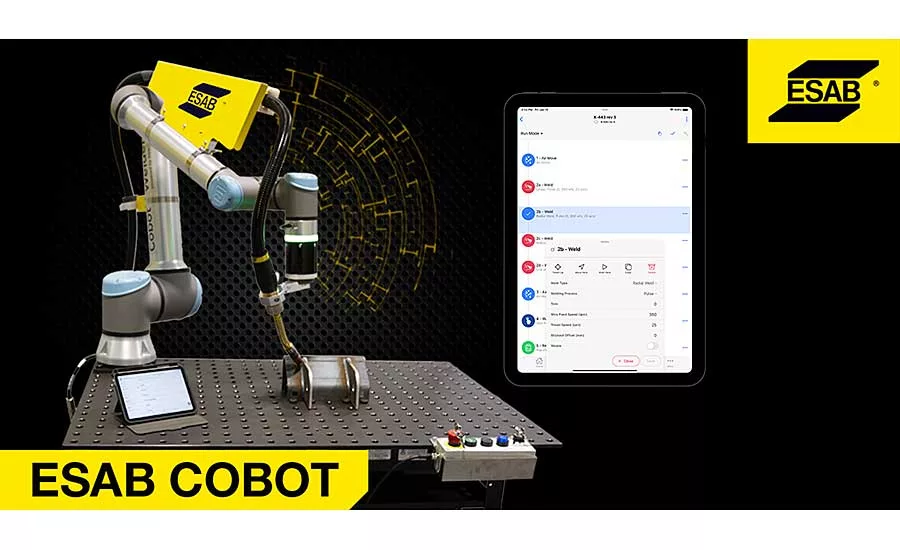
The ESAB Cobot enables operators to teach welding paths using a software app that runs on a standard smartphone or tablet and a “Smart Puck” to hand-guide the torch and record its position. Photo courtesy ESAB Corp.
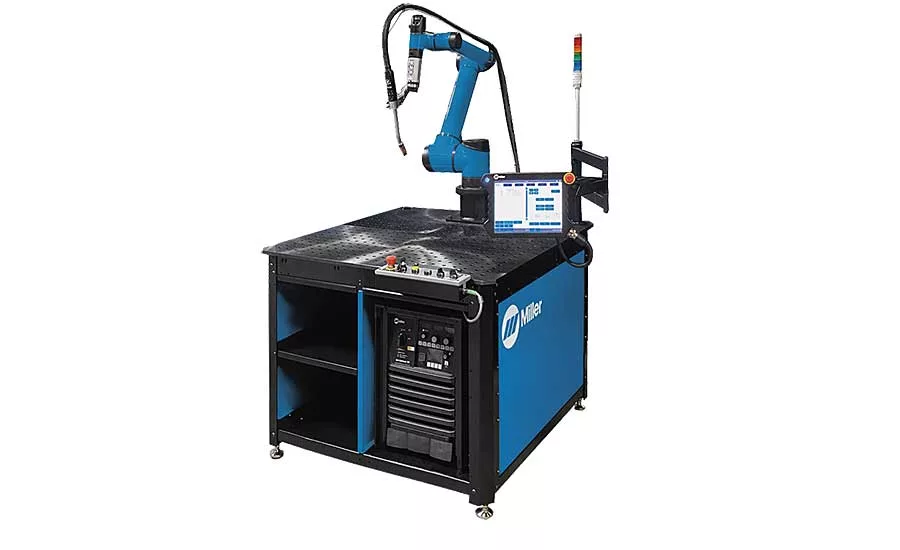
The Copilot Collaborative Welding System is an entry-level cobot for shops that are new to robotic welding. Photo courtesy Miller Electric Manufacturing
Machine tending is, by far, the most popular application for collaborative robots. It’s a perfect fit for a cobot’s unique ability to work alongside or together with people without safety fencing.
That’s not to say, however, that process tasks, such as welding, cannot be done with cobots. They can. Granted, equipping a cobot with an arc-welding torch will require engineers to re-evaluate the notion of “inherently safe” operation. But, there are other advantages to using cobots for welding.
One is ease of programming. Cobots can be programmed with CAD-CAM technology, a teach pendant, or simply by manually positioning the arm in “free drive” mode at specific points or along a specific path. This enables anyone with welding experience to program a cobot.
Cobots also enable manufacturers to make better use of their talent. With cobots handling routine or repetitive welds, experienced welders have higher job satisfaction doing more stimulating work that better utilizes their skills. Employers with higher production and lower costs may be able to offer more competitive salaries to retain their skilled welders.
Here’s a look at the latest technology for welding with cobots.
FastARC CW Cobot
The FastARC CW from Acieta includes a FANUC CRX-10iA/L six-axis cobot mounted on a mobile platform to move quickly between production areas. The system is compatible with Fronius, Lincoln Electric and Miller welding units.
Intuitive software and a touchscreen interface make the FastARC CW simple to set up and operate so it can be managed by a less skilled worker. One person can operate several cobots simultaneously for maximum productivity.
Looking for quick answers on assembly and manufacturing topics? Try Ask ASM, our new smart AI search tool. Ask ASM
The weld table is 46 inches square and can accept a maximum part weight of 750 pounds. At full reach, the robot can weld a part as tall as 27.5 inches.
With the FastARC CW, people can safely load and unload parts while the cobot welds so the system runs continually. If the low-speed arm bumps into a person or object, the cobot stops immediately. No safety fencing is needed, which saves on costs and floor space.
“Typical FastARC cobot users see return on investment in as little as six months, based on a two-shift operation, because they are making more product at a much lower cost per part,” says Steve Alexander, vice president of Wisconsin operations at Acieta. “The FastARC CW is a pre-engineered standard product that helps us keep costs low and helps manufacturers stay more competitive.”
For more information, click www.acieta.com.
Copilot Collaborative Welding System
The Copilot Collaborative Welding System from Miller Electric Manufacturing is an entry-level cobot with advanced capabilities designed for shops that are new to robotic welding and looking for ways to keep up with demand.
The welder-centric design removes complexity and makes it easy to handle quick changeovers for high-mix, low-volume parts.
“Our goal was to create a system that’s focused on automated welding for users who have never programmed robots before—to take their different skill levels and amplify them,” says David Savage, product manager for Miller Welding Automation.
Rugged and reliable, the Copilot system is the only cobot with Miller-developed software, fine-tuning capabilities, and the ability to easily set and store parameters. Powered by the Auto-Continuum 350 welding power source and featuring Accu-Pulse, Versa-Pulse and Regulated Metal Deposition welding processes, the Copilot system will grow with businesses as they take on more projects.
For accurate welds, the AccuGuide Precision Joystick simplifies precise gun positioning and adjustment with easy, fingertip control. Intuitive software takes the guesswork and complexity out of weld settings. Welders simply input the material thickness and wire diameter, and IntelliSet technology will configure the ideal settings for the best results.
Designed with a tooling hold pattern that is compatible with most modular fixturing, the robust 48 by 48 inch table can hold up to 1,500 pounds.
“A common reaction to automation offerings is concern that ‘robots will take my job.’ We’re finding that with the Copilot system, it’s just the opposite,” says Ross Fleischmann, marketing manager for Miller Welding Automation. “Welders quickly identify that it’s another tool to help them, like their MIG gun. With the Copilot system, the skilled welding workforce is going to increase their value and extend their capabilities.”
For more information, visit www.millerwelds.com.
ESAB Cobot
ESAB Corp. has introduced its first cobot for MIG and pulsed MIG welding applications on steel, stainless steel and aluminum alloys. The ESAB Cobot enables operators to teach welding paths using a software app that runs on a standard smartphone or tablet (Apple iOS or Android) and a “Smart Puck” to hand-guide the torch and record its position with the push of a button. The cobot costs a fraction of a pre-engineered robot cell, does not require a programmer, and deploys in a matter of hours.
“The ESAB Cobot gives small- and medium-sized fabricators the freedom to automate high-mix, low-volume applications while improving productivity 200 to 400 percent,” says Olivier Biebuyck, president of fabrication technology at ESAB. “With its intuitive operation, we have revolutionized automated welding while addressing the industry’s foremost issues: improving productivity and finding more workers. Using an ESAB Cobot, fabricators can improve quality, weld more parts without adding staff, and free their skilled welders to concentrate on other value-driven tasks.”
The ESAB Cobot features a Universal Robots UR10e cobot arm. Welding components include ESAB’s Aristo 500ix pulse power source, the RobustFeed U82 wire feeder, an air- or water-cooled torch, and accessories.
A Siegmund 32 by 48 inch welding table organizes components and allows welders to move the cobot around a shop. The entire package ships on a pallet typically within two to three weeks of ordering from a distributor. Setup takes a few hours following step-by-step instructions accessed with a QR code. If operators have the skills to set up an industrial MIG system, they have the skills to start automated welding with the ESAB Cobot.
The ESAB Cobot enables operators to teach welding paths using a software app that runs on a standard smartphone or tablet and a “Smart Puck” to hand-guide the torch and record its position. Photo courtesy ESAB Corp.
“The ESAB Cobot is a game-changer because it enables fabricators to enjoy the benefits of automation without any of the historical complexity or costs associated with automation,” says Dan Colvin, vice president of sales for automated systems at ESAB. “The ESAB Cobot deploys rapidly to address immediate needs, such as bidding on new projects, reducing delivery time to existing customers, and improving repeatability.”
The cloud-connected ESAB software app offers free and fast in-app support from a team of experts that responds to inquiries in two minutes or less, as well as access to articles and extensive list of tutorials. The app automatically stores weld sequences, enabling them to be recalled even if they are deleted from a device. Users can add charts to track production data and consumables use, as well as share part programs between cobots.
The software app’s basic plan is free. A “pro plan” extends chart visibility from seven to 30 days and enables users to export chart data. It also enables additional features, such as requiring a password log-in and attaching photos and files to a part (such as photos showing part location on the table or a PDF of welding procedures).
The Aristo 500ix power source has a maximum welding output of 500 amps. It features stable arc in all transfer modes, including reduced spatter with short circuit MIG, as well as all the benefits associated with pulsed MIG (little to no spatter, reduced heat input to prevent burn-through and preserve mechanical properties, all-position welding, and using the next size larger wire diameter).
The RobustFeed wire feeder has a completely sealed wire feed compartment to protect the internal components and the wire against grinding dust. To further ensure wire integrity, a heater inside the wire feed compartment prevents moisture and reduces the risk of defects related to porosity or hydrogen inclusion.
Users control welding functions with the U82 control panel. The panel offers pre-programmed synergic lines, which enable fabricators to begin welding faster and reduce change-over time between parts.
For more information, visit https://esab.com
Looking for a reprint of this article?
From high-res PDFs to custom plaques, order your copy today!