Plastics Assembly: Profit From Green Plastics
Bioplastics promise to reduce our dependence on foreign oil-and can save assemblers money, too.

Peas, corn, potatoes, soybeans, wheat, beets, rice, canola oil, kelp, sugar, tapioca, castor beans and algae. No, these are not the ingredients for a most unappealing dinner. Instead, they could be something even more astonishing-the components of your next assembly.
Over the past few years, researchers have developed innovative, cost-effective ways to turn corn, soybeans and other plant materials into plastics with little or no need of petroleum. These bioplastics are being made into simple molded products, such as bottles, packaging, flowerpots and eating utensils, as well as parts for complex assemblies, such as automotive components, laptop computers, sporting goods, pens and household goods. Bioplastics are also being used to make fibers for carpets and upholstery, and films for bags and agricultural purposes.
If bioplastics aren’t big business now, they will be. By 2013, manufacturers worldwide will buy 900,000 tons of bioplastic worth $2.6 billion, according to market research firm The Freedonia Group. That’s more than four times the current market for bioplastics. (In comparison, manufacturers consume 500 million tons of petroleum-based plastic annually.)
A separate study sponsored by bioplastics manufacturer Cereplast Inc. projects that the U.S. market for bioplastics could top $10 billion by 2020, a tenfold increase from 2007 sales. Some estimates point to bioplastics capturing 30 percent of the total plastics market within 10 years.
“American consumers are pushing major manufacturers and retailers to make the switch to environmentally conscious [materials],” says Frederic Sheer, founder and CEO of Cereplast. “Many of the largest retailers have already made inroads with programs designed to adopt alternative packaging.”
As much as manufacturers want to trumpet themselves as being ecofriendly, the increasing interest in bioplastics is actually being driven by the bottom line. The rising cost of crude oil and natural gas has made bioplastics more cost-competitive with petroleum-based resins, particularly if the price of oil exceeds $70 per barrel. Indeed, bioplastics are often less expensive than comparable petroleum-based plastics.
Bioplastics are made mostly or entirely from renewable plant materials. They may or may not be mixed with petroleum-based polymers or inorganic materials, such as glass fibers. Bioplastics may or may not be recyclable or biodegradable.
Biodegradable plastics can be broken down into their constituent compounds by naturally occurring microorganisms. Biodegradable plastics can be made from either plant-based or petroleum-based sources.
The green label has been applied to bioplastics, biodegradable plastics, recyclable plastics and even high-strength engineering plastics, because they replace metal parts.
There are many types of bioplastic. One of the most common is polylactic acid (PLA), a transparent plastic that is typically produced from corn. To make its Ingeo brand of PLA, NatureWorks LLC harvests corn starch and enzymatically hydrolyzes it into glucose. Next, microbial fermentation converts the glucose to lactic acid, which is then polymerized into PLA.
DuPont uses a similar process to make its Sorona EP thermoplastic polymer, which exhibits performance and molding characteristics similar to high-performance polybutylene terephthalate.
Braskem SA makes a polyethylene sourced entirely from sugarcane. It’s the first time a substance exactly equivalent to petrochemical polyethylene has been produced from nonpetroleum sources. To make its bioplastic, Braskem starts with ethanol produced from sugarcane and converts it into ethylene through ethanol dehydration. This transfers 99 percent of the carbon in ethanol into ethylene, which is then polymerized.
Solvay Indupa takes Braskem’s process a step further, converting the sugar-derived ethylene into polyvinyl chloride that is indistinguishable from petroleum-based PVC. The company even uses renewable plasticizers, such as epoxidized soybean and linseed oils, to create flexible PVC formulations.
Bioplastics can be processed with many conventional techniques, including extrusion, injection molding, blow molding, compression molding and blown film, says David Grewell, Ph.D., an assistant professor of agricultural and biosystems engineering at Iowa State University. Moreover, many of same assembly techniques that have been applied to petroleum-based plastics, such as ultrasonic welding and hot-plate welding, can also join bioplastics, though finding the right settings may require some experimentation.
A good example is Arkema’s Rilsan HT, the first polyphtalamide (PPA) material to replace metal for tubing in high-temperature automotive applications. Compared with metal assemblies, tubing assemblies made from Rilsan HT are less expensive and last longer. As much as 70 percent of the material comes from renewable non-food crop vegetable feedstock.
Based largely on long-chain chemistry, the material is much more flexible than previous PPA formulations and possesses excellent thermoformability and fitting-insertion properties. With processing characteristics similar to high-performance aliphatic polyamides, the material is easily extruded to form smooth or convoluted tubing.
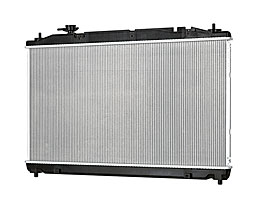
In another automotive example, Denso Corp. molded the radiator end tank for the 2009 Toyota Camry from DuPont’s Zytel RS nylon, a hybrid bioplastic derived from castor beans and petrochemicals. Although the material also contains glass fiber and other additives, 40 percent of the resin is comprised of plant-based ingredients.
Not only is the resin made from environmentally friendly materials, but the new radiator tank releases less carbon dioxide emissions into the atmosphere during its life cycle than a tank made from conventional materials.
“The plant-derived resin meets requirements for exceptional heat resistance, durability and road-salt resistance,” says Patrick Ferronato, global director of development and marketing for DuPont Automotive Performance Polymers.
Mazda Motor Corp. developed its own high-strength, heat-resistant bioplastic in 2006 as part of a consortium that included two universities, seven manufacturers and two research institutes. Made of 88 percent corn and 12 percent petroleum, Mazda’s bioplastic is being used for both interior and exterior body panels. Starting with PLA, Mazda researchers developed a new nucleating agent for crystallization and a compatibilizer compound to raise the strength and heat-resistance of the plastic.
Compared with petroleum-based polypropylene, Mazda’s bioplastic requires 30 percent less energy to produce. It’s also more rigid, so engineers can use less material in their designs.
The next step for Mazda is to create an automotive bioplastic from non-food-based cellulosic biomass, such as plant waste and wood shavings. The company hopes to introduce that material by 2013.
Bioplastics are also being used in automotive interior applications, where feel and appearance are important. For example, on the Toyota Prius, plant-derived plastics are used for the seat cushion foam, cowl side trim, inner and outer scuff plates, deck trim cover and floor mats. The latter are made from Ingeo fibers from NatureWorks. Compared with mats made from petroleum-derived nylon fibers, the bioplastic mats reduce fossil fuel consumption by 65 percent and carbon dioxide emissions by 90 percent.
While the automotive industry has been a leader in adopting bioplastics, other industries are catching up.
Dorel Industries Inc. uses a hybrid bioplastic from Cereplast for its “Safety First, Nature Next” line of juvenile furniture, which includes a potty seat, booster chair and step stool. The bioplastic replaces a petroleum-based polypropylene.
“Parents can feel good about caring for their children and caring for the earth with these products,” says Vinnie D’Alleva, executive vice president of business development for Dorel. “[These materials] allow us to provide ecoconscious products that meet our high standards of quality.”
Warner Manufacturing Co. chose a biodegradable bioplastic from Cereplast to produce an ecofriendly line of putty knives. “We were looking for a biodegradable resin with similar mechanical properties to the resins we were currently using,” says Bill Laramy, executive vice president of sales and marketing at Warner Manufacturing. “The critical factor was the flexural modulus, as we needed the proper stiffness for the putty knife blades. We also wanted the material melt flow and process temperatures similar to our previous materials to maintain cycle time requirements.”
Even medical and dental products are potential candidates for bioplastics. DenTek uses a biodegradable bioplastic from Cereplast to mold disposable flossing tools.
Mobile Edge uses fibers of DuPont Sorona, a bioplastic derived from corn, to make carrying cases for laptop computers. Some 37 percent of the material, by weight, is renewably sourced ingredients, and production of the material requires 30 percent less energy than production of an equal amount of nylon. The bioplastic fibers are soft, strong, stiff and stain-resistant.
ASSEMBLY ONLINE
For more information on green manufacturing, visit www.assemblymag.com to read these articles:
* Lean and Green.
* It Is Easy Being Green.
* The Road to Green.
Peas, corn, potatoes, soybeans, wheat, beets, rice, canola oil, kelp, sugar, tapioca, castor beans and algae. No, these are not the ingredients for a most unappealing dinner. Instead, they could be something even more astonishing-the components of your next assembly.
Over the past few years, researchers have developed innovative, cost-effective ways to turn corn, soybeans and other plant materials into plastics with little or no need of petroleum. These bioplastics are being made into simple molded products, such as bottles, packaging, flowerpots and eating utensils, as well as parts for complex assemblies, such as automotive components, laptop computers, sporting goods, pens and household goods. Bioplastics are also being used to make fibers for carpets and upholstery, and films for bags and agricultural purposes.
If bioplastics aren’t big business now, they will be. By 2013, manufacturers worldwide will buy 900,000 tons of bioplastic worth $2.6 billion, according to market research firm The Freedonia Group. That’s more than four times the current market for bioplastics. (In comparison, manufacturers consume 500 million tons of petroleum-based plastic annually.)
A separate study sponsored by bioplastics manufacturer Cereplast Inc. projects that the U.S. market for bioplastics could top $10 billion by 2020, a tenfold increase from 2007 sales. Some estimates point to bioplastics capturing 30 percent of the total plastics market within 10 years.
“American consumers are pushing major manufacturers and retailers to make the switch to environmentally conscious [materials],” says Frederic Sheer, founder and CEO of Cereplast. “Many of the largest retailers have already made inroads with programs designed to adopt alternative packaging.”
As much as manufacturers want to trumpet themselves as being ecofriendly, the increasing interest in bioplastics is actually being driven by the bottom line. The rising cost of crude oil and natural gas has made bioplastics more cost-competitive with petroleum-based resins, particularly if the price of oil exceeds $70 per barrel. Indeed, bioplastics are often less expensive than comparable petroleum-based plastics.
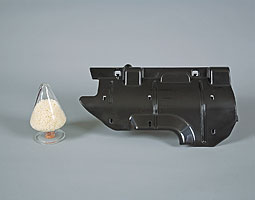
This automotive interior trim component is molded from a bioplastic that is 88 percent corn-based and 12 percent petroleum-based. Photo courtesy Mazda Motor Corp.
What's Bioplastic?
Bioplastics, biodegradable plastics and “green” plastics are not necessarily the same.Bioplastics are made mostly or entirely from renewable plant materials. They may or may not be mixed with petroleum-based polymers or inorganic materials, such as glass fibers. Bioplastics may or may not be recyclable or biodegradable.
Biodegradable plastics can be broken down into their constituent compounds by naturally occurring microorganisms. Biodegradable plastics can be made from either plant-based or petroleum-based sources.
The green label has been applied to bioplastics, biodegradable plastics, recyclable plastics and even high-strength engineering plastics, because they replace metal parts.
There are many types of bioplastic. One of the most common is polylactic acid (PLA), a transparent plastic that is typically produced from corn. To make its Ingeo brand of PLA, NatureWorks LLC harvests corn starch and enzymatically hydrolyzes it into glucose. Next, microbial fermentation converts the glucose to lactic acid, which is then polymerized into PLA.
DuPont uses a similar process to make its Sorona EP thermoplastic polymer, which exhibits performance and molding characteristics similar to high-performance polybutylene terephthalate.
Braskem SA makes a polyethylene sourced entirely from sugarcane. It’s the first time a substance exactly equivalent to petrochemical polyethylene has been produced from nonpetroleum sources. To make its bioplastic, Braskem starts with ethanol produced from sugarcane and converts it into ethylene through ethanol dehydration. This transfers 99 percent of the carbon in ethanol into ethylene, which is then polymerized.
Solvay Indupa takes Braskem’s process a step further, converting the sugar-derived ethylene into polyvinyl chloride that is indistinguishable from petroleum-based PVC. The company even uses renewable plasticizers, such as epoxidized soybean and linseed oils, to create flexible PVC formulations.
Bioplastics can be processed with many conventional techniques, including extrusion, injection molding, blow molding, compression molding and blown film, says David Grewell, Ph.D., an assistant professor of agricultural and biosystems engineering at Iowa State University. Moreover, many of same assembly techniques that have been applied to petroleum-based plastics, such as ultrasonic welding and hot-plate welding, can also join bioplastics, though finding the right settings may require some experimentation.
Denso Corp. molded the radiator end tank for the 2009 Toyota Camry from Zytel RS nylon, a plastic derived from castor beans and petrochemicals. Photo courtesy DuPont
Bioplastic Applications
Bioplastics are for more than just packaging and disposable beverage cups. Bioplastics are increasingly part of assemblies in which safety, durability, aesthetics and performance are critical.A good example is Arkema’s Rilsan HT, the first polyphtalamide (PPA) material to replace metal for tubing in high-temperature automotive applications. Compared with metal assemblies, tubing assemblies made from Rilsan HT are less expensive and last longer. As much as 70 percent of the material comes from renewable non-food crop vegetable feedstock.
Based largely on long-chain chemistry, the material is much more flexible than previous PPA formulations and possesses excellent thermoformability and fitting-insertion properties. With processing characteristics similar to high-performance aliphatic polyamides, the material is easily extruded to form smooth or convoluted tubing.
In another automotive example, Denso Corp. molded the radiator end tank for the 2009 Toyota Camry from DuPont’s Zytel RS nylon, a hybrid bioplastic derived from castor beans and petrochemicals. Although the material also contains glass fiber and other additives, 40 percent of the resin is comprised of plant-based ingredients.
Not only is the resin made from environmentally friendly materials, but the new radiator tank releases less carbon dioxide emissions into the atmosphere during its life cycle than a tank made from conventional materials.
“The plant-derived resin meets requirements for exceptional heat resistance, durability and road-salt resistance,” says Patrick Ferronato, global director of development and marketing for DuPont Automotive Performance Polymers.
Mazda Motor Corp. developed its own high-strength, heat-resistant bioplastic in 2006 as part of a consortium that included two universities, seven manufacturers and two research institutes. Made of 88 percent corn and 12 percent petroleum, Mazda’s bioplastic is being used for both interior and exterior body panels. Starting with PLA, Mazda researchers developed a new nucleating agent for crystallization and a compatibilizer compound to raise the strength and heat-resistance of the plastic.
Compared with petroleum-based polypropylene, Mazda’s bioplastic requires 30 percent less energy to produce. It’s also more rigid, so engineers can use less material in their designs.
The next step for Mazda is to create an automotive bioplastic from non-food-based cellulosic biomass, such as plant waste and wood shavings. The company hopes to introduce that material by 2013.
Bioplastics are also being used in automotive interior applications, where feel and appearance are important. For example, on the Toyota Prius, plant-derived plastics are used for the seat cushion foam, cowl side trim, inner and outer scuff plates, deck trim cover and floor mats. The latter are made from Ingeo fibers from NatureWorks. Compared with mats made from petroleum-derived nylon fibers, the bioplastic mats reduce fossil fuel consumption by 65 percent and carbon dioxide emissions by 90 percent.
While the automotive industry has been a leader in adopting bioplastics, other industries are catching up.
Dorel Industries Inc. uses a hybrid bioplastic from Cereplast for its “Safety First, Nature Next” line of juvenile furniture, which includes a potty seat, booster chair and step stool. The bioplastic replaces a petroleum-based polypropylene.
“Parents can feel good about caring for their children and caring for the earth with these products,” says Vinnie D’Alleva, executive vice president of business development for Dorel. “[These materials] allow us to provide ecoconscious products that meet our high standards of quality.”
Warner Manufacturing Co. chose a biodegradable bioplastic from Cereplast to produce an ecofriendly line of putty knives. “We were looking for a biodegradable resin with similar mechanical properties to the resins we were currently using,” says Bill Laramy, executive vice president of sales and marketing at Warner Manufacturing. “The critical factor was the flexural modulus, as we needed the proper stiffness for the putty knife blades. We also wanted the material melt flow and process temperatures similar to our previous materials to maintain cycle time requirements.”
Even medical and dental products are potential candidates for bioplastics. DenTek uses a biodegradable bioplastic from Cereplast to mold disposable flossing tools.
Mobile Edge uses fibers of DuPont Sorona, a bioplastic derived from corn, to make carrying cases for laptop computers. Some 37 percent of the material, by weight, is renewably sourced ingredients, and production of the material requires 30 percent less energy than production of an equal amount of nylon. The bioplastic fibers are soft, strong, stiff and stain-resistant.
ASSEMBLY ONLINE
For more information on green manufacturing, visit www.assemblymag.com to read these articles:
* Lean and Green.
* It Is Easy Being Green.
* The Road to Green.
Looking for a reprint of this article?
From high-res PDFs to custom plaques, order your copy today!