Assembly Magazine logo
search
Ask ASSEMBLY AI
cart
facebook twitter linkedin youtube
  • Sign In
  • Create Account
  • Sign Out
  • My Account
Assembly Magazine logo
  • TRENDS
    • Ask ASSEMBLY AI
    • Trends
    • News
    • New Products
  • INDUSTRIES
    • Aerospace
    • Appliance
    • DFMA Assembly
    • Medical Devices
    • Green Manufacturing
    • Lean Manufacturing
    • Machinery Assembly
    • Electronics Assembly
    • Automotive
  • TECHNOLOGIES
    • Adhesives & Dispensing
    • Assembly Presses
    • Automated Assembly Systems
    • Manufacturing Management
    • Manufacturing Software
    • Motion Control
    • Screwdriving & Riveting
    • Robotics
    • Test & Inspection
    • Plastics & Metal Welding
    • Wire Processing
    • Workstations
  • AUTONOMOUS & ELECTRIC MOBILITY
    • AEM Magazine Archives
    • Autonomy
    • Electrification
    • Mobility Services
    • Assembly & Testing
    • AV/EM News
  • MEDIA
    • Ask ASSEMBLY AI
    • Podcasts
    • Assembly News Now
    • Assembly TV
    • Webinars
    • eBooks
  • EVENTS
    • Calendar
    • The ASSEMBLY Show
  • MORE
    • Exclusives >
      • Plant of the Year
      • Capital Spending
    • Buyers Guide >
      • Supplier Insights
    • Classifieds
    • Featured Products
    • Newsletters
    • Store
    • White Papers
    • Columns
    • Sponsor Insights
  • INFOCENTER
    • Assembly & Test Solutions
  • EMAGAZINE
    • eMagazine
    • Archive Issues
    • Advertise
    • Contact Us
    • Sign Up
Columns

Quality in Assembly: How Effective Is Your Assembly System?

By John Sprovieri
August 22, 2008
OEE quantifies how well an assembly system performs relative to its intended capacity.
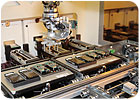

By monitoring overall equipment effectiveness, engineers can uncover hidden capacity in their assembly plants. Photo courtesy Nokia Corp.

Watch an automated assembly system turn out product at top speed, and it’s hard to imagine things could go wrong. But, of course, they do. Springs tangle. Grippers lose their grip. Parts come in out of tolerance.

Some problems, such as a faulty part that jams a feed track, are isolated incidents. Others indicate a systemic problem, such as an entire batch of bad parts, or worse, a flawed design. A simple metric-overall equipment effectiveness (OEE)-can help engineers ferret out such problems and improve the efficiency of the system.

OEE quantifies how well an assembly system performs relative to its intended capacity. It’s calculated from three measurements: availability, performance and quality.

Availability, or uptime, is the percentage of scheduled time that the system is available to assemble parts. For example, let’s say Acme Valve runs two 8-hour shifts, each with a 30-minute break. Ideally, the system would run for 900 minutes (16 hours x 60 minutes per hour – 60 minutes). If the system unexpectedly goes down for an hour, it can only assemble parts for 840 minutes (900 – 60). The availability of the system is therefore 93.3 percent (840/900 x 100).

For calculating availability, downtime includes time spent on setup, tweaking processes, repairing equipment and waiting for parts. It does not include minor stoppages to clear jams. A world-class goal for availability is 90 percent.

Performance is the speed at which the system runs as a percentage of its intended speed. For example, let’s say Acme’s assembly system puts out 42,000 valves in a day. It’s production rate for that day is therefore 50 assemblies per minute (42,000/840). If the system was designed to produce 60 assemblies per minute, its performance is 83.3 percent (50/60 x 100).

Note that this metric does not distinguish between good assemblies and bad assemblies, complete assemblies or those aborted early. It’s the total number of assemblies started that’s important. For performance, a rating above 90 percent is considered world-class.

Quality, or first-pass yield, is the number of good assemblies produced as a percentage of total assemblies started. For example, let’s say 840 of Acme’s valves fail a leak test at the end of the line. The system’s quality rating is therefore 98 percent (41,160/42,000 x 100). When calculating quality, engineers should include assemblies rejected at any point and time in the process, even defects produced at startup, when the process may not be immediately stable. Needless to say, quality should be as close to 100 percent as possible.

To obtain OEE, multiply availability times performance times quality. For example, the OEE of Acme’s system is 76.1 percent (0.933 x 0.833 x 0.98 x 100).

Given that the manufacturing benchmark for OEE, regardless of the level of automation, is 85 percent, Acme clearly has room for improvement! Reducing downtime to just 15 minutes would boost Acme’s OEE above 80 percent, but the company’s biggest problem is performance. Too many minor stoppages to clear jams could be to blame, or a machine might be wearing out. Worse, the company might be deliberately operating the system at a reduced pace because running it at top speed produces too many interruptions. In that case, engineers may need to rethink the design of both the product and the process.

Much of the data for OEE is collected by sensors, PLCs and vision systems and can be sent automatically to software that calculates availability, performance and quality. This information can be displayed graphically on a control panel or andon board.

Operators can collect data, too. For example, operators can enter a particular code for common assembly defects or machine stoppages. This data can then be used to create Pareto charts so engineers know where to concentrate improvement efforts. If most machine stoppages are related to screws jamming a driver, it could be time for a new feeder or a new fastener supplier.

Share This Story

Looking for a reprint of this article?
From high-res PDFs to custom plaques, order your copy today!

John has been with ASSEMBLY magazine since February 1997. John was formerly with a national medical news magazine, and has written for Pathology Today and the Green Bay Press-Gazette. John holds a B.A. in journalism from Northwestern University, Medill School of Journalism.

Recommended Content

JOIN TODAY
To unlock your recommendations.

Already have an account? Sign In

  • Made in the U.S.A.

    Consumer Products Manufacturing: Made in the USA

    Supply chain lessons learned during the coronavirus...
    Automated Assembly Systems
    By: Austin Weber
  • Best Practices for Press-Fit Assembly

    Best Practices for Press-Fit Assembly

    In manufacturing, ironclad formulas for success are hard...
    Assembly Presses
    By: Jim Camillo
  • aem0523leader-tesla1.jpg

    Tesla Rethinks the Assembly Line

    Engineers at Tesla Inc. have developed a new process that...
    Electrification
    By: Austin Weber
Manage My Account
  • eMagazine Subscription
  • Assembly Newsletters
  • Online Registration
  • Subscription Customer Service
  • Manage My Preferences

More Videos

Sponsored Content

Sponsored Content is a special paid section where industry companies provide high quality, objective, non-commercial content around topics of interest to the ASSEMBLY audience. All Sponsored Content is supplied by the advertising company and any opinions expressed in this article are those of the author and not necessarily reflect the views of ASSEMBLY or its parent company, BNP Media. Interested in participating in our Sponsored Content section? Contact your local rep!

close
  • ultrasonic welding
    Sponsored bySonobond Ultrasonics

    Engineering Efficiency in High-Performance Assembly: How Ultrasonic Welding Enhances Throughput, Reliability and Quality

  • UV curing system
    Sponsored byDymax

    Why UV Intensity Alone Doesn’t Define Curing Performance

  • wooden pallets
    Sponsored byLEAN Manufacturing Products

    Eliminating Waste on the Shop Floor: Applying Lean Principles to Improve Manufacturing Efficiency

Popular Stories

ASSEMBLY News Now, episode-30: Volvo Redesigns EV Manufacturing

Volvo Redesigns EV Manufacturing

Boeing CEO Kelly Ortberg announces 1 billion investment

Boeing Plans $1 Billion Wichita Investment, Workforce Training Center

GE Appliances Worker on Line

GE Appliances Expands Factory AI With 800 Gemini Enterprise Agents

Watch the latest episode of ANN now!

Events

July 24, 2025

From Shop Floor to CFO: How Manufacturers Are Closing the Loop Between Operations and Finance

On Demand Learn how manufacturers are bridging the gap between the shop floor and ERP systems to gain real-time visibility, streamline operations, and kick-start digital transformation—without waiting years.

Sponsored by:

PicoStratusGreen
July 30, 2025

Buffer Analysis and Design Fundamentals for Manufacturing Excellence

On Demand In this presentation, Dr. Herman Tang shares practical insights from his industry experience and research on buffer management in manufacturing operations.

View All Submit An Event

Poll

Difficult Assembly Processes

Which assembly process gives you the most difficulty?
View Results Poll Archive

Products

Manufacturing Cost Policy Deployment (MCPD) Profitability Scenarios: Systematic and Systemic Improvement of Manufacturing Costs

Manufacturing Cost Policy Deployment (MCPD) Profitability Scenarios: Systematic and Systemic Improvement of Manufacturing Costs

See More Products
Register for webinar - Modernizing Automotive Assembly: Why Upgrading Legacy MES is a Business Imperative

Related Articles

  • Quality in Assembly: How Capable Are Your Power Tools?

    See More
  • Quality in Assembly: Problem-Solving System Helps Cabinet Maker Win

    See More
  • Quality in Assembly: To Consumers, Reliability Is the True Measure of Quality

    See More

Related Products

See More Products
  • leaner

    Leaner Manufacturing: How to Make the Lean Production Process Easier, Faster, and More Cost-Effective

  • Kaizen Assembly: Designing, Constructing, and Managing a Lean Assembly Line

  • OIP.jpg

    Is Quality Just a Word We Use?

See More Products
×

Never miss the latest news and trends driving the manufacturing industry

Stay in the know on the latest assembly trends.

JOIN TODAY!
  • RESOURCES
    • Advertise
    • Contact Us
    • Directories
    • Manufacturing Division
    • Store
    • Want More?
  • SIGN UP TODAY
    • Create Account
    • eMagazine
    • Newsletters
    • Customer Service
    • Manage Preferences
  • SERVICES
    • Marketing Services
    • Reprints
    • Market Research
    • List Rental
    • Survey/Respondent Access
  • STAY CONNECTED
    • LinkedIn
    • Facebook
    • Instagram
    • YouTube
    • X (Twitter)
  • PRIVACY
    • PRIVACY POLICY
    • TERMS & CONDITIONS
    • DO NOT SELL MY PERSONAL INFORMATION
    • PRIVACY REQUEST
    • ACCESSIBILITY

Copyright ©2026. All Rights Reserved BNP Media, Inc. and BNP Media II, LLC.

Design, CMS, Hosting & Web Development :: ePublishing