Motion Control: End of the Rod
A rod end bearing, also known as a heim joint or rose joint, is a mechanical articulating joint. Originally used in aircraft, these bearings can be found in cars, trucks, lawn tractors, boats, industrial machines and other applications. This article explains how they work and how to specify them.
What do assembled items as diverse as aircraft, lawn tractors and industrial machines have in common? They all require rod end bearings, which are mechanical articulating joints that accommodate significant misalignment between two components, either statically, dynamically, or in combination, in an assembly. Vaguely resembling the ends of ratchet wrenches, rod end bearings attach to a static rod via a threaded shaft. They are also known as heim or rose joints.
Unlike traditional ball and roller bearings, which are designed for all kinds of rotating assemblies, rod end bearings provide more precise control and greater wear resistance in oscillating assemblies with back-and-forth movements.
As a result, these bearings are used on the ends of control rods, steering links, tie rods, cylindrical parts or anywhere a precision articulating joint is required. Originally used in aircraft control mechanisms, these bearings increasingly are being used by assemblers of cars, trucks, boats and industrial machines.
“Their appeal is allowing misalignment without any deflection,” says John McCrory, race car product manager for Aurora Bearing Co., a manufacturer of rod end bearings. “They were originally used in aircraft because they allowed precise control of the plane’s flaps and wings, which have to flex. Now their applications have expanded to include rocket engines, space stations and rovers, along with military and other vehicles.”
Rod end bearings are also used in a variety of processing and packaging equipment, and in positioning systems for solar panels, wind turbines and satellite dishes.
A three-piece bearing also features a race swaged around the ball swivel to provide low friction and smooth operation. To further reduce wear and friction, a PTFE (polytetrafluoroethylene) liner of woven fabric can be chemically bonded to the race’s inner diameter.
Usually, the ball swivel is retained in the housing by a mechanical staking process or retaining rings. The ball swivel has a bore opening through which a bolt or other attaching hardware may pass. Bearings are available with bore diameters ranging from 1/8 to 6 inches in increments of 1/16 inch.
The bearing’s shaft can be made to any length and is measured in English or metric sizes, depending on the supplier. Shaft diameter can either be the same as the bore, or larger than the bore for greater strength. The shaft bottom can be supplied with a wrench flat to assist with mounting.
The shaft features one of four types of threads: male external right hand, male external left hand, female internal right hand and female internal left hand. Right or left indicates the slant direction of the threads.
Although most rod end bearings have the usual “righty-tighty” threading, some tighten counterclockwise to fit special situations.
Female bearings may feature a Zerk-type grease fitting in the shaft; male bearings have the grease fitting in the head. Occasional grease is typical maintenance.
Rod end bearings are made of ferrous metals, brass, bronze, or high-performance plastic.
They are available in commercial, heavy duty, military and aerospace grades. Bearings used in military machines or aircraft are made of premium materials and manufactured and tested in accordance with strict standards. These higher-grade rod ends may also be used in industrial or commercial applications that require high reliability.
Dimensions. The assembler needs to confer with its supplier to make sure the bearing’s overall body length, bore diameter, distance from the bore’s center line to the body base, ball swivel width and thread type will fit the connecting rod perfectly.
Load Ratings. “Rod ends are designed primarily for radial loading and not well suited for high-sliding velocities,” says John Wallace, vice president of operations for AST Bearings LLC, a bearing supplier. “The pin or bolt assembled in the bearing bore carries the structural load through the joint. So it must be of the proper material and heat treat condition, and have the proper fit and surface finish.”
Manufacturers publish static and dynamic load ratings for each rod end bearing. The static load rating represents the load that can be taken up by the bearing when static contact stress at the bearing contact surface reaches the material stress limit. The dynamic load rating represents the load, constant in magnitude and direction, under which a basic rating service life, expressed as a sliding distance, will be attained for continuous oscillating movement.
Wallace points out that load rating values are always dependent on the definitions used. Therefore, it is not always possible to make direct comparisons with load ratings published by different manufacturers.
Maximum Misalignment. Assemblers need to make sure the bearing’s maximum misalignment fits within application parameters. Failure to do so can lead to premature wear. “A rod end bearing’s ability to misalign is measured by the degree of angle the ball can accommodate without interference,” says McRory. “The misalignment angle is dependent upon the shaft-mounting procedure and the ball and body width.”
Wallace says rod ends can handle misalignment of 17 degrees and more, depending on the rod end type. However, the ability to handle larger angles of misalignment usually comes with some kind of compromise elsewhere, so checking with the bearing supplier is critical to proper matching of the rod end to the application.
 Internal Clearance of the
Bearing. This
is the total radial distance that the inner ring can be moved with respect to
the outer ring. “This value typically changes before and after mounting because
the bearing can be expanded or compressed by interference fits,” says Wallace.
Suppliers provide bearings with normal, tight and loose clearances.
Internal Clearance of the
Bearing. This
is the total radial distance that the inner ring can be moved with respect to
the outer ring. “This value typically changes before and after mounting because
the bearing can be expanded or compressed by interference fits,” says Wallace.
Suppliers provide bearings with normal, tight and loose clearances.
Material. Engineers should account for the limitations of metal and plastic. “Plastic bearings are only 35 percent to 40 percent as strong as steel bearings, but are quieter and require no maintenance,” says Tom Miller, bearings unit business manager for igus Inc., a supplier of plastic rod end bearings. Miller says that plastic bearings also are very effective in oscillating applications where water is present, such as car washes.
Work Environment. For dirty environments, Wallace recommends using a bearing with a seal rather than a maintenance-free type. “Under oscillation, particulate contamination will quickly destroy the PTFE liner,” he says. For corrosive or high-temperature environments, Wallace recommends bearings with zinc-plated or stainless steel housings.
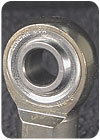
This close-up of the head of a three-piece rod end clearly shows the ball surrounded by a race, which is staked into the body. Photo courtesy Aurora Bearing Co.
What do assembled items as diverse as aircraft, lawn tractors and industrial machines have in common? They all require rod end bearings, which are mechanical articulating joints that accommodate significant misalignment between two components, either statically, dynamically, or in combination, in an assembly. Vaguely resembling the ends of ratchet wrenches, rod end bearings attach to a static rod via a threaded shaft. They are also known as heim or rose joints.
Unlike traditional ball and roller bearings, which are designed for all kinds of rotating assemblies, rod end bearings provide more precise control and greater wear resistance in oscillating assemblies with back-and-forth movements.
As a result, these bearings are used on the ends of control rods, steering links, tie rods, cylindrical parts or anywhere a precision articulating joint is required. Originally used in aircraft control mechanisms, these bearings increasingly are being used by assemblers of cars, trucks, boats and industrial machines.
“Their appeal is allowing misalignment without any deflection,” says John McCrory, race car product manager for Aurora Bearing Co., a manufacturer of rod end bearings. “They were originally used in aircraft because they allowed precise control of the plane’s flaps and wings, which have to flex. Now their applications have expanded to include rocket engines, space stations and rovers, along with military and other vehicles.”
Rod end bearings are also used in a variety of processing and packaging equipment, and in positioning systems for solar panels, wind turbines and satellite dishes.
A profile-systems
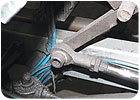
manufacturer uses plastic rod end bearings in this packaging-line pedestal. The
manufacturer used these bearings in place of heavy metallic roller bearings and
ball bearings. Photo courtesy igus Inc.
Many Different Types
Rod end bearings feature either a two-piece or three-piece design. A two-piece bearing consists of a ball swivel, or spherical end bearing, incorporated into a housing that has an eye-shaped head and integral threaded shaft.A three-piece bearing also features a race swaged around the ball swivel to provide low friction and smooth operation. To further reduce wear and friction, a PTFE (polytetrafluoroethylene) liner of woven fabric can be chemically bonded to the race’s inner diameter.
Usually, the ball swivel is retained in the housing by a mechanical staking process or retaining rings. The ball swivel has a bore opening through which a bolt or other attaching hardware may pass. Bearings are available with bore diameters ranging from 1/8 to 6 inches in increments of 1/16 inch.
The bearing’s shaft can be made to any length and is measured in English or metric sizes, depending on the supplier. Shaft diameter can either be the same as the bore, or larger than the bore for greater strength. The shaft bottom can be supplied with a wrench flat to assist with mounting.
The shaft features one of four types of threads: male external right hand, male external left hand, female internal right hand and female internal left hand. Right or left indicates the slant direction of the threads.
Although most rod end bearings have the usual “righty-tighty” threading, some tighten counterclockwise to fit special situations.
Female bearings may feature a Zerk-type grease fitting in the shaft; male bearings have the grease fitting in the head. Occasional grease is typical maintenance.
Rod end bearings are made of ferrous metals, brass, bronze, or high-performance plastic.
They are available in commercial, heavy duty, military and aerospace grades. Bearings used in military machines or aircraft are made of premium materials and manufactured and tested in accordance with strict standards. These higher-grade rod ends may also be used in industrial or commercial applications that require high reliability.
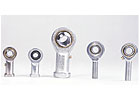
Suppliers offer
extensive lines of three-piece rod end steel bearings. Various features include
a bronze ring, female or male threads, grease fitting, wrench flats and zinc
plating. Photo courtesy AST Bearings LLC.
The Specification Challenge
Here are several factors a manufacturer should consider when selecting the correct rod end bearing for a particular assembly.Dimensions. The assembler needs to confer with its supplier to make sure the bearing’s overall body length, bore diameter, distance from the bore’s center line to the body base, ball swivel width and thread type will fit the connecting rod perfectly.
Load Ratings. “Rod ends are designed primarily for radial loading and not well suited for high-sliding velocities,” says John Wallace, vice president of operations for AST Bearings LLC, a bearing supplier. “The pin or bolt assembled in the bearing bore carries the structural load through the joint. So it must be of the proper material and heat treat condition, and have the proper fit and surface finish.”
Manufacturers publish static and dynamic load ratings for each rod end bearing. The static load rating represents the load that can be taken up by the bearing when static contact stress at the bearing contact surface reaches the material stress limit. The dynamic load rating represents the load, constant in magnitude and direction, under which a basic rating service life, expressed as a sliding distance, will be attained for continuous oscillating movement.
Wallace points out that load rating values are always dependent on the definitions used. Therefore, it is not always possible to make direct comparisons with load ratings published by different manufacturers.
Maximum Misalignment. Assemblers need to make sure the bearing’s maximum misalignment fits within application parameters. Failure to do so can lead to premature wear. “A rod end bearing’s ability to misalign is measured by the degree of angle the ball can accommodate without interference,” says McRory. “The misalignment angle is dependent upon the shaft-mounting procedure and the ball and body width.”
Wallace says rod ends can handle misalignment of 17 degrees and more, depending on the rod end type. However, the ability to handle larger angles of misalignment usually comes with some kind of compromise elsewhere, so checking with the bearing supplier is critical to proper matching of the rod end to the application.
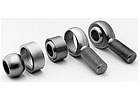
All components of the
three-piece rod end bearing are shown in this photo. From left are a ball
swivel, a race, a ball assembled with a race, a body and a complete three-piece
bearing. Photo courtesy Aurora Bearing Co.
Material. Engineers should account for the limitations of metal and plastic. “Plastic bearings are only 35 percent to 40 percent as strong as steel bearings, but are quieter and require no maintenance,” says Tom Miller, bearings unit business manager for igus Inc., a supplier of plastic rod end bearings. Miller says that plastic bearings also are very effective in oscillating applications where water is present, such as car washes.
Work Environment. For dirty environments, Wallace recommends using a bearing with a seal rather than a maintenance-free type. “Under oscillation, particulate contamination will quickly destroy the PTFE liner,” he says. For corrosive or high-temperature environments, Wallace recommends bearings with zinc-plated or stainless steel housings.
Looking for a reprint of this article?
From high-res PDFs to custom plaques, order your copy today!