The ASSEMBLY Show Preview
Reshoring evangelists headline a comprehensive conference program for manufacturing engineers and managers.
Tim Hutzel will never forget the first time, back in 1995, that he walked the shop floor at Hamilton Caster & Manufacturing Co., a maker of industrial wheels, casters, carts and trailers in Hamilton, OH. Hutzel had just left his job as director of lean transformation at GE Aviation to strike out on his own as a consultant and lean guru. Hamilton Caster was his first customer.
“They literally had inventory piled to the ceiling,” recalls Hutzel, who spent some 20 years at GE in positions ranging from shop foreman to quality assurance manager. “It was alarming, once we started putting costs to it.”
Hutzel immediately began putting his organizational development skills to work, implementing kaizen projects and persuading both workers and management to cooperate on Hamilton’s lean journey. To increase efficiency and create a sense of shared goals, the company reorganized from departments, such as production, order entry and purchasing, into product teams.
“The departmentalized structure of our company had created invisible walls,” explains Dave Lippert, president of Hamilton Caster and a former flight instructor with the Air Force.
Moving people together cut the time involved in transferring paperwork from one worker to the next, and it reduced the amount of time from when a customer inquires about a product to when the order is actually entered. Moving departments together also made workers more versatile. Instead of each person specializing in a particular area, workers became cross-trained and multiskilled.
It didn’t take long before Hamilton Caster started seeing results. Indeed, just a year after beginning its lean transformation, the company won the Governor’s Award for Team Excellence in Manufacturing, Ohio’s highest manufacturing honor.
“Lean engages everyone in this place,” says Lippert. “We’ve got 75 people, and everyone is a contributor. Everyone is involved in solving problems.”
Looking for quick answers on assembly and manufacturing topics? Try Ask ASM, our new smart AI search tool. Ask ASM
Lippert is adamant in his belief that getting lean has enabled the 107-year-old family-owned business to continue making its products in the United States.
“We firmly believe that we can compete in the world, even if much of it pays a lower rate for labor than we do,” says Lippert, the fourth-generation family member to head the company. “I can’t say where we’d be if we had not started on our lean journey, but I can say we wouldn’t be as successful as we are now. It has played a huge role in advancing our company.”
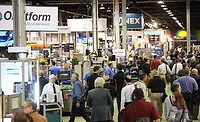
Hutzel and Lippert will deliver the keynote speech at the second annual ASSEMBLY Show on Wednesday, Oct. 29, at 9 a.m. The show will be held Oct. 28-30 at the Donald E. Stephens Convention Center in Rosemont, IL, adjacent to Chicago O’Hare International Airport.
At press time, more than 1,400 manufacturing and design engineers and managers had registered to attend the show. Registrants represent such diverse manufacturers as AGCO, BorgWarner Inc., Cree Inc., Honeywell International Inc., Insinkerator, Northrop Grumman Corp. and Stryker Corp.
More than 170 suppliers will be displaying the latest assembly technology at the show, including ATC Automation, Banner Engineering Corp., Cincinnati Test Systems Inc., EPSON Robots, Fisnar, Ingersoll Rand and Promess Inc.
Besides the keynote, the conference program includes 17 hours of educational sessions covering topics ranging from power tools to snap-fit assembly to high-speed automated assembly.
Lean and Reshoring
The lean transformation at Hamilton Caster was so dramatic, Hutzel decided to write a book about the experience. Co-authored with Paul Piechota, executive director of the Center for Competitive Change at the University of Dayton, Keeping Your Business in the USA: Profit Globally While Operating Locallywas published in 2011. It details how Hamilton Caster and two other Hutzel clients—The Dupps Co., a manufacturer of rendering machinery, and Midmark Corp., a medical device manufacturer—have succeeded in the global economy while keeping their production based in the United States.
Though all three companies represent different industries and differ vastly in size, they nevertheless share several things in common. All three have implemented lean cultures and voice-of-the-customer initiatives. All three focus on team building and product innovation. All three have adapted to changes in the marketplace by adding new offerings while selling off unprofitable product lines. And, all three rely on metrics and rigorous self-assessment.
The success of Hutzel’s first book prompted a second, this time co-authored with Hamilton Caster’s Lippert. Published in June of this year, Bringing Jobs Back to the USA: Rebuilding America’s Manufacturing Through Reshoringtells the stories of companies that have sent their jobs outside of the United States and the negative effects this had on the quality of their products and services, as well as on their employees, suppliers and consumers.
“We want to make Americans aware of the true cost of offshoring, not only at the company level, but also in the larger sense. What are the dangers that offshoring has created for our national defense, our economy and our culture? What is it doing to our young people, who can’t find jobs?” says Hutzel. “We want to be instrumental in educating manufacturers about the microeconomic and macroeconomic dangers of offshoring. More importantly, we want to show them what they can do about it. We want to teach them how to calculate their true costs and how to decide whether to bring work back or not.”
The book reveals the motivations various companies had to offshore their jobs, as well as the errors of omission they made by not understanding the true costs of offshoring.
“If you only look at one or two glaring components, like the cost of labor, then offshoring might seem like a good deal,” explains Lippert. “But there are a lot of hidden costs that management may not be aware of. For example, there’s the cost of the extra inventory you need to accommodate longer delivery times—including the cost of moving it and storing it. There’s a cost associated with having to accept substandard parts. There’s the rising cost of fuel and transportation. And, there’s the cash you don’t have because you had to pay in advance for all this stuff arriving from overseas.
“Our book tries to get people to take a hard look at all these costs and decide if offshoring still makes sense.”
Moral Issue
For Hutzel and Lippert, offshoring is not just an economic issue, it’s a moral issue. “Most companies would like to be good corporate citizens,” says Lippert. “I know my little company is. We impact the economy. We impact the culture. We employ people. We create tax revenue.
“All this stuff goes beyond the accounting ledger. We shouldn’t ignore the impact of offshoring on our neighbors. People can no longer get good jobs. We have so much extra crime, so much extra cost for welfare. That’s not a dollar and cents figure that any company would count, but it’s out there, and it’s real.”
To be clear, Hutzel and Lippert don’t take issue with offshoring when and where it makes financial sense. “When multinational companies are making stuff overseas to sell overseas—that makes good sense,” says Lippert. “We don’t have any issues with that. We’re focusing on the companies that shipped their manufacturing operations overseas and are bringing finished products back.”
Indeed, manufacturing close to one’s customers conveys distinct advantages in terms of responsiveness. “In my business, delivery time is critical,” Lippert points out. “Being able to make to order, to do things like mass customization, is increasingly important, so it makes sense to manufacture products close to where they’re used.
“The closer we can be to our customers, and the closer our suppliers can be to us, the better off we are. If a customer orders one of our products by noon, we’re shipping it later that day—and we don’t need tons of inventory.”
Hutzel agrees. “One of the consequences of offshoring is that it dries up the supply chain in your own back yard,” he says. “When Toyota, Nissan and Honda wanted to sell more cars in the United States, where did they decide to make them? Where did they set up their supply chains?”
Besides exposing the true costs of offshoring, Hutzel and Lippert also supply concrete suggestions to help government officials and activists prevent offshoring and incentivize reshoring. Using a step-by-step methodology, the book provides business leaders with the understanding to make the right decisions regarding reshoring.
“Our book is a wake-up call to companies,” says Hutzel. “Maybe offshoring made sense a few years ago, but now it’s time to take another look.”
For a complete lineup of speakers and exhibitors at the ASSEMBLY Show, visit www.theassemblyshow.com.
Preshow Workshops Cover DFMA, Plastics Assembly
The exhibits at the ASSEMBLY Show will officially open on Tuesday, Oct. 28, at 5 p.m. That afternoon, however, the show will host two comprehensive workshops addressing plastics assembly and design for manufacture and assembly (DFMA). The workshops will be held from 2-5 p.m.
The DFMA workshop is being run by Boothroyd Dewhurst Inc., originators of the popular DFMA software.
At least 85 percent of manufacturing costs are determined in the early stages of design. When engineers make informed design decisions during the concept stage, they can avoid costly corrections later on. This workshop will show you how to lower manufacturing costs through good design. Learn what features make a product easy and cost-efficient to assemble. Find out how to consolidate features and reduce fastener counts, and discover how to design parts to facilitate automation.
The presenters include three representatives from Boothroyd Dewhurst: Nicholas Dewhurst, executive vice president; Chris Tsai, director of DFMA implementation services; and Brian Rapoza, R&D manager. Also presenting will be Matt Miles, DFMA and value engineering manager at Dynisco Instruments LLC, a Boston-area sensor manufacturer.
The plastics assembly workshop was organized by ASSEMBLY magazine and covers both thermal and mechanical joining methods.
The agenda is as follows:
The Dish on Hot-Plate Welding
Bill Reed, sales and marketing director, Extol Inc.
Hot-plate welding is one of the simplest and most versatile methods for joining two plastic parts. The technology can weld small parts or large ones, flat parts or contoured ones. It can weld one assembly at a time, or multiple assemblies simultaneously. In many cases, hot-plate welding works when other joining methods, such as ultrasonic welding and vibration welding, do not. In this presentation, you’ll learn how the process works, what equipment is needed, and what applications it’s used on. You’ll learn key process parameters and get tips on material selection and joint design.
Improving Plastic Assemblies With Inserts and Compression Limiters
Christie L. Jones, market development manager, Spirol International Corp.
When screws or bolts are threaded directly into plastic components, failures can occur due to stripped threads or plastic creep. (When plastic is exposed to static mechanical stresses or elevated temperatures, it can move or deform.) Threaded inserts provide serviceable threads for situations when joint strength and the ability to assemble and disassemble without degrading the components are required. Compression limiters protect the plastic components from the compressive loads generated by tightening threaded fasteners. This presentation will show you how to use and specify these components.
Snap Fits for Plastics Assembly
Paul A. Tres, president, ETS Inc.
Sometimes, the most cost-effective way to assemble plastic parts is simply to snap them together. There’s no need for welding machines, fixtures, fasteners or tools. However, a successful snap-fit assembly requires careful attention to design. This session provides tips and design guidelines for snap-fit assembly.
Selecting the Proper Assembly Method for Your Plastic Application
Jeff Frantz, director of ultrasonic business development, Branson Ultrasonics
There are many ways to join plastic parts, including threaded fasteners, adhesives, ultrasonic welding, vibration welding, spin welding and laser welding. Which to use depends on the size and shape of the parts, the materials, sealing requirements, and even aesthetics. In this session, you’ll learn what information is required to pick the most appropriate assembly method for your application. Frantz will review the major plastic joining methods, covering, theory, advantages, limitations and typical applications.
Looking for a reprint of this article?
From high-res PDFs to custom plaques, order your copy today!