Delta Robots Feed Need for Speed
Spiders are one of the quickest and most efficient assemblers in nature. Just ask anyone who’s ever encountered a pesky web blocking a filter, tube, vent line or some other critical artery.
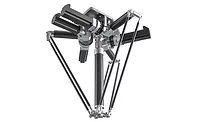
With their spindly arms and extremely fast motion, delta robots resemble spiders. Each arm is driven by a motor mounted in a stationary base above a large cylindrical work envelope. The arm joints work together to drive a rotary axis connected to an end-effector.
Jointed in the middle, the arms bend inward and connect with a small tooling plate to which the end-effector is attached. Coordinated movement of the forearms up or down pushes the elbows inward or outward, which move the plate in the X, Y and Z axes. As the robot moves up and down and side to side, the tooling plate remains parallel with the work surface.
“Mechanically, delta robots are constructed very differently [than other types of robotic configurations],” says Raad Asmaro, account manager for the North American distribution group at FANUC America Corp. “Typically, most robotic arms are considered as serial-link, which relates to having each axis joint mechanically connected in series.
“Deltas are considered to be a parallel-link robot, where the major axes are mechanically connected in parallel,” explains Asmaro. “This design provides great motion advantages with explosive speed, accelerations and high duty cycle.”
“With delta robots, all the motors are in a stationary location on the mechanism,” adds Rick Tallian, picking, packing and palletizing business line manager at ABB Robotics, which first commercialized the technology more than 15 years ago. “Unlike other types of robots, the mechanism does not carry around the weight of the motors. And, the robots operate in an obstruction-free work envelope.
“That, combined with components made out of lightweight materials, such as aluminum and carbon-fiber composites, provides a very low inertia system,” adds Tallian. “This type of mechanical design allows us to achieve high-speed performance.”
Looking for quick answers on assembly and manufacturing topics? Try Ask ASM, our new smart AI search tool. Ask ASM
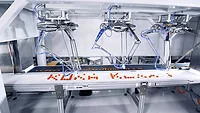
Delta robots were originally designed for low-payload applications, such as packaging. That’s why the machines are popular in the food processing industry, where they’re used to sort and pack everything from fine chocolates to frozen fish sticks. Cosmetic and pharmaceutical manufacturers have also deployed many delta-style robots on their production lines.
In addition to packaging, manufacturers are discovering that delta robots are ideal for a wide variety of assembly applications, such as adhesive dispensing, labeling, parts insertion, pick-and-place, screwdriving and soldering. The machines are used to mass-produce batteries, circuit breakers, electronics, medical devices, pens, semiconductors, solar panels and other products.
In fact, according to the International Federation of Robotics, delta robots are one of the fastest-growing segments of the industry. And, the number of machines on the market has doubled over the last five years as vendors scramble to meet increasing demand.
“Delta robots are becoming very popular for assembly applications,” claims Asmaro. “Manufacturers are always looking to increase production rates and reduce footprint; delta robots are great tools for those demands.”
FANUC markets a family of delta-style robots in three, four- and six-axis variants that are used to assemble a wide variety of products. And, it will soon be unveiling a new six-axis product called the M-2iA/3A that will accommodate even more assembly applications.
At the International Manufacturing Technology Show last fall in Chicago, FANUC demonstrated several high-speed applications with its M-1iA robot. For instance, a three-axis robot used state-of-the-art vision technology to detectthe presence of a screw. The robot then picked up the screw and inserted it.
Unique Advantages
According to Asmaro, delta robots provide several advantages for assemblers. They are faster than most serial-link robots and they have small footprints. In addition, “there are no dead zones or singularity to maximize motion efficiency from one station to another with one straight move,” he points out.
“Simple assembly operations, such as picking, placing, stacking and kitting, can all be accomplished with a delta-style robot,” claims Yan Banducci, senior product line manager at Adept Technology Inc. “Because of their speed, delta robots are best suited for assembly operations that utilize conveyors to present parts.” That’s why they are typically mounted over a conveyor or a parts feeding device.
“Delta robots are being deployed in high-speed assembly tasks as a means of placing components accurately and quickly in a larger work envelope than most SCARA robots,” says Dean Elkins, senior general manager at the Motoman Robotics division of Yaskawa America Inc. “The fact that the robots are mounted overhead, coupled with the size of the work envelopes, allows for great flexibility in workcell design and the in-feed of components.”
“In small parts assembly applications, high speed and space restrictions are critical factors,” adds Lisa Maitre, senior applications engineer at Kawasaki Robotics USA Inc. “Delta robots are becoming more popular in the electronics and solar panel industries, as the cost per square foot of floor space increases and throughput demands rise.”
Kawasaki’s new YS02N robot can pick and place a 0.5-kilogram load every 0.3 second, with the overall footprint of the robot almost the same diameter as the work envelope. “By installing several delta robots in a row, even the most demanding production rate requirements can be met with a minimal investment in floor space,” Maitre points out.
When delta robots first came onto the market in the mid 1990s, the trend was bigger work envelopes to appeal to a wider range of applications, particularly in the food industry. “Now, the industry focus has moved to developing smaller footprint arms that are suitable to higher density installations for assembly applications,” says Maitre.
Kawasaki’s latest addition to its delta robot family is the YS02. It features a 600-millimter horizontal diameter and 200-millimeter vertical stroke work envelope. “With a maximum linear speed of 3,300 millimeters per second and a high repeatability of 0.1 millimeter, the YS02 is ideal for assembly of electrical, electronic and small machine parts,” claims Maitre.
Super Fast Speed
When it comes to speed, it’s hard to beat delta robots, which are more than 30 percent faster than SCARA robots. The machines can pick, place and orient parts from an inbound conveyor to an outbound conveyor at more than 180 parts per minute or three parts every second.
“Delta robots are built for speed,” says Elkins. “They [feature] a high-speed motor assembly which drives light weight carbon fiber arms to a high degree of repeatability. [However], what they gain in speed they lose in the ability to place objects deep into other objects, such as cases.”
End-of-arm tooling also plays a critical role in achieving fast speeds. “Delta robots require very lightweight tooling with fast actuation, due to their small payload capacity and fast cycle rates,” notes Maitre. “Simple vacuum tooling with suction cups is the most popular type of end-effector.”
“Vacuum grips allow you to go a lot faster,” adds Tallian “Mechanical grippers are also used for some applications, but they add mass and inertia to the system, which slows down the robot.”
Despite all the speed and throughput advantages, there are some potential drawbacks to delta robots. “Moveable area and payload capacity are a few things that engineers should pay attention to,” says Brent Fischthal, senior marketing manager for products and solutions at Panasonic Factory Solutions Co. of America.
Delta robots must be mounted to an overhead frame. “To expand to a wider work area, engineers need to prepare a taller frame to install the robot,” explains Fischthal. “And, it is difficult to expand payload capacity because of the structure limitation.”
“With a delta robot, you also don’t have the same accuracy as with a SCARA or a six-axis robot,” warns Nicolas De Keijser, new applications business line manager at ABB Robotics. “Typically, they’re better suited for applications that require high throughput, but not high accuracy.”
“But, you can still get submillimeter pick-and-place accuracy with a delta robot,” adds ABB’s Tallian. “It depends on what you’re trying to achieve. If you’re looking for submicron accuracy and can sacrifice some speed, a Cartesian or a SCARA robot would probably be better. To take advantage of the performance benefits of a delta robot, an application should require more than 60 pick-and-place cycles per minute.”
“Like any other robot, there is always a compromise between payload and speed,” notes Motoman’s Elkins. “Most delta robots are rated with payloads in the 1 to 3 kilogram range. This limits the types of handling applications that the robots can be placed in and the tool designs that the robot can carry.”
While delta robots have traditionally been limited to small payloads, that’s starting to change. Several machines are now able to handle larger payloads, such as Adept’s Quattro robot, which is rated for continuous operation with a 6-kilogram payload. The machine also features a compact controller that can be easily mounted above the robotic cell, which reduces floor space requirements.
Myths and Misperceptions
Although delta-style robots are becoming more popular, the machines are misunderstood by some engineers.
“It is a common misperception that delta robots are the best-suited arm for all pick-and-place applications,” says Kawasaki’s Maitre. “But, delta robots are generally [more expensive] than traditional serial-link arms and are limited to small payload applications. In some cases, where throughput does not demand the super high speed of a delta robot, installing two small serial- link arms may be a more cost-effective solution.”
Many engineers also believe that delta robots are more complicated to install and program than other types of robots.
“Many robot [vendors now] offer software tools to aid in system deployment,” notes Adept’s Banducci. “Our PackXpert software enables users to configure robots by simply answering a series of questions. It also offers manufacturers the ability to create their own operator interface with large custom-configurable command buttons.
“Integrating vision systems into a packaging or assembly line is critical, so it is important that the delta robot, system controller, configuration software and vision system operate seamlessly with each other,” Banducci points out.
“Typically, with a delta robot, there are parts moving in and moving out on conveyors,” explains Banducci. “When you have a bunch of pieces that are moving at high speeds, it’s a more complex environment than with most six-axis robot applications, where parts are typically stationary.
“Delta robots require a more sophisticated control scheme,” adds Banducci. “Historically, people have been reluctant to go through that higher learning curve. But, software has evolved and become much easier to use.”
Panasonic also boasts that its new Parallel Link Robot, which was unveiled at the 2014 IPC APEX show, is easy to program and deploy. “It’s simple, direct teaching process uses hand-guided intuitive operation to faithfully replicate precise human motion,” claims Fischthal. “This robot doesn’t require the typical engineering skills and computer work needed to program most robots.”
Looking for a reprint of this article?
From high-res PDFs to custom plaques, order your copy today!